正在加载视频...

视频加载失败

📢 QuickSplat: Fast 3D Surface Reconstruction via Learned Gaussian Initialization Yueh-Cheng Liu learns 2DGS initialization, densification, and optimization priors from ScanNet++ => fast & accurate reconstruction! Project:
27,302 次观看 • 1 年前 •via X (Twitter)

2 条评论

Gleb Arestov 的头像
Gleb Arestov1 年前

@liuyuehcheng @MattNiessner @LukasHollein can it work with terrain (+trees)?

CodeRabbit 的头像
CodeRabbit1 年前

AI-first pull request reviewer with context-aware feedback, line-by-line code suggestions, and real-time chat.

相关视频

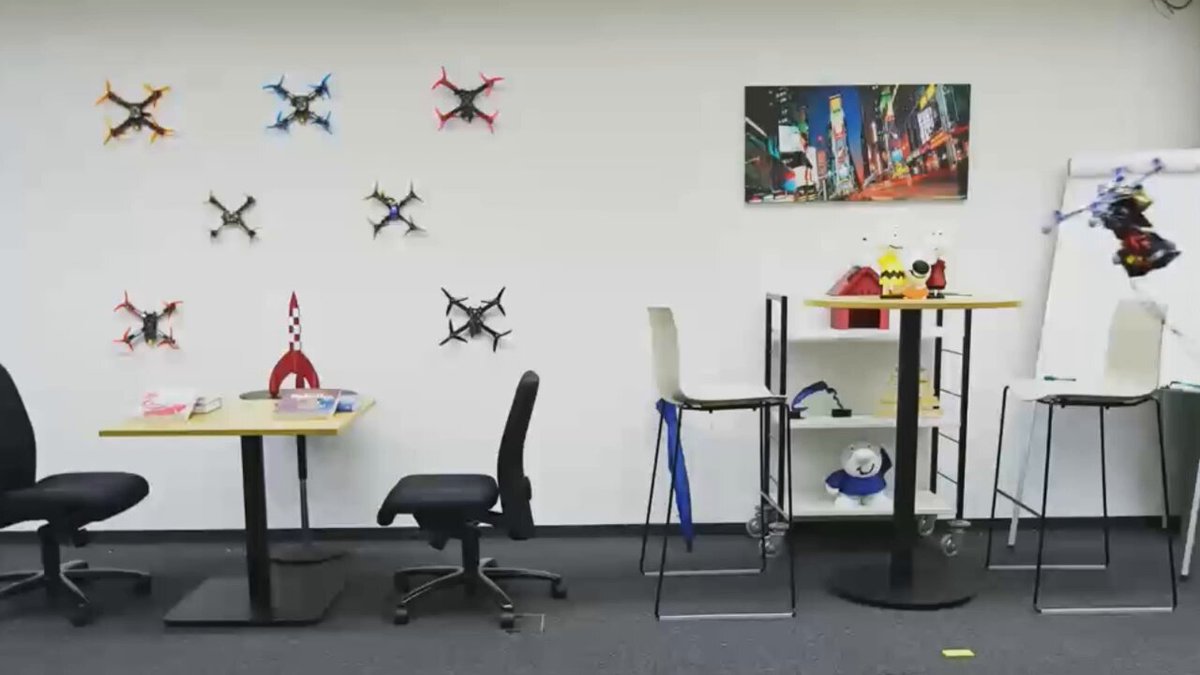
We are excited to share our work “Event-Aided Sharp Radiance Field Reconstruction for Fast-Flying Drones” published in IEEE Transactions on Robotics IEEE Transactions on Robotics (T-RO), which tackles sharp radiance field reconstruction under agile drone motion, where RGB frames are heavily motion-blurred and pose priors become unreliable! 4 years in the making! Code & dataset released! PDF: Code & Dataset: Full Narrated Video: High-speed flight is essential for time- and battery-constrained missions (e.g., inspection, exploration, search & rescue). However, fast motion corrupts visual data with severe motion blur and introduces drift/noise in visual-inertial odometry, making NeRF-based 3D reconstruction particularly brittle. We propose a unified framework that leverages asynchronous #EventCamera streams together with motion-blurred frames to reconstruct high-fidelity radiance fields from agile drone flights. Our key idea is to embed event-image fusion directly into radiance field optimization while jointly refining a shared, continuous-time camera trajectory initialized from event-based VIO. This enables us to recover sharp radiance fields and accurate trajectories without ground-truth supervision during training. We validate our method on synthetic data and on real sequences captured by a drone flying up to 2 m/s. Despite severe blur and noisy pose priors, our method preserves fine scene details and achieves a performance gain of over 50% on real-world data compared to state-of-the-art methods. Kudos to Rong Zou and Marco Cannici! Marco Cannici Reference: Rong Zou*, Marco Cannici*, Davide Scaramuzza Event-Aided Sharp Radiance Field Reconstruction for Fast-Flying Drones IEEE Transactions on Robotics (T-RO), 2026 NCCR Robotics European Research Council (ERC) AUTOASSESS UZH IfI University of Zurich UZH Science Prophesee SynSense UZH Space Hub

Davide Scaramuzza

11,946 次观看 • 4 个月前

📢📢 𝐀𝐯𝐚𝐭𝟑𝐫 📢📢 Avat3r creates high-quality 3D head avatars from just a few input images in a single forward pass with a new dynamic 3DGS reconstruction model. Video: Project: Our core idea is to make Gaussian Reconstruction Models animatable. We find that a simple cross-attention to an expression code sequence is already sufficient to model complex facial expressions. We then incorporate position maps from DUSt3R and feature maps from Sapiens to facilitate the prediction task. While DUSt3R's position maps act as a pixel-aligned initialization for the Gaussians' positions, the Sapiens feature maps help the cross-view transformer to match corresponding image tokens in the 4 input images. One major challenge in creating a 3D head avatar from smartphone images comes from inconsistent facial expressions when the subject could not remain perfectly static during the capture. We eliminate this static requirement by simply showing our model input images with different facial expressions during training. This technique makes our model robust to inconsistent input images later on. Finally, we show that despite the model has been trained with 4 input images, one can even create a 3D head avatar when only a single image is available. To achieve this, we employ a pre-trained 3D GAN to lift the single image to 3D and then render the 4 input images for our model. This allows us to create 3D head avatars from single images and even highly out-of-distribution examples like AI generated faces, paintings or statues. Great work by Tobias Kirschstein from his internship at Meta with Javier Romero, Artem Sevastopolsky, and Shunsuke Saito

Matthias Niessner

74,698 次观看 • 1 年前

[NeurIPS '24] DreamMesh4D: Video-to-4D Generation with Sparse-Controlled Gaussian-Mesh Hybrid Representation Abstract (excerpt) We introduce DreamMesh4D, a novel framework that combines mesh representation with sparse-controlled deformation technique to generate high-quality 4D object from a monocular video. To overcome the limitation of classical texture representation, we bind Gaussian splats to the surface of the triangular mesh for differentiable optimization of both the texture and mesh vertices. In particular, DreamMesh4D begins with a coarse mesh provided by a single image based 3D generation method. Sparse points are then uniformly sampled across the surface of the mesh, and are used to build a deformation graph to drive the motion of the 3D object for the sake of computational efficiency and providing additional constraint. For each step, transformations of sparse control points are predicted using a deformation network, and the mesh vertices as well as the bound surface Gaussians are deformed via a geometric skinning algorithm. The skinning algorithm is a hybrid approach combining LBS (linear blending skinning) and DQS (dual-quaternion skinning), mitigating drawbacks associated with both approaches. The static surface Gaussians and mesh vertices as well as the dynamic deformation network are learned via reference view photometric loss, score distillation loss as well as other regularization losses in a two-stage manner. Extensive experiments demonstrate that our method outperforms prior video-to-4D generation methods in terms of rendering quality and spatial-temporal consistency.

MrNeRF

12,323 次观看 • 1 年前

A new 30-minute presentation from Ashok Elluswamy, Tesla’s VP of AI, has been released, where he talks about FSD, AI and the team’s latest progress. Highlight from the presentation: • Tesla's vehicle fleet can provide 500 years of driving data every single day. Curse of Dimensionality: • 8 cameras at high frame rate = billions of tokens per 30 seconds of driving context. • Tesla must compress and extract the right correlations between sensory input and control actions. Data Advantage: • Tesla has access to a “Niagara Falls of data” — hundreds of years’ worth of collective fleet driving. • Uses smart data triggers to capture rare corner cases (e.g., complex intersections, unpredictable behavior). Quality and Efficiency: • Extracts only the essential data needed to train models efficiently. Debugging and Interpretability: • Even though the system is end-to-end, Tesla can still prompt the model to output interpretable data: 3D occupancy, road boundaries, objects, signs, traffic lights, etc. • Natural language querying: ask the model why it made a certain decision. • These auxiliary predictions don’t drive the car but help engineers debug and ensure safety. Tesla’s Advanced Gaussian Splatting (3D Scene Modeling): • Tesla developed a custom, ultra-fast Gaussian splatting system to reconstruct 3D scenes from limited camera views. • Produces crisp, accurate 3D renderings even from few camera angles — far better than standard NeRF/splatting approaches. • Enables rapid visual debugging of the driving environment in 3D. Evaluation & World Models: • Evaluation is the hardest challenge: models may perform well offline but fail in real-world conditions. • Tesla builds balanced, diverse evaluation datasets focusing on edge cases — not just easy highway driving. Introduced a learned world simulator (neural network-generated video engine): • Can simulate 8 Tesla camera feeds simultaneously — fully synthetic. • Used for testing, training, and reinforcement learning. • Allows adversarial event injection (e.g., adding a pedestrian or vehicle cutting in). • Enables replaying past failures to verify new model improvements. • Can run in near real-time, letting testers “drive” inside a simulated world. What’s Next: • Scale robotaxi service globally. • Unlock full autonomy across the entire Tesla fleet. • Cybercab: next-gen 2-seat vehicle designed specifically for robotaxi use, targeting lowest transportation cost (cheaper than public transit). • Same neural networks will power Optimus humanoid robot. • The same video generation system is now being applied to Optimus. • The system can simulate and plan movement for robots, adapting easily to new forms. via the International Conference on Computer Vision (ICCV). Full presentation:

Sawyer Merritt

1,286,614 次观看 • 8 个月前

Fast Company just published a great piece on World Labs , Fei-Fei Li , Marble, and the idea that spatial intelligence / world models may be one of the next big shifts in AI. I was happy to be quoted in the article, but I also wanted to share more context about my own experience with World Labs and Marble, and why this direction is especially interesting to me. My starting point: volumetric capture — For the past few years I’ve been exploring and using volumetric capture and reconstruction (photogrammetry, NeRFs, 3D Gaussian Splats) mostly capturing locations around Montreal. Alleys, museums, urban interiors. I love every step of it: the capture itself, the pipeline, and what can be done with the output. Turning real spaces into real-time explorable systems. I do this personally, sharing explorations here, and professionally as chief technologist, and co-founder of Dpt. Physical reality + generative manipulation — In my work I’m especially drawn to mixing physical reality with generative and digital manipulation: using physical interfaces (light, clay, ink, ... ) to drive generative AI pipelines, building mixed reality prototypes that reshape your surroundings, or starting from real captured spaces and transforming them using tools like Marble. Like many people, I saw the World Labs announcement on Twitter in September 2024, and Marble when it surfaced in early December. But by then, I already had a sense something was coming. The first conversation — As someone deep into volumetric capture and radiance fields, I obviously knew about Ben Mildenhall and his pioneering work on NeRF. To my surprise, Ben reached out to me in late June 2024. He’d been following some of my experiments and wanted to chat about my process and workflows and how I was using this “stuff” creatively. At that point he didn’t share what he was building, but we had a genuinely great conversation about radiance fields, AI, and my work. He was curious about the creative perspective, not just the technical one. When the World Labs announcement dropped a few months later, it all made sense. I understood what Ben had been working on, and why the creative angle mattered to them. Then in August 2025, he invited me to try the Marble beta, and I’ve been experimenting with it since. Experimenting with Marble — The first thing I used Marble for was materializing scene and world concepts during ideation at the studio, and seeing if and how it could fit into our production pipeline. In parallel, I dove into a series of experiments focused on world manipulation: starting from real captured spaces and transforming them using Marble. I’d already been exploring that idea using img2img diffusion with ControlNet on NeRF renders, real-time video streams, and even mixed reality using headset camera feeds. But Marble brings something different. It generates persistent, spatially cohesive 3D worlds that can be rendered in real time across a wide range of devices. That’s a real shift. Experiment 01: Parallel Realities — The first experiment, Parallel Realities, starts from a volumetric capture of a real location, reconstructed as 3D Gaussian Splats. Using Marble, I generate an alternate version of that same space, something informed by the original architecture: abandoned, nature-reclaimed, alternate era. Then, using Spark (World Labs’ 3D Gaussian Splatting renderer for THREE.js) I make both realities coexist in the same spatial coordinate system. From there, I use a portal UX mechanic to let the user step between the real reconstruction and the Marble-generated version. Experiment 02: Hidden Depth The second experiment, Hidden Depth, does not transform a space as much as expand it. A captured location has a visual boundary (a mural, a doorway, a dark corridor) and Marble generates what exists beyond it. For example: a Montreal alley has a painted mural; step through it and you’re inside a world informed by what is actually depicted there. World Labs showcased part of this work here: And in their Spark 2.0 post: The project page is here: Why this matters to me — Being able to start from a real 3D Gaussian Splat scene and manipulate it with Marble opens up a lot of ideas. The 3DGS pipeline is becoming an increasingly compelling foundation for exploration, experimentation, and storytelling. What matters most to me right now is more control. The more I can steer the generated scene or world, the more useful the tool becomes. I want more features like the already existing multiple input images and Chisel, the blockout-based approach. I would like better local control, the ability to expand a generated world more and more while preserving coherence, and the ability to directly import 3D Gaussian Splat scenes to be used as a starting point. I want more ways to shape the result, not just a “prompt and hope” approach. — It is exciting to see this field moving from research and demos toward actual creative workflows.

Hugues Bruyère

64,336 次观看 • 26 天前

The Genie 3 release is a perfect moment to have a discussion about the future of 3D But first it would be nice to make the terminology more clear, specifically: What is a “spatial representation” Implicit vs Explicit Generalization vs Specialization Reconstruction vs Generation Production vs Execution Let’s start: For me, a spatial representation is just a way to describe a thing in the physical world The core property that makes it useful is consistency You can enforce consistency explicitly via rendering equations, geometric constraints, and physics Or implicitly, purely through training data Then, your representation parameters can be explicit, like points, gaussians, triangles, voxels, etc. Or implicit, weights or latent vectors Parameters alone are not the representation. It’s a combination of the parameters, the process that produces them, and the way you materialize them through a function (physics-based rendering, simulation, neural network, etc.) Generalization means you take data from multiple scene observations, and then produce a map from desired input to representation parameters Specialization means you take single-scene observations and directly fit a function parameters to describe thar scene Many representations can serve both of the approaches, as long as you keep them differentiable Both of the above can be used for reconstruction, where the main goal is to explain observations through a lens of physics (hard constraint) On the other hand, generation needs generalization, and its task is to produce statistically plausible results that could be conditioned on observations (soft constraint) Both tasks are not solved yet and they can complement each other in various ways Yet another important aspect is the difference between production and execution Production = process of going from inputs to parameters Execution = process of going from parameters to result It’s important to separate these, because most usecases require fast execution to be viable which is severely constrained by the hardware So, are *world models* like Genie an important step forward? Yes Do they make other representations obsolete? Maybe some of them - but there are tons of economically valuable tasks that won’t be solved by it, at least in any observable future

Lucky Iyinbor

13,959 次观看 • 5 个月前