Video yükleniyor...

Video Yüklenemedi

Ana Sayfaya Dön

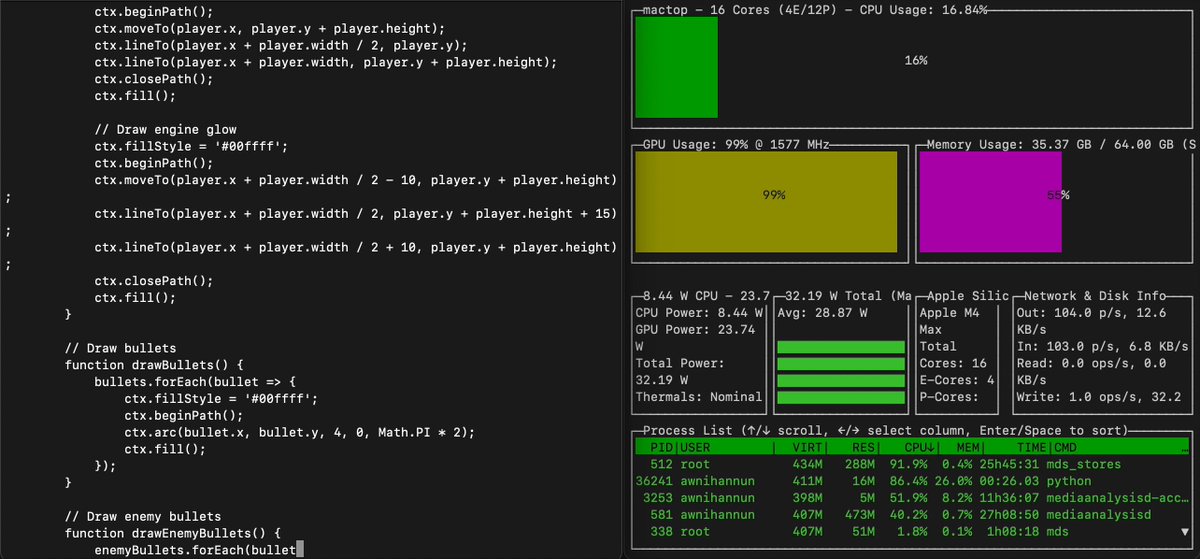
Qwen 32B (4-bit) generates at >40 toks/sec on an M4 Max with assisted decoding and Qwen 0.5B as the draft model. Coming soon to mlx-lm. Compare regular decoding (left) to assisted decoding (right):

50,353 görüntüleme • 1 yıl önce •via X (Twitter)

11 Yorum

N8 Programs profil fotoğrafı
N8 Programs1 yıl önce

WOW! How does this differ from my speculative decoding impl - what makes it so much faster? Cause this is awesome.

Lab4crypto profil fotoğrafı
Lab4crypto1 yıl önce

🚀 Don't gamble with your portfolio! Use our advanced hybrid quant risk tool using on/off-chain data daily and make informed decisions. 📈 Acess to 1000+ charts for your crypto journey. 📚Receive free weekly quant analysis. 📊+21 projects supported. 🏗️ Beginners and experts.

Ivan Fioravanti ᯅ profil fotoğrafı
Ivan Fioravanti ᯅ1 yıl önce

Super fast! 💪

Tay profil fotoğrafı
Tay1 yıl önce

Assisted decoding?

Awni Hannun profil fotoğrafı
Awni Hannun1 yıl önce

A small draft model is used to generate tokens which are then accepted or rejected by the main model depending on certain criteria. In this case the criteria is exact match.

Caleb profil fotoğrafı
Caleb1 yıl önce

Super cool 🤩

DS profil fotoğrafı
DS1 yıl önce

Apple intelligence so far: "siri can set an alarm even faster now!"

Mark Lord profil fotoğrafı
Mark Lord1 yıl önce

Try with the 2b model, set draft tokens to 31, and modify the wording of the prompt to “Write me a quick sort in C++. Don’t give me a preamble, just immediately write the code.” If it’s anything like my tests, I reckon you’ll squeeze a few more tokens/second 😁

SM profil fotoğrafı
SM1 yıl önce

Impressive! But do you think one can run diffusion models inference on phones?

Sohaib profil fotoğrafı
Sohaib1 yıl önce

Awesome!

Unclecode (Hossein) profil fotoğrafı
Unclecode (Hossein)1 yıl önce

Interesting, It makes sense to be faster due to assusted coding definition, however did you try any eval? I wonder what are unpredictable effect of such decoding
Benzer Videolar

Researchers found a way to make LLMs 8.5x faster! (without compromising accuracy) Speculative decoding is quite an effective way to address the single-token bottleneck in traditional LLM inference. A small "draft" model first generates the next several tokens, then the large model verifies all of them at once in a single forward pass. If a token at any position is wrong, you keep everything before it and restart from there. This never does worse than normal decoding. But current drafters in Speculative decoding still guess one token at a time. That makes the drafting step itself a bottleneck, capping real-world speedups at 2-3x. DFlash is a new technique that swaps the autoregressive drafter with a lightweight block diffusion model that guesses all tokens in one parallel shot. Drafting cost stays flat no matter how many tokens you speculate. On top of that, the drafter is conditioned on hidden features pulled from multiple layers of the target model and injected into every draft layer, so it makes significantly better guesses than a drafter working from scratch. In the side-by-side demo below, vanilla decoding runs at 48.5 tokens/sec. DFlash hits 415 tokens/sec on the same model, with zero quality loss. It's already integrated with vLLM, SGLang, and Transformers, with draft models on HuggingFace for several models like Qwen3, Qwen3.5, Llama 3.1, Kimi-K2.5, gpt-oss, and many more. I have shared the GitHub repo in the replies! KV caching is another must-know technique to boost LLM inference. I recently wrote an article about it. Read it below. 👉 Over to you: What use case are you working on that can benefit from this new technique?

Avi Chawla

157,390 görüntüleme • 3 ay önce