Video wird geladen...

Video konnte nicht geladen werden

Zur Startseite

Really enjoyed chatting with Michael Nielsen about how we recognize scientific progress. It's especially relevant for closing the RL verification loop for scientific discovery. But it's also a surprisingly mysterious and elusive question when you look at the history of human science. We approach this question stories like Einstein...

290,897 Aufrufe • vor 3 Monaten •via X (Twitter)

0 Kommentare

Keine Kommentare verfügbar

Kommentare vom Original-Post werden hier angezeigt
Ähnliche Videos

The Terence Tao episode. We begin with the absolutely ingenious and surprising way in which Kepler discovered the laws of planetary motion. People sometimes say that AI will make especially fast progress at scientific discovery because of tight verification loops. But the story of how we discovered the shape of our solar system shows how the verification loop for correct ideas can be decades (or even millennia) long. During this time, what we know today as the better theory can often actually make worse predictions (Copernicus's model of circular orbits around the sun was actually less accurate than Ptolemy's geocentric model). And the reasons it survives this epistemic hell is some mixture of judgment and heuristics that we don’t even understand well enough to actually articulate, much less codify into an RL loop. Hope you enjoy! 0:00:00 – Kepler was a high temperature LLM 0:11:44 – How would we know if there’s a new unifying concept within heaps of AI slop? 0:26:10 – The deductive overhang 0:30:31 – Selection bias in reported AI discoveries 0:46:43 – AI makes papers richer and broader, but not deeper 0:53:00 – If AI solves a problem, can humans get understanding out of it? 0:59:20 – We need a semi-formal language for the way that scientists actually talk to each other 1:09:48 – How Terry uses his time 1:17:05 – Human-AI hybrids will dominate math for a lot longer Look up Dwarkesh Podcast on YouTube, Apple Podcasts, or Spotify.

Dwarkesh Patel

850,267 Aufrufe • vor 3 Monaten

.Naval: Epistemology, which is a fancy word for the theory of how knowledge grows or how knowledge growth occurs. And we've all been told since we're young that there's a scientific method and that scientists sort of do this stuff in white lab coats and we're supposed to accept it because of this thing called the scientific method. And then they give us true beliefs that we can then say, well the science is settled and we take that we move on. And we all only have a very, very vague understanding of how this works. And people say, well maybe you go out in the real world, you look at what's happening, you make all these observations, and then based on that you form a theory, you test the theory against more observations, and the more observations you get the closer you get to the truth. And once you have enough observation it's true and then you call it a scientific theory or a law and it's settled and you move on. And this is the popular conception of how science works. And as Popper pointed out and as you take even further, this is completely wrong. And so I'd love for you to get into that, which is what is knowledge? How does it grow? What is the real scientific method? And how do we figure things out? David Deutsch: I love the way you just stated the prevailing view there and laced every aspect of it with the contempt that it deserves. So you just went through touching every base. It's amazing that this series of misconceptions is still common sense. I mean, that it was common sense at a time when we didn't really have science or when science was just starting up, when the main issue in science was freeing itself from dogmatism, freeing itself from religion, freeing itself from authority, and so on. There it was understandable that people would look for an alternative source of authority and they would think, oh, it's sense impressions. We can see the world and you know, these religious people, they can't even see God and so on. And so we are confined to what we can see. That's where we get our ideas from. And as you say, that is completely false. Sense impressions, like all observation, even the most careful scientific observation is all theory laden. And theories are inherently fallible. I mean, we actually want to replace our best theories. Everybody who does a PhD is technically anyway, working to overturn something in the existing body of knowledge. You're not turned away at the door if you say, I don't believe this stuff, I'm going to produce something better. Whereas for most of human history, that was exactly what you were forbidden to do. The idea was that we already had all the important knowledge. If you want to discover something new, what you had to make sure of was that it didn't contradict the existing knowledge. Now, you have to make sure that it does contradict existing knowledge. So more or less. Naval: Yeah, it's this tradition of criticism that you've talked about in the West, that the Enlightenment really ushered in the Enlightenment era. David Deutsch: It has been institutionalized. So in many ways, our institutions are wiser than we are. So the institutions of science, for instance, have this built in, even if scientists actually don't always act that way. In fact, they often don't act that way, and act in a dogmatic way and try to preserve the status quo and are resistant to new ideas and so on. But the institutions, the way the procedures of science work, makes the right thing happen in the end anyway, regardless of what the people are trying to do. Naval: So you're saying the knowledge of the true scientific method is embedded in the institutions of science in the PhD process? David Deutsch: Well, the best scientific method that we know of, and one shouldn't really think of it as a method, you know, there's this wonderful lecture by Popper when he first was made a professor at the London School of Economics. He was made a professor of scientific method, and his first six lectures, I wish the rest of them were, the first six lectures are on the internet somewhere. And he starts the first one by saying, I am the first professor of scientific method in the British Empire. The British Empire still existed at the time, more or less. And so the first thing I want to say to you is that there is no such thing as the scientific method. And then he goes on from there. So this subject does not exist. So if any of you have come here to learn the handle that you have to turn in order to make scientific knowledge come out the other end, you're going to be disappointed.

Deutsch Explains

114,992 Aufrufe • vor 1 Jahr

Today: a 1.5 hour interview with the co-founders of Coherence Neuro: Ben Woodington and Elise Jenkins They are, as far as i can tell, the only (neurotechnology x oncology) startup that exists today. 'Neurotechnology? For cancer?' you may ask. Yes! As it turns out, tumors interact with the nervous system a fair bit, and you can use the very same neuromodulation toolbox that exists for neuropsychiatric conditions, for monitoring and treating cancer. Coherence has built an invasive device to place at the site of a tumor to do exactly this. Their first indication is a form of brain cancer called glioblastoma; one of the most fatal subtypes of cancer to exist today. The standard of care (with one exception that we discuss) has not changed in 25 years. If Coherence works out, and there is a very real chance they will, that may change. Most interesting of all is that Coherence believes that the bioelectric properties of cancer are not just worth poking at for brain cancers, but for all cancers. And maybe even for diseases outside of it! This conversation covers how Coherence’s first neurotech device (SOMA) works, the molecular reasons behind why neuromodulation affects cancer at all, what the biomarker readouts look like, the obvious Michael Levin comparison, and a lot more. Also: shout to Nicole for setting up the connection here in the first place! Crazy to think that a meeting in mid-2025 ended up leading to this Youtube/Spotify/Apple Podcasts links in replies 0:00:00 - Introduction 0:01:42 - How is SOMA different from Novocure’s Optune? 0:08:57 - Why does neuromodulation affect cancer at all? 0:13:28 - How was cancer-nervous system crosstalk first discovered? 0:15:42 - Anti-epileptics and beta blockers as accidental cancer drugs 0:17:38 - What is molecularly happening when you block cancer-neuron crosstalk? 0:19:50 - What is SOMA actually reading out as a biomarker? 0:20:44 - What does it mean that cancer is “very electric”? 0:22:02 - Can you derive universal biomarkers across patients? 0:23:09 - How is the device placed? 0:24:45 - How does the blocking stimulation regime work? 0:26:43 - Is it fair to say this is closed loop? 0:29:05 - Why not just spam the tumor with constant stimulation? 0:32:31 - Why MRI safety is non-negotiable for oncology devices 0:33:35 - Walk us through the patient journey from diagnosis to implantation 0:36:13 - The Michael Levin question: can you reprogram cancer back to normal? 0:42:29 - Efficacy, hospice settings, and the utility of the neuromodulation literature 0:45:52 - Why start with glioblastoma instead of an easier cancer? 0:48:57 - Regulatory strategy and the reimbursement threat 0:55:37 - How well does mouse-to-human translation work for neuromodulation? 0:55:57 - What do in silico models of neuromodulation look like? 0:58:09 - Why didn’t this exist 10 years ago? 1:01:48 - The founding story 1:06:38 - Why build your own device instead of using off-the-shelf arrays? 1:08:35 - Speaking with glioblastoma patients 1:12:04 - What was it like to raise money for this? 1:13:56 - Beyond cancer: TBI, lung disease, and the pan-disease argument 1:17:40 - Hiring at Coherence + what is the hardest type of talent to find 1:23:17 - What would you do with $100M equity-free? 1:27:15 - Are you a neurotech company or a cancer company?

owl

37,299 Aufrufe • vor 4 Monaten

I found the discussion about Darwin especially fascinating. Why did it take till 1859 to lay out an idea whose essence every farmer and herder since antiquity must have observed? The Origin of Species was published in 1859. Principia Mathematica was published in 1687, two centuries earlier. Conceptually, natural selection is much simpler than the theory of gravity. Thomas Huxley read The Origin of Species and said, "How extremely stupid not to have thought of that!" Nobody ever said the same about not beating Newton to the Principia. One reason it took so long: Darwin's theory cannot be decisively tested. The evidence is circumstantial, retrospective, and cumulative. There's no equivalent of Newton running the numbers on the Moon's orbital period and confirming they correspond to his equations. In a previous interview with Terence Tao, I brought up Lucretius as an ancient precursor to Darwin. I didn’t actually realize how different Lucretius is from Darwin. Lucretius thought that there was some generative period in the past where a bunch of different species emerged somewhat spontaneously. And then there was a one time filter where the unfit ones got culled out. What he was missing was the idea that there’s common descent between all the species, that there’s a tree of life, that natural selection is a cumulative process. In fact we don’t talk about how wild it is that all life on Earth has a common ancestor! It’s wild! So what actually had to be in place? Charles Lyell doing the foundational work in geology in the 1830s gave Darwin the concept of deep time. Without at least tens of millions of years, evolution is a non-starter, because you'd need to see species transforming within human lifetimes. You also needed paleontology showing intermediate species (including between humans and other apes), biogeography from the age of colonization, and more sophisticated artificial selection like pigeon breeding. The proof that these preconditions mattered: Darwin and Wallace arrived at the same idea almost simultaneously, and both credited Lyell. Their work was presented jointly at the Linnean Society in 1858. Something that went undiscovered for all of human history and then was independently discovered twice within a few years. The building blocks had just fallen into place.

Dwarkesh Patel

38,291 Aufrufe • vor 3 Monaten

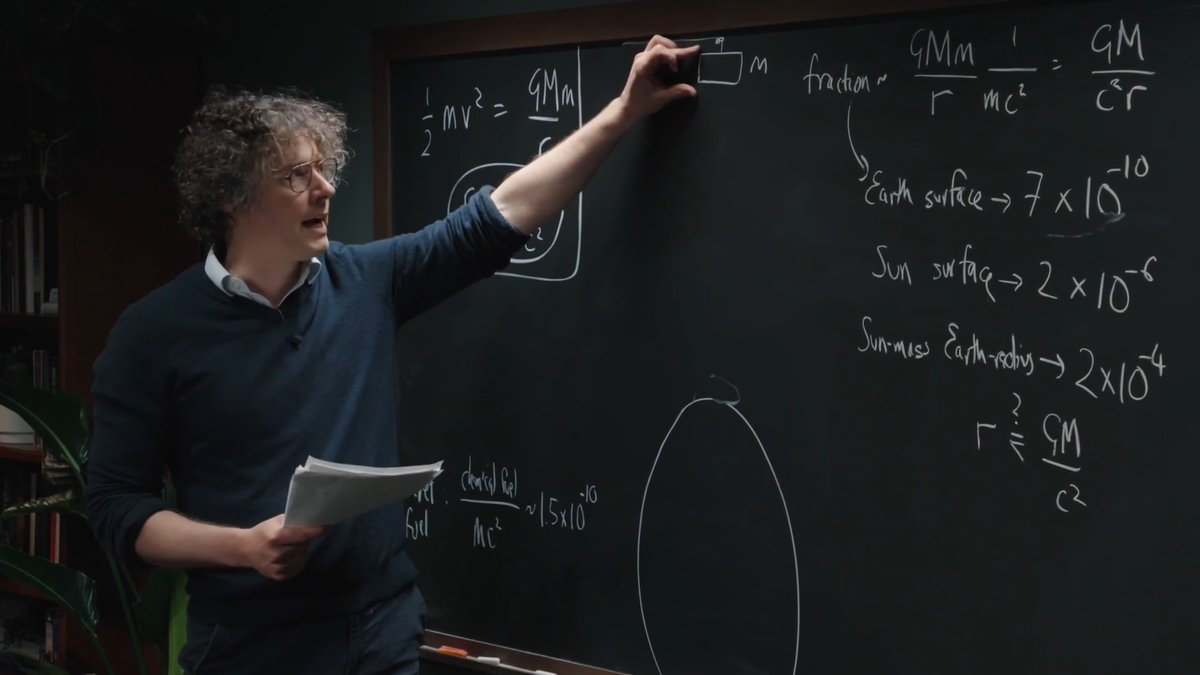
Adam Brown (Adam Brown) is back! General relativity is said to be the most beautiful idea the human mind has ever produced. Most of us will never get to fully appreciate its elegance by taking the 20-lecture graduate course Adam taught on it at Stanford. But in the video below, Adam distills the key idea at its heart so clearly and compellingly that even I could keep up lol. At the core of general relativity, Einstein is trying to figure out the principle behind a particular coincidence: that the mass that resists acceleration and the mass that gravity pulls on just happen to be exactly the same. Adam then leads us through the path of insight which Einstein called his “happiest thought.” Then Adam lectures on black holes. First, by showing how even under special relativity you could create a perpetual motion machine if black holes weren't truly black. And then, by explaining why the observations of an infalling observer and a distant bystander to the black hole would be so radically different Adam leads Blueshift, the team at Google DeepMind cracking science and reasoning. Which gave us the opportunity to discuss at the very end how close we are to AIs that could rediscover general relativity from scratch. Stay till the close for some philosophy of science. 0:00:00 – The coincidence that led Einstein to general relativity 0:16:42 – Gravity is a consequence of curved spacetime, not a force 0:31:46 – Why black holes prevent unlimited energy extraction 0:47:12 – Black holes are the ultimate power plants 1:13:50 – What falling into a black hole would actually feel like 1:18:51 – The three ways we know black holes are real 1:24:21 – The first time we saw gravity bend light 1:29:33 – How far can AI get without experimental evidence? Look up Dwarkesh Podcast on YouTube/Spotify to watch. Enjoy!

Dwarkesh Patel

629,431 Aufrufe • vor 7 Tagen

🚨 Holy Moly! The Second Vice-President of Spain, Yolanda Díaz Pérez just THREATENED President Trump and the USA! Transcription of video IN ENGLISH here: (0:00) Good morning, thank you very much for these questions. (0:05) I am going to tell Mr. Trump that the so-called punishment that he wants to give to the Spaniards (0:11) is going to be very expensive for the Americans. (0:14) I want to explain myself. (0:16) I am going to give a bad news to Mr. Trump. (0:19) And it is that the commercial balance of Spain with the United States is deficitary. (0:26) We have to remind Mr. Trump. (0:27) This means something as simple as that if he practices these policies, (0:33) he is going to directly harm the Americans and the North Americans. (0:39) That is to say, if he took that threat, that policy of hate forward, (0:45) he would not punish our country. (0:47) He would directly repel the Americans and the North Americans. (0:52) The punishment is going to be very expensive for Mr. Trump. (0:55) And two, to be clear, if that happens, Spain is going to defend its productive sectors. (1:04) What do we mean? (1:05) That if we have to defend oil, automotive, wine, (1:11) the productive sectors that could be affected by this policy of punishment, (1:15) we are going to do it. (1:17) And a third question. (1:18) In Spain, the Spaniards rule. (1:22) Not Mr. Trump. (1:23) We are not his protectorate.(1:26) But I insist. (1:26) The so-called punishment is going to be expensive for the Americans and the North Americans. (1:32) Mrs. Ayula, what do you think if Isabel Díaz Ayuso calls the president of the government machito (1:37) for the issue of abortion? (1:38) Thank you. (1:40) And do you think that Avalos could go to prison? (1:43) I cannot make judgments of value on a judicial cause. (1:47) As you know, I respect the instruction that is made.

MAGA Kitty

365,024 Aufrufe • vor 9 Monaten

BREAKING IN WASHINGTON: Dr. Fauci tells Congress he had to contradict President Trump on the podium because he felt it was his responsibility to tell the American people the truth, to tell them about what science actually said. He was responding to a leading question by Democratic Congressman Jared Moskowitz (Jared Moskowitz). WATCH Question: Dr. Fauci, you talked about how we live in partisan times. A lot of misinformation and colleagues on this body said you should be charged and found guilty. Of course, the only one that's happened to is your former boss. But the question I have is when you saw a lot of that disinformation, whether it was we can use a disinfectant to do like a cleaning or do light in the body, or that China is working super hard, President Xi's got it contained. All of this stuff that was being put out, were you concerned? What was your feeling at that time working in the administration, seeing that come from the podium? Answer: Well, I was very frustrated by that. It was very clear I was put in a very difficult position that I didn't like of having to contradict publicly the president of the United States. I took no great pleasure in that, but I felt it was my responsibility to preserve. Question: He must have thought you did a great job. He gave you a commendation right before he left. Answer: Well, I felt it was my responsibility, you know, as to preserve my own personal integrity and my major responsibility to the American public to tell them the truth. And if I could just take this opportunity. When I was saying that if you attack me, you attack science, I didn't mean that I am science. What I meant was that when the data show that hydroxychloroquine does not work and there are people saying, oh, it does, I'll give it to people, and we know it can be hurtful to them, then when you're attacking what I'm saying, that the science shows it doesn't work and the science shows that bleach doesn't work, that when you attack that you really are attacking science because science has shown that it doesn't work. That's what I meant when you attack me, you're attacking science. Response: Thank you, doctor. Thank you, mister chairman. I yield back, time's expired. Now recognize Mister Jordan from...

Simon Ateba

2,818,632 Aufrufe • vor 2 Jahren

David Chalmers on why consciousness is science's greatest unsolved problem: Science has mapped subatomic particles, distant stars, the chemistry of life yet it remains almost completely silent on the one thing we know most directly: our own conscious experience. In a rare early interview, philosopher David Chalmers explains why: "Consciousness is at once the most familiar thing in the world and the most mysterious. Consciousness is what we start with when it comes to knowing the world. I know that I exist. I know that I'm conscious. Everything else is secondary." And yet, despite this intimacy, consciousness sticks out like a sore thumb in the scientific picture. Chalmers points to a deep irony: science has made extraordinary progress on phenomena that are extraordinarily remote: subatomic particles, distant galaxies, the molecular machinery of biology while making almost no progress on the one thing closest to us. Why? Because science, by design, eliminates the subjective. "To do proper science, you have to be objective. You have to eliminate anything subjective from the picture." He uses heat as the perfect example. Physics gives us a complete account of heat molecules in motion, energy transfer, temperature gradients. It explains every objective aspect of the phenomenon. But it never explains what hotness actually feels like. "Science doesn't actually give a theory of the conscious feeling of hotness." This is what Chalmers calls the Hard Problem of Consciousness. You can trace every neural signal from your heat sensor along your nerves into your brain and still have explained nothing about the subjective experience of feeling warm. As interviewer Jeffrey Mishlove puts it: you can't even do science without a conscious mind to observe, interpret, and make meaning of data. Consciousness is the precondition for science itself and yet science has no framework to account for it. Chalmers' conclusion is striking: The methods of science may need to be expanded. Consciousness might not be something science explains away. It might be something science has to learn to start with.

Mateus — eu/acc 🇪🇺

31,628 Aufrufe • vor 3 Monaten

Google DeepMind CEO Demis Hassabis on "leaving AI in the lab for longer” (full question + answer in the video as I've seen him misquoted). Here's what he said: "For me, the best use case of AI was to improve human health and accelerate scientific discovery..." "Given how important AGI is and how transformative a technology is, maybe the most transformative one in human history, I thought it would be best to approach the sort of latter stages of building it, which we're in now, using the scientific method, very carefully, very precisely, very thoughtfully, and rigorously with all the best scientists, in my ideal world, collaborating on in CERN-like effort, on making sure each step we understood each step each as we got to the final goal of, of building AGI.... "While we're building AGI in this careful scientific way, humanity could benefit from the proceeds of that, like cures for cancer, or maybe new energy sources or new materials… “Looking at this from 20, 30 years ago when I started out on all of this, that would have been the ideal way for it to play out, in my opinion. “Now, it didn't happen like that because technology's unpredictable and in fact, it turns out that things like language were a lot easier than we were all expecting… “We were sort of playing around with that, so were the other leading labs, but of course with ChatGPT and fair play to OpenAI, they scaled it and then they put it out there. “And I think even they say it was kind of a research experiment. They didn't realize it would go so viral. And I think none of us did and we had sort of fairly equivalent systems at the time… “Now, the downside of it is, we're in this sort of ferocious commercial pressure race that everyone's sort of locked into currently. “And then on top of that, there's geopolitical issues like the US-China race and so on. So there's sort of multiple levels of pressure to sort of move fast. So the benefit of that, of course, you get faster progress, obviously. The progress is just at lightning speed these days. So that's good for all the good use cases. The second benefit is that everybody, all of the viewers out there, everyone, you're all getting to use the most cutting edge AI technology, perhaps only three to six months behind what is actually in the labs. So that's kind of mind blowing. “It's also great because I think it gives everyone a feeling for, it's democratizing AI. It's giving everyone a feeling for what it's like to interact with cutting edge AI and what it can do and what it can't do… “So I think there's positives and negatives about the way it's gone. It's not the way I dreamed about years ago where we would be sort of contemplating this philosophically and carefully considering each next step. We're not in that world. And I'm, although I'm a scientist first and foremost, I'm also a pragmatic engineer. So, we have to deal with the world as we find it and make the best of that. And we try to do that by advancing the frontier, but also trying to be as responsible as we can with doing that as we deploy these, you know, very powerful technologies, like Gemini and Alphafold.”

Cleo Abram

64,840 Aufrufe • vor 3 Monaten

The “scientific consensus” talking point was succinctly dismantled by Dr. Judith Curry in her interview with John Stossel back in October. 𝗝𝗼𝗵𝗻 𝗦𝘁𝗼𝘀𝘀𝗲𝗹: “The overwhelming scientific consensus. That’s what people still believe.” 𝗗𝗿. 𝗝𝘂𝗱𝗶𝘁𝗵 𝗖𝘂𝗿𝗿𝘆: “. . . when you talk about ‘scientific consensus,’ like the Earth orbits the sun, you don’t need to say ‘There’s a consensus that the Earth orbits the sun,’ it’s a well-known fact. When you’re talking about consensus, it’s usually on a topic where there is disagreement, and a government has asked a group to come to some sort of an agreement on what’s what. You see it in science, you see it in. . . medical boards. . . So, it’s a manufactured consensus. It’s a consensus of scientists, which is different than a scientific consensus. . .” Dr. Curry goes on to explain that there is no consensus on the most contentious issues of climate change, such as extent of human contribution and the impacts. 𝗗𝗿. 𝗝𝘂𝗱𝗶𝘁𝗵 𝗖𝘂𝗿𝗿𝘆: “. . . there’s a true scientific consensus on very little of this, you know that, • The temperatures have been increasing for over a hundred years. • That burning of fossil fuels emits CO₂ into the atmosphere. • And, CO₂ has a radiation spectrum that sort of keeps the Earth’s surface warm, all other things being equal. Beyond that, there’s no real big consensus on anything. The most consequential issues we don’t have a consensus on: • How much of the recent warming is caused by fossil fuels? We still don’t know. • Is fossil fuel and is warming dangerous? This is the weakest part of the argument. There’s no agreement as to whether warming is dangerous.” 🔗 You can watch the full 40+ minute interview here:

Chris Martz

112,060 Aufrufe • vor 2 Jahren