正在加载视频...

视频加载失败

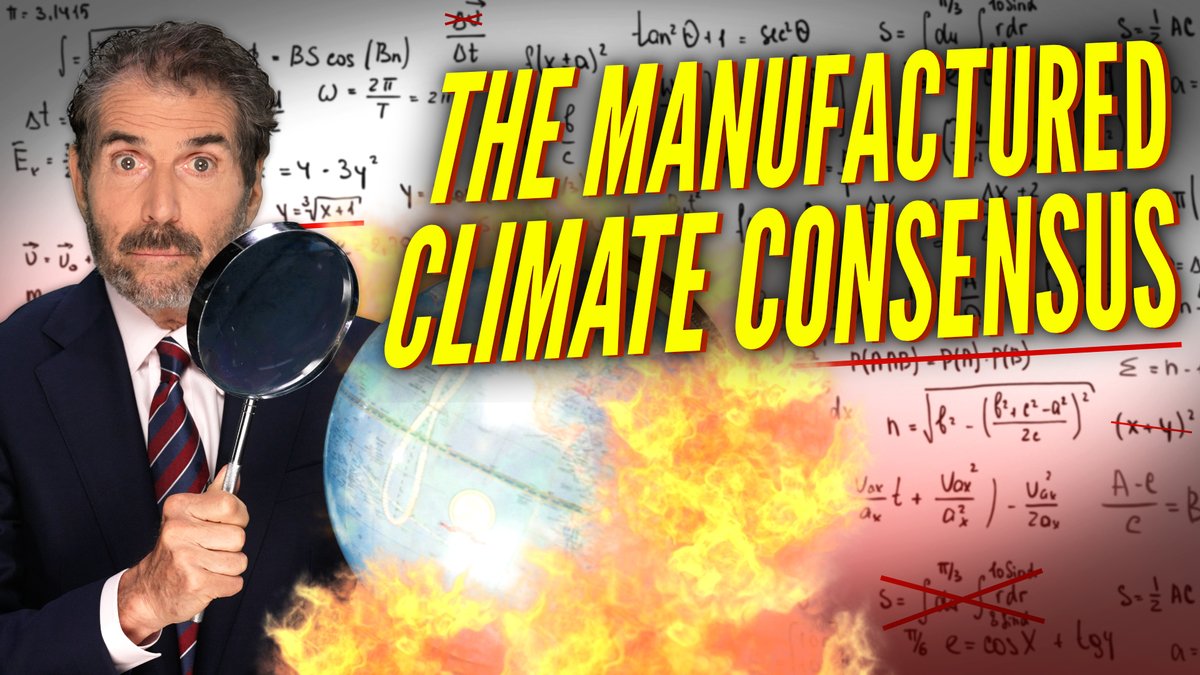
The “scientific consensus” talking point was succinctly dismantled by Dr. Judith Curry in her interview with John Stossel back in October. 𝗝𝗼𝗵𝗻 𝗦𝘁𝗼𝘀𝘀𝗲𝗹: “The overwhelming scientific consensus. That’s what people still believe.” 𝗗𝗿. 𝗝𝘂𝗱𝗶𝘁𝗵 𝗖𝘂𝗿𝗿𝘆: “. . . when you talk about ‘scientific consensus,’ like the Earth orbits the...

112,060 次观看 • 2 年前 •via X (Twitter)

7 条评论

ockhams-scheermes 的头像
ockhams-scheermes2 年前

This is also very good on the bogus consensus

Chamanit 的头像
Chamanit2 年前

@RealDeanCain If the consensus is manufactured, then the public should be hearing the other side as well. Let's hear one side demolish the arguments of the other. Or not. Otherwise, it's only a sketchy, wishful-thinking theory.

Marcus Nancy 的头像
Marcus Nancy2 年前

The climate crisis is now officially a balding fat middle aged dude trapped in a dead end job and hoping he can make it to retirement

Agent86 的头像
Agent862 年前

@RealDeanCain Consensus was used by the church 500 or so yrs ago to support that the earth was the middle of the universe and later that the earth was flat. Anyone who said otherwise was scorned, maybe killed. Kinda like where we are today with the man made climate catastrophe.

Mark Reardon 的头像
Mark Reardon2 年前

Most cults make a big deal about consensus, which probably explains why they are a cult and not merely a group.

Robert kaapke 的头像
Robert kaapke2 年前

We are emerging from an ice age. On what day is that complete. Or do we gradually warm until we reach equilibrium. For the love of God a little common sense. How accurate is our testing from over 100 years ago. Did we hang a thermometer in a field 50 miles from civilization?

Hamilton Garmany 的头像
Hamilton Garmany2 年前

Nor should there be Consenus & the "Science be settled". We are currently witnessing, what Thomas Kuhn called a "Revolutionary Period" in Science...where 2 contrasting paradigms are competing for supremacy. This is the Nature of the Scientific Method

相关视频

Stephen Meyer just exposed one of the dirtiest secrets of modern science. We’re constantly told: “Trust the science.” “The scientific consensus says…” But scientists are only exposing themselves when they say things like that, according to Meyer. “When scientists appeal to consensus, almost invariably, there isn’t one.” “You only appeal to consensus to shut down dissenting opinions.” “If there really is a consensus, you don’t need to appeal to one.” “Scientists never say: the consensus is that the formula for water is H2O.” “They only appeal to consensus when there’s actual debate, and they want to shut down a dissenting group of scientists who hold a different opinion.” “We’ve had this move made or applied against us numerous times.” “Proponents of intelligent design, or critics of Darwinian evolution or neo-Darwinian evolution will be told: this is settled science, and to challenge it is pseudoscience.” “When there’s an appeal to consensus… it’s usually a rhetorical ploy to silence an alternative perspective or a group of dissenting scientists.” “And this is actually ironically profoundly unscientific behavior.” “If there’s no serious dissent, you don’t need to appeal to consensus.” “When people appeal to settled science or consensus, it’s often a tell that there’s subterranean dissent that needs to be heard.” Stay tuned for my full interview with Stephen C. Meyer—coming this Saturday at 5PM ET!

Jan Jekielek

11,823 次观看 • 2 个月前

Eric Schmidt on what he calls "the San Francisco consensus": "There's a group of people that I work with. They're all in San Francisco and they've all basically convinced themselves that in the next two to four year, the average is three years the entire world will change." He's careful to flag the catch in that word "consensus": "It's true that it's a consensus, but it's not necessarily true that the consensus is true." So why do these people believe it? Eric walks through the reasoning. First came language-to-language models. "ChatGPT is the best one, they did a great job," he says, with everyone else catching up. Then came two additions: reasoning, and memory inside these systems. Put those together and you get what he calls the agentic revolution: "The agentic revolution… can be understood as language in, memory and language, language out." To make it concrete, he uses a deliberately mundane example. Say he wants to build a house in California. One agent finds the lot. Another works out the rules. Another designs the building. Another selects the contractor. And, at least in America, another agent sues the contractor when the house doesn't work. The point of such a "stupid example," as he puts it, is exactly that it's ordinary: "I just gave you a workflow example that's true of every business, every government and every group human activity." That's why he thinks the consensus carries weight: "When you understand that the agentic revolution and the reasoning revolution together really changed the way we operate as humans, then you understand why the San Francisco consensus is so powerful." On the reasoning side, he points to models that work a problem forward and backward: "It will blow your mind away, especially when you ask it a question that you have no idea what the question is about and you watch it reason." And he cites the numbers he's seeing: "Google now has a math model that is at the 90 percentile of math graduate students." More broadly, he claims, "we now have systems now that are 90% of all of the graduate school skills. You know, math, physics, and so forth." When something can do that, he argues, "it will happen at a big scale." This is where the consensus reaches its sharpest point: recursive self-improvement. "There's a moment when what is called recursive self-improvement, the system begins to learn on itself, where it goes forward at a rate that is impossible for us to understand. It becomes combinatorial in a way that we as humans do not understand." His verdict on all of it is two-sided: "This is both incredibly exciting and also very worrisome."

High Signal AI

31,085 次观看 • 1 个月前