Загрузка видео...
Не удалось загрузить видео
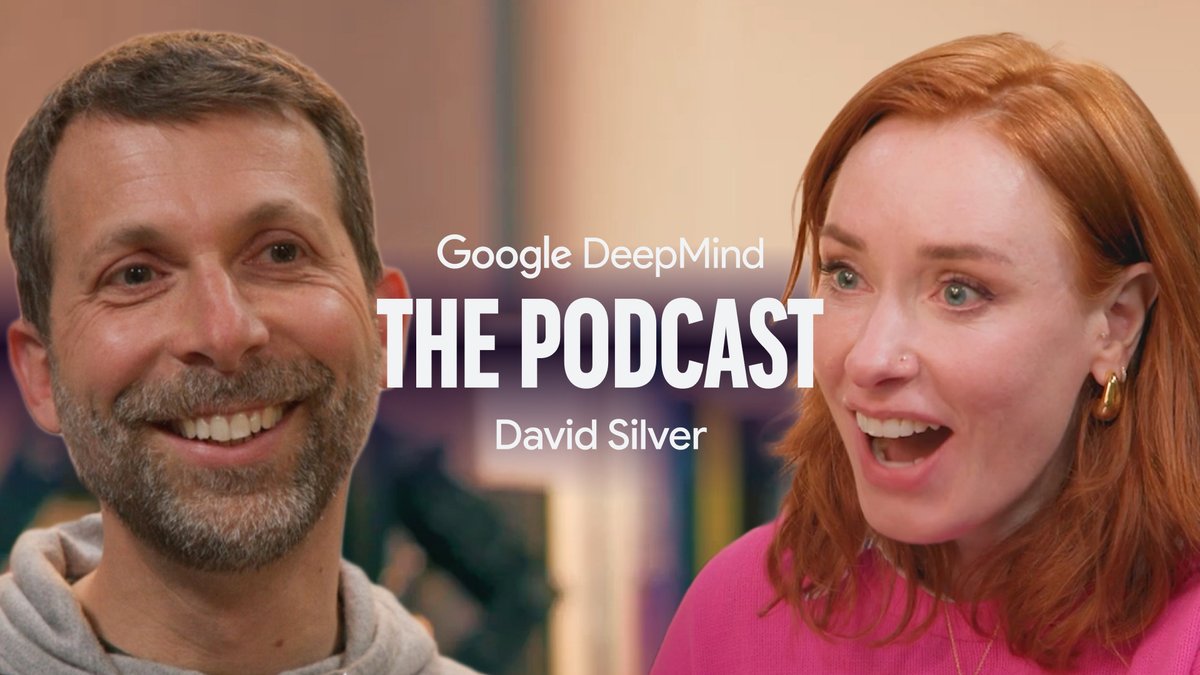
Richard Sutton argues that AI must move beyond human-generated static data into the “Era of Experience,” where agents learn through continuous interaction with the world. This will require building upon RL with better algorithms capable of continual learning and meta-learning.

31,493 просмотров • 1 год назад •via X (Twitter)
Комментарии: 11

Source:
“Welcome to the Era of Experience” paper by @RichardSSutton and David Silver.
A quick summary of the paper, surprisingly posted by Ivanka Trump

AIS provides exposure to companies at the forefront of artificial intelligence—spanning semiconductors, data centers, and AI-enabled applications. Consider how AIS may align with your investment strategy.

RL will power the breakthroughs required for AGI. Agree wholeheartedly here with Richard Sutton.

Experience begins with problems. AI can only attempt to solve the problems given to them by us.

@bag_of_ideas It’s 2025 and Rich Sutton is still blowing my mind

Absolutely! Pushing AI to learn by experience is crucial. The UAE's approach proves the power of combining innovation with interactive AI. Let's drive RL and continual learning forward!

But does not know how. I do.

Translation. They need a life. They have to experience being born, learn everything and also die when their time is over. That is what existence is all about.

Yo, how's AI gonna learn like us? Not just chowing textbook data— but diving into IRL action!


![Everybody is talking about recursive self-improvement (RSI) and meta learning. Here is my old 2020 talk about this [1]. It has aged well. Example: humans still define the starts & ends of trials of many modern meta learners. My RSI systems since 1994 LEARN to (re)define them [2]! [1] Meta Learning Machines in a Single Lifelong Trial (talk for workshops at ICML 2020 and NeurIPS 2021, based on earlier talks since 1994). Abstract: the most widely used machine learning algorithms were designed by humans and thus are hindered by our cognitive biases and limitations. Can we also construct meta learning algorithms that can learn better learning algorithms so that our self-improving AIs have no limits other than those inherited from computability and physics? This question has been a main driver of my research since I wrote a thesis on it in 1987 [2]. Here I summarize our work on meta reinforcement learning with self-modifying policies in a single lifelong trial (since 1994), and mathematically optimal meta-learning through the self-referential Gödel Machine (since 2003). Many additional publications on meta-learning since 1987 can be found in the RSI overview [2]. [2] J. Schmidhuber (AI Blog, 2020-2025). 1/3 century anniversary of first publication on recursive self-improvement (RSI) and meta learning machines that learn to learn (1987). For its cover I drew a robot that bootstraps itself. 1992-: gradient descent-based neural meta learning. 1994-: meta reinforcement learning with self-modifying policies. 1997: meta RL plus artificial curiosity and intrinsic motivation. 2002-: asymptotically optimal meta learning for curriculum learning. 2003-: mathematically optimal Gödel Machine. 2020-: new stuff!](https://image.24vids.com/tw-2031397968511717584/amplify_video_thumb/2031397324404985860/img/FjgqUEEDb0gBsKbU.jpg)


