Video wird geladen...

Video konnte nicht geladen werden

Zur Startseite

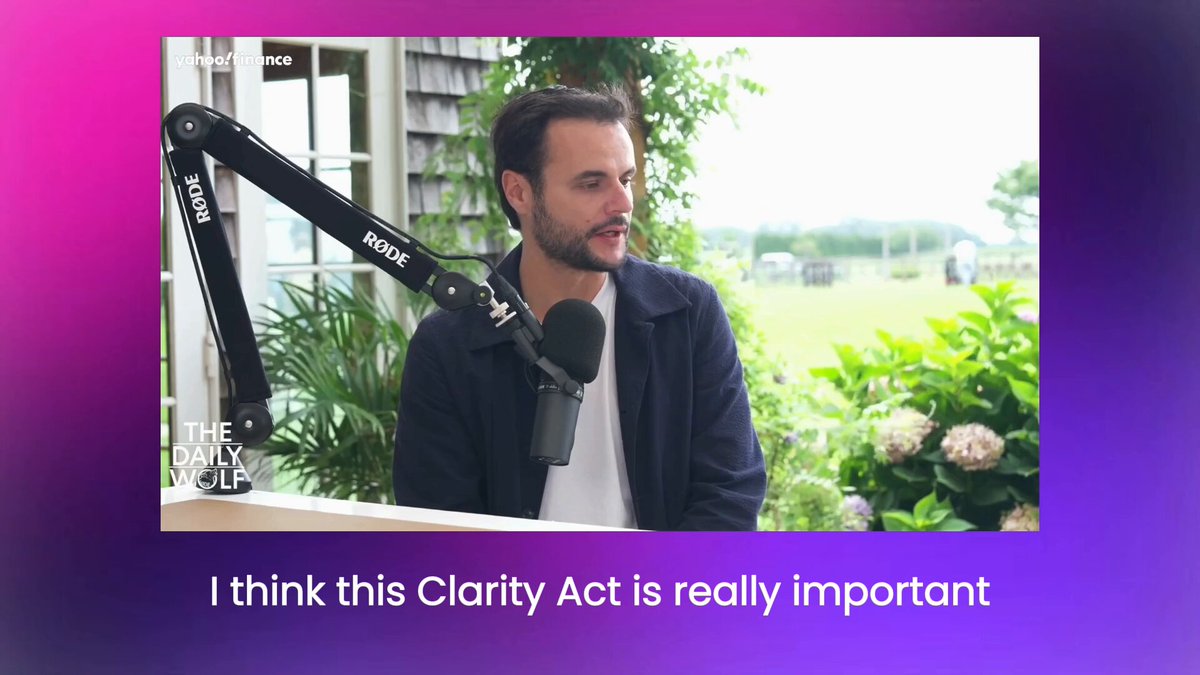
"Robinhood appears to be doing what PayPal probably should have done, which is take every single user they can get their hands on and offer them USDG" Austin Campbell on why USDG with Robinhood is a test case the stablecoin space hasn't seen "USDG is going to be a...

19,531 Aufrufe • vor 1 Monat •via X (Twitter)

0 Kommentare

Keine Kommentare verfügbar

Kommentare vom Original-Post werden hier angezeigt

Ähnliche Videos

Robinhood Chain could become the next billion-dollar meme ecosystem. The reason is simple Every successful ecosystem in crypto was never built around a single meme coin pumping. It was built around the users, attention, and ecosystem effects that memes created. $BRETT once reached a $2B market cap and became one of the most iconic memes in the Base ecosystem. It helped Base attract massive attention, users, and liquidity. Solana followed a similar path. Over the past few years, meme coins became one of Solana’s strongest user acquisition channels. further proved that speculation can be transformed into massive on-chain user growth. Almost every successful ecosystem has gone through a meme-driven growth phase. And Robinhood Chain happens to have several unique advantages: First, it has Robinhood’s distribution power with tens of millions of traditional finance users. Second, Robinhood is building around RWA and tokenized stocks, which requires bringing more users on-chain. Third, memes could become the lowest-friction entry point connecting traditional finance users with the crypto world. Robinhood’s CEO said: “While we’re building Robinhood Chain to be the best chain for RWA… it works great for memes too.” Many people see this as just a casual comment. But I think it reveals Robinhood’s deeper product strategy. Because RWA is unlikely to be the reason users enter crypto for the first time. Very few people will download a wallet and learn how bridges work just to buy a tokenized stock. But a viral meme can become the first interaction that brings users on-chain. Once users enter the ecosystem, they can gradually explore stablecoins, RWA, tokenized stocks, and other on-chain products. If Robinhood can replicate the Base and Solana playbook, Robinhood Chain could become the catalyst for the next major meme wave in crypto.

Shawn

61,533 Aufrufe • vor 1 Monat

Naval Ravikant’s checklist for starting a company “The most important thing is there are no formulas. At the end of the day, you have to do what you love, and you have to do it even though people tell you it’ll never work. But that being said, if there was a formula [for starting a company], I would put it something like this.” Naval started seven companies before AngelList and this is the checklist he recommends running through before starting a startup: 1. Pick a great cofounder. This is most important: “You can do a company on your own, but it’s like you can raise a child on your own, but you probably shouldn’t. You need someone who’s going to be there with you.” This has it’s own checklist. Your cofounder should be: a. Very high intelligence (”hopefully they make you feel dumb, or they’re not smart enough”) b. Very high energy (”They should be extremely hardworking. A founder is someone who never has to be motivated. You should not have to be telling them to do their job.”) c. Very high integrity. (”a smart, hardworking crook who’s going to cheat you is the worst kind of person to be paired up with.”) 2. Pick a very large market. “Notice I don’t talk about the idea. I think ideas are almost irrelevant… The more important thing is that you pick a large space that you’re knowledgeable and passionate about. And then you will figure out what the right thing to do within that space is.” You want to be able to say to investors: “This is a space where there’s a huge market. I’m really knowledgeable and passionate about it. Here’s the great person that I have doing it with me. And here’s the minimum viable product that we have built. That will show that we can test in the marketplace… You iterate until you get to product/market fit… And then you go and you raise money from people you trust. And you use that money to scale.”

Startup Archive

36,050 Aufrufe • vor 1 Jahr

EXCLUSIVE: Robinhood is going to pay 7% on dollars to 27.7 million customers. In this Interview Johann Kerbrat, their SVP of Crypto explains how it all works. Robinhood Earn lives inside the main investing app. You can buy the USDG stablecoin in a few taps, and it gets deployed into vaults built with Morpho and Steakhouse, and the target yield is roughly 7%. Where does 7% come from? Market makers and liquidity providers pay it. These are traders who need USDG liquidity to run spot and perps trading. Your deposit is funding someone else's 50x leverage, and you're the one getting paid for it. Assuming you get paid back. Which, as we've seen, doesn't always work in DeFi with hacks and smart contract risk. But Robinhood has done something extra to make this retail-grade. Robinhood's answer is an insurance program with Lloyd's of London and Relm covering smart contract and vault failure. He says it's one of the largest ever built for a crypto product. Earn was one of 12 announcements; some others that caught my eye: Stock tokens in 120+ countries, backed 1:1 by real equities. You can withdraw them to a self-custody wallet and post them as collateral. Borrowing against a stock portfolio used to be a private banking perk; now it's a smart contract. Robinhood Chain went to public mainnet after 200 million transactions on testnet. Perps on stocks, crypto, and commodities at 20 to 50x leverage, bringing an entire new asset class to the mainstream. Robinhood is all in on DeFi. DeFi protocols spent a decade fighting for users. Robinhood just made a Morpho vault look like a savings account, in front of 27.7m funded customers. See the 15-minute highlights below and the full episode on the Tokenized Podcast youtube channel Full interview with Johann on bryton k. YouTube

Simon Taylor

348,552 Aufrufe • vor 1 Monat

The founders of Stripe and Pinterest on how to convince people to join your startup Stripe CEO Patrick Collison argues that part of the reason startups resonate so much is because the outcome is not guaranteed: "If it were guaranteed, it would be boring... Whether or not you're the best person in the world at what you do, you're probably not going to alter Google's trajectory. But if you really want to benchmark yourself and see how much of a contribution and impact you can make--which is a really compelling prospect for a lot of the best people--a startup is a much better place to test that." Pinterest founder Ben Silbermann emphasized this as well: "No smart person that you're hiring is under the illusion that you have a crystal ball into the future and that joining is a guaranteed thing. In fact, if you're telling them that and they select in, you shouldn't hire them because they didn't pass a basic intelligence test. I think it's important to tell them what's exciting and where you think the company can go. But also tell them where it will be hard and chart your best plan. And then tell them why their role can be instrumental--because it will be... What I would discourage doing is whitewashing all of that. If people are joining your company because they want all of the certainty and safety of working at Google but also the perks of working at a small startup with lots of responsibility and transparency, that's a really negative sign." Apparently in the early days of PayPal, Peter Thiel and Max Levchin would tell people after they interviewed all the reasons that the company would fail: "Visa and MasterCard want to kill us. We also might be doing something that's illegal. But if we succeed, we'll redefine payments." Don't whitewash the risks. Instead tell them how your startup will change the world if you succeed and how their role will be instrumental in affecting that change. Video source: Y Combinator (2014)

Startup Archive

11,811 Aufrufe • vor 9 Monaten

Chamath: "Nvidia is not doing what's in the best interest of the United States." 🇺🇸🇨🇳 "I think we can all do the math. About 47% of all of NVIDIA's revenue goes to China and Chinese-related countries." "And I think when you peel back this onion, what you will find is a whole raft of companies that were stood up to buy these Nvidia GPUs to essentially act as a waystation for China." "And I think that is the big problem." "Let's have a thought starter: if 47% of all of the AI capability and horsepower is being shipped to three Asian countries, where do you think the apps that require that amount of horsepower live?" "Is there a Cursor of Bhutan that we did not know? Is there a great shopping app in Cambodia that's come out of nowhere, that's AI powered?" "I think the answer is no." "Every single time we have an advance in the United States, how is it that Alibaba shows up with something incredible? DeepSeek shows up with something better?" "At every turn and at every step of AI, they are at the same rate or one step ahead." "To be honest with you, I think the real problem that we have is that Nvidia is not doing what is in the best interest of the United States." "You have a American company that has been working around the guidelines at every turn to try to land silicon into the hands of China." "Late last year, they introduced this thing called the H20 that was explicitly designed for China and to be compliant with US rules at the time." "Which again, gives these guys substantial performance." "This is a case where (Nvidia) has plausible deniability. I sell something to a Singaporean registered company? Plausible deniability." "What am I supposed to do? You can't expect me to audit it. I think that's what NVIDIA's answer will be to this question." "But what is the real expectation? At a minimum, the United States should have a mechanism to understand it." "It is implausible that if you did one or two layers of work, you would not find that most of this traffic is being used by Chinese organizations."

The All-In Podcast

910,450 Aufrufe • vor 1 Jahr

Q: What's the secret to building a great product that grows really fast? Paul Graham explains that the secret to growing really fast is to: "start with a small, intense fire." He uses Apple as an example. They started by selling just 500 Apple I computers. Today Apple is the largest company in the world. It's impossible to make something that a large number of people really want when you're just starting out. So you have to find people who want what you're building A LOT. And that's necessarily going to be a small number at first. But that's ok because that's how almost every giant company gets started. PG continues: "You have to know who those first users are and how you're going to get them. Then you're going to sit down and just have a party with those first few users and focus entirely on them and making them super super happy." Another example he draws upon is a startup in a Y Combinator batch making a new mobile email client. Their beta group had one user: Sam Altman. This startup's goal was to just make Sam happy. Sam uses email a lot on the go, knows all of the other email client options, and is super demanding. So they know that if they build a product that makes Sam happy, odds are it will make lots of other people happy too. "One of the things we tell startups in these extreme cases where they can make just one user happy is to act like a consultant. Act like Sam has hired you to make an email app just for him. All you have to do is make Sam happy--it can say 'Sam Altman' at the top of the screen. That's ok! Just so long as Sam would feel bummed if you stopped working on it. That's the test." Ultimately the secret to building a great product that grows really fast is to build something a small group of people love so much that they'd be really disappointed if you stopped working on it. There's lots of important steps to get right after this, but this is the foundation for growth. It's somewhat counterintuitive, but most of the world's largest companies (e.g. Apple, Facebook, etc.) started by building a product that made a small group of people really happy.

Michael McGuiness

890,425 Aufrufe • vor 3 Jahren

This narrative that Palantir $PLTR and Robinhood $HOOD are meme stocks is absolute nonsense and needs to stop. Memestocks are companies that are being hyped up by investors that have zero fundamental reason to gain their appreciation in value. While it can be subjective over how to think of what constitutes a meme, the idea of comparing the company that deploys software on the battlefield to defend the warfighter or the company that has increased their assets under custody to 1/4th of a TRILLION in less than a year is just ridiculous. Palantir and Robinhood are led by two exceptional founders. Both have executed at a level that has realistically not been seen in the public markets EVER and cultivated an audience of retail investors that saw the potential, believed in them when the world didn't, and continue to see their growth trajectories as exponential. Now, you can absolutely disagree with the market's valuation of these two companies. I think that is a reasonable debate. However, to categorize their aggressive premiums as just filled with memes COMPLETELY discounts why the street is willing to pay a multiple and if you're best argument is valuation, please tell me why $COST Costco deserves a 50 P/E or why $NFLX Netflix, as incredible as it is, deserves to have a premium that is more than triple of $GOOGLon a P/E basis. The point is valuations are debatable but what is not debatable is the level of focus, dedication, and execution $PLTR and $HOOD have shown the public markets. Discounting them as memestocks just makes it seem like you'd rather ignore their execution vs. understand why the markets have given them their multiples.

amit

134,791 Aufrufe • vor 1 Jahr

$ABCL CEO Carl Hansen explains the net negative overall value creation in biotech and how AbCellera plans to beat it: “I really think it can be beat because there’s a lot of mistakes that get made in where you allocate capital.” “If you’re a biotech and you start a company on a drug, and you go public and have a drug, and now the data is looking not that great, you just keep running that drug. … Because if you quit that drug, the company is done.” “So, because you’re so concentrated on one thing, you end up having blinders. It’s like a cult of a molecule. And even a real, practical, capital access problem that makes you continue to move things forward” ______________________________________ “Another problem is that many of the drugs that get started, get started by people who don’t understand the competitive or commercial landscape and have no intent of ever actually manufacturing it. … Because they know someone else is going to buy it. So then their framework is not ‘Am I making a drug that’s going to make a difference for people?’ The framework is ‘Can I make something that I think someone will take off my hands?’ And that happens a lot.” “There are many acquisitions where a big pharma company spends $10B, $20B, and it’s a complete bust. So really no value is generated for patients but someone was able to get a good exit on that because they anticipated what someone would want. And a lot of decision making gets done like that”. _______________________________________ “I’m not saying that we have this all solved. But what we’re trying to do is create a framework where we are able to take many bets so that we don’t fall in love with anything, or we don’t have to fall in love with anything. … And then always hold up very explicitly what we know and what we don’t know along the dimensions that matter. The dimensions that matter are - Will it work? That’s a science. - When it gets where will people care? - Is it differentiated? - Does it solve a big problem? In order to get it there, is there a path with our resources and expertise that would allow us to see it through?” “When you start to hold things up like that, you start to see where the mistakes are, where the uncertainties are, and you can be more rational in deciding ‘We’re going to run it to here because we get to flip the card and if the card goes the wrong way we’re going to kill it because we’ve got something else behind it.’” “I do think that if done right, and if you can pick the right opportunities, the success rate can be well higher than an order of magnitude better. … And there are examples of this… companies I’ve mentioned, you know, Regeneron, their success rate is at least 10x the industry in bringing programs forward and getting them approved. … So it’s… you can do it better that way”

Jack Prescott

27,317 Aufrufe • vor 19 Tagen

Q: How do you build a great company? In the clip below, Sam Altman walks through 9 things he has seen the best founders do: #1 Get to know your users really well “The best founders do customer support themselves. They go visit their users—in the case of Airbnb they go live with them. You want to get to know your users really really well.” #2 Have a short cycle time & understand compound growth “The cycle here is basically: talk to customer to understand pain point → build product to address that → get product in front of user → see what they do → repeat cycle. This cycle is how you iterate and improve. The law of compound growth being what it is: if you can get 2% better every iteration cycle, your iteration cycle is every four hours rather than every four weeks, and you compound that over the course of a few years, you’ll be in a very very different place. Make it one of your top goals to build one of the fastest iterating companies the world has ever seen.” #3 Make a long-term commitment “Most companies have a 2-3 year time horizon. But companies are almost always a 10 year project if they work. If you think about it that way from the very beginning, you will make very different and much better decisions. I think this is the only arbitrage opportunity left in the market. Almost no one makes a fairly long-term commitment to a new project. But if you do that, you will think in a different way, you will hire different people, and it will work very well.” #4 Stay lean until everything is working really well “In the early days, when you’re experimenting and zig zagging, you’re like a fast little speed boat and want to be able to turn the whole company on a dime. You can’t do that if you’re a big company—cash burn aside, which is another problem. The flexibility of the company basically decreases with the square of the number of employees, so you want to stay really small until you’re sure things are working. Once things are working, then you can get really big.” #5 Resist the urge to hire; especially resist the urge to hire mediocre people “Vinod Khosla has a saying that I love: ‘the team you build is the company you build.’ This is really true and I never appreciated how true this was for a long time. If you build a team of great people and you have a product that people love, you’ll have a 90%+ chance of success. Those are both really hard to do, and they’re independent variables. But don’t ignore the team component. The best CEOs I know spend huge amounts of their time recruiting and retaining good talent.” #6 Relentless execution “You have to keep going, and do things perfectly, and get all of the details right. You have to care too much about every experience that a customer has with your company.” #7 Startups are about not giving up “One of the very best companies in the last YC batch applied 7 times before they got in. This is just a version of what happens in startups all of the time: you get beat down, again, and again, and again. And that last time when you get pushed down and don’t think you have enough energy to get back up—that’s the time it actually works. This is what you sign up for if you’re going to start a startup.” #8 Fiduciary duty to take care of yourself “This is a 10-year marathon and you have a fiduciary duty to your shareholders to take care of yourself. Some people treat startups like an all-nighter: they don’t take care of their health, they don’t sleep, they don’t maintain their personal relationships. It is true that startups are a bad choice for work-life balance. But you have a duty to yourself, your team, and your investors to take care of yourself.” #9 Clear mission “You don’t have to figure this out on Day 1, but all of the most successful startups I’ve been fortunate enough to be a part of pretty quickly—in the first one to two years—figure out a really important mission. It’s this mission that gets people to join them. It drives the founders. It gets the media to write about them. And even if you start off building a project that’s just interesting to you and solves a problem in your life—which is how you should start—remember that you should have a clear mission at some point… That is what will convince people to come help you, and that is how you will build this idea into a huge company with a ton of people that really love your product.” Follow Startup Archive for more tactical startup advice!

Startup Archive

407,717 Aufrufe • vor 2 Jahren

Sam Altman on why you shouldn’t track absolute user growth in the early days of a startup “Nothing but a great product will save you; you can get everything else right and it still won’t work.” He points out that almost all startup founders get the following wrong: “It is more important to have a small number of users that love you than a lot of users that like you… Eventually what you want of course is a lot of users that really love your product, but that’s almost impossible to do.” In practice, you have two choices: Deep and Narrow: “You have a small number of users that really love you and then find out how to find more and more of those users and broaden the appeal of the product.” Shallow and Wide: “You can have a lot of people that sort of use the product once or twice and kind of like it and try to figure out how to get them more engaged over time.” “With high confidence, I can say that you want to start with a small number of users that really love you. Almost all great companies have products that start this way.” He argues that a good indicator of users loving your product is retention and frequency of use: “In fact, I think this is so important that you actually shouldn’t track absolute growth in number of users in the early days of a startup. You should just track how often they’re using it… That’s a good early indicator of users that love you—better still is them spontaneously telling their friends to buy your product.” Follow Startup Archive for more tactical startup advice!

Startup Archive

565,789 Aufrufe • vor 2 Jahren