Loading video...

Video Failed to Load

Go Home

ROSClaw Integration Update Read the text in the video carefully ⊙ Robot is present both physically can in Nvidia Isaac Sim simulation. ⊙ The agent’s initial goal set to explore any object it finds in its spatial view. ⊙ Think of it as if the physical robot is seeing...

23,374 views • 4 months ago •via X (Twitter)

0 Comments

No comments available

Comments from the original post will appear here

Related Videos

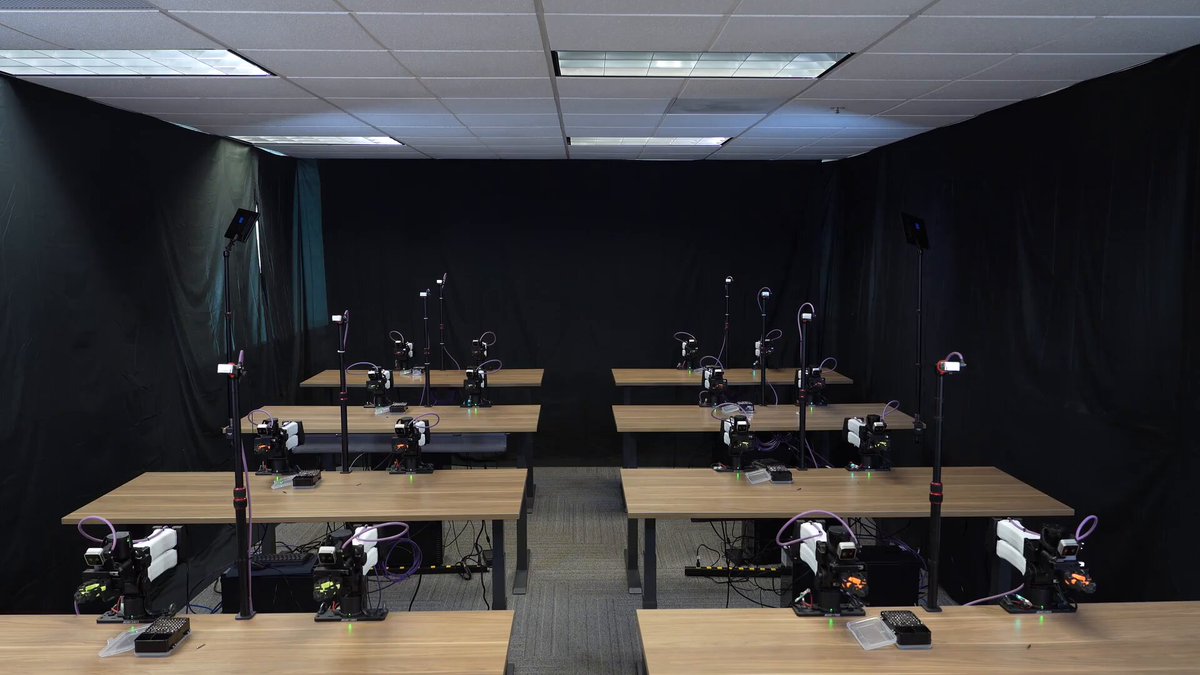
I made Physical AutoResearch sound simple (conceptually), but it took a village to pull off and lots of design thinking into the robot /loopcraft. The hardest part is everything we need to setup *before* pressing Enter. Here's a behind-the-scene tour: 1. Safety harness Letting 8 robots run unattended overnight means safety has to be more than a hint in the system prompt. ENPIRE hardwires it in 2 layers: (1) hard kinematic limit that trips an immediate task failure and auto-resets as soon as a robot leaves its safety envelope, and (2) a torque-limited compliant gripper so a bad contact or misaligned insertion ends in a safe stall, instead of crushing the robot or the object at hand. We make safety more conservative than usual so humans can sleep tight. In reality, we still need a few human operators to watch over the "robots of loving grace". 2. Definition of /done An agent that can edit its own reward will game it for sure. ENPIRE fixes the goalposts before the fleet can move them. Here's the recipe: Collect a few minutes of success & failure demos -> Ask agent to write code using computer vision tools to classify success and measure against groundtruth -> Agent hill-climbs on classifier until reliably good -> This classifier becomes the real-time reward function that directly computes on sensor streams -> *Freeze* the reward function before AutoResearch. It's sacred, enshrined in a Gym env that no one can touch. 3. System telemetry design Robot-seconds is by far the scarcest resource, followed by GPU-seconds, and finally tokens. We instrument all three and surface them to ENPIRE for live resource awareness rather than letting it hill-climb in a vacuum. We define: - Mean Robot Utilization ("MRU"): the fraction of wall-clock time when the robot is actively executing an experiment. Otherwise the hardware is sitting idle and waiting for the next code commit. - Mean Token Utilization ("MTU"): tokens consumed per minute, our proxy for how hard the agent is actually thinking. A low MTU means the agent is stalled, waiting on a robot rollout to finish instead of doing research. - GPU utilization: fraction of wall-clock time when GPU is active. ... and evaluate on two budget-to-outcome metrics: 1. Tokens-to-Success: token budget the fleet burns to complete /goal. 2. Time-to-Success: wall-clock time to /goal

Jim Fan

105,221 views • 1 month ago

The teams shipping AI agents right now are bleeding money on the dumbest possible expense: teaching a 400B-parameter model to read a file name. Every time an AI agent needs to "see" something today, it routes an image through a frontier model. OCR, object detection, checking if a button exists on screen. You're paying GPT-4o or Claude pricing for tasks that require perception, not reasoning. One agent workflow processing a few thousand screenshots per day can burn through more on vision calls than on the actual thinking. Perceptron's Isaac is 2B parameters. Built by the team that created Meta's Chameleon multimodal models. On perceptive benchmarks, it matches or beats models 50x its size. The VQA, OCR, and object detection scores are competitive with models running on infrastructure that costs orders of magnitude more. The MCP wrapper is the distribution play. One install command and every Claude Code agent can offload vision tasks to a model that runs on a single consumer GPU. The agent keeps its reasoning in the frontier model and routes perception to a specialist. That split is how you get vision-heavy agent workflows from "technically possible but expensive" to "cheap enough to run on everything." This is the same pattern that won in every other compute-intensive stack. General-purpose handles orchestration. Specialists handle the heavy lifting. Graphics went through it. Audio went through it. Video encoding went through it. Vision in AI agents is next. The teams building agents that see 10,000 images a day will care about this before anyone else does.

Aakash Gupta

55,978 views • 3 months ago

Dr. Fei-Fei Li just called out the biggest blind spot in the entire AI industry. We have been building half of human intelligence. And calling it the finish line. Li: “If you look at human intelligence, it pretty much boils down to two buckets.” The first bucket is language. Symbolic reasoning. Communication. The ability to think in words and abstractions. That’s what every major AI lab has spent the last decade building. The second bucket is the one the industry has almost entirely ignored. Li: “We call that in AI spatial intelligence.” How humans and animals perceive, navigate, and interact with the three-dimensional physical world. How we reach for objects. How we move through space. How we build and manipulate physical reality. From painting masterpieces to constructing the pyramids, non-verbal spatial intelligence is what actually shapes the world. Language describes reality. Spatial intelligence acts on it. And the gap between those two things is the gap between a chatbot and a robot. Li: “When this technology is ready, the robotic revolution is gonna start. We’re already seeing that trend.” Every robot is a moving agent. Every moving agent requires spatial intelligence to function in the real world. The humanoid robots being deployed in factories right now are hitting the ceiling of what language models alone can power. Spatial intelligence is the unlock. But Li didn’t stop at robotics. Li: “From a geopolitics point of view, this is part of the technology that goes straight into weapons.” Autonomous drone swarms. Battlefield navigation. Physical target acquisition without human oversight. Every military application of AI that operates in the real world runs on spatial intelligence. The nation that masters the transition from static text to dynamic three-dimensional perception doesn’t just win the software race. It commands the physical battlefield. The AI arms race just broke out of the data center. It’s operating in three dimensions now.

Dustin

122,680 views • 4 months ago

We trained a robot dog to balance and walk on top of a yoga ball purely in simulation, and then transfer zero-shot to the real world. No fine-tuning. Just works. I’m excited to announce DrEureka, an LLM agent that writes code to train robot skills in simulation, and writes more code to bridge the difficult simulation-reality gap. It fully automates the pipeline from new skill learning to real-world deployment. The Yoga ball task is particularly hard because it is not possible to accurately simulate the bouncy ball surface. Yet DrEureka has no trouble searching over a vast space of sim-to-real configurations, and enables the dog to steer the ball on various terrains, even walking sideways! Traditionally, the sim-to-real transfer is achieved by domain randomization, a tedious process that requires expert human roboticists to stare at every parameter and adjust by hand. Frontier LLMs like GPT-4 have tons of built-in physical intuition for friction, damping, stiffness, gravity, etc. We are (mildly) surprised to find that DrEureka can tune these parameters competently and explain its reasoning well. DrEureka builds on our prior work Eureka, the algorithm that teaches a 5-finger robot hand to do pen spinning. It takes one step further on our quest to automate the entire robot learning pipeline by an AI agent system. One model that outputs strings will supervise another model that outputs torque control. We open-source everything! Welcome you all to check out the paper, more videos, and try the codebase today: Code:

Jim Fan

908,799 views • 2 years ago