Video wird geladen...

Video konnte nicht geladen werden

Zur Startseite

Self hosting AI agents is officially having a moment.. and it's going to disappoint a LOT of people. Everyone wants OpenClaw or Hermes running 24/7 in the background. But here's what actually happens when you try it yourself: you're debugging setup instead of shipping the workflow you're the one...

27,411 Aufrufe • vor 1 Monat •via X (Twitter)

0 Kommentare

Keine Kommentare verfügbar

Kommentare vom Original-Post werden hier angezeigt

Ähnliche Videos

HERMES AGENT VS OPENCLAW. a local ai onboarding flow test. a 3.9gb bonsai served on localhost, both agents upstream and latest, i point each one at the endpoint and watch which one even finds it. > hermes opens a provider menu, thirty plus options, local servers sitting right there next to the cloud ones, i hand it 127.0.0.1:8899, it verifies the endpoint, one model visible, auto-detects the model by name, bonsai-27b-q1_0, reads the context length straight off the server, saves it, and starts reasoning and firing real tool calls on my local model. no key. no friction. > openclaw has no menu. it goes hunting for a codex login, an openai key, finds none because there are none, prints no models available three times, defaults to openai/gpt-5.5, a cloud model it cannot reach, and dead ends on run auth login --provider openai. read that back. it asked me for an openai key. to run a model already running on my own machine. it never once looked at localhost. to be fair, openclaw can run local if you hand wire endpoint yourself. what it will not do is find the model already sitting on your box. hermes agent found it in one line. now the part i owe you. the auto-detect that just won, the model name read, the .gguf strip, the context length probe off the server, that is my code, it is in hermes agent main right now, authorship preserved, #2051 and #4218. the wizard fix that stops an agent from silently routing you to someone else's creds, the exact trap openclaw still falls into, mine too, #4210. i contribute to hermes agent, i told you that going in. one agent is built to talk to whatever you are running, the other is built to talk to a cloud api, so one found my model and ran it and the other asked me to log into openai. onboarding flow of both, mapped, below.

Sudo su

23,816 Aufrufe • vor 1 Monat

Airtable's Howie Liu says that basically everyone will need to graduate from being ICs to ICs that manage teams of 20-30 agents: "The best developers today don't just sit there in front of their IDEs and synchronously talk to their agent." "[Instead], you have like 30 separate branches that are each being worked on by a different agent. And you can have the agents continue to update the branches based on human and other agent feedback." "And I think this whole idea of it taking hours for that entire loop to complete — agent pushes some changes, the changes get feedback from other agents or humans, the agent responds to that — that whole loop could be hours, not just minutes. So you're not going to just sit there and watch it one at a time." "But the powerful thing about this is, each one is still actually operating faster than a human engineer. One agent on one branch can do the work of maybe three humans, operating 3x as fast. So it's like a 10x leverage factor just for one agent." "But the best engineers are now able to multitask and say, 'I'm going to oversee my own little team of 20-30 agents working concurrently.'" "Everyone needs to graduate from being an IC to an IC manager of agents. Meaning, if you're a VC analyst, your job should no longer be to go synchronously research one company. You need to go and research like 30 companies, and do them all faster, better, and higher quality than you could before." "That's the greatest leap that is going to be challenging for a lot of people in a lot of roles. Because it's a totally different mentality in how you operate, and what your role is."

TBPN

35,595 Aufrufe • vor 4 Monaten

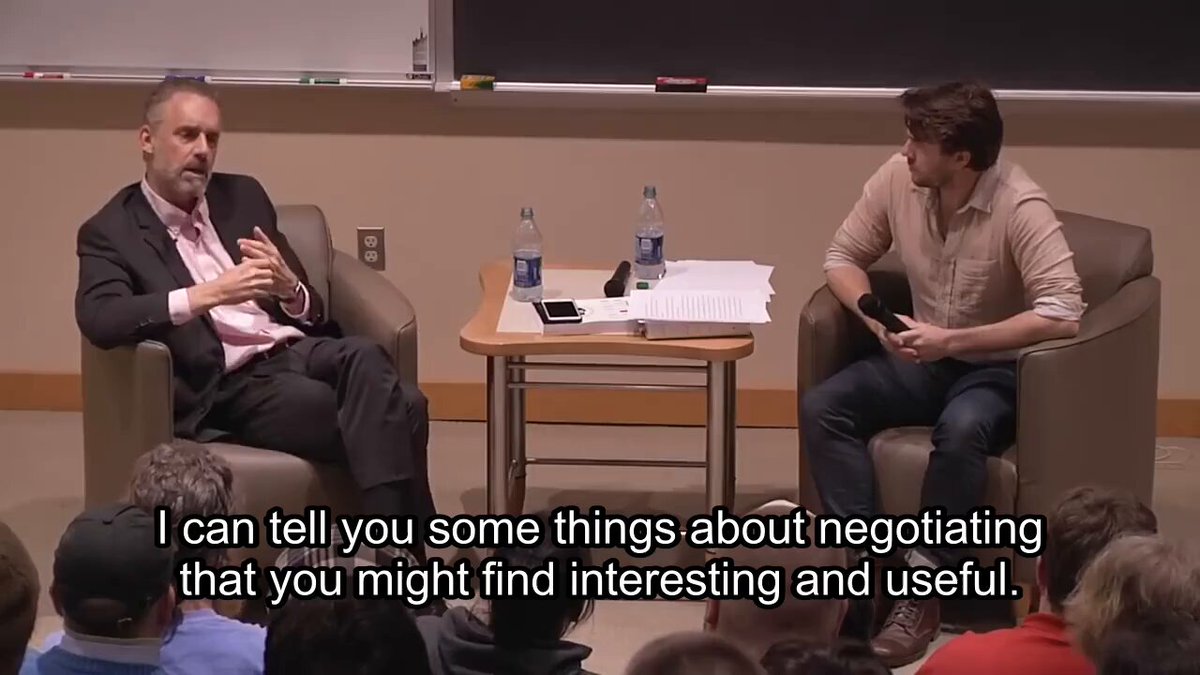
Jordan Peterson: "If you're competent and silent you will be ignored." "You might think well people should reward you because you're competent. And yes of course they should. But if you're competent and silent then you're just part of the background that's keeping everything functioning" On why you cannot negotiate from a position of weakness: "If you want to push your career forward you have to push it forward. You have to be competent and you have to be strategic" "To be strategic when you negotiate for a new position or a new salary you have to be able to say if you don't give me what I want then something you don't like will happen to you" "It's not a physical threat. It's that you have an option" "You have your CV in order. You're educated and competent and desirable to people outside of your immediate job. You're willing to instantly put yourself on the job market" "So that when you go talk to the person you're negotiating with you're credible" On the one thing most people completely miss about negotiation: "It's very seldom that you're talking to the person who's at the top of the pecking order. What you need to do is tell them a story that they can tell to their boss to make you not a problem" "A good story is look we really need this person because they're hyper competent and they have a better offer" "If you go in there with no power you're going to lose. Obviously" He concludes with the one thing every competent person needs to hear: "The first thing you need to know if you're going to negotiate is that you have to be able to say no. And what no means is that you're not going to do it"

Brad

34,992 Aufrufe • vor 25 Tagen

Hermes agent just left the terminal. 𝗛𝗲𝗿𝗺𝗲𝘀 𝗗𝗲𝘀𝗸𝘁𝗼𝗽 dropped yesterday. native app for macOS, Windows, and Linux. for months Hermes was the agent that learned your projects, wrote its own skills, and built a model of who you are. all of it buried in terminal logs. now it has a window. the important part is that it's not a wrapper. it runs the same agent core, the same sessions, memory, and skills as the CLI. you can start a task in the terminal and finish it in the app without anything resetting. the state is shared across every interface, not copied between them. what the GUI actually adds: → streaming chat that shows live tool calls and inline reasoning instead of a spinner → a preview rail that renders pages, code, and images right beside the conversation → an artifacts panel that collects every file the agent has ever produced → remote gateway mode, so you can point the app at a VPS and run the heavy work elsewhere → skills, cron, profiles, and gateways managed point-and-click instead of through YAML → voice mode, drag-drop files, and inline image generation remote gateway mode is the one worth slowing down on. the agent runs 24/7 on a $5 server while you control it from your laptop like a local app. other agent UIs are chatboxes with a logo. this one shows the autonomy instead of hiding it, so you watch the skills load, the tools fire, and the artifacts pile up as it works. it was teased in Jensen's GTC keynote. MIT licensed, local-first, no telemetry. if you already run Hermes, download it and everything is already there. your chats, memory, and skills carry straight over. i wrote a full masterclass on Hermes Agent that walks through the SOUL. md identity layer, the three-tier memory system, the self-evolving skills loop, and how to run three specialized agents 24/7. desktop is the interface that finally does all of it justice. the article is quoted below.

Akshay 🚀

51,540 Aufrufe • vor 2 Monaten