Loading video...

Video Failed to Load

Go Home

Seth Godin explains the difference between a logo and a brand: “If Nike opened a hotel, I think we would be able to guess pretty accurately what it would be like. If Hyatt came out with sneakers, we’d have no clue what they’d be like. That’s because Hyatt doesn’t...

45,685 views • 2 years ago •via X (Twitter)

4 Comments

Startup Archive's profile picture
Startup Archive2 years ago

Join 4,000+ founders receiving tactical advice from the world's best founders and investors delivered directly to your inbox here:

Bearfoot Shoes's profile picture
Bearfoot Shoes1 year ago

★★★★★ "These are my favorite shoes ever. They fit perfectly and are so comfortable. My feet feel so natural in these shoes, it's like I'm not wearing any shoes at all." - Michael S.

Alex Ross's profile picture
Alex Ross2 years ago

Oh goodness 🤦 This has been (rightly) ridiculed on LinkedIn for being nonsense.

Zenn.com's profile picture
Zenn.com2 years ago

It’s a good point. But I wouldn’t have a clue what a Nike hotel would look like. They’re too creative. And I’m glad.

Related Videos

Steve Jobs on how to build a great brand After re-joining Apple in 1996, Steve Jobs announced the “Think different” campaign with the following statement: “To me, marketing is about values. This is a very complicated and noisy world. We’re not going to get a chance to get people to remember much about us. No company is. So we have to be really clear on what we want them to know about us.” He cites Nike as one of the greatest jobs of marketing the universe has ever seen: “Remember, Nike sells a commodity—they sell shoes! And yet when you think of Nike, you feel something different than a shoe company. In their ads, they don’t ever talk about the product. They don’t ever tell you about their air soles and why they are better than Reebok’s air soles. What does Nike do in their advertising? They honor great athletes, and they honor great athletics. That’s who they are, that’s what they are about.” Marketing guru Seth Godin also used Nike as an example of great branding in a blog post a few years ago: “If Nike announced that they were opening a hotel, you’d have a pretty good guess about what it would be like. But if Hyatt announced that they were going to start making shoes, you would have NO IDEA WHATSOEVER what those shoes would be like. That’s because Nike owns a brand and Hyatt simply owns real estate.” Jobs goes on to explain how the Apple team arrived at the “Think Different” campaign: “Our customers want to know who is Apple and what is it that we stand for. Where do we fit in this world? What we’re about isn’t making boxes for people to get their jobs done—although we do that well. We do that better than almost anybody, in some cases. But Apple is about something more than that. Apple at the core—its core value—is that we believe people with passion can change the world for the better… And that those people who are crazy enough to think that they can change the world are the ones who actually do.” He continues: “And so, what we’re going to do in our first brand marketing campaign in several years is to get back to that core value. A lot of things have changed. The market is in a totally different place than it was a decade ago, and Apple is totally different… the products and the distribution strategy and the manufacturing are totally different. And we understand that. But values and core values—those things shouldn’t change. The things that Apple believed in, at its core, are the same things that Apple really stands for today.” Apple’s “Think Different” campaign was designed to honor those people who have changed the world. And as Jobs so eloquently put it: “Some of them are living. Some of them are not. But the ones that aren’t, you’ll know that if they ever used a computer, it would’ve been a Mac. The theme of the campaign is ‘Think Different.’ It’s honoring the people who think different and who move this world forward. And it is what we are about. It touches the soul of this company.” If you’re looking to create a great brand, I’d start out by asking: what are your core values and what does your company honor?

Startup Archive

338,105 views • 2 years ago

Steve Jobs on what separates the successful founders from unsuccessful ones Steve is asked what the factors of success and common pitfalls are for young entrepreneurs. He responds: “I get asked this a lot, and I have a pretty standard answer. A lot of people come to me and say, ‘I want to be an entrepreneur.’ And I go, ‘Oh, that’s great, what’s your idea?’ And they say they don’t have one yet. And I say I think you should go get a job as a busboy or something until you find something you’re really passionate about, because it’s a lot of work.” Steve continues: “I’m convinced that about half of what separates the successful entrepreneurs from the non-successful ones is pure perseverance. It is so hard. You pour so much of your life into this thing, and there are such rough moments in time that most people give up. I don’t blame them. It’s really tough, and it consumes your life. I mean, if you’ve got a family and you’re in the early days of a company, I can’t imagine how one could do it. I’m sure it’s been done, but it’s rough because it’s pretty much an 18-hour-a-day job, 7 days a week for a while. So unless you have a lot of passion about this, you’re not going to survive. You’re going to give it up.” He concludes: “You’ve got to have an idea or a problem or a wrong that you want to right that you’re passionate about. Otherwise, you’re not going to have the perseverance to stick it through. And I think that’s half the battle right there.”

Startup Archive

80,791 views • 10 months ago

Trump on World Cup: Trump: All I did was ask for a review because I didn’t think it was a foul. And I think it would have been terrible if they wouldn’t allow, you know, a top player—maybe the best, maybe among the best players on the team—to play. I think it would have had a big stain, How would you feel if we took Messi out? You know, “Messi, you ran into somebody.” Or we took Ronaldo out. “Ronaldo, you bumped into somebody. We’re going to take you out of the game.” Or Harry Kane. “Harry Kane, we’re going to take you out of the game, Harry, because you happened to hit somebody a little bit harder.” You can’t do that. If you would have taken him out, I think it would have really stained this incredible championship. We’ve got to have our best players, and Belgium has a great team, by the way. We have to have our best players, and they have to have their best players. If we win or we lose, it’s fair. Otherwise, let’s say we lost him and we lose the game—it would be a terrible thing. So I think they made a really brilliant decision. I think the referee’s call was horrible, and nobody talks about that. They talk about the red card like it’s fine. Nobody talks about the referee’s decision to issue the red card. I didn’t know what the hell a red card was. When I found out, I said, “You’ve got to be kidding.” This guy just holds it up: “OK, your best player is not going to play in the next game.” I said, “Wow, that’s a lot of power. That’s terrible.” But then I looked at his past, and it wasn’t so great.

Acyn

2,604,570 views • 2 months ago

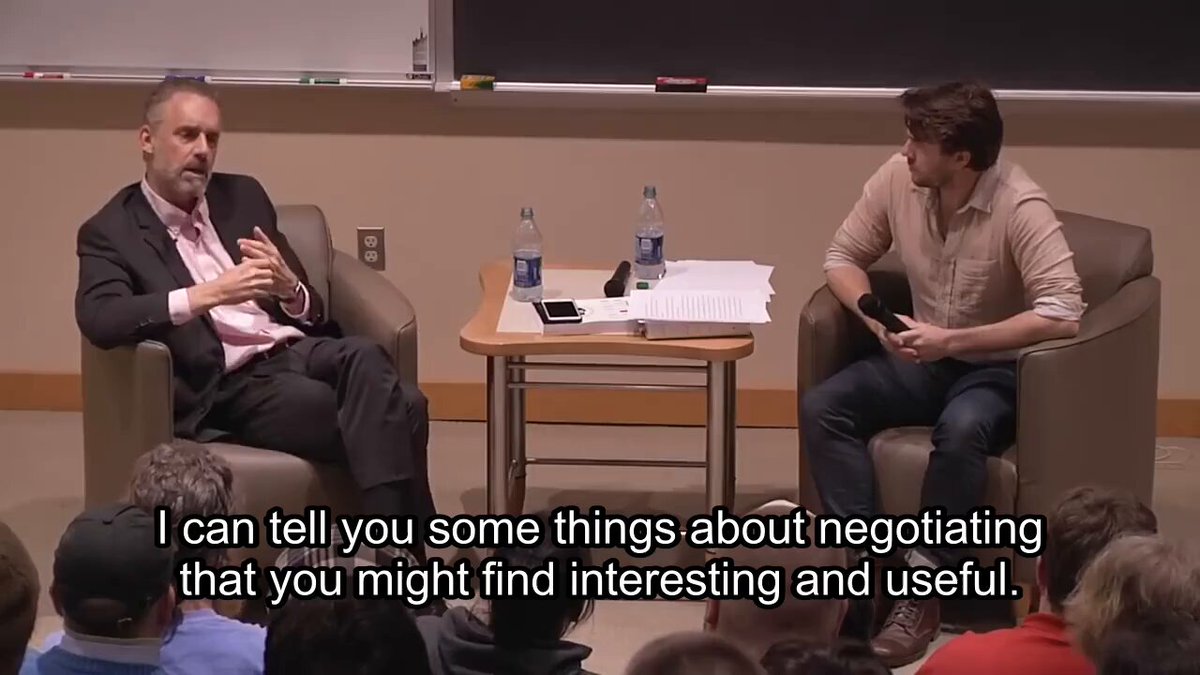
Jordan Peterson: "If you're competent and silent you will be ignored." "You might think well people should reward you because you're competent. And yes of course they should. But if you're competent and silent then you're just part of the background that's keeping everything functioning" On why you cannot negotiate from a position of weakness: "If you want to push your career forward you have to push it forward. You have to be competent and you have to be strategic" "To be strategic when you negotiate for a new position or a new salary you have to be able to say if you don't give me what I want then something you don't like will happen to you" "It's not a physical threat. It's that you have an option" "You have your CV in order. You're educated and competent and desirable to people outside of your immediate job. You're willing to instantly put yourself on the job market" "So that when you go talk to the person you're negotiating with you're credible" On the one thing most people completely miss about negotiation: "It's very seldom that you're talking to the person who's at the top of the pecking order. What you need to do is tell them a story that they can tell to their boss to make you not a problem" "A good story is look we really need this person because they're hyper competent and they have a better offer" "If you go in there with no power you're going to lose. Obviously" He concludes with the one thing every competent person needs to hear: "The first thing you need to know if you're going to negotiate is that you have to be able to say no. And what no means is that you're not going to do it"

Brad

35,334 views • 1 month ago

$ABCL CEO Carl Hansen explains the net negative overall value creation in biotech and how AbCellera plans to beat it: “I really think it can be beat because there’s a lot of mistakes that get made in where you allocate capital.” “If you’re a biotech and you start a company on a drug, and you go public and have a drug, and now the data is looking not that great, you just keep running that drug. … Because if you quit that drug, the company is done.” “So, because you’re so concentrated on one thing, you end up having blinders. It’s like a cult of a molecule. And even a real, practical, capital access problem that makes you continue to move things forward” ______________________________________ “Another problem is that many of the drugs that get started, get started by people who don’t understand the competitive or commercial landscape and have no intent of ever actually manufacturing it. … Because they know someone else is going to buy it. So then their framework is not ‘Am I making a drug that’s going to make a difference for people?’ The framework is ‘Can I make something that I think someone will take off my hands?’ And that happens a lot.” “There are many acquisitions where a big pharma company spends $10B, $20B, and it’s a complete bust. So really no value is generated for patients but someone was able to get a good exit on that because they anticipated what someone would want. And a lot of decision making gets done like that”. _______________________________________ “I’m not saying that we have this all solved. But what we’re trying to do is create a framework where we are able to take many bets so that we don’t fall in love with anything, or we don’t have to fall in love with anything. … And then always hold up very explicitly what we know and what we don’t know along the dimensions that matter. The dimensions that matter are - Will it work? That’s a science. - When it gets where will people care? - Is it differentiated? - Does it solve a big problem? In order to get it there, is there a path with our resources and expertise that would allow us to see it through?” “When you start to hold things up like that, you start to see where the mistakes are, where the uncertainties are, and you can be more rational in deciding ‘We’re going to run it to here because we get to flip the card and if the card goes the wrong way we’re going to kill it because we’ve got something else behind it.’” “I do think that if done right, and if you can pick the right opportunities, the success rate can be well higher than an order of magnitude better. … And there are examples of this… companies I’ve mentioned, you know, Regeneron, their success rate is at least 10x the industry in bringing programs forward and getting them approved. … So it’s… you can do it better that way”

Jack Prescott

31,665 views • 1 month ago

Chris Bosh explains how Kobe Bryant taught him that greatness is mostly an unglamorous routine “If you’re trying to go after something, it’s a process and you cannot cheat it. That is one thing you cannot do. You can’t cheat the process, and even then that doesn’t guarantee you anything. You have to have your stuff together because you want to win, that doesn’t guarantee a win. You just have to make sure you’re doing your process.” “I had the chance to have a conversation with Kobe. We were friendly and we tried to have dinner once a year. He always talked about loving the process of what you do. That’s important. You have to love what you do and love putting the work in because some days are going to suck. It’s always going to suck to go in the gym and shoot 10,000 free throws.” “Everybody’s like, ‘Oh, Kobe, this is amazing.’ He’s like, ‘Yeah, that’s cool, but think about my day. I get up at 4:30am, take my kids to school, I lift weights, I go to practice, I pick them up from school, then I’ve got to do treatment because I’m 35 years old in the league. Then I’ve got to do treatment, and by the time I finish all that stuff, the day’s over. I don’t do anything else. This is all I do.’” “If you take on that approach to something that you love, if you can stick with it even in those tough days, that’s where you want to be.” “You gotta love the grind, man. That’s the part I always like to think of anytime something gets hard. If I’m pursuing a goal and I want to quit, it’s going to come. It’s going to come. It’s okay.” “How many people would quit right now? That’s the first thing I think about. Then I keep going. I’m like, okay, I’m not going to let this drop me off and keep me away from what I’m doing.”

Josh Chambers

42,324 views • 1 month ago