Video yükleniyor...

Video Yüklenemedi

Ana Sayfaya Dön

🚨SHOCKING: Most people will work 9 extra years because they never ran this AI model. I asked Perplexity Computer one question: "I'm 28, earning $85K. When can I retire with $2M?" Here's how it works: You describe your situation → It models 5% annual salary raises compounding over decades...

46,193 görüntüleme • 5 ay önce •via X (Twitter)

0 Yorum

Yorum bulunmuyor

Orijinal gönderinin yorumları burada görünecek

Benzer Videolar

🚨PERPLEXITY JUST LAUNCHED SOMETHING THAT MAKES EVERY OTHER AI PRODUCT LOOK LIKE A TOY.. AND NOBODY IS TALKING ABOUT IT.. They built a Personal Computer.. Not an app.. Not a chatbot.. A full digital worker that runs 24/7 on a Mac mini even while you sleep.. You press both command keys.. And it wakes up.. Ready to work.. But here's where it gets insane.. This thing doesn't run on one AI model.. It runs on 19 of them.. At the same time.. It uses Claude Opus for complex reasoning.. Gemini 3.1 Pro for deep research with a 2 million token context window.. Nano Banana Pro for 4K images.. Grok for fast tasks.. It doesn't just pick one model and hope for the best.. It reads your task.. Breaks it into subtasks.. And routes each one to whichever model is best at that specific thing.. All running in parallel.. While ChatGPT is still thinking about your first question.. Perplexity has already split your project into 6 pieces and assigned each one to a different AI.. And here's the part that should worry OpenAI.. Perplexity hallucinates at 3.3%.. ChatGPT hallucinates at 12%.. Claude at 15%.. It's not even close.. Because Perplexity is built differently.. Every other AI tries to remember facts.. Perplexity searches for them first.. It's structurally forced to cite live sources before it's even allowed to generate a response.. OpenAI Operator launched with a 32.6% success rate on computer-use tasks.. People called it "the world's most anxious intern" because it pauses every 5 seconds to ask if it's doing the right thing.. Perplexity runs multi-hour and multi-day workflows independently.. Only interrupts you when it hits a decision that actually matters.. You can start a task from your iPhone on the train.. And it executes on your Mac mini at home.. The economics are wild too.. Internal studies show it saved teams an average of $1.6 million in labor costs.. Performing 3.25 years of work in four weeks.. And unlike every other AI company.. Perplexity dropped ads entirely.. They charge $200 a month because they said they're in the "accuracy business".. Not the advertising business.. They even launched a $42.5 million publisher program to pay media partners when their content gets cited.. While OpenAI is getting sued by every newspaper on earth.. Google and OpenAI want you locked into their ecosystem.. If a better model comes out tomorrow you're stuck.. Perplexity just updates its routing matrix.. You get the best model on earth automatically.. No switching.. No migrations.. No friction.. This isn't an AI assistant anymore.. This is the first real AI employee.. And it costs $200 a month.

Evan Luthra

1,097,438 görüntüleme • 3 ay önce

SOMEONE FROM THE ANTHROPIC TEAM LEAKED THEIR OBSIDIAN SETUP. 8 MILLION PEOPLE SAW HOW HE ACTUALLY USES CLAUDE the funniest part? all of this information was sitting in claude's documentation from day one. nobody read it one guy did, packed it into a 9-step guide and posted it. and it broke the internet. 4,100 likes, 800 retweets, then china picked it up and 8 million views want to know what's in it? one file. called CLAUDE.md. it holds everything about you: how you think, what you're working on, where you get stuck, even how you want the ai to talk to you. claude reads it first every single session one file changed everything. because now ai doesn't open with "how can i help?" it already knows. it remembers your projects, sees your goals, catches moments where you're contradicting yourself people spent years searching for the perfect prompt. the right temperature. the magic formula. and the answer turned out to be not how you ask ai. but what ai knows about you before you even open your mouth then the guy went deeper. taught claude to work on a schedule. every morning at 7am the ai walks through all notes on its own, finds new stuff, links it, cleans what's stale. no command. no reminder and all of this runs on obsidian. free app. text files on your drive. no cloud, no lock-in. switch models tomorrow and the folder keeps working the most liked comment under the original post: "this is the difference between using ai and building a system. most people won't realize it until they waste hundreds of hours repeating themselves" hundreds of hours. you've already spent some of them full guide in the video. i break down finds like this every day - follow so you don't miss the next one

kai

174,650 görüntüleme • 22 gün önce

I charge $999 to ask a business owner questions for 45 minutes. Then Claude does the analysis in 5 minutes. I call it the AI Tools Assessment. It finds 3 to 7 off-the-shelf tools that reclaim 5 to 10 hours a week, and it's the front door to upsells from $3,500 projects to $2,000/month retainers. Here's the entire model: 1) The discovery call is questions only. "Walk me through yesterday." "What tasks do you dread?" "Where does work pile up?" No pitching. A free AI notetaker captures the transcript. 2) Claude runs the entire analysis. Paste the transcript, run one skill, and it pulls the pain points and prescribes the tools in about 5 minutes. It catches patterns you missed on the call. 3) When Claude whiffs on a tool, and fill the gaps. Thousands of tools, grouped by industry. 4) The report is 9 slides. Executive summary, effort vs impact matrix, tool recommendations, a 4-day quick win plan, and the financial impact. I open sourced the template free at 5) I go for the close on the review call. Three questions: which of these is most urgent, do you want to DIY or get help, and what's your timeline? 50 to 60% of clients ask you to implement it for them. 6) Process redesign sells for $3,500 with zero automation. One e-commerce client had an 18-step ad workflow. We cut it to 9 steps. Fixed the process, didn't touch AI, charged $3,500. 7) Knowledge systems are $3K builds. A business broker got 400 emails per listing. We trained a custom GPT on the marketing package, and buyers called it the best broker experience they've had. 8) You don't need an audience to sell this. One guy walked into 30 local businesses offering a free 15-minute mini assessment. 5 meetings, 2 clients. The free mini assessment is the hook for every channel. 9) Co-working spaces are the cheat code. Dennis in our community hosted his first free AI office hours this week. 9 people showed up, 2 became warm leads. 10) AI Concierge is the best upsell of all. Two 45-minute calls a month at $1,200 to $2,000. I have 5 clients and my blended rate is about $1,100 an hour at 99.9% net margin. Two things that make this work: 1) Sell the diagnosis before the cure. The $999 assessment is a paid discovery call that qualifies the buyer and tees up every upsell on the menu. 2) High perceived value can cost you nothing. Unlimited Voxer access sells the retainer. In 3 months across 5 clients I've gotten 4 messages. Full breakdown below. watch, implement, make money. (also available on the Build With AI podcast wherever you get your pods)

Corey Ganim

48,767 görüntüleme • 23 gün önce

One guy keeps a farm of Mac minis on his desk and says each $600 box brings him $2,000 a month while he sleeps. AND THE HARDWARE ACTUALLY WORKS. But the number is not even the interesting part. The broken part is HOW: his AI no longer sits in a chat window. It sees the screen, moves the mouse itself, types and clicks the interface like a human at a computer. That is it. While most people still run AI in a chat and ask it for text, he sat Claude down right at the computer and put it to work with its hands. He automated not a single task but the workplace itself. How it actually works: on every Mac mini Claude runs with computer use turned on and the official Claude API docs spell it out: screenshot capture, mouse control, keyboard input, desktop automation. The agent opens the browser and the apps itself and runs the boring routine on a schedule: pulls leads, fills the CRM, checks orders, runs QA on the site. One box, one quiet worker that does not sleep and does not ask for a salary. His math is simple: a Mac mini is $600 once, Claude Max is $200 a month, and a live white-collar worker on the same routine costs a business $4,000 and up. So he rents out each node to a client as an AI worker for about $2,000 and 6 Mac minis come out to around $12,000 a month with costs a bit over $1,000 on subscriptions. But the $12,000 is his projection not a revenue dashboard: the video has no client, no task log, no working automation at all. The real asset here is not the stack of hardware but the one repeatable process the agent actually closes. Because a Mac mini on its own earns nothing. The money shows up exactly where the boring browser routine used to be done by hand for a salary and now you can hand it to an agent for the price of a subscription. Computer use is still in beta, almost nobody builds a service on it and the demand for cheap GUI routine is huge. The window is open for literally the next few months. Most people will watch this, laugh at the "$600 AI worker" and close it. And the ones who actually put an agent on one boring task and grind it into a repeat will ride this wave while it is still empty. Would you sit an AI right at your own computer on the boring routine or are you still clicking through it by hand?

Sorven

11,948 görüntüleme • 1 ay önce

I just built one of the greatest insider buying tracker tools of all time with Perplexity Computer. I wanted to find out one question: Which stocks actually have a high correlation of share price appreciation and insider buying? What Perplexity Computer built to answer this was truly amazing. Here's what it did: It pulled 1,301 real SEC Form 4 insider purchases across 184 S&P 500 stocks over the last 5 years. Then it tracked what happened to each stock AFTER insiders bought, measuring forward returns, win rates, and purchase frequency. It combined all of that into a single "Alpha Score" that ranks every stock by how reliably it goes up after insiders buy. The results? $COIN: 100% win rate. +187% average return after insider buys. $ET: 100% win rate. 52 purchases. $514M in total insider buying. $VST, $LUV, $CAT, $LLY, all 100% win rates. 73% of ALL insider purchases across the S&P 500 led to share price gains. But it didn't stop there. It also built: - A live purchase feed tracking every new SEC filing - Cluster buy detection (multiple insiders buying the same stock within 14 days) - A sector heatmap showing where insiders are putting their money - Top conviction buys (Berkshire's $2.1B OXY position, Musk's $1B TSLA buy) The whole thing looks like a Bloomberg terminal. Dark theme. Real time data. Fully interactive. I didn't write a single line of code. I just told Perplexity Computer what I wanted, and it researched the data, ran the analysis, and built the entire dashboard from scratch. This is the future of building things with AI. The best part was that it created a proprietary "Alpha Score" for every stock. This was a composite ranking from 0 to 100 that weighs four factors: 1. How often insiders bought (frequency) 2. How much money they put in (total value) 3. What percentage of buys led to gains (win rate) 4. How big those gains were (average forward return) The higher the Alpha Score, the stronger the correlation between insider buying and share price appreciation. It revealed insights you would've never expected. The energy sector ended up having the highest Alpha Score, meaning insiders buying energy stocks is very correlated with energy stocks surging. I have paid for data on insider buying in the past. I literally built a better tool with Perplexity Computer than the insider buying tools I have been using for the last 3 years.

Dividendology

184,157 görüntüleme • 5 ay önce

Stan Druckenmiller just explained the one rule that separates great investors from everyone else. "If the reason I bought a stock is no longer the case, I don't care what I paid for it." No anchoring to your cost basis. No waiting to break even. Clean slate. He bought at $60. It drops to $50. Most investors sit paralyzed waiting to get back to where they started. Druckenmiller has zero emotion about it and sells immediately. "I just don't care what I paid for a stock. It's absolutely irrelevant to my investment process going forward." This is actually what support and resistance on a chart is measuring. Resistance at $60 means a crowd of people bought at $60, watched it fall, and have been waiting three or four years just to break even. While they waited, they missed everything that was going up the whole time. Anchoring to your cost basis is one of the most expensive habits in investing. But Druckenmiller pairs this with something most people struggle to do at the same time: concentration. "Not being afraid of concentration is a big reason for my success." He plays across five buckets: equities, bonds, currencies, commodities, and credit. When one market has no clear edge, he finds one that does and sizes up there instead. Bear market in equities? The real action moves to bonds and currencies. He just follows it. Unemotional about losses. Concentrated when he has conviction. Flexible across markets. That combination is what kept him from ever having a down year. Our analysts use the same discipline sizing into high conviction positions across sectors. They were early to $AMD, $MU, $BE and $CRDO before their big run ups. You can follow their exact portfolios for $1 at Milk Road PRO. (link in bio)

Milk Road Macro

170,012 görüntüleme • 3 ay önce

An entire empire was overthrown over a two percent tax on a breakfast beverage. Look at what you tolerate now. You are taxed when you earn it. Taxed when you spend it. Taxed when you save it. Taxed when you invest it. And when you die, they tax whatever is left. That is not a system. That is a harvest. You commute in a car you paid sales tax to buy. You drive it on roads you were already taxed to build. You fill it with gas taxed by the gallon. When you sell that car, the next buyer pays sales tax on it again. The same car. Taxed every time it changes hands. You arrive at a job where your salary is cut before it ever touches your hands. If you work for yourself, you pay both sides. Two people on paper. Neither one keeps what they earned. Then you go home. Every bill you open has a government standing behind it with its hand out. You buy a house with money they already took their share of. Then they charge you property tax on it every year for the rest of your life. You want to renovate your own kitchen. You need a permit. You want to build a deck on your own land. You need a permit. You pay for the property. Then you pay for permission to use it. Stop paying property tax and they seize your home. Not because you missed a mortgage payment. Because you missed a payment to the government for the privilege of keeping what is already yours. You do not own your home. You rent it from the state. If you leave something behind for your children, they are taxed on what you were already taxed to earn. The same wealth. Taxed at every stage of your life. Then taxed one final time because you had the audacity to die. They found a way to monetize your absence. We are told this is the price of civilization. It is not. It is architecture. The most effective prison ever built is the one where the inmates believe they are free. They did not take your freedom. They priced you out of it. If you kept the full value of your labor, you would be free within years. Not decades. Years. The system cannot allow that. A machine built on consumption needs a consumer that never stops. You did not sign a social contract. You were assigned one. Now pay attention. They spent decades perfecting the extraction of your productivity. Now they are building the technology to replace you. AI is not coming for your job because corporations are greedy. It is coming because a system that already takes half your output just realized it can take all of it. Without needing you in the equation. You were never the point of this arrangement. You were the input. And the moment they engineer a cheaper one, you become a rounding error on a quarterly earnings call. They did not build AI to free you. They built it to finish what the tax code started. It was never about the tea. It was about the precedent. Today we hand over half our waking lives and thank them for the potholes. You do not live in a free economy. You live in a subscription you never signed up for. And the penalty for canceling is everything you have.

Dustin

27,811 görüntüleme • 3 ay önce

Perplexity declared war on the biggest open source AI movement of 2026. This changes how millions of people will interact with AI agents forever. Here is what happened and why almost nobody is talking about the real implications. OpenClaw exploded in January and it became one of the fastest growing open source projects in GitHub history.​ The premise was radical. An AI agent that runs on your own machine, connects to your messaging apps and actually does things while you sleep.​ Developers went wild and over 700 community built skills appeared on ClawHub. People were negotiating car deals, filing legal rebuttals, and building entire social networks run by AI agents.​ Then Perplexity showed up with something different. A cloud powered system that coordinates 20 frontier AI models at once.​ They call it Perplexity Computer and this week they went even further.​ They announced Personal Computer. An always on AI agent that lives on a Mac mini in your home, connected to your local files and Perplexity's secure servers around the clock.​ It never sleeps or stops working and you control it from any device, anywhere.​ But the real story is what CEO Aravind Srinivas said during the Q&A session at their inaugural developer conference in San Francisco.​ He called Perplexity Computer a product "meant for serious people."​ He talked about Uber drivers asking him when they could stop driving and let AI make them passive income. That, he said, is the actual vision and then he went directly after OpenClaw. He said even a former Perplexity engineer struggled to get OpenClaw running on their own machine.​ He warned about unvetted malware being imported through OpenClaw's community skill hub, with no control over what people are contributing.​ He called the hobbyist approach of managing 700 API keys and sub agent configuration files a dead end for mainstream adoption.​ And four years of building world class orchestration gives Perplexity something an open source project cannot match. Enterprise grade security for solopreneurs and businesses alike.​ On one side, OpenClaw represents radical openness. Your data stays local, you choose your own models, you own everything and the community builds the tools. On the other hand, Perplexity is betting that most people don’t want to be system administrators. They want results, security guarantees, and something that just works out of the box. The Personal Computer runs on Perplexity's SOC 2 certified infrastructure. Every sensitive action requires user approval, every action is logged, and there is a kill switch. The enterprise version connects natively to Snowflake, Salesforce, HubSpot, and hundreds of other platforms. Teams can query data warehouses and build financial models without waiting on an analytics team.​ The real question is not which product is technically better. The real question is whether the future of AI agents looks like Linux or looks like the iPhone. Because the Uber driver Srinivas described is not going to configure sub agent routing tables. That person needs something that works the moment they open it. And if Perplexity captures that market, the open source movement becomes a niche for developers instead of a revolution for everyone. That is the billion dollar bet being made right now.

Milk Road AI

22,256 görüntüleme • 4 ay önce

Caller: I’m going to retire in about three years at 76. I have no mutual funds, no 401k. My question is, should I buy or rent at that time, at 76? ​Dave Ramsey: Okay. How would you be able to buy if you don't have any money? ​Caller: Currently, my income is $4,500 a month. $2,000 is going to rent, $2,000 is going to student loan, and I spend $500 on living expenses. ​Dave Ramsey: You're 70 years old and you have a student loan? ​Caller: Yes. I will pay it off. ​Dave Ramsey: What's the balance on it? ​Caller: $12,000. So I'm paying $2,000 a month on that. ​Dave Ramsey: All right. I'm really curious how you end up with a student loan at your age. How did you do that? ​Caller: I paid the interest only for a long time, since 2005, I guess. That's when I graduated. ​Dave Ramsey: You graduated 18 years ago, and your degree is in what? ​Caller: That particular degree was in communications. ​Dave Ramsey: Okay. And what do you do for a living? ​Caller: I'm a quality inspector. ​Dave Ramsey: At retirement, you have to have monthly money to pay bills, buy food, and provide shelter. The largest line item in your budget for the rest of your life is going to be housing. If you're renting, your cost of housing is going to go up every year because rent always goes up. If you buy, at least you're locked in to what you're going to be spending on housing from this point forward. So, buying is good. Having a paid-off home by the time you get there is even better, and of course, having a nest egg to live on. So, do you have a pension, or are you counting on just Social Security? ​Caller: Right currently, I have a universal life policy that has a cash value of approximately $9,000 in it. I'm reluctant to cash it out because it has a long-term care rider of 50 months on it at 4%. By the time I retire, I will have approximately $500 in pension and $2,500 in Social Security, which will give me $3,000. ​Dave Ramsey: And you have no money in savings? At all? ​Caller: $1,000. I have my thousand. ​Dave Ramsey: I want you to cash the universal in and pay the student loan down, and let's be done with this student loan very quickly. Let's get that in the background as soon as possible so we can try to accomplish a couple of these other goals, which is housing and start to build some kind of a nest egg over the next three years. Basically, you're going to live on beans and rice for the next three years while you throw as much money towards housing, buying a home, and as much money towards a nest egg as you can throw.

Traeyz ♠️

174,559 görüntüleme • 1 ay önce

Elon Musk just explained why the best engineers on Earth will never take your call. Three reasons. Most companies fail all three. Elon Musk: “State what’s the mission, what’s the problem we’re trying to solve? And just be clearly willing to pour a lot of blood, sweat, and tears into it.” The top one percent of talent does not care about your office. Your perks. Your free lunches. Your branded hoodie. They care about one thing. Does this matter. If the answer takes more than one sentence to explain, they are already gone. Musk broke motivation into three layers. The first is the work itself. Musk: “Somebody’s got to look forward to coming to work in the morning. Are they enjoying the work itself intrinsically?” Not the paycheck. Not the title. The work. Solving problems most people cannot even frame correctly. Alongside people who make you sharper just by being in the room. If Monday morning feels like a sentence, no salary commutes it. The best people leave. Not eventually. Within months. The second is money. Musk: “They also feel like they will receive fair financial compensation. Like that the financial rewards are good and fair.” Not charity. Not below-market equity with a four-year cliff. Fair. One word. Most companies still get it wrong. The engineer who knows exactly what they generate does not negotiate. They compare. When the gap gets wide enough, they vanish. No conversation. No counteroffer window. Two-week notice on a Friday afternoon. You do not cap the ceiling of someone producing at that level. You match it. Or you fill the desk again in six months. The third is the one that separates real companies from forgettable ones. Musk: “For the best people in the world, they’ll want to know: is what they’re doing going to matter? If they spend 10 years doing this, will it make a difference to the world?” Ten years. The best engineers on the planet are running a calculation no recruiter has a spreadsheet for. If I give this company a decade of my life, does the world look different because I did? If the answer is no, they are not coming. No signing bonus changes that. No recruiter pitch rewrites it. No equity package papers over it. The mission has to be real. And the person at the top has to be visibly bleeding for it. Musk: “Be clearly willing to pour blood, sweat, and tears into it.” Talent watches the founder before they read the offer letter. If the person running the company is coasting, optimizing for exits, playing it safe, the best people sense it before the first interview ends. They do not want a manager. They want someone who has bet everything and would do it again tomorrow. Most companies post a job. The ones that land the best people alive offer something no job listing can contain. The work has to be the reward. The money has to be fair. The mission has to be worth a decade of someone’s only life. Miss one and the person you needed most never even opened your email.

Dustin

486,049 görüntüleme • 4 ay önce

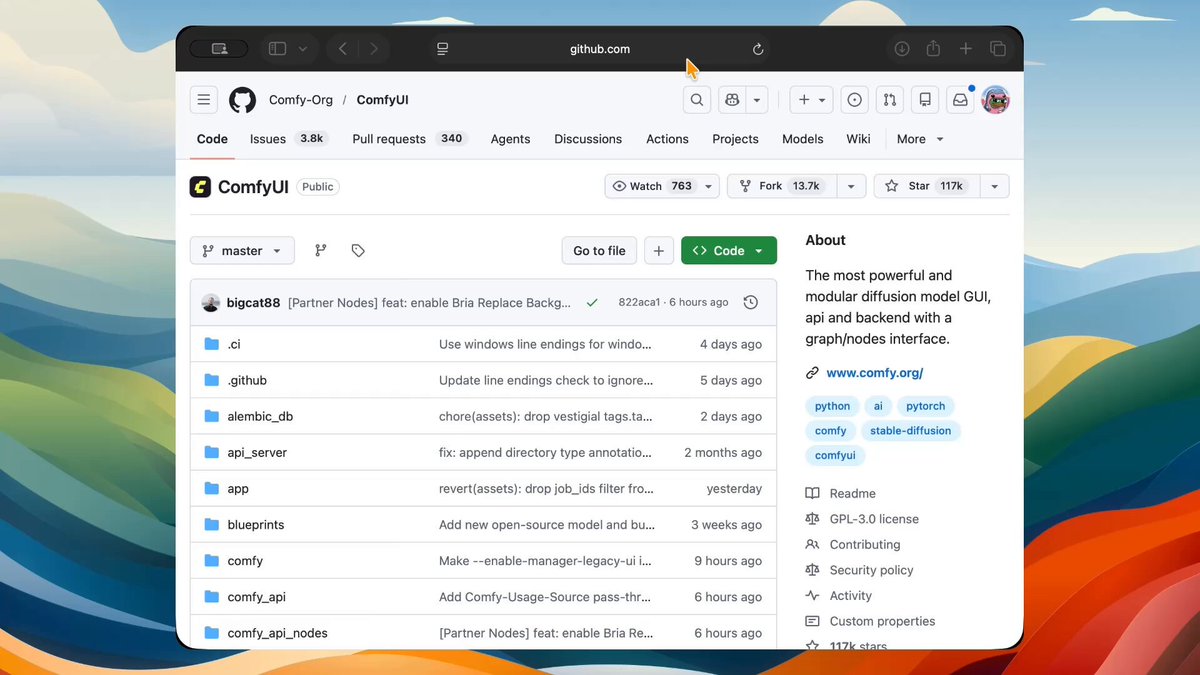
no money for grok or midjourney? this tool is for you. there's a FREE tool created by an anon dev. open-source. runs locally. 117k stars on github. it generates: > images & video > 3d models > audio > 20+ models here's how to set it up in under 5 minutes: 1️⃣download ComfyUI Desktop go to and grab the desktop app for your system. windows 10+, mac (apple silicon), or linux. it installs like any normal app, it sets up python and every dependency for you in the background. no terminal, no config files. 2️⃣open it first launch, it spins up its own environment automatically. you just wait a few seconds and you're in. you'll land on a node canvas, that's the whole interface. 3️⃣load a starter workflow top menu → Workflow → Browse Templates → Image Generation. click it. this drops a ready-made setup onto your canvas so you don't build anything from scratch. 4️⃣grab a model comfyui ships empty on purpose, the model is the brain, and you pick it. in the template, the "Load Checkpoint" node has a Download button when no model is installed. click it. it pulls one in for you (a few GB, this is the only real wait). 5️⃣install ComfyUI Manager this is the one add-on you don't skip. it lets you install models, custom nodes, and updates with a click instead of the command line. grab it from github (link in comments). it's the difference between fighting comfyui and flying in it. one honest note: an NVIDIA gpu makes this fast, apple silicon works great too, and a weak machine still runs it just slower. that's the whole setup. you now own an image, video, and 3D studio that costs you nothing per month. save this. and the next time grok or midjourney asks for your card. you won't need it. disclaimer: comfyui itself is 100% free. so are the local models (sdxl, flux, wan 2.2, ltx-2). some premium models like seedance are pay-per-use api models, only if you want top-tier quality. the free local ones cover most of what you need. (github link in the comments) follow and turn on post notification for daily AI contents.

m0h

14,542 görüntüleme • 1 ay önce

JUST IN: Perplexity launched "Perplexity Computer" — and it might be the most complete AI agent system available right now. Not a chatbot upgrade. Not a research tool with a new name. A system that plans entire projects, delegates to specialist AI models, and runs autonomously for hours, days, or months (their words). Here's what makes the architecture genuinely different: → Opus 4.6 handles core reasoning and orchestration → Gemini handles deep research (spawning its own sub-agents) → Grok handles lightweight speed tasks → Veo 3.1 handles video generation → Nano Banana handles image creation → ChatGPT 5.2 handles long-context recall and wide search → You can override model choices per subtask 19 models total. Each task runs in an isolated environment with a real filesystem, real browser, and real tool integrations. You describe an outcome. It breaks it into tasks and subtasks, creates sub-agents for each, and coordinates them automatically. When a sub-agent hits a problem, it spawns more sub-agents to solve it. And it connects to your existing stack — GitHub, Google Drive, Gmail, Slack, Jira, Linear, Notion, Confluence, Ahrefs, Airtable, and more. Critically, it doesn't just run once. It can run on a schedule. Reading your docs, checking your project boards, pulling from your CRM, and acting on what it finds. Market monitoring. Competitor tracking. Weekly reports with charts. Content pipelines. CRON jobs that actually execute. Not "AI that helps you once." AI that runs in the background for days or months. Think of it as managed OpenClaw — similar autonomous capability (scheduled tasks, multi-step workflows, tool integrations) but fully managed. No Mac Mini. No security config. No infrastructure to maintain. I tested it with a complex prompt — a full stock trading simulator with what-if scenarios, correlation heatmaps, sentiment analysis, and a Bloomberg Terminal aesthetic. Two prompts later: deployed to Netlify via GitHub, with working CRON jobs updating live data. I've started using it to analyze my portfolio. But coding is just one lane. This thing researches, writes reports, generates datasets, creates videos, processes documents, and connects to your existing tools — all in one coordinated workflow. The real shift: you don't choose a model anymore. You describe what you need. The system routes each piece of work to whichever model does it best — and spawns new agents when it hits a wall. 19 models, dynamic sub-agents, scheduled tasks, and your entire tool stack connected. Thoughts?

Paweł Huryn

219,681 görüntüleme • 5 ay önce

Elon Musk just told you the job is dying. Most people heard a prediction. A few heard a prison door opening. Musk: “In less than 20 years, working at all will be optional.” That is not a policy suggestion. That is a countdown. For three hundred years, the human blueprint has been identical. You are born. You move to the city. You rent a box near the office. You trade your body and your hours for the right to exist. You do this until you are old. Then you stop. Then you die. The entire model runs on one assumption. That human labor is the only engine. AI and robotics delete that assumption. When the machine handles production at a scale no human crew can match, the forced migration to the city evaporates. The commute evaporates. The cubicle evaporates. The alarm clock that owns your nervous system for forty years evaporates. Musk: “I think it won’t be the case that you have to be in a city for a job.” The city was never a choice. It was a requirement disguised as ambition. You moved to the noise and the concrete and the $4,000 rent because the paycheck lived there. Remove the paycheck from the equation and the geography changes overnight. You can live in the mountains. On the coast. In the silence of a town most people have never heard of. You can wake up to nothing but trees and cold air and the complete absence of anyone else’s schedule. That is not a fantasy. That is the math resolving. But here is where most people break. They hear “work is optional” and they see emptiness. A species with nothing to do. Billions of people staring at screens until their minds dissolve. That fear tells you everything about what the system has already done to us. We confused labor with purpose. The grind with meaning. The paycheck with proof that we matter. Musk: “In the same way that you could grow your own vegetables in your garden.” The analogy is precise. You do not grow tomatoes because the economy demands it. You grow them because something in you wants to build a thing with your hands and watch it come alive. That instinct does not disappear when the job does. It gets unleashed. The artist who spent twenty years doing accounting finally paints. The engineer who always wanted to build something of her own finally builds it. The kid in a small town who could never afford to take the risk finally takes it. Work does not vanish. Forced work vanishes. What replaces it is creation without a gun to your head. This is the part that keeps me up at night. We are standing at the edge of the largest liberation in human history. And the loudest voices in the room are begging to stay in the cell. They want the commute. They want the boss. They want the structure that tells them when to eat and when to sleep and when they are allowed to think about their own life. Because freedom without a template is terrifying. The next twenty years will not test our technology. The technology is already ahead of schedule. They will test whether the species can handle what it has been asking for since the beginning of civilization. Time. Space. Silence. And the unbearable weight of choosing what your life actually means when no one is forcing the answer. That is not a prediction. That is the final exam. And nobody is ready.

Dustin

111,730 görüntüleme • 4 ay önce