正在加载视频...

视频加载失败

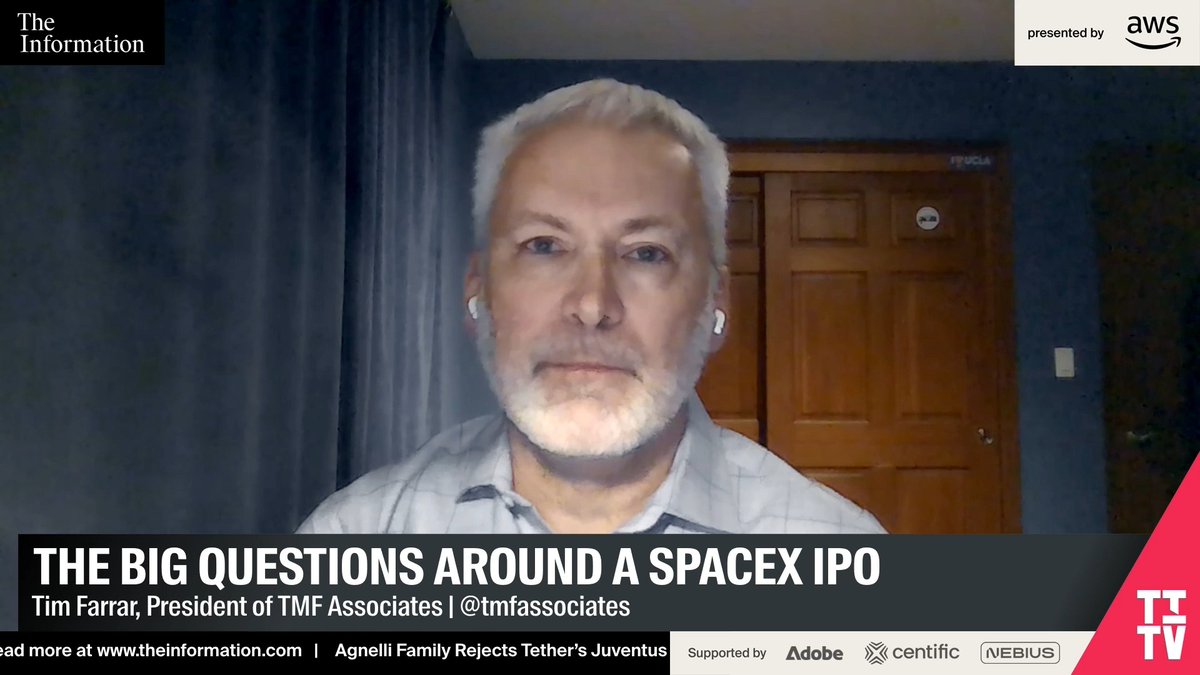
SpaceX employee #13 Eric Romo: "The idea that launch prices are going to fall significantly in the next 5 years is nonsense." "There are an awful lot of business models that are predicated on 'when Starship allows me to launch for $200 a kilogram…'" "I think they’re all broken,...

120,441 次观看 • 18 天前 •via X (Twitter)

0 条评论

暂无评论

原始帖子的评论将显示在这里

相关视频

BREAKING: Eric Romo (Eric Romo), President & COO of Impulse Space (Impulse Space) says: "The idea that launch prices are going to fall significantly in the next 5 years is nonsense." "I think there are an awful lot of business models that are predicated on “when Starship allows me to launch for $200 a kilogram…” I think they’re all broken, & all those companies are going to fail." "I think we’ve seen this play out already with Falcon 9 & the pricing around it, where the costs of Falcon 9 allowed SpaceX to deliver the Starlink constellation at a cost per CapEx that made them profitable. But they set the price in the market at something that just barely made it an okay investment to think about OneWeb or Kuiper or anything like that. So they ran that playbook exactly on Falcon 9, & they had their gross margins on Falcon 9—people think we’ll see when the S1 comes out—are like 50% plus. So they could have dropped the price, & they didn’t. They’re going to do the same thing on Starship, because why wouldn’t they? Their internal costs on Starship are going to be whatever they need to be to deploy Starlink & orbital data centers, but they’re going to set the price so that anybody trying to do comms, anybody trying to do orbital data centers—the price is going to be too high. So if you’re a third party relying on them for a lower price of access to space, I think you’re hosed." 00:20 Hot Take Launch Prices 01:41 SpaceX Market Power 02:23 Impulse Space Overview 02:54 Mira For GEO Defense 03:45 Helios Direct To GEO 05:19 Caravan Rideshare To GEO 06:42 Space Economy Reality Check 08:46 Tom Mueller Legends 10:54 SpaceX IPO 13:42 Investor Frenzy & Broomstick 14:05 Alien Eyeballs Outro Elon Musk Recorded at NYSE 🏛 x Payload 🚀 Space Summit

Molly O’Shea

197,636 次观看 • 2 个月前

Elon Musk is building orbital data centers. Sam Altman just called the idea ridiculous. One of them is thinking in decades. The other is thinking in quarters. Altman: “I honestly think the idea with the current landscape of putting data centers in space is ridiculous.” The math he’s running is real. Launch costs are brutal. Power economics favor earth. GPUs break and you can’t send a technician to orbit. Altman: “If you just do the very rough math of launch costs relative to the cost of power we can do on Earth, to say nothing of how you’re going to fix a broken GPU in space, and they do break a lot still unfortunately.” He’s not wrong about today. He might be wrong about what today’s constraints tell us about tomorrow. Altman: “We are not there yet. Orbital data centers are not something it’s going to matter at scale this decade.” This decade. That’s the qualifier doing all the work. Musk has never been in the business of optimizing for this decade. He’s in the business of building infrastructure everyone calls ridiculous until it becomes inevitable. They called reusable rockets ridiculous. Until Falcon 9 landed itself. And the entire economics of space changed overnight. Orbital compute has the same logic underneath it. No land constraints. No permits. No power grid politics. Unlimited solar energy. Positioned anywhere on earth within milliseconds. The launch costs that make it unviable today are the same launch costs Starship is designed to collapse by orders of magnitude. Altman is doing the math on the current landscape. Musk is building a different landscape entirely. When the person who made rockets reusable tells you space infrastructure is coming, that’s not a vision. That’s a roadmap.

Dustin

28,002 次观看 • 5 个月前

The Rapid Growth of SpaceX, Starlink, Starshield & Armada: “I am very grateful that SpaceX is an American company.” "Data centers in space is coming, & it makes sense" “5 years ago they hadn’t even launched Starlink—now it’s in 150 countries & it’s continuing to grow every week.” “It’s an unfair advantage that we have with Starshield.” “If the world can get access to SpaceX, I think that’s a good thing.” Dan Wright (Dan Wright), CEO of Armada Elon (Elon Musk) builds long-term advantage, then unleashes it at massive scale: SpaceX, Starlink, Tesla, Neuralink, xAI.. . . . "We started the company working with SpaceX & they’ve continued to be a great partner for us. What that means is that as SpaceX rolls out throughout the world—& most people don’t know 5 years ago they hadn’t even launched Starlink —it’s in 150 countries & it’s continuing to grow every week. We are the first mover when it comes to the infrastructure, & that partnership works really well because we complement the connectivity with the infrastructure & the AI. We always are at the edge. It’s funny, I get messages from our team all the time & it’s like the most crazy places you can imagine. And the edge is gonna continue to get redefined. I get calls literally—I was on the call with somebody and they’re like, “Hey, can we get one of these in Antarctica?” I’m like, “Well yeah, Starlink’s live in Antarctica. No reason why we can’t do that.” Obviously data center in space is the new hotness. Everybody’s talking about it." "Yeah, what’s the deal with that—so are you gonna get these in space?" :They are modular. I mean the edge is continuing—this is actually a debate that we have in terms of how soon it’s going to happen—but it’s definitely going to happen. Data centers in space is coming, and it makes sense, right? If you think about what SpaceX is talking about with Starship going to the moon—you’re going to need compute, especially as you start to think about Optimus robots building bases on the moon, later Mars. You’re going to need large amounts of compute. Not to mention a lot of the things that we do here on Earth, you’re gonna want to do there in space. And it’s a lot more efficient to do it, especially in hostile environments, if you can automate more of that—things like mining, for example. And so you’re gonna see data centers in space, and I’m sure we’re definitely gonna be a part of it. "What do you think about SpaceX’s rumored IPO for 2026?" "I mean, I think SpaceX is an incredible company and they have a ton of value. So I don’t have any insider information here—but I would say, hey, if the world can get access to SpaceX, I think that’s a good thing. Starlink is really amazing in the sense that it just continues to get better so fast. They’re rolling out in new countries every week in major markets. Just as a real recent example, just this last week they launched in South Korea—big market and an important ally for the US, so that’s a big deal. They’re also expanding the types of services that are available. It started as a consumer product, then they brought it to enterprise. Initially that was used more as a backup, and now it’s being used more as a primary—and that is because the service keeps getting better and better as more satellites go up into the sky. Each generation of satellite is also better, not to mention the terminals on the ground. There’s now multiple types of terminals, including the more recent minis that people really like—“Hey, I can put it in a backpack if I go on a hike or if I’m traveling. I can put it on the ski rack of my car.” Perfect internet all the time. All that does for us is it gives us more use cases that we can unlock. Now that you have connectivity on the oil rig, or on a farm, or a ranch—wherever you are—we can apply the AI to those situations on the ground without latency, and then send the metadata back to some other location that they want it. Part of the full-stack approach. And also with Starshield—that’s a huge advantage when you think about some of the conflicts that are going on. People talk to me a lot about this race with China and the geopolitical conflicts around the world. I am very grateful that SpaceX is an American company. I feel like it’s an unfair advantage that we have with Starshield available to the DoD. We want to be the first mover with the infrastructure and the AI to help solve problems at the edge, and the work we’re doing with the Navy is a good example of that."

Molly O’Shea

30,317 次观看 • 5 个月前

Brian Armstrong on the importance of disagreeableness if you want to do important things “What I’ve realized about a lot of people who I think are building important things in the world is that they’ve developed this high disagreeableness muscle where they’ve recognized that they’re not going to make everybody happy and they’ve made peace with it.” He gives Mark Zuckerberg as an example. “They realized at a certain point that whether I do the thing that I think everyone’s going to like or the thing that is more authentic to me, someone’s going to be pissed no matter what .So at the end of the day, I’m just going to do the thing that I think is right. And they’ve leaned more into authenticity instead of trying to say what they think people want to hear. And that does require you to have thick skin and some kind of high disagreeableness. And then they can actually do even more interesting stuff because they’re being themselves instead of trying to be liked.” This is something Brian himself is even trying to work on. And of course there are limits — you don’t want to get to a place where you’re listening to nobody. You want people around you have your best interest at heart and to listen to them. But for people who don’t have your best interest at heart, you need to build the ability to ignore them. “It’s a real superpower to care less what other people think — at least people who don’t have your best interests at heart.” Video source: Steven Bartlett (2022)

Startup Archive

30,193 次观看 • 6 个月前