Video wird geladen...

Video konnte nicht geladen werden

Zur Startseite

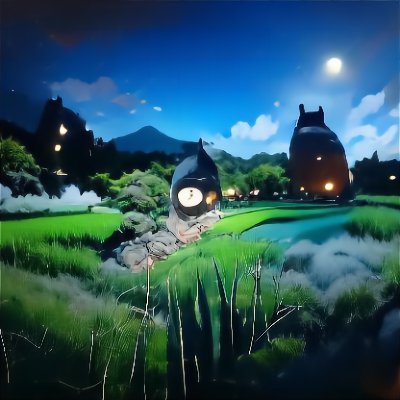
StyleDrop: Text-to-Image Generation in Any Style introduce StyleDrop, a method that enables the synthesis of images that faithfully follow a specific style using a text-to-image model. The proposed method is extremely versatile and captures nuances and details of a user-provided style, such as color schemes, shading, design patterns, and...

56,408 Aufrufe • vor 3 Jahren •via X (Twitter)

5 Kommentare

Profilbild von AP
APvor 3 Jahren

Imagen about to be OP. Great work @natanielruizg !

Profilbild von 8pm
8pmvor 3 Jahren

CSS generation would save a lot of time.

Profilbild von CubanHodLer🇨🇺
CubanHodLer🇨🇺vor 3 Jahren

Why are you sharing only HG hosted papers and not Arxiv anymore? 🤔

Profilbild von 𝘓𝘶𝘪𝘴 𝘎𝘰𝘮𝘦𝘻-𝘎𝘶𝘻𝘮𝘢𝘯
𝘓𝘶𝘪𝘴 𝘎𝘰𝘮𝘦𝘻-𝘎𝘶𝘻𝘮𝘢𝘯vor 3 Jahren

So is StableDifusion dead? Is this new method the new path to go?

Profilbild von Mitchell Stooksbury
Mitchell Stooksburyvor 3 Jahren

Now I'm curious why we don't have style transfer for images that's this good yet.

Ähnliche Videos

We've officially released and open-sourced HunyuanImage 2.1, our latest text-to-image model. The new model delivers on our commitment to balancing performance and quality. With native 2K image generation, HunyuanImage 2.1 is an advanced open-source text-to-image model.🎨 ✨ New in 2.1: 🔹Advanced Semantics: Supports ultra-long and complex prompts of up to 1000 tokens, and precisely controls the generation of multiple subjects in a single image. 🔹Precise Chinese and English Text Rendering with seamless image–text integration: The model naturally integrates text into images, making it suitable for a wide range of applications such as product covers, illustrations, and poster design to meet the needs of various fields. 🔹Rich Styles and High Aesthetic: Capable of generating images in various styles—including photorealistic portraits, comics, and vinyl figures—it delivers outstanding visual appeal and artistic quality. 🔹High-Quality Generation: Efficiently produces ultra-high-definition (2K) images in the same time other models take to generate a 1K image. HunyuanImage 2.1 uses two text encoders: a multimodal large language model (MLLM) to improve the model's image and text alignment capabilities, and a multi-language character-aware encoder to improve text rendering capabilities. The model is a single- and double-stream diffusion transformer with 17B parameters. We've also open-sourced the weights of the the accelerated version with meanflow which reduces inference steps from 100 to just 8, and PromptEnhancer, the first industrial-grade rewriting model that enhances your prompts for more nuanced and expressive image generation. Now, creators turn complex ideas—like posters with slogans or multi-panel comics—into visuals faster than ever. We’re just getting started. Stay tuned for our native multimodal image generation model coming soon. 🌐Website: 🔗Github: 🤗Hugging Face: ✨Hugging Face Demo:

Tencent Hy

89,430 Aufrufe • vor 1 Jahr

One-2-3-45: Any Single Image to 3D Mesh in 45 Seconds without Per-Shape Optimization paper page: Single image 3D reconstruction is an important but challenging task that requires extensive knowledge of our natural world. Many existing methods solve this problem by optimizing a neural radiance field under the guidance of 2D diffusion models but suffer from lengthy optimization time, 3D inconsistency results, and poor geometry. In this work, we propose a novel method that takes a single image of any object as input and generates a full 360-degree 3D textured mesh in a single feed-forward pass. Given a single image, we first use a view-conditioned 2D diffusion model, Zero123, to generate multi-view images for the input view, and then aim to lift them up to 3D space. Since traditional reconstruction methods struggle with inconsistent multi-view predictions, we build our 3D reconstruction module upon an SDF-based generalizable neural surface reconstruction method and propose several critical training strategies to enable the reconstruction of 360-degree meshes. Without costly optimizations, our method reconstructs 3D shapes in significantly less time than existing methods. Moreover, our method favors better geometry, generates more 3D consistent results, and adheres more closely to the input image. We evaluate our approach on both synthetic data and in-the-wild images and demonstrate its superiority in terms of both mesh quality and runtime. In addition, our approach can seamlessly support the text-to-3D task by integrating with off-the-shelf text-to-image diffusion models.

AK

179,061 Aufrufe • vor 3 Jahren

MagicScroll: Nontypical Aspect-Ratio Image Generation for Visual Storytelling via Multi-Layered Semantic-Aware Denoising paper page: Visual storytelling often uses nontypical aspect-ratio images like scroll paintings, comic strips, and panoramas to create an expressive and compelling narrative. While generative AI has achieved great success and shown the potential to reshape the creative industry, it remains a challenge to generate coherent and engaging content with arbitrary size and controllable style, concept, and layout, all of which are essential for visual storytelling. To overcome the shortcomings of previous methods including repetitive content, style inconsistency, and lack of controllability, we propose MagicScroll, a multi-layered, progressive diffusion-based image generation framework with a novel semantic-aware denoising process. The model enables fine-grained control over the generated image on object, scene, and background levels with text, image, and layout conditions. We also establish the first benchmark for nontypical aspect-ratio image generation for visual storytelling including mediums like paintings, comics, and cinematic panoramas, with customized metrics for systematic evaluation. Through comparative and ablation studies, MagicScroll showcases promising results in aligning with the narrative text, improving visual coherence, and engaging the audience. We plan to release the code and benchmark in the hope of a better collaboration between AI researchers and creative practitioners involving visual storytelling.

AK

22,379 Aufrufe • vor 2 Jahren

Google presents Still-Moving Customized Video Generation without Customized Video Data Customizing text-to-image (T2I) models has seen tremendous progress recently, particularly in areas such as personalization, stylization, and conditional generation. However, expanding this progress to video generation is still in its infancy, primarily due to the lack of customized video data. In this work, we introduce Still-Moving, a novel generic framework for customizing a text-to-video (T2V) model, without requiring any customized video data. The framework applies to the prominent T2V design where the video model is built over a text-to-image (T2I) model (e.g., via inflation). We assume access to a customized version of the T2I model, trained only on still image data (e.g., using DreamBooth or StyleDrop). Naively plugging in the weights of the customized T2I model into the T2V model often leads to significant artifacts or insufficient adherence to the customization data. To overcome this issue, we train lightweight Spatial Adapters that adjust the features produced by the injected T2I layers. Importantly, our adapters are trained on "frozen videos" (i.e., repeated images), constructed from image samples generated by the customized T2I model. This training is facilitated by a novel Motion Adapter module, which allows us to train on such static videos while preserving the motion prior of the video model. At test time, we remove the Motion Adapter modules and leave in only the trained Spatial Adapters. This restores the motion prior of the T2V model while adhering to the spatial prior of the customized T2I model. We demonstrate the effectiveness of our approach on diverse tasks including personalized, stylized, and conditional generation. In all evaluated scenarios, our method seamlessly integrates the spatial prior of the customized T2I model with a motion prior supplied by the T2V model.

AK

40,492 Aufrufe • vor 2 Jahren