Video yükleniyor...

Video Yüklenemedi

Ana Sayfaya Dön

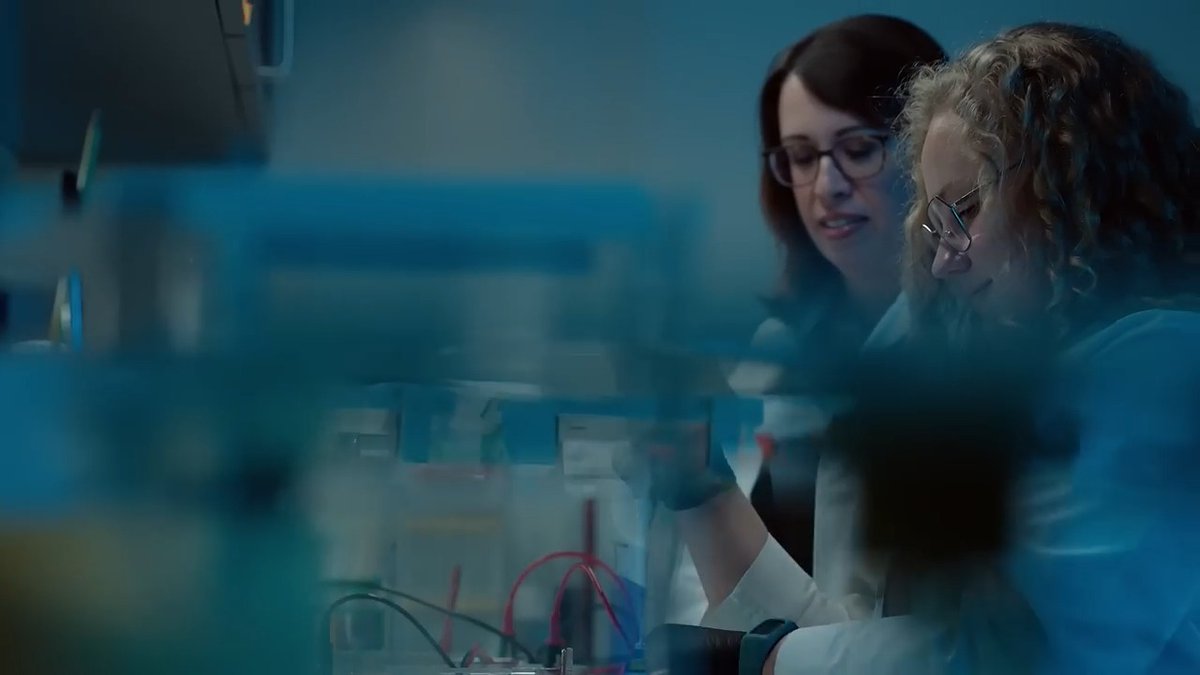
🧬 Take a look inside a 3D tissue bioprinting lab! NIH postdoctoral fellow Dr. Cristina Antich Acedo demonstrates how cutting-edge bioprinting can recreate human tissue structure. By combining different cell types and biomaterials, researchers can mimic real biological environments with precision. 🔬 This technology helps accelerate the path from...

14,495 görüntüleme • 3 ay önce •via X (Twitter)

0 Yorum

Yorum bulunmuyor

Orijinal gönderinin yorumları burada görünecek

Benzer Videolar

NEW episode! Drug development has never been more expensive, in terms of output per dollar spent. This trend, called Eroom’s law, is surprising, considering the incredible technological advances in drug discovery, from genome sequencing to engineering to microscopy. On a new episode of the Works in Progress podcast, Ben Southwood and I talk to Ruxandra Teslo 🧬 about why this has happened and what can be done about it. We discuss how: • AI isn’t a magic bullet for drug discovery. Predictive models lack the physical human data, like individual variation and rare side effects, that can only be generated by actually running real-world clinical trials. • As scientists invent more effective drugs, it becomes harder to discover new treatments that can surpass past successes. This is known as the "Better than the Beatles" problem. • Biotech companies are increasingly moving their "first-in-human" trials to Australia because its simpler regulations allow researchers to test drug safety faster and cheaper than in the US. • Clinical trials can be made more efficient with various reforms including: embracing platform trials, allowing researchers to select from independent ethics boards, expanding the funding and validation of surrogate endpoints, increasing transparency by releasing regulatory correspondence from failed companies, and much more. Timestamps: 00:00:00 Eroom’s law and the paradox of drug development 00:08:03 How clinical trials actually work 00:10:23 The power and controversy of surrogate endpoints 00:14:01 How historical patent laws influenced trial timelines 00:22:46 The Australia advantage and regulatory drag 00:29:08 Institutional review boards (IRBs) and bureaucratic drag 00:32:21 Open science and successful reforms 00:41:49 Our wishlist for clinical trial reforms, and which reforms we *don’t* like 00:53:48 Why AI isn’t a magic bullet for drug discovery

Saloni

109,256 görüntüleme • 4 ay önce

Dr Anthony Fauci authorized over $200 million US taxpayer dollars for transgender animal testing and animal torture “Can you describe what exactly the American people's taxpayer dollars were spent on regarding transgender animal testing?” “Yeah: - In a lot of these cases, they involve mice, rats, monkeys who are being surgically mutilated and subjected to hormone therapies to mimic female to male or male to female gender transitions - Gender affirming hormone therapies, and then looking at the biological, psychological, and physiological effects of the gender transitions - Looking at the effects of taking vaccines after you've transitioned these animals from male to female or female to male - Looking at the size of their genitals changing after you've put them on estrogen or testosterone therapies to transition them - There was a $1.1 million grant to give female lab rats testosterone to mimic transgender male humans and then overdose them with this party drug to see if female animals taking testosterone were more likely to overdose on the sex party drug than animals who are not taking testosterone “Are many of these taxpayer funded animal studies shared with the public or is there a significant oversight of this research?” “You essentially needed a degree in information technology to navigate the federal spending databases to find any of this stuff.” “In our analysis, Dr. Fauci funded about 95% of the change-drender animal experiments” “What we are doing to test human effects is poisoning lab animals - Forcing them to breathe wildfire smoke simulated in a laboratory by burning different types of foliage and pumping into animals cages - Making them obese to simulate what it would be like for obese people to be exposed to wildfire smoke - Shooting off handguns and rifles and forcing animals to breathe the emissions and gun control experiments - and the list goes on and on”

Wall Street Apes

237,297 görüntüleme • 1 yıl önce

How many of you actually know how "what you eat" grows? 🤔 I never learned crop science in school. I learned it by walking around our farm with my father, who showed me different crops and explained how they grow. But not everyone has access to a farm, so I built a 3D Crop Science application in Three.js using Claude Opus 5 to make that learning experience more visual and interactive. It is an exploration of different types of seeds where each seed has three different stages. The first stage shows the whole seed. The second stage is a cross section that shows what is inside the seed and how it grows. The third stage shows the germination phase through a 3D model. There are 24 models in total. The original models were 1,349.6 MB, which Claude optimized down to just 11.6 MB in total. All of the 3D models were generated using Tripo 🔜 gamescom. Claude also created visual information for each seed showing details like seed type, storage tissue and germination phase. Each seed also has a YouTube video that shows how it actually grows in the real world. There is also a section showing where each seed is commonly grown using both a 3D globe and a flat map. You can explore different regions and click on specific areas to see more information about where that seed is grown. The entire experience is fully responsive and also includes quizzes that you can take in both normal and 3D formats. I strongly believe education becomes much more effective when you can see, interact, watch and explore instead of relying only on textbooks. Live: Code:

The Bugged Dev

41,496 görüntüleme • 3 gün önce