正在加载视频...

视频加载失败

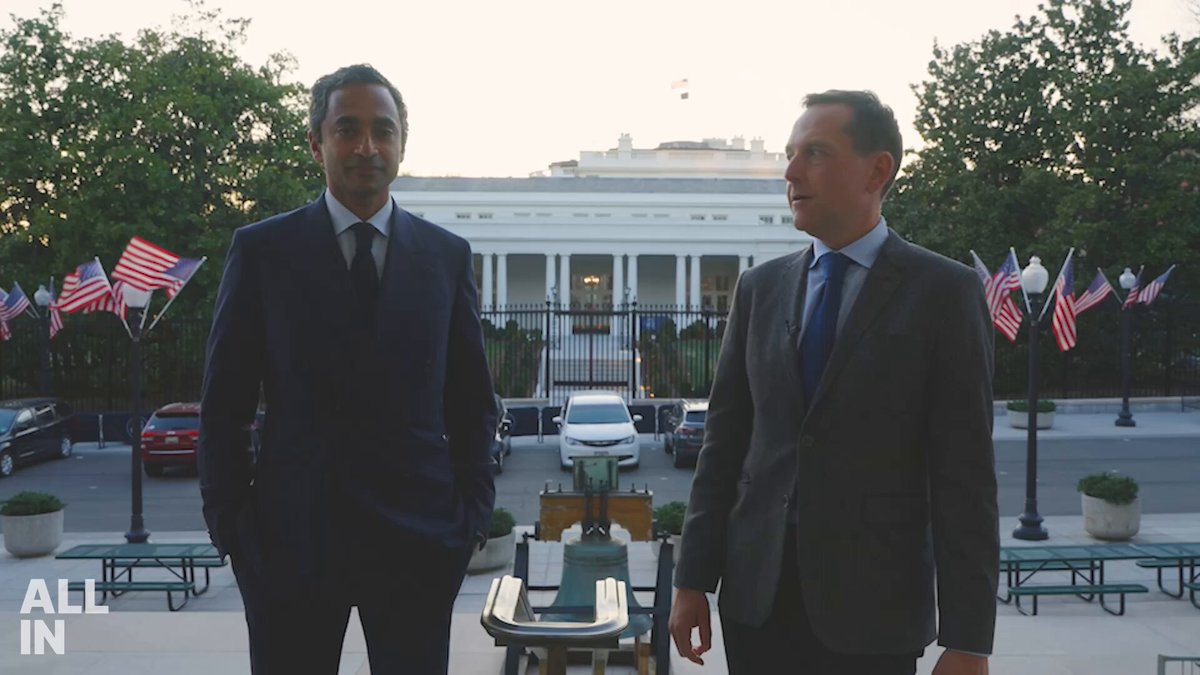
The All-In Interview is BACK! 🚨 Chamath Palihapitiya sits down with Commerce Secretary Howard Lutnick to talk the 2026 agenda -- Biggest outstanding trade deals -- Could we see 5% (or 6%!?) GDP growth this year? -- Fraud crackdown ++ much more! (0:00) Commerce Secretary Howard Lutnick tells a...

501,245 次观看 • 7 个月前 •via X (Twitter)

0 条评论

暂无评论

原始帖子的评论将显示在这里

相关视频

Howard Lutnick has some explaining to do… 🚨 It appears Howard Lutnick’s Family greatly benefited from the SCOTUS Ruling against President Trump Today The Supreme Court just ruled against President Trump’s tariff powers, which we know could trigger refunds of up to $175 billion (or more). Well… Howard Lutnick was the Chairman and CEO of Cantor Fitzgerald, a global financial services firm. Howard Lutnick stepped down from Cantor Fitzgerald when he became President Trump’s Commerce Secretary — then transferred control and ownership of Cantor Fitzgerald (and related entities like BGC Group and Newmark Group) to trusts benefiting his adult children, with his two eldest sons—Brandon Lutnick (Chairman & CEO) and Kyle Lutnick (Executive Vice Chairman)—taking primary leadership and control. In mid-2025, Cantor Fitzgerald marketed and reportedly executed deals to purchase importers' rights to potential FUTURE TARIFF REFUNDS at steep discounts of 20-30 cents on the dollar— essentially betting on a court ruling that the tariffs would be deemed illegal and refunds issued. With the SCOTUS decision now ruling against President Trump — any such acquired refund claims held by Cantor Fitzgerald stand to pay out at full value (100 cents on the dollar, minus what they paid upfront), delivering MILLIONS of dollars in profits to the family-controlled firm. To be clear… the SCOTUS’ ruling just means they are leaving mechanics of what gets paid back to the lower courts/Treasury, but the Lutnick Family betted against President Trump… and won. This is extremely concerning to me because Lutnick has publicly expressed strong confidence in a SCOTUS win for the tariffs for months saying he believes SCOTUS will rule in Trump’s favor… meanwhile, his children did the exact opposite and betted against it. This screams ethics violations…

MJTruthUltra

109,059 次观看 • 6 个月前

This week, Colin M. McDonald joins us on The Arena. We discuss the Trump Administration’s fight against fraud, U.S. Department of Justice’s brand-new Fraud Division, and the most shocking fraud schemes DOJ has uncovered. 00:00 - Intro 00:36 - Colin McDonald Joins the Show 00:59 - Who Are You and What Do You Do? 02:22 - Why Public Service? 03:25 - Why Be a Prosecutor? 05:50 - What Does a Prosecutor Actually Do? 09:21 - No Prosecution Without Law Enforcement 11:08 - Relentless: Cases That Last Years 12:02 - Turning to Fraud Enforcement 13:06 - Why No One Tackled Fraud Before 13:41 - The Old Binary Choice: Violent Crime vs. Fraud 15:21 - Tallying the True Cost of Fraud 17:10 - Wasteful Spending vs. Outright Theft 19:17 - The Goal Is Deterrence 21:25 - Building Roots, Not a Potted Plant 23:18 - No Fraud Too Big, No Fraud Too Small 25:28 - Fraud Wounds the Soul, Not Just the Wallet 27:36 - Quarterbacking the Fight 28:26 - One Front Door to DOJ 29:38 - A 500-Person Division in Two Weeks 31:13 - A Career Home for Young Lawyers 33:26 - The Ripple Effects of Unchecked Crime 34:24 - Changing the Incentive Structure 35:23 - Which Statutes Do You Enforce? 36:05 - Healthcare Fraud: The Biggest Target 37:00 - The Student Athlete Who Died 38:03 - The Skin Graft Scheme 39:28 - Fraud Robs Dignity, Too 40:49 - Benefit Programs and the Public Trust Section 42:06 - Global Trade and Commerce Enforcement 43:43 - The Many Inspectors General Offices 45:05 - The Most Shocking Cases 45:56 - “Everybody’s Doing This” 46:48 - The Home Care Scam 48:25 - Billing Medicaid From Egypt and Prison 50:22 - Minnesota’s Looted Housing Program 51:27 - Clearing the Decks for the Truly Needy 52:44 - DOJ Is Here to Help 54:14 - Outro

The Arena America First Legal

446,467 次观看 • 13 天前

Season 1, Episode 6: THE ONE WHERE HOWARD LUTNICK GETS IN BED WITH TETHER AND SCORES A MASSIVE PAYDAY On May 17, 2024, Giancarlo Devasini, reportedly owner of the majority of Tether’s voting stock, told an associate that he had given Howard Lutnick a large number of shares “bloody cheap”. Devasini’s admission followed Lutnick’s January 2024 Bloomberg appearance in Davos when, unprompted by the interviewer, Lutnick launched into a long monologue in which he passionately vouched for Tether. In his confirmation hearing on Jan. 29, 2025, Lutnick, now the United States Commerce Secretary, admitted that Devasini sold his firm @CantorFitzgerald a 5% economic interest in Tether in early 2024 for $600 million, implying a $12 billion valuation. Fast forward to today, as Tether is currently marketing a private fundraising round of $20 billion on a $500 billion pre-money valuation, which would balloon the Lutnick/Cantor stake by ~42x, to around $25 billion. The fundraising is reportedly being led directly by “the Chairman’s office” at Cantor, according to a source. While Cantor is not publicly listed, LLMs estimate the bank’s enterprise value in the $8-10 billion range, a figure now dwarfed by the imputed value of its Tether stake. On June 8, 2024, Devasini said of Lutnick: “Howard is a caricature of himself. He’s a shark. He’ll take a piece of flesh if he has a chance. So the game is always to align his interest.” The big question, then, which perhaps The Wall Street Journal Bloomberg Financial Times The New York Times may be interested to dig into: Who does Howard Lutnick, the current Commerce Secretary of the United States, really work for? And for Donald J. Trump: When push comes to shove, is Howard Lutnick going to have your back, or will he do the bidding of the guys who are making him rich beyond anything you could ever do for him? Note: The Senate Committee responsible for oversight is Banking, Housing, and Urban Affairs, led by Tim Scott Senator Tim Scott and Elizabeth Warren Elizabeth Warren. The House Committee is Financial Services, led by French Hill French Hill and Maxine Waters Maxine Waters.

Cory 🦢 Real Bitcoin @ Swan.com

251,707 次观看 • 9 个月前

Had so much fun chatting with Greg Kaplan (Greg Kaplan) and Michael Brennan of e61 Institute about Australia's stagnant productivity growth and how to fix it. The 2010s saw Australia's weakest productivity growth in 60 years. It was in many ways a lost decade. And it's dragging on—unlike the US, we haven't bounced out of covid with strong productivity growth. We discuss the extent to which this is being (i) caused by frontier-wide factors; (ii) caused by Australia-specific factors; and (iii) simply an artefact of how productivity is measured. We also go into a bunch of specific ideas, like: - why it could be better to densify Canberra than Sydney/Melbourne; - what should Albo do if he was bullish on AI; and - what we can learn from the stunning innovativeness of Australia's agricultural sector. And we discuss deeper questions around the role of government—as it's not really clear what levers the government currently has over productivity (at least for its *growth rate*). Links below. Enjoy! Timestamps: (0:00:00) - Introduction. (0:01:47) - Why has construction productivity stagnated—in Australia and the West? (0:08:38) - Can housing supply meaningfully grow just by improving construction productivity (without planning reform)? (0:12:50) - If construction and regulatory bottlenecks ease, what becomes the new supply constraint? (0:21:49) - Would densifying Sydney/Melbourne deliver big productivity gains—or should smaller cities scale? (0:29:48) - The most important limitations of GDP as a metric. (0:34:29) - Growth accounting in ~8 minutes: capital, labour, TFP. (0:43:04) - Is there a single “north-star” metric for policymakers? (0:47:12) - Should policymakers care more about TFP or labour productivity? (0:52:11) - Why revenue per worker is an imperfect proxy for firm-level productivity. (0:56:00) - Do these measurement critiques change what policy should do now? (0:58:25) - Stylised facts about the Australian economy. (1:04:01) - Status update on the health of the Australian economy. (1:06:43) - What would it take for Australia to be the richest country again? (1:11:23) - What growth rates are realistically achievable for Australia? (1:15:24) - How much GDP do we forgo over 10 years if weak productivity persists? (1:16:23) - Services, Baumol’s cost disease, and measurement. (1:29:18) - Lowest-hanging fruit for quality/productivity gains in services. (1:35:29) - Australia-specific vs frontier-wide causes of the slowdown. (1:39:51) - Best/worst Australian industries for TFP (i.e. “MFP”) growth over recent decades. (1:53:18) - Why has TFP slowed across almost every industry? (The chart behind the slowdown.) (1:59:41) - What is Australia’s “single most productive” company? (2:01:43) - Which industries have the biggest gaps between frontier and laggard firms? (2:07:53) - Is the median US firm more productive than its Australian counterpart, or is the US average skewed by superstars? (2:10:10) - What would Australian management look like if we converged on US practices? (2:13:15) - Why has the US—almost alone among rich countries—had strong recent productivity growth? (2:15:11) - How much of the US–Australia TFP gap is “culture”? (2:21:21) - Minimum reforms needed to restore 1–2% annual labour-productivity growth? (2:24:38) - Beyond Sydney/Melbourne: building (or scaling) new cities. (2:28:59) - If you were Anthony Albanese and bullish on AI, what would you do? (2:31:21) - How important is the CSIRO to Australia’s TFP? (2:33:02) - Three sensible reforms: tax; carbon pricing; road-user charging. (2:40:46) - Are the 1980s microeconomic reforms overrated? (2:44:33) - What levers reach the productivity growth rate—or is lifting levels the only game? (2:49:54) - Are we too concerned about the reform era ending? (2:56:12) - Most non-obvious lessons from the reform era.

Joseph Noel Walker

128,950 次观看 • 1 年前

February 2025: - Five million dollars. For five million dollars, it can be yours. This is the very first copy. Do you know what it is? - A gold card? - Yes, a gold one. The 'Trump Gold Card'. - Who's the first buyer? - Me. - And the second? - I don't know. I was the first. They'll go on sale in two weeks, even sooner. Cool, right? April 2026: - You'll never guess how many 'gold cards' the Trump administration sold. Remember that bullshit? The Trump Gold Card? He had a genius idea about how to pay off our national debt back then. Offer the world's richest people to move to the US for just five million dollars. The White House turned it into a spectacle, even giving rapper Nicki Minaj an 'honorary' card. And soon, Commerce Secretary Howard Lutnick revealed on a podcast how many of these cards he'd already managed to sell. March 2025: - By the way, I've already sold a thousand of them. There are 37 million people worldwide who can afford it. - Holy shit! 37 million! And how many do you expect to sell? - The president thinks we'll easily sell a million. April 2026: - I sold a thousand in just one day. Multiply that by the number of days that have passed since then. That's trillions of dollars in revenue! With all this money from foreign rich people, we could've paid off all our debts instantly! The problem is, we've only managed to find out how many of these cards were actually sold. How many do you think? How many gold cards has the White House 'delivered' to happy consumers? Just one. That same Lutnick who bragged about a thousand cards sold in one day has now admitted that this card has only gone to one single person so far. And not for five million, but for just one. Of course, Lutnick added that there are thousands of people in line. But so far, it all looks like an ABSOLUTE FRAUD. Far from the first one perpetrated by Donald Trump. And definitely not the last one.

Sprinter Press Agency

35,229 次观看 • 4 个月前