Video wird geladen...

Video konnte nicht geladen werden

Zur Startseite

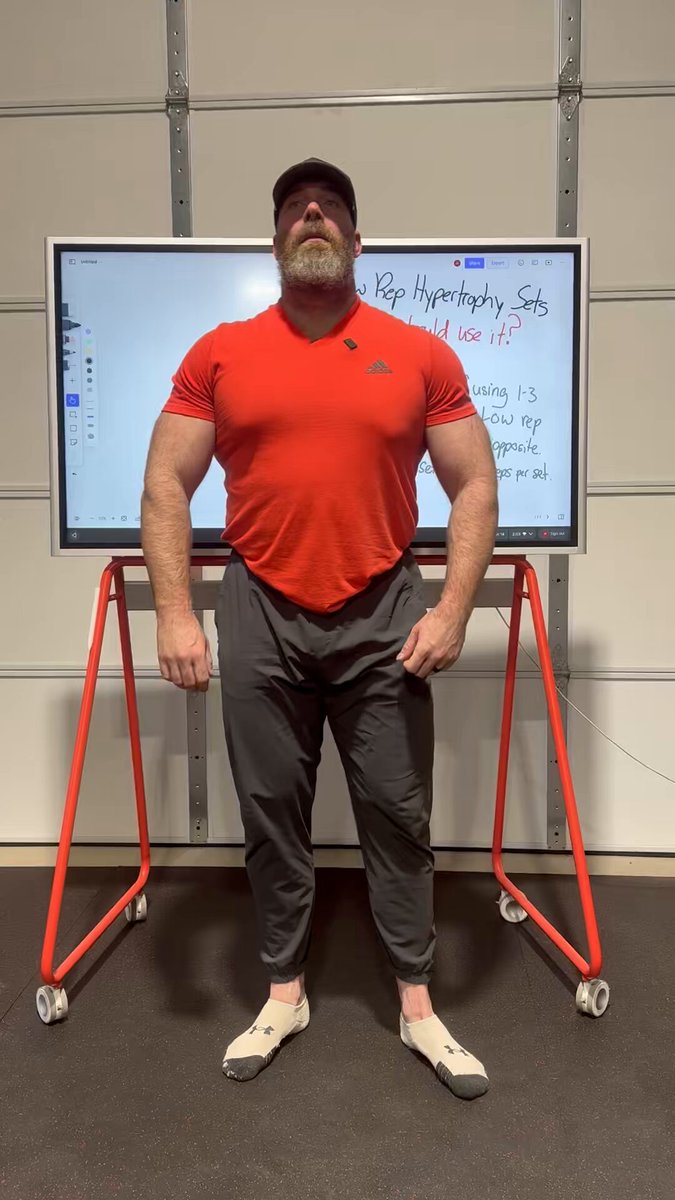
The grease the groove approach for increasing strength. Note this is not focused on hypertrophy. For hypertrophy you do want to go to failure sometimes (or more), and emphasize time under tension.

380,213 Aufrufe • vor 1 Jahr •via X (Twitter)

10 Kommentare

Profilbild von Midland Landman
Midland Landmanvor 1 Jahr

I keep seeing clips of this and get more confused. @hubermanlab we need another simple breakdown from you on this episode with some example protocols.

Profilbild von Martin Sætre
Martin Sætrevor 1 Jahr

I told my kids about this and now my 9 year old says “I’m just gonna grease the groove” every time he passes the piano and he does a quick minute of practice. Already seen improvements!

Profilbild von user
uservor 1 Jahr

Could you do this with multiple different movements so long as they don’t overlap in muscle groups? I.e squat and bench press, follow this for every 10 mins that way you build strength in more than 1 movement?

Profilbild von Chase DiPersia
Chase DiPersiavor 1 Jahr

I do this with writing music and it works well. Never thought to try it with weights. I definitely will.

Profilbild von emily miller
emily millervor 1 Jahr

I’ve listened to this whole pod. Would you consider doing an essentials on fitness/exercise/training? I’m still working on adding jumps and sprint from the Stacy Sims podcast. Now the Kettlebell Mile and next Grease the Groove. [brain explodes]

Profilbild von Daniel Aros
Daniel Arosvor 1 Jahr

"Grease the Groove" is a great approach for increasing strength. Reminds me of recovery runs between intense workout sessions.

Profilbild von Sami Osman
Sami Osmanvor 1 Jahr

Wonderful ✨️

Profilbild von Chuck Jewell
Chuck Jewellvor 1 Jahr

AKA farmer strength.

Profilbild von BogdanCobra🥷
BogdanCobra🥷vor 1 Jahr

👀👀

Profilbild von Eugen Borcea
Eugen Borceavor 1 Jahr

Interesting

Ähnliche Videos

Do you need to train heavy to build muscle? 💪 For years the mantra was you need to go heavy to build muscle. Or you needed to go heavy to stimulate large type II fast twitch fibers but go light for more reps to stimulate smaller type I fibers. But new research has challenged that dogma. Several meta-analysis have shown similar muscle growth with low loads vs high loads when set number is matched & proximity to failure is similar (PMIDs: 28834797, 35015560, 33312275, & 33433148). While muscle hypertrophy was not different between high and low load training, strength increased significantly more with high load training in all these meta-analysis As far as targeting fiber types, it becomes kind of irrelevant when you take an exercise close to failure because fiber types tend to be recruited in order from smallest to largest. So with high load training, small & large fibers get recruited quickly but you don’t do many reps. With low load training, you initially recruit smaller fibers but as the muscle fatigues it is forced to recruit the larger fibers as the exercise is taken close to failure. The net effect is that taking sets close to failure with high or low loads produces a lot of muscle activation and similar hypetrophy The take home is, do what you enjoy if muscle growth is the goal. Just make sure you train HARD & go close to failure (within a few reps) & do enough total sets. But if strength is a priority you’ll need to train heavy & be careful going to failure as it can impair strength gains From my first conversation with Andrew D. Huberman, Ph.D.

Layne Norton, PhD

53,312 Aufrufe • vor 2 Jahren