Загрузка видео...

Не удалось загрузить видео

На главную

The infamous hyperspeed bug in Peter Jackson's King Kong is now fixed! The game tracks time with CPU cycles, but casts the frequency to a 32 bit value. On modern high-clock CPUs that overflows, so the engine thinks your CPU is way slower than it actually is. It then...

72,290 просмотров • 4 месяцев назад •via X (Twitter)

Комментарии: 0

Нет доступных комментариев

Здесь появятся комментарии из оригинального поста

Похожие видео

Microsoft sold every spare CPU it had to Anthropic and OpenAI. Amazon tripled its CPU buys year over year and still can't keep up. Two of AWS's biggest customers asked Andy Jassy if they could buy the entire 2026 production run of Graviton chips. He said no. The ratio inside an AI datacenter used to be 100 megawatts of GPUs to 1 megawatt of CPUs. CPUs handled storage, checkpointing, pre-processing. Light work. GPUs did the actual training and inference. Then OpenAI shipped o1-preview in September 2024. RL post-training went from "check the model output with a regex" to "run classifiers" to "compile the code and run the unit tests" to "spin up a sandbox, call three databases, run a physics simulation, verify the answer." Every rollout now needs a CPU-backed environment to verify against. Codex 5.4 runs agentically for 6-7 hours at a time. Each database call, each cron job, each scraped URL is CPU work. Coding agent revenue went from a couple billion to north of $10B in six months. That compute is sitting on CPUs. The CPU to GPU ratio is now approaching 1:1. The entire global cloud was built for 1:8. That's why GitHub has been unstable for weeks. Nvidia and Arm both announced they're entering the server CPU market in March. TSMC will only meet 80% of server CPU wafer demand this year. High-end server CPU prices are already up 50%. When the GPU king and the IP licensor both pivot to CPUs in the same month, the boring chip isn't boring anymore.

Aakash Gupta

290,767 просмотров • 3 месяцев назад

*** SEGA GENESIS/MEGADRIVE - SCALING PART 2 *** Whats better on a Friday than seeing some scaling effects on the Megadrive ? .. nothing, so read on ... In the previous part we were software scaling in either axis by a given factor, but I couldn't change the scale factor per scanline on the same frame, so I couldn't skew the base image for tilting into screen eg Mode 7 type effects. - One issue was it was scaling column by column which got wrecked for performance trying per scanline adjustments. So I converted to a row scaler rather than column, this allowed expansions and contractions on a per scanline basis. - Speed up the code significantly , now running a sprite load + music + scaling on cpu with ~50% cpu free. Relied heavily on Python scripts I wrote to generate the 68k assembly for this as it was mind numbing labourious. In doing so I got the scripts competing with each other to come up with the fastest method for each scale , I'm starting to like python ;-) - Tried all sorts to speed up the horizontal interupt - handles vertical scaling, exotic methods eg unsafe interupts / racing the beam & updating the vertical scroll every X cpu cycles, in the end the Z80 cpu (audio) stealing the 68k cpu bus intermittendly just killed these ideas as it would only be 95% stable, ended up just doing smarter interupts that saved a lot of cpu instead. - The good and the bad, spent too long on this is the bad, the good is we will need it in Lufthoheit in a few places to make up for that !! Carsten666 CYBERDEOUS - Crouzet Laurent #SGDK #SegaMegadrive #SegaGenesis

Shannon Birt

11,070 просмотров • 1 год назад

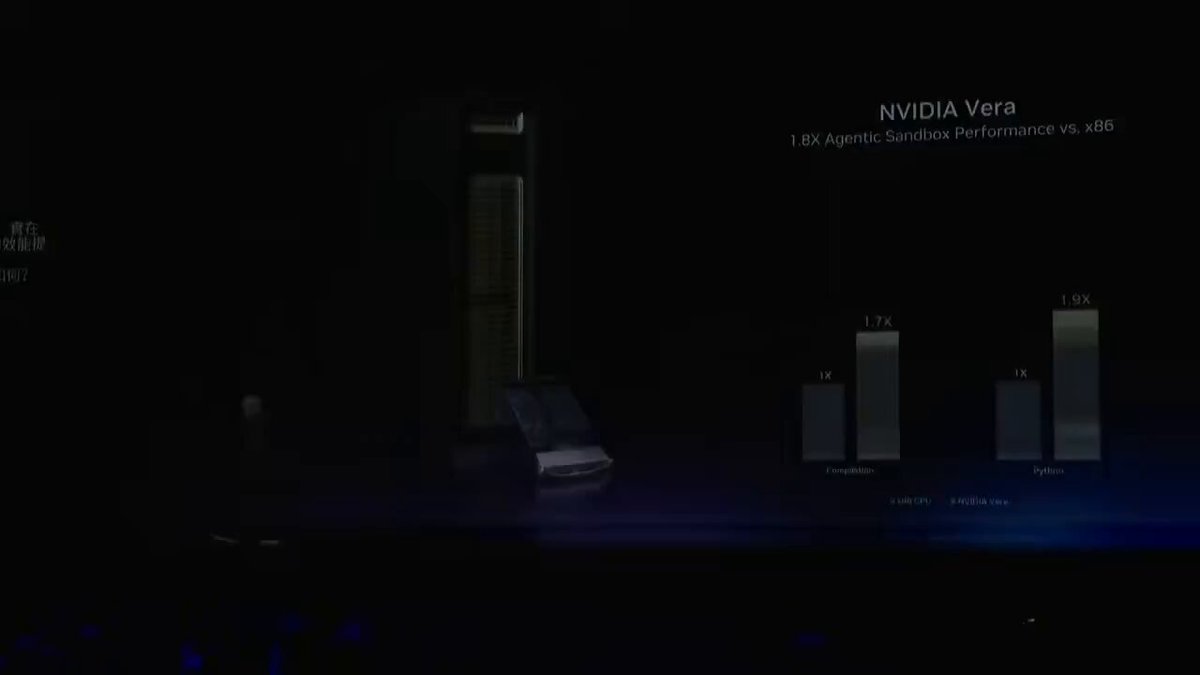
Jensen Huang just identified the next $200 billion market (Save this). The shift starts with a observation about agentic AI that changes everything about infrastructure. In the era of training and inference, the GPU was everything while CPU was a traffic cop, scheduling work, managing memory, dispatching tasks while the GPU did the heavy lifting. Agentic AI breaks that model entirely. An AI agent does not just run a single inference pass but rather it plans, calls tools, executes code in sandboxes, retrieves data from multiple sources and loops through complex multi-step reasoning sequences often thousands of times per second at scale. Every one of those operations runs through the CPU and the GPU sits idle waiting for the CPU to prepare the next task, supply the right context and execute the retrieval and tool calling logic fast enough to keep the accelerators fed. The CPU is now the conductor and the GPU is the orchestra and the bottleneck is the conductor falling behind. This is showing up in production AI factory utilization right now, which is exactly why Jensen built Vera from scratch rather than licensing x86. Vera achieves 40% lower peak memory latency than x86, 50% faster core to core communication, and 1.8 times the agentic sandbox performance of current x86 processors on a purpose-built architecture designed around the agentic loop. Now here is where the investment thesis gets interesting. The obvious beneficiary is Nvidia itself, and that thesis is real. Nvidia's CFO has guided for nearly $20 billion in Vera CPU revenue this fiscal year alone, a market Nvidia had zero presence in just three years ago. Intel held 60% of server CPU market share as recently as Q4 2025 and that transition is now happening at a pace Intel structurally cannot respond to. But the deeper question is, what architecture is Vera actually built on? Vera's Olympus cores are ARM compatible and every single Vera CPU deployed in every Vera Rubin rack in every data center in the world runs on ARM architecture. And ARM Holdings collects a royalty on every one of them. ARM does not make chips but rather licenses the instruction set architecture and CPU core designs that others build on top of. Every time Nvidia ships a Vera CPU, every time a hyperscaler deploys a Vera Rubin rack, every time an enterprise qualifies Vera for their AI factory, ARM earns a royalty. The secular tailwind here is almost perfectly constructed for ARM's business model. Amazon's Graviton, Microsoft's Cobalt, Google's Axion, Apple's silicon stack, and Qualcomm's data center push all run on ARM. And now Nvidia's Vera, which is projected to displace Intel as the largest server CPU supplier by revenue in a single fiscal year, is ARM. ARM's royalty rate on high end server chips is estimated at roughly 1 to 2% of chip selling price. At $5,000 per Vera CPU and 4 million units projected for FY2027, that is a royalty line growing from near zero to potentially $400 million to $800 million annually from Nvidia's data center CPU business alone before counting Amazon, Microsoft, Google, Apple, and Qualcomm. The total ARM addressable royalty base across all the silicon it already licenses is compounding at a rate that the current $130 billion market cap does not fully reflect. Jensen's CPU thesis is the most underappreciated catalyst in ARM's fundamental story, and the royalty compounding has barely started. Come join Milk Road Pro and get our full ARM royalty model and our entire AI trade thesis. Link below!

Milk Road AI

11,819 просмотров • 2 месяцев назад

Why the character movement in my custom game engine felt janky and how I fixed it. In a game engine, most often, a character moves using the physics engine. Meaning, the player is not just a coordinate in space but a physical body. It has velocity, it handles collisions, and it interacts with the world. Now, as you might know, physics engines need stability. If you run them at variable framerates, things start breaking. Objects phase through walls or fly off into space because the math becomes unpredictable. This is why most game engines lock their physics loop to a 60Hz fixed rate. But here’s the problem: If you have a high-end system, you don't want to limit it at 60 FPS. That's a waste of good hardware. Now, that said, if the GPU is rendering at 144 FPS but the player's position (physics driven) only updates 60 times a second, it creates a micro-stutter that ruins the "smooth" feel of the game. A good way to fix this is to treat the character as two separate things: 1. The Physics Body (Invisible part): This is the "real" character. It lives in the 60Hz physics world, it moves the player and handles collisions. 2. The Visual Model and Camera (Visible part): This is what the player actually sees. It doesn't care about collisions, its only job is to look nice and smooth at whatever framerate the GPU is pushing. Once you have this separation, you can use interpolation to keep them in sync. Every time the physics clock ticks, you save the previous position of the invisible body before moving it to the new one. Between those ticks, calculate how far we are between the last physics update and the next one. By using this to drive the visible parts of the game, the stutters disappear. The physics loop stays fixed behind the scenes, while the visuals slide smoothly between the snapshots. Example: - Right after a tick: blend_weight= 0.0 (The visual model stays at the old physics position). - Halfway to the next: blend_weight= 0.5 (The visual model slides to the middle point). - Just before the next: blend_weight= 0.9 (The visual model is almost at the new physics position). Pro-Tip A critical mistake I made initially, and one many devs make, is parenting the camera and visible parts directly to the player body. If you do this, the camera inherits the discrete 60Hz physics movement by default. In that setup, interpolation won't work because the camera is "stuck" to the physics clock. For this fix to work you must decouple the camera and visuals from the body and move them separately. Player movement processing in Detis Engine: - fixed_process: Physics runs at 60Hz. Handles collisions and raw movement. - process: Variable rate. Mainly used for player input caching in the player case. - late_process: Variable rate. Handles interpolated camera movement after physics and everything else is done being processed. - render. Submits the final interpolated transforms to the GPU. The test environment in the video is running on an old 2070-based laptop. Hopefully the video compression won't introduce any stutter... I’m sharing this in hopes it helps a fellow dev. Cheers.

Ioannis Koukourakis

48,636 просмотров • 7 месяцев назад

** MEGA Parodius Scaling Effects Part 1 ** One of the big challenges with the Parodius Megadrive port is Stage 8's boss - The puffer-fish *Pooyan* with his full screen scaling effect. The goal is to be very close to the arcade (with extras on top ) so I thought lets tackle it head on to see how close we can get. I was also keen to jump into another scaling code rabit hole haha. Pyron pulled out all the stops and got me the source frames and reworked the BG tiles for this test - a big thankyou to him , Vector Orbitex is busy working on Stage 2 tracks so the team is working hard all round on this port. The MD has no sprite / background GFX scaling hardware , however the VDPs Vertical scroll can be updated per scanline to help vertical scaling on backgrounds, but there is a cpu cost to manage all the interupts so thats not free either. With the Horizontal scaling there is no help at all , apart from a semi-friendly packed pixel format for the cpu to work with, its not quite chunky format but better than planar format still for scaling. So its falls back to the 68k CPU to do all of the horizontal expansion which is the largest cpu cost. Basically drawing strips of either 1x, 2x, 3x or 4x wide columns at speed. So we are one week into this Boss's routine and you can see from the below video the horizontal scaling is implented ( vertical will be in the next update ) . We are scaling from 1x to 4x in the video below in 74 steps for testing . The column distributions are always a bit painfull to do - thankfully they are all worked out now. This is the third scaler I have built and the goal was with this one to make it really flexible for use in other projects also, sometimes when you optimise something to the last degree all the flexibility gets taken out of it. Currenty scaling at 12-25 FPS update here, I had some rules against some optimisations which I would use and some I wouldn't , thankfully we are a bit ahead of the Arcades animation frame rate here still and I may yet find optimisations that fit within the scope. We have vertical scaling and sprite spikes to add yet so Im hoping i can find a few more optimisations to offset things when they are implemented also. In a scale frame update we are processing close to 42000 pixels in ram before using DMA to send to VRAM . Using a 41x16 (656 tile scale buffer) - single buffered for now due to its size in VRAM. So thats nearly 21k in tiles ! I had to re-organise ram a bit to support a buffer of that size for the stage. The scaling function is written in 68k assembly , with a little C code handling the Vertical interupt code ( so the game logic can actually run & DMA updates etc ) . The DMA routines are in assembly also and customised for large chunk size ( big blocks of tiles ) which suits the scaler. I had some race conditions to sort out where the cpu was faster than DMA (sending tiles from RAM to VRAM ) and in some cases where it wasn't so it had to be balanced. We may be able to add more detail into the top and bottom of the background yet but its low priority for now until all the other bits are in !! #SGDK #SegaMegadrive #Genesis #Parodius

Shannon Birt

25,545 просмотров • 6 месяцев назад