Загрузка видео...

Не удалось загрузить видео

На главную

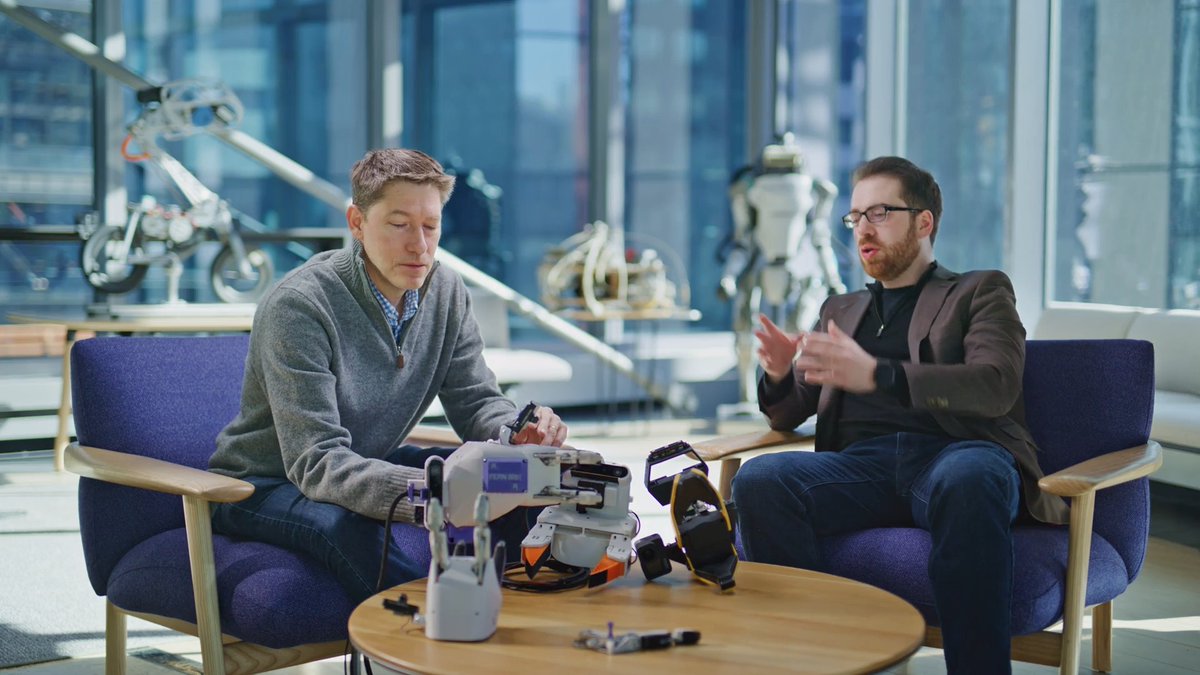
The Koala gripper is a co-designed system that pairs a handheld data collection device and a robotic gripper, allowing a single operator to easily record task demonstrations. Engineered with three controllable degrees of freedom and force-optimized triggers, the device enables complex, human-like object interactions. Training on a dataset of...

18,978 просмотров • 1 месяц назад •via X (Twitter)

Комментарии: 2

Фото профиля Clara Lafever Jane
Clara Lafever Jane1 месяц назад

No more demos please Let's do more deployments This shit is getting old 😒

Фото профиля Soph w
Soph w1 месяц назад

Facts!

Похожие видео

A gripper with two thumbs! 🐨 Handheld data collection is how a lot of manipulation datasets get built now. Someone picks up a gripper-shaped device, does the task by hand, and the recording becomes training data. Voila! 🤌🏼 The catch is that these devices are usually shaped to match whatever robot gripper already exists. The human ends up working around the robot's morphology, which costs both ergonomics and the quality of the demonstration being recorded. The RAI Institute team designed The Koala Gripper. It includes two devices with full parity: a capture device a person holds, and a robotic device that executes the learned policy. Anything you can do with one, the other reproduces. The shared feature set gets updated as the design iterates, so neither side quietly compromises the other. The morphology is where it gets interesting. Two independently controlled underactuated fingers are opposed by a single pivoting "dual thumb", which is where the koala name comes from. → Each finger is a 9-bar linkage with one actuated and one underactuated degree of freedom, with the spring sitting proximal to the phalanges to drive preshaping → Fingernails on the distal link for precise pinches, contoured pads for secure wrap grasps → The handheld trigger traces a natural fingertip arc instead of a straight line, lengthening the stroke and giving the operator better mechanical advantage → On the robot side, a frameless motor with an integrated high-pitch ballscrew keeps reflected inertia low, so the fingers stay backdrivable at an effective mass of tens of grams The dual thumb is what buys tool stabilising, singulating one object out of a pile, and tabletop pinches. Congrats to Zubin Kremer Guha and the RAI Institute team behind it 👏🏼 🔗 Project page: ~~ ♻️ Join the weekly robotics newsletter, and never miss any news →

Lukas Ziegler

19,233 просмотров • 1 месяц назад

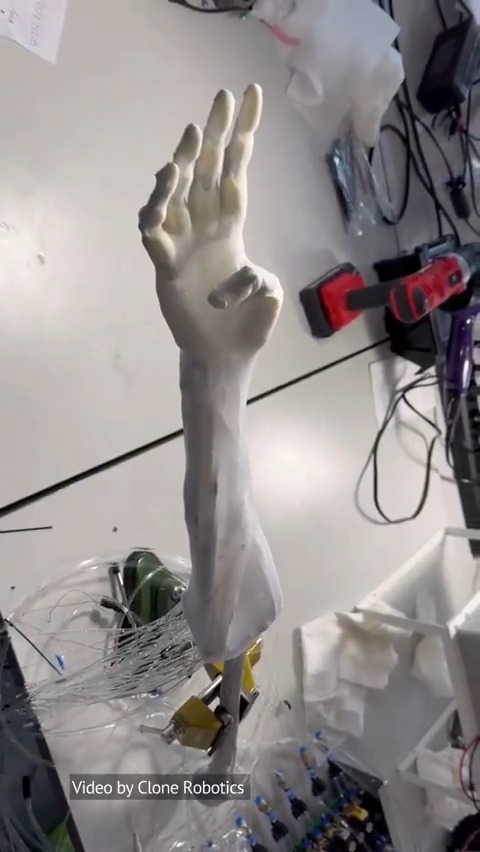
🎙️ Excited to introduce one of my favorite projects from the past year: TeleDexter, from the BIGAI dexterity team. It’s a stable, human-level dexterous teleoperation system and a suite of autonomous policies trained with it. Pen spinning, complex in-hand reorientation, and long-horizon tool use—once seen as the holy grail of manipulation—are now unlocked. 🧵👇 The hardware is already here; we have some incredible high-DoF robotic hands. The bottleneck? The controller. Most current systems are stuck in "quasi-static" grasping mode. Meanwhile, dynamic in-hand dexterity has remained severely limited. 🧠 To unlock the massive capabilities of human-like hands, we need to build an excellent "cerebellum" for dexterous hands. TeleDexter solves this with a novel co-tracking approach: it simultaneously tracks both human hand kinematics and object states, beautifully bridging the gap between human intent and robotic control. In order to train a better co-tracking policy that works robustly in the real world, we designed : (1) a hybrid reward design that combines consecutive goal reaching and dense tracking, (2) an action masking strategy during training that enhances sim2real performance, (3) a dexterous curriculum for learning the long-horizon interactions. Each design is inspired by numerous trials and countless real-world experiments. We’ve synthesized all the system details, engineering challenges, and core insights into our latest post. If you're interested in the future of dexterous manipulation, grab a coffee and check it out (9-min read): If you have more time, check out the paper:

Siyuan Huang

12,772 просмотров • 2 месяцев назад