Loading video...

Video Failed to Load

Go Home

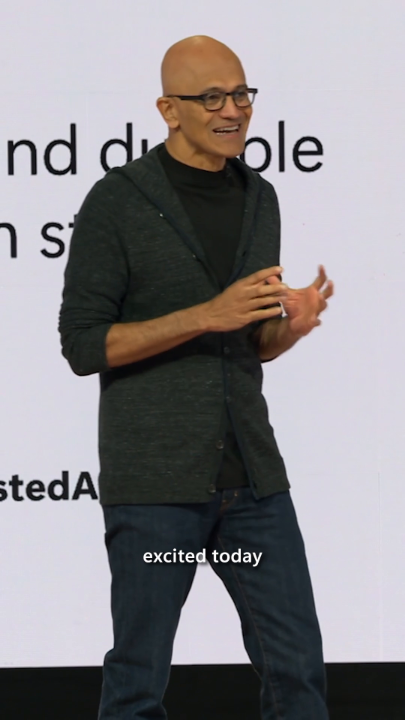
The new Azure Cobalt 200 VMs were announced at #MicrosoftBuild, introducing a next generation ARM based CPU built for cloud native and agent workloads and expected over 50% better performance and meaningful gains in speed, latency, and throughput.

27,067 views • 2 months ago •via X (Twitter)

0 Comments

No comments available

Comments from the original post will appear here

Related Videos

$AMD $MSFT Partnership is MASSIVE in 2026 🚀 If you were excited about my thread on $AMD $AMZN AWS long time partnership, you will be even more excited about what Microsoft gonna do with 2026 AMD EPYC "Venice". Historical Context: The relationship between AMD and Microsoft began in the early 2000s, with Microsoft initially focusing on Intel's x86 architecture for its Windows operating system and server products. However, AMD's entry into the server market with its Opteron processors in 2003 marked the beginning of a competitive dynamic that eventually led to collaboration. The partnership intensified with the launch of 3rd Generation EPYC "Milan" in 2021, powering Azure's N2D and C2D VM families. By 2025, Microsoft had integrated 5th Generation EPYC "Turin" into new compute-optimized instances, reflecting a strategic shift towards AMD for cost and performance benefits. This "Secret Weapon" breakthrough will mark another inflection point for AMD Microsoft Azure relationship, will probably be more aggressive than EPYC "Milan" moment in 2021. We can call it EPYC "Venice" moment 2026" 1. Technical performance of AMD EPYC "Venice" (2026) AMD's 6th Gen EPYC "Venice" processors, slated for 2026, introduce New Chiplet design breakthrough. a revolutionary chiplet interconnect fabric that redefines server scalability for AI. This isn't just faster silicon; it's a paradigm shift for Microsoft Azure , enabling hyper-efficient, rack-scale AI inference that slashes costs and latency while boosting throughput. ~Up to 256 Zen 6 cores, a 70% performance increase over "Turin," optimized for AI and HPC. ~Memory and Bandwidth: 1.6 TB/s per socket, doubling "Turin's" capability, with support for MR-DIMM/MCR-DIMM. ~Efficiency: 1,500-1,700W power draw, a 50% reduction, aligning with Microsoft's sustainability initiatives. ~Interconnect: PCIe 6.0 and a new chiplet fabric for rack-scale AI, reducing latency and enhancing scalability. 2. Why $MSFT will adopt $AMD YPYC Share to 50%+ in 2026. AMD EPYC Share: ~30-35% of Azure's x86 CPU-based business while Intel Xeon share is 65% Microsoft's Azure has been progressively integrating AMD EPYC, with "Venice" expected to expand this footprint: A. Dominance of AI Inference Workloads ~AI inference constitutes 80% of AI workloads in cloud environments, with latency-sensitive applications like chatbots, recommendation engines, and fraud detection requiring sub-second response times. ~"Venice's" 35x inference performance uplift directly addresses these requirements, outperforming Intel's offerings and custom Arm solutions in multi-threaded scenarios. B. Cost Efficiency and Operational Savings ~Azure's 2025 capex of $118B is under pressure to deliver returns. "Venice" can reduce operational expenses by $20-30B annually due to its power efficiency and performance gains, improving Azure's margins to 35-40%. ~The cost per inference operation is significantly lower with "Venice," estimated at 24-31% less than Intel-based alternatives, enhancing Azure's competitiveness against AWS and GCP. C. Scalability for Enterprise AI: ~"Venice" supports rack-scale AI deployments, enabling Azure to scale AI services for enterprise customers. For example, a 1,000-node cluster can process 700,000+ tokens per second, crucial for large-scale AI applications like personalized marketing and predictive analytics. ~This scalability is particularly important as Azure aims to capture the $100B+ AI opportunity by 2026, as stated by Microsoft CEO Satya Nadella. D. Reduction of Nvidia Dependency ~While Nvidia ( $NVDA) dominates AI accelerators, AMD's integrated EPYC-GPU solutions (MI450 with "Venice") offer a balanced approach, reducing Azure's reliance on Nvidia's high-cost GPUs. ~"Venice" enables hybrid inference models, where CPU-based inference handles 80% of workloads, and GPU acceleration is reserved for training and complex tasks, optimizing resource allocation. 3. Financial Implication: ~Revenue from Azure could reach $15-18B annually by 2026, part of a total revenue projection of $70-100B ~Profit margins could improve to 55-60%, boosting net income to $20-25B, supported by scale economies and reduced production costs. Intel could respond by giving more aggressive discounts, but this breakthrough has been a decade long of $AMD R&D, or rethinking chiplet design, a complete new approach. "Venice's" lead in AI inference and efficiency is challenging to match. Broader Industry: Other hyperscalers ( Amazon Web Services , GCP) and enterprises will follow Azure's lead, standardizing EPYC technology and pressuring Intel further. This could lead to a broader industry shift towards AMD, enhancing its ecosystem and bargaining power. Conclusion: The strategic adoption of AMD's 6th Generation EPYC "Venice" processors by Microsoft Azure in 2026 marks a pivotal moment in the evolution of cloud computing, particularly for AI inference capabilities. "Venice's" groundbreaking chiplet design, offering a 35x performance uplift for AI inference tasks, a 50% reduction in power consumption, and unparalleled scalability, positions Azure to leapfrog its competitors in the race for AI dominance. This technical superiority, combined with significant cost savings potentially $20-30B annually in operational expenses; aligns perfectly with Microsoft's ambitions to capture the $100B+ Revenue AI opportunity by 2026. The shift to 50% x86 market share for AMD within Azure is not merely a technical transition but a strategic realignment that redefines the competitive landscape. Historically, Microsoft's partnership with AMD has evolved from niche deployments to a core component of Azure's infrastructure, and "Venice" accelerates this trend. The 30-35% AMD EPYC share in 2025 is expected to double, driven by new VM families like C4D and H4D, which will dominate AI-intensive and HPC workloads. This migration is incentivized by "Venice's" efficiency gains, reducing dependency on Intel and Nvidia, and enhancing Azure's sustainability profile. Not Financial Advice!

Mike

141,018 views • 9 months ago