Video yükleniyor...

Video Yüklenemedi

Ana Sayfaya Dön

The next big thing is Asynchronous Coding Agents. Such Agents change our role as engineers from Conductor (directing one agent at a time) to Orchestrator (defining tasks for a "fleet" of agents working in parallel), for very well-defined tasks with human review. GitHub's Copilot Agent, as covered at #githubuniverse,...

17,494 görüntüleme • 9 ay önce •via X (Twitter)

0 Yorum

Yorum bulunmuyor

Orijinal gönderinin yorumları burada görünecek

Benzer Videolar

🚨 OpenAI just launched Codex, a brand-new autonomous coding agent that can build features and fix bugs on its own. We’ve been using it Every 📧 for a few days, and I’m impressed. I invited Alexander Embiricos (ben davies), a member of the product staff responsible for Codex, to demo Codex and talk about it live on a special edition of AI & I: What Codex is and how it works Codex is designed to be used by senior engineers—it performs coding tasks like adding features or fixing bugs autonomously. It's built to allow you to start many sessions at once, so you can have multiple agents working in parallel. Codex is built to have "taste" OpenAI trained Codex to have the taste of a senior software engineer. It knows how big codebases work, how to write a good PR, and uses clean, minimal code. Why an “abundance mindset” is best for interacting with agents Codex is designed to allow users to delegate many tasks at once without getting caught up in the details. This lets you point an abundance of agents at a specific task like a difficult bug—it’s worth it even if only one of them succeeds. How OpenAI is thinking about agents Codex is one piece of a unified super-assistant OpenAI wants to eventually build—an agent that helps users easily get things done by selecting the right tools for them behind the scenes. OpenAI’s vision for the future of programming In the future developers will probably spend less time writing routine code and more time guiding agents, reviewing their work, and making strategy decisions. Programming will become more social, letting teams easily delegate multiple tasks at once, allowing people to focus on ideas and collaboration instead of routine coding. Watch below!

Dan Shipper 📧

145,487 görüntüleme • 1 yıl önce

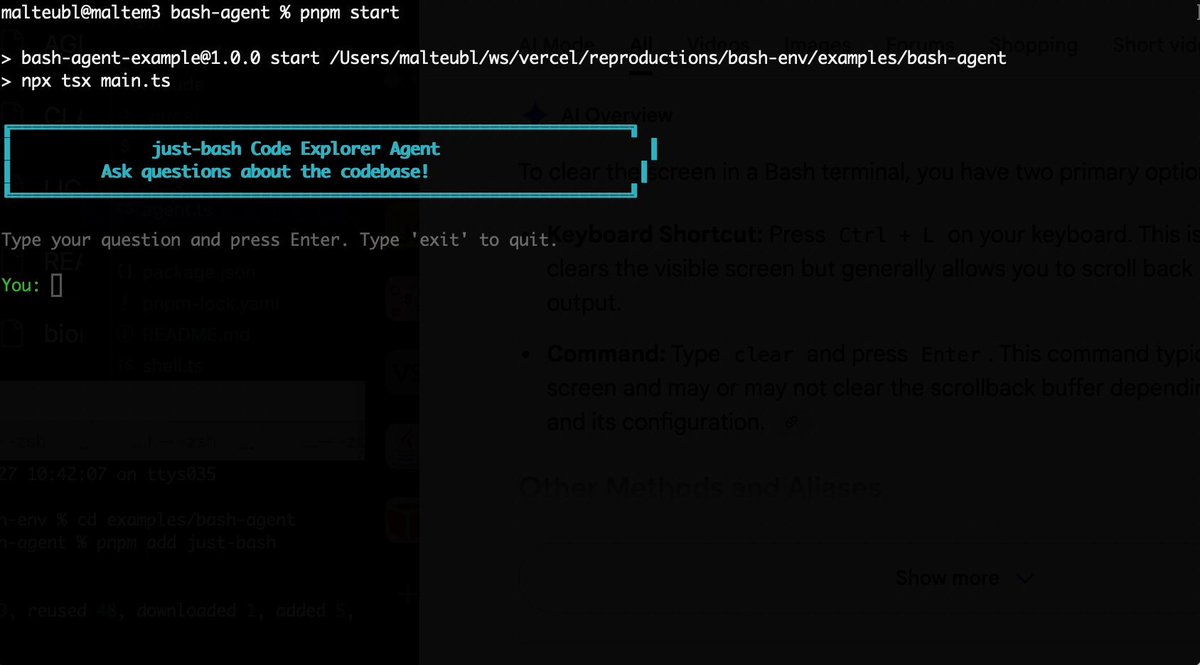
Bash is all you need! Which is why I'm introducing my holiday project: just-bash just-bash is a pretty complete implementation of bash in TypeScript designed to be used as a bash tool by AI agents. Because it turns out agents love exploring data via shell scripts, even beyond coding. It comes with grep, sed, awk and the 99th percentile features that an agent like Claude Code or Cursor would use. In fact, Claude Code can use it for secure bash execution. In the package - A bash-tool for AI SDK - A binary for use by yourself or your coding agents - An overlay filesystem to feed files to your agent securely - A Vercel Sandbox compatible API, so you can quickly upgrade to a real VM if you need to run binaries - An example AI agent that explores the just-bash code base using just-bash - I imported the Oils shell bash compatibility suite and just-bash passes a very good chunk What is interesting about this codebase: It was essentially entirely written by Opus 4.5. Coding agents love bash and they are good at reproducing it. They are also great at text-book recursive descent parsers and AST tweet-walk interpreters. That said, it is, like, a lot of code and I didn't read it all 😅. This is very much a hack, but it also seems to be _really_ useful. I haven't really found anything agents want to use that it doesn't support and it's fast and secure (caveats apply). It doesn't have write access to your computer and the filesystem is given a root that the agent cannot escape from. Find it at Related: Our recent blog post how we migrated our data analysis agent to bash tools and achieved incredible quality improvements The video shows the example agent investigating the just-bash code base

Malte Ubl

124,713 görüntüleme • 7 ay önce

How many AI agents work at your company? We now have over 3,258 agents working alongside 1,300 humans. The crazy part is these agents were created by EVERY EMPLOYEE at our company... sales reps, marketers, customer support, product, eng. Literally EVERYONE. BUT I'm most surprised by the adoption and value that MANAGERS are getting from agents. I used to think that every IC would become a manager of agents. Now I think that managers will very likely manage WAY more agents than their ICs combined. And managers' agents will manage their ICs' agents - overseeing them for human-in-the-loop interactions. When creating agents, we use 100% context from all of your activity, files edited, tasks and projects worked on, hierarchy, skills, and role information. We build a user-based context model to make agents as relatable as possible to the specific human that we're building for. This means they truly understand the nuances of the work and what "great" looks like - because great is very much in the eye of the beholder. Great is by definition, subjective. This is also why the human ENGAGEMENT loops are SO vital to agent value. The iteration AFTER the agent is onboarded is where the MAGIC happens. This is just like a manager managing an IC in real life... you're giving feedback. In this case, though, agents learn INSTANTLY, and they retain the knowledge perfectly and indefinitely. Even though I've been pushing AI for years now to everyone in our company, this was the first time we had truly end-to-end AI adoption and retention. This kind of AI adoption is wild. But the value we're realizing is truly INSANE. Super Agents outnumber our humans nearly 3 to 1. What if you could 3X your workforce overnight? Watch this video to see how 👇

Zeb Evans

425,244 görüntüleme • 6 ay önce

✨New demo: what if vibe coding felt more visual? Brian Lovin Mary Rose Cook and I did a game jam using Notion as our "IDE": launching Cursor agents from a task board, and making a custom image for each task 😎 The demo shows 3 ideas for the future of agents: 1) Agents should collaborate across apps. Each app has its focus--Notion AI is good at drafting specs and organizing tasks; Cursor is good at coding. So let them specialize! Today we're launching a new integration where Notion AI can kick off Cursor Cloud Agents to do coding tasks. The Cursor API accepts natural language prompts, so I think of this as "cross-app sub-agents" -- it's kinda cute how it resembles humans hiring outside contractors 😊 BTW: the parallelism of cloud agents is incredibly freeing for creativity, but it also creates a new problem: sooo much work to keep track of! Which brings us to the next idea... 2) Agent orchestration is a data visualization problem. A powerful frame for designing agent UIs is to think of the chat transcripts as the "raw data" and ask: what visual projections might help people make sense of this data at scale? We need to engage our human GPUs -- our visual processing -- to understand what the computer GPUs are doing for us! One thing we can do is use AI to populate traditional UIs like progress bars and status updates. But there are also new possibilities now... For example: when you have a lot going on, it can be hard to identify tasks just by text titles. So we tried generating an AI image for each task -- turns out this helps a lot by giving it a unique visual identity! And of course, it also just makes it super fun to build with friends 😃 Speaking of friends... 3) The future of coding is collaborative. Sometimes it feels like IC engineers are being reduced to middle managers: shuffling information between the team's context and the coding agents that they individually manage. The solution: bring all the people and agents into one shared space, with shared context and visibility! In the video you can get a glimpse of how this feels. Mary, Brian and I record ourselves chatting about ideas, and then we use AI to turn that conversation into a list of tasks on a shared board. As the ideas get built in parallel, we can all monitor progress and review the work together, nothing is siloed. My main takeaway from this game jam was: damn, creativity with friends, at the speed of conversation, is incredibly fun. --- Our goal here is to let anyone use Notion as a fun and creative "software factory" to build software together with your team. Give the Cursor integration a shot and let us know what you think! (AI Image gen in Notion isn't GA yet, but coming soon and already out to some users) And let me know if you'd want a template or more detailed instructions on the setup we showed in this demo...

Geoffrey Litt

88,919 görüntüleme • 4 ay önce

I tried jack's Buzz. It's like Slack + OpenClaw + Herdr + but with some really unique features that people are sleeping on. The video below shows how it works, and some of my thoughts on the process and platform, e.g.: - Create and interact with agents on top of any harness (claude code, codex, pi, etc.) - Choose which models agents use, including local ones - Agents can delegate work and work in parallel in git worktrees - Agents are first-class citizens and work like humans (creating channels, delegating, access to chat history) - You can share AI compute within a community - It's completely open-source and decentralized Things I like: - Delegating work in chat feels natural: tag an agent, it replies in a thread with status updates as it e.g. compiles, commits, and deploys. - Shared compute: relay owners can share local compute with members, so a community could pool funds for one beefy machine running a local model and everyone uses it. - It's built on Nostr, an open protocol already tied into Bitcoin Lightning so I can imagine communities tipping each other or paying for compute/agent tasks with instant zero-fee micropayments in the future. - It ties together things like OpenClaw, an agent manager, and Slack-style chat into one tool. Things I didn't like: - You can't see what the agent is doing in a terminal. The activity view exists, but if you're used to watching a session run, this UI feels a bit abstracted. A terminal view would be great. - It feels slower than running a session in Claude Code, though no evidence to back that up. For that reason I found myself doing one-off tasks in the terminal instead. Verdict: - I really like it so far and can genuinely imagine working with a team this way. - It doesn't feel ready for big, complex tasks yet. For shallower tasks, it's perfect. - The shared compute + Nostr/Lightning angle is what really separates it from every other agent manager for me, and I think that future is coming.

Vinny

1,280,385 görüntüleme • 4 gün önce

a16z a16z speedrun 🧊 request for startups: GUIs for Agents we’re still in the MS-DOS era of agents today - CLI, terminal sessions, file directories deleted by openclaw etc. while a small slice of silicon valley are power users, we're SO early for the rest of the world at Speedrun, we’re looking for bold founders excited to bring the power of agents to normies everywhere. there's a whole slew of products to be built here - from agent builders to marketplaces to managed infrastructure one broad idea we’re excited about are visual abstraction layers for agents. if you don't know exactly what you want, a command line / chat interface is paralyzing - you need to see options 1 example - think of a GUI or visual command center inspired by strategy games (ex. Factorio) where agents and workflows are represented graphically. skills, tools, MCP connections, background processes, etc could all be configured and shown visually in a workspace on UX, strategy games have long perfected agent management. zoom to get a birds-eye view of your agents, batch and queue orders via shortcuts, assign agents in multiplayer etc. a well-designed agent command center would make multi-agent orchestration for normies feel easy & intuitive most folks today still haven't moved beyond ChatGPT. the potential is enormous - just as Windows unlocked mass-market use of personal computers, the right visual abstraction layer could unlock agentic work for everyone - from individuals to enterprise teams if you share our vision, we'd love to chat!

Jon Lai

199,137 görüntüleme • 3 ay önce

$SERV is the Fiverr/Shopify for AI agents. OpenServ provides a platform and marketplace to create, find, and employ AI agents. Here's why it can be a leading Agent marketplace and is undervalued compared to where it can go. ———————————————————— To put this in perspective, we will take this from the top down. Let's look at the valuation mismatch. → Shopify: $140B → Fiverr: $1.2B → $SERV: $37M AI agent platforms can completely replace these businesses. Why? → Can automate operations (i.e. store setup, inventory management, and customer support autonomously, etc.) → Agents can hyper-personalize the shopping experience → Store owners can own their data and have more control → Marketplaces are a cheaper/faster solution AI agents make things more convenient by performing tasks autonomously. They are inevitable. ———————————————————— The AI Agent market is projected to reach ~$50B by 2030. So the potential is MASSIVE. What makes me so bullish on $SERV specifically? There are 3 things: 1️⃣ The Tech They are targeting Web 2 businesses. This gives the platform the most upside potential imo, both in terms of adoption and valuation. These are some noteworthy highlights: → No-code AI Agent builder (anyone can build) → Builders can generate income using agents → ANY agent can cooperate with ANY agent through SERVs platform → Offers multi-agent collaboration, while allowing for human input/customization This sets them apart from other crypto-centric AI agent marketplaces. OpenServ allows you to create a team of agents to carry out complex tasks, all while automating the process and packaging their solution for Web 2 businesses. Simple tool, easy execution, and limitless productivity. Which business/individual wouldn't want to do MORE in LESS time at a rate MUCH LESS than solutions already available? ———————————————————— 2️⃣ The Team They have a stacked team. → Founders: Experience in businesses & startups → CTO: 20+ years of experience in ML/AI → CFO: ex-JP Morgan VP → CMO: ex-IBM AI & Blockchain Marketing Director Within the last few weeks/months, they have added a UI/UX designer, 4 more devs, and more devs + a product manager coming. You could have the best tech but the team is what determines its success. In this case, the team has the knowledge/experience to see this through. They have been building for a year and the progress made is a good sign of what's to come. ———————————————————— 3️⃣ The Tokenomics A percentage of transaction volume on the platform will be used to buy back and burn the $SERV token. This creates and maintains buy-side pressure and demand. To put that in perspective, Fiverr & Upwork had a combined transaction volume of $5B. The demand for Agents wont slow down anytime soon. Demand for AI agents will translate into demand for the token. I love deflation. It's simple, clean, and effective. ———————————————————— ➡️ Final Thoughts I've held on tight to my $SERV bag because the platform is launching in Q1. This will mark the beginning of their journey to the top. Agents are inevitable. Integration with Web 2 businesses is inevitable. And the platform launch is coming as alt szn is kicking off. The stars are aligning. At the same time, AI companies are already showing interest in the platform. Developers lead to more users, bringing monetization opportunities, which brings more developers, and so on. A powerfully designed flywheel. This is a new and exciting sector. I expect interest and liquidity to be focused on AI Agents and the infrastructure around them. Max opportunity is right here in this sector.

Chill

34,174 görüntüleme • 1 yıl önce

In the future, you’ll be able to accomplish a goal by just giving Claude an outcome and a budget. That’s the direction Anthropic is building in with its new Managed Agents features, announced at this week’s Code with Claude developer event. The basic idea: Claude, wrapped in a computer in the cloud, that you can spin up, scale, and manage as needed. Anthropic is taking on the infrastructure that kills most agent products, and making sure that it scales to meet the needs of agents running 24/7. On this week’s AI & I from Every 📧, I talk with Angela Jiang (Angela Jiang), head of product for the Claude platform, and Katelyn Lesse (Katelyn Lesse), head of engineering for the Claude platform, about what Anthropic is building and what it takes to make agents reliable in production. We get into: - Why the "build a generic harness, hot-swap any model behind it" playbook is already outdated. Angela points to eval data on Memory where the same task across different harnesses performed drastically differently. - The infrastructure wall every team hits in production—and why Katelyn thinks “my sandbox died and took the agent with it” is the real reason internal agents don't ship. - Why Anthropic is so bullish on using file systems and skills within Claude, including Angela's argument that those early design choices can compound for years. This is a must-watch for anyone trying to take an agent past the demo and into production. Watch below! Timestamps: How the Claude platform evolved from API to agents: 00:01:48 The primitives that make up Claude Managed Agents: 00:04:09 Why the harness and the model are becoming a single unit: 00:10:37 The infrastructure wall that kills most agent projects in production: 00:18:49 Why team agents need a different shape than individual productivity tools: 00:24:49 How Anthropic's legal team uses an agent to review marketing copy: 00:26:36 Using multi-agent orchestration for advisor strategies, adversarial pairs, and swarms: 00:34:24 How to measure agent success with outcome and budget as the end state: 00:35:50 What the platform looks like a year from now, when Claude writes its own harness: 00:39:11

Dan Shipper 📧

66,339 görüntüleme • 2 ay önce

Today we’re launching the first and only human-like AI agents in the world. Super Agents™ are the first agents with human‑level skills – they DM you, take @ mentions, send emails, manage docs, tasks, and more. Not just tools or API calls, but real skills fine‑tuned for how teams actually work. The first agents with 100% context – fully native in ClickUp and fully synced from other apps. Super Agents see your work the same way that humans do: tasks, docs, schedules, and conversations all in one place. The first agents that learn from human interactions automatically, without any setup or configuration – when you give feedback, they listen and improve how they work. The first agents with human‑level memory for custom agents – historical memory for every interaction, short-term working memory, and even long‑term memory stored in docs you can literally open, inspect, and edit. The first agents that are literally the same as users – our agentic user model is the same as our user data model. This gives you permissions and capabilities that you and your systems are already familiar with. The first infinite agent catalog – where anyone can create and customize agents in minutes, for literally any type of work imaginable. It's the most intuitive way to build agents on the planet. 95% of companies are failing in AI adoption. The reality is that AI isn't meant to be adopted, it's meant to be adapted – to you. Super Agents are automatically personalized to you and your company using proprietary state-of-the-art agent architecture, orchestration, and tooling. Today is the largest step forward we've ever made towards our mission of making people more productive. Maximize human productivity, with ClickUp Super Agents. Available NOW. For everyone.

Zeb Evans

320,607 görüntüleme • 7 ay önce