Loading video...

Video Failed to Load

Go Home

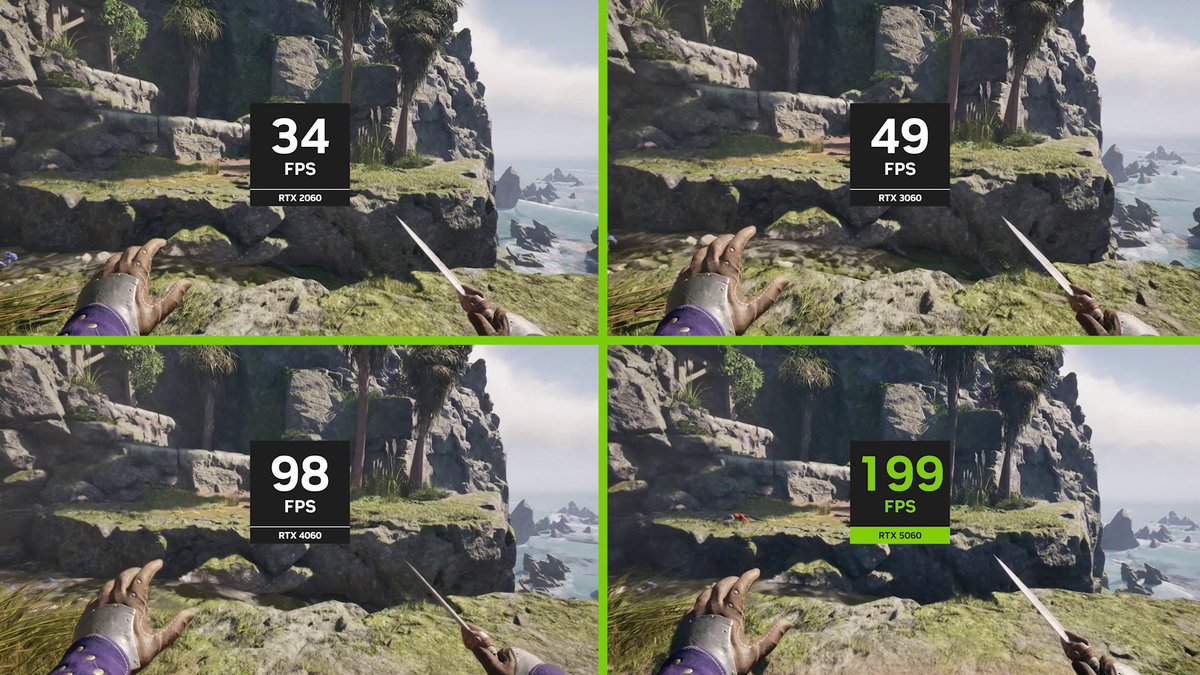
The ultra-efficient NVIDIA Ada Lovelace architecture delivers higher frame rates and lower power draw in immersive games like Warhammer 40,000: Darktide – minions of Chaos beware. #RTX4060

290,004 views • 3 years ago •via X (Twitter)

0 Comments

No comments available

Comments from the original post will appear here
Related Videos

🚨 THE RACE TO 6G JUST ACCELERATED. Northrop Grumman has developed a W-band GaN chip operating at up to 110 GHz and took it from concept to market-ready hardware in less than six months. The new gallium nitride chip operates in the W-band (75–110 GHz), a frequency range that delivers massive bandwidth, extremely high data rates, and much lower latency than current systems. What makes this impressive is the speed: the chip went from concept to market-ready hardware in less than six months through a U.S. government-backed microelectronics program. That’s unusually fast for advanced defense-grade semiconductors. The chip acts as a high-power signal amplifier that can strengthen wireless links while shrinking the size and power consumption of the hardware. It’s designed for military radar, secure satellite communications, and the coming wave of 6G networks. Why this matters: • W-band offers far more spectrum than current 5G bands, enabling much faster data transmission and higher-resolution sensing • Gallium nitride can handle significantly higher power and frequencies than silicon, making it ideal for these demanding applications • The rapid development cycle shows how public-private collaboration can accelerate critical semiconductor technologies • The same tech that strengthens military radar and satellite links will directly feed into future commercial 6G infrastructure The deeper implication: We’re watching the foundation of next-generation wireless and sensing systems being laid in real time. High-frequency GaN chips like this won’t just improve existing radar and satellite systems they’re likely to become core building blocks for 6G, autonomous systems, and advanced defense platforms. The fact that this moved from lab to market in under six months suggests the pace of high-frequency electronics is accelerating dramatically. The future of wireless isn’t just faster. It’s operating at frequencies most people have never heard of and it’s being built right now. How soon do you think W-band and GaN technology will start appearing in everyday 6G devices? Follow for more frontier semiconductors, defense tech, and next-generation wireless systems.

TheNewPhysics

22,647 views • 2 months ago

OF Nick Dumesnil (California Baptist Baseball) is one of the higher upside college bats in this year's Draft. Showed flashes across a limited sample as a Freshman, but exploded last year to the tune of a .362/.440/.702 slash line with 40 XBH (19 HRs) and 45 RBIs across 61 games. Proceeded to have an excellent summer on the Cape in which he hit .311/.378/.489 with a league-leading 12 2B, 4 HR, 15 RBIs and a league-leading 26 SB in 36 games. Strong, athletic frame at 6'2" and 205-pounds. Big league body. Slightly wide base in the box with a somewhat high handset (lowered his hands as the summer went on, was ultra-high at school with his bat pointed almost straight down behind his back shoulder. Drew Burress-ish look). Ultra-small stride that is more of a toe tap than anything else. Hands already start pretty far back, though they drift slightly in his load. Engaged lower-half, especially his back side. Easy plus bat speed. Dumesnil showed the ability to drive the baseball to all fields both at school and on the Cape. Would give his power a 55 overall, but it's a 6 to the pull side. Top spun a 2-run HR (EV of 106) off the scoreboard in the ASG. Very curious to monitor how his hit tool progresses this spring. There's a present feel for the barrel and his bat-to-ball skills are plus (ovr. IZ contact rate of 90%, including 93% and 91% against FB and SL, respectively). Will certainly need to shore up his pitch recognition skills and swing decisions in order to maximize his offensive upside. Some chase up/out against FB, down/out against secondaries. Key will be doing a better job of picking up spin out of the hand. Plus runner—who most importantly knows HOW to run—whose speed translates on both sides of the baseball. Chaos-causer on the bases, Dumesnil's speed also gives him the opportunity to take an extra base on a ball in the gap or down the line. I thought his instincts in CF got better as the summer went on. Dumesnil's speed and elite athleticism allow him to cover plenty of ground and his arm is average, I'm sure he'll get the opportunity to prove he can stick there in pro ball. Chance he could move off and end up at a corner eventually. Key for Dumesnil is adding polish to his hit tool. There is 5-tool upside (key word) with him and he can impact the game in a number of ways. Potential first round pick this July. (📽️: California Baptist Baseball)

Peter Flaherty III

21,730 views • 1 year ago

Observe the subtle differences between a mestiza (left) and a castiza (right). First, note the darker complexion and hair of the mestiza, a result of the darker pigmentation common among Amerindians. You’ll also note a more robust frame. This is an archaic feature due to the presence of higher Neanderthal-like Denisovan admixture present among Siberian and North American peoples. The castiza has longer limbs and is slenderer, with a narrow waist. Her Southern European ancestors descend predominantly from the Neolithic Farmers of Early Europe, who came from the Middle East, where heat dissipation in a hot climate was facilitated by a higher ratio of surface area to body mass. Likewise, being 50% descended from Siberian migrants who experienced a bottleneck 12,000 years ago as they crossed subarctic Beringia and the receding Late Pleistocene glaciers, the mestiza has a larger trunk and stockier limbs to reduce the surface area and heat dissipation, for survival in a cold climate. You can see the larger teeth of the mestiza, another sign of robustness and that her Amerind ancestors ate a harder, less processed diet. The castiza, having a majority of ancestors who lived in European civilization thousands of years more advanced than the Stone Age primitives of the Americas. Psychological differences exist as well. You can see increased impulsivity in the mestiza as she invents new moves and brings herself closer to the camera. She also follows less of a structured dance. This is a result of lesser planning capabilities primarily due to lower IQ, as selection for intelligence was not as intense in North America as it was in Southern Europe. The mestiza is obese, whereas the castiza is merely overweight. A higher proportion of Amerindian genetics is associated with risk for developing metabolic syndrome, obesity, insulin resistance, and diabetes. The genetic factors involved are not clear, but it may be due to a longer history of adaptation to the carbohydrate heavy diet of agriculture. However, maize-based agriculture was widely practiced in the Americas prior to the Columbian event. I hope you have enjoyed this analysis and are able to see these differences in women I post in the future, so that people no longer make inaccurate claims that the women I am posting are not castiza or mestiza.

Mid Castizas

4,001,465 views • 1 year ago

Welcome to CyberNetwork, where the future of gaming meets the power of blockchain technology. CyberNetwork is revolutionising the gaming industry with a decentralised platform that offers unparalleled opportunities for gamers, developers, and investors. By leveraging blockchain technology, we ensure transparency, security, and fairness, transforming traditional gaming models into more immersive and rewarding experiences. CyberNetwork is built on SovereignChain technology from Multiversᕽ, featuring: ⚡️ 100K Transactions Per Second (TPS): Ensuring fast and seamless interactions. ⚡️ 1-Second Block Timing: Providing near-instantaneous transaction confirmations. ⚡️ 2-Second Finality: Guaranteeing rapid settlement and reduced waiting times. This robust infrastructure supports our mission to create a more equitable, transparent, and rewarding gaming ecosystem. Leveraging #MultiversX's Interoperability layer, CyberNetwork is able to seamlessly interact with major blockchains like #Bitcoin, #Ethereum, and #Solana. CyberNetwork Features: 1. Gaming Launchpad 🚀: Empowering game developers to launch and scale their projects. 2. Game Store 🏪: A comprehensive game distribution platform for discovering and purchasing games. 3. Digital Asset Marketplace 🎨: Facilitating the creation, buying, and selling of in-game assets. 4. DEX 💱: Enabling decentralized exchanges of gaming tokens and assets. 5. Gamer's Passport 🎮: A unified identity and achievement system across games. 6. Metaverse Services 🌌: A service for game developers to create high-density virtual worlds. CyberNetwork is set to transform how we experience and engage with games. In the upcoming days, we’ll be unveiling each of these exciting features one by one. Stay tuned for a journey of discovery! For more info: Telegram Discord #Web3Gaming #BlockchainGaming

CyberNetwork

74,814 views • 2 years ago

Ending 2025 Take On The U.S. Economy…And An Apology From The Bottom Of My Heart For My Realistic Yet Pessimistic Takes On The State Of The Economy…. As 2025 ends, the U.S. economy still looks solid at the surface. Stocks are higher. GDP prints are strong. Unemployment remains low by historical standards. But once you step back and connect households, labor, credit, and real world activity, the picture becomes more fragile. This isn’t an economy in freefall. But it is one being carried by a shrinking set of supports while pressure builds underneath. Growth and Markets: Real Numbers, Narrow Support Real GDP grew at a 4.3% annualized pace in Q3, the strongest in two years, driven mainly by consumer spending (+3.5%) and exports (+8.8%). On paper, that looks like acceleration. The issue is what kind of spending is doing the work. Roughly 70% of GDP is consumption, and an increasing share reflects non discretionary or imputed costs, not confidence. Healthcare alone accounts for 17% of PCE, running near $3.6T annualized. That lifts GDP, but it says more about rising mandatory expenses than broad consumer strength. Markets told a different story. The S&P 500 gained 17–19%, the Nasdaq 21%, and the Dow 11%, powered by AI optimism and expectations of easier Fed policy. Asset prices moved ahead. Household reality did not. Labor and Sentiment: Cooling Is Becoming Visible The labor market is no longer tightening. Unemployment rose to 4.6% in November, up from 4.1% in January, with just 64,000 jobs added. Underemployment (U-6) climbed to 8.7%. Layoffs reached 1.17 million through November, up 54% year over year, concentrated in tech, healthcare, and industrials. Consumer sentiment reflects that shift. The University of Michigan index ended December at 52.9, nearly 30% lower YoY, while the Conference Board index fell to 89.1, its fifth straight monthly decline. Household Stress Is Broadening Debt pressure is spreading across categories… • Credit card delinquencies: 12.4%, exceeding 20% in lower income areas • Auto loans: 5.02%, a 15 year high • Student loans: 9.4%, rising sharply after repayment resumed • Mortgages: 3.76%, with FHA near 10.8% Bankruptcies are rising alongside it. Filings are up 8–10% YoY, with 717 large corporate cases, the highest since 2010. Individual filings rose 8%, with roughly 41,000 in November alone. CRE, Trade, and the Physical Economy Commercial real estate remains a pressure point. Office vacancy rates sit near 19%, well above long term norms. Industrial vacancies have edged higher, while retail remains comparatively tight. Trade policy added another layer of strain in 2025. Average tariffs moved above 15%, including 50% on steel and aluminum and 35% on Canadian goods complicating supply chains. Trucking: A Quiet Signal Freight continues to confirm the slowdown in goods demand. Truck tonnage rose just 0.2% in November, but remains down nearly 7% YoY. Spot rates are lower, and load postings are down 15–22%, pointing to soft volumes and ongoing capacity adjustment. Overall The U.S. economy is increasingly unbalanced. Growth is being padded by non discretionary spending, markets are running ahead of household fundamentals, labor is cooling, and credit stress is spreading. This is the late cycle phase where momentum fades quietly, long before the data forces a name onto it.

EndGame Macro

33,011 views • 7 months ago

🚨 A MAJOR BARRIER TO TURNING CO₂ INTO USEFUL FUEL MAY HAVE JUST FALLEN. Scientists have developed a new catalyst that triples methanol production while solving a decades-old chemistry trade-off. For years, researchers trying to turn carbon dioxide into methanol (a valuable fuel and chemical feedstock) have faced an annoying trade-off: at lower temperatures the reaction is more efficient, but CO₂ is hard to activate. Raise the temperature to speed things up, and you get more unwanted carbon monoxide instead of methanol. A team at the Dalian Institute of Chemical Physics has now broken this deadlock. By redesigning the catalyst so that different reaction steps happen on spatially separated active sites, they achieved a space-time yield of 1.2 g of methanol per gram of catalyst per hour roughly three times higher than standard commercial Cu/Zn/Al catalysts. Why this matters: • Methanol from CO₂ is seen as a key route for carbon recycling and producing sustainable fuels and chemicals • The new design dramatically improves both activity and selectivity at the same time • It reduces the formation of carbon monoxide byproduct while keeping hydrogen dissociation efficient • This kind of catalyst improvement is essential if we want CO₂-to-fuel processes to become economically viable at scale The deeper implication: Converting CO₂ into useful products has always been limited by fundamental chemistry trade-offs. By cleverly separating reaction steps across different parts of the catalyst, this work shows we can overcome those limitations without needing extreme conditions or exotic materials. It’s a practical step toward making carbon capture and utilization more efficient turning one of our biggest waste products into something valuable instead of just burying it. We’re getting closer to catalysts that don’t force us to choose between speed and cleanliness. How important do you think breakthroughs like this will be for scaling up carbon-to-fuel technologies in the coming years? Follow for more frontier chemistry, catalysis, and carbon utilization research.

TheNewPhysics

18,681 views • 2 months ago