Loading video...

Video Failed to Load

Go Home

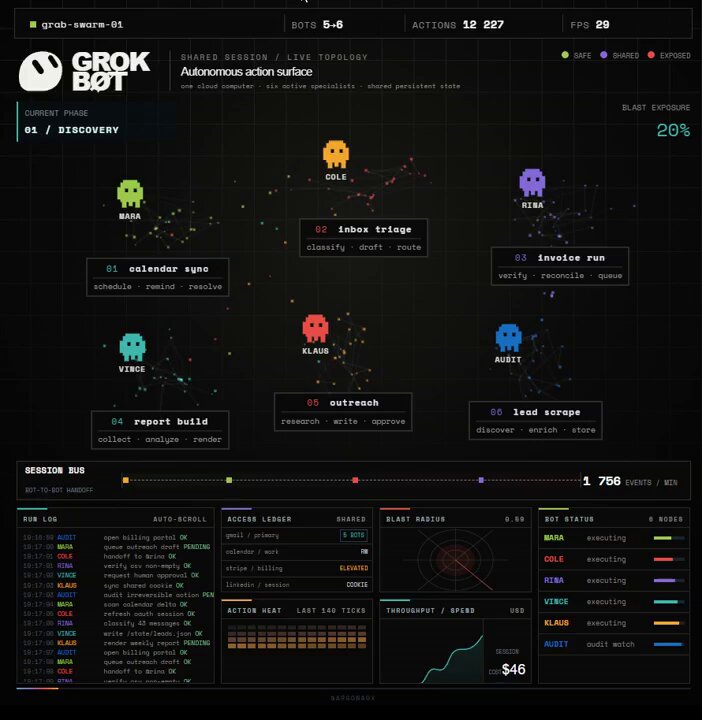
this graph is not just a visualization of five AI bots working at once it is a map of shared context, authority and handoffs grok bot becomes interesting when the agents stop behaving like separate chat windows and start operating as one persistent system a chief of staff can...

15,114 views • 1 month ago •via X (Twitter)

0 Comments

No comments available

Comments from the original post will appear here
Related Videos

everyone is looking at grok bot like it is five new employees the more interesting part is that they are not five isolated employees they share one persistent cloud environment: the same browser sessions, terminal, filesystem and authenticated tools - while a chief of staff can route work between them without waiting for you to open the laptop that turns one login into infrastructure a research bot can collect leads, pass them to a writer, hand the result to a designer and let an ops bot update the workflow all inside the same running machine the upside is obvious: less copying, fewer handoffs and work that continues while you sleep the blast radius is just as obvious: - authenticate only the services the whole agent fleet is allowed to reach - give every bot a narrow role description, because that description becomes its place in the org chart - keep irreversible actions behind human approval: sending, publishing, spending and production changes - store skills, configuration and long-term state inside `/workspace`, because the rest of the VM may disappear during an update - treat shared sessions as shared authority, not as separate bot identities the same architecture that makes grok bot useful is what makes it dangerous to configure casually my take: the breakthrough is not that you can hire five AI workers it is that they can operate like one persistent company inside your real tools and your job changes from prompting every task to designing the permissions, boundaries and handoffs the full chief-of-staff setup, session handoff model, approval matrix and `/workspace` survival strategy are mapped out in the article ↓

monokern

1,023,196 views • 1 month ago

WTF, GROK BOT JUST MADE AI AGENTS AVAILABLE TO LITERALLY ANYONE – CREATING CONTENT HAS NEVER BEEN THIS EASY, EVEN IF YOU'VE NEVER MADE ANYTHING BEFORE Content was never a talent problem. It's a headcount problem. One person doing research, design, copy, analytics, timing and publishing – that's six jobs. The switching between them is what kills consistency, not a lack of ideas. Here's what one of these setups actually looks like. A Chief of Staff sits in the middle and routes every task. Nothing lands on the human. → Researcher tracks what's actually moving and pulls real sources instead of guesswork → Writer turns that research into finished copy, ready to review → Visualiser gets fed a few reference visuals once, then ships everything in that style → Analyst reads the numbers and tells the rest of the team what worked → Scheduler owns timing and holds the queue → Publisher ships it The part that makes it work: every agent on Grok Bot gets its own persistent computer, browser and file system – and they all share memory. So the research is already sitting inside the draft before the draft starts. No copy-pasting between tools. No approving every step. No human in the middle. You can even teach an agent a repetitive task by recording yourself doing it once. Start recording, do the thing, stop. It learns the pattern. And that's the real shift. Nobody needs AI to tell them what to post. They need it to delete the 40 steps between the idea and the post. Everyone has a backlog of things they've meant to make for months. This is what starts clearing it. Full breakdown of the setup in the article below ↓

SCOTTY BEAM

4,827,162 views • 1 month ago

whoever leaked this has bigger balls than sense SpaceXAI shipped five hireable workers for $200 a month, then wrote the catch into its own Grok Bot documentation and left the page up: all five run on one computer, so one sign-in hands the browser session, the files and the command-line credentials to every one of them the NSA, CISA and the cyber agencies of the UK, Canada, Australia and New Zealand had published the opposite instruction 103 days earlier: no broad or unrestricted access, low-risk and non-sensitive work only i ran four of mine on one account for a week, counting what each could reach: eleven signed-in apps, one browser profile, and deleting a bot left all of it standing Grok Bot is worth hiring five times over, and you can draw its blast radius before the second one exists: - sign in for the bot that needs the site, then open the others and see what they reach: that session is theirs the moment it exists - give each bot its own account on the app, since the docs tell you in writing to stop using separate bots as a security boundary - put the stop line in the description, as an approval controls the proposed action and leaves whatever already ran where it landed - cap the spend outside the product, because there is no bot-specific spend cap yet and the audit view of what they did is still coming - keep the money and the customer replies in your own hands, and let the other four start from scratch each morning on work that cannot bite one sign-in is also why this pays: five names finish inside your real tools instead of handing you drafts to paste my take, and it is the uncomfortable one: your real limit on Grok Bot is how many logins you will put on one machine, and the hiring was always the easy half bookmark this, the five descriptions that let bots hand work to each other and the one folder that survives an update are written out in the article ↓

Argona

698,051 views • 1 month ago

I'M SHOCKED – ALMOST NOBODY IS USING GROK BOT THE RIGHT WAY. A LEAD ENGINEER AT SPACEX AI JUST DROPPED A 1-HOUR COURSE ON HOW IT'S ACTUALLY DONE. HERE'S ALL OF IT IN 60 SECONDS. The mistake almost everyone makes: they hand Grok Bot random one-off tasks. That's it. That's the whole reason it still feels like a chatbot to you. Here's the system he teaches instead – five parts: → ROLE – stop assigning tasks, create permanent roles. Chief of Staff, Inbox Manager, Researcher, Developer, Reviewer. A bot with a job title beats a bot with a to-do list → TOOLS – connect each bot to what it actually needs: Gmail, Slack, Calendar, Notion, GitHub. It does the work on its own persistent cloud computer → SKILL – teach it your workflow. Write the instructions, or just record yourself doing the job once – Grok Bot turns that demonstration into a reusable skill → ROUTINE – anything you repeat becomes a routine. It runs on a schedule or fires off an event, with your laptop closed → TEAM – group the bots together. The lead bot delegates, the specialists work in parallel, and you set approval rules before anything sends an email, moves a calendar or pushes code The one honest catch: a new bot still needs context and some hand-holding on its first few runs. But that's the entire system. Role → Tools → Skill → Routine → Team. Everyone else is still typing one-off prompts into Grok Bot and wondering why nothing compounds. Bookmark this & read the full breakdown in the article below ↓

SCOTTY BEAM

97,697 views • 1 month ago

FIVE LAYERS OF AGENT ENGINEERING, EACH ONE WRAPS THE ONE BELOW IT. IF YOU SKIP LAYER 2, YOUR LAYER 5 WILL LOOK BROKEN WHEN IT IS ACTUALLY JUST STANDING ON NOTHING. for weeks i debated harness vs loop vs graph like they were competing choices. then a stack diagram made the shape obvious. they are not choices. they are floors. 01 | prompt engineering. the message. unit of work: one input. inputs are role, instructions, examples, format. output is a single raw response. 02 | context engineering. the memory. unit of work: what stays in the window. a curator selects, compresses, and drops from query, docs, memory, prior turns, and tool outputs before the prompt runs. 03 | harness engineering. the machine. unit of work: the machine itself. gather (context + prompt) → LLM → tools or sub-agents → verifier → final response. the article calls this the operating environment. 04 | loop engineering. the system. unit of work: the run. goal + success criteria + max iterations + budget + completion check wrap around one harness pass. failed pass appends results to context and retries. 05 | graph engineering. the topology. unit of work: the graph run. goal + nodes + edges + state schema. graph routes to agent nodes, tool nodes, or human approval. a reviewer node with a different model and fresh context checks the final answer. the wrapping is the whole point. layer 5 assumes layer 4 works. layer 4 assumes layer 3 works. skip layer 2 and layer 3's verifier keeps failing without a clear reason. this is why swapping the model is a one-day project and swapping the stack is a quarter. the model is the commodity. the five layers around it are the engineering. full three-layer breakdown of the top of the stack (harness, loop, graph) in the post below.

kocer

31,198 views • 1 month ago

Kimi K3 + GPT-6 Astra can become something bigger than two agents: a Two-Brain AI Operating System the formula: Two-Brain OS = Research Brain + Execution Brain + Shared State + Router + Tools + Verification not two models doing the same job. two specialized brains connected through one persistent system step 1 -> Kimi K3 becomes the research brain. complex research, source comparison, long-context synthesis and strategic planning happen here. its job is to explore the problem and compress the findings into a clear plan. step 2 -> GPT-6 Astra becomes the execution brain. it receives the plan, writes code, operates tools, creates artifacts and turns decisions into finished work. step 3 -> build a shared state layer. store the objective, evidence, decisions, constraints, failed attempts and next action outside the chat. both brains always know what happened and where the system should continue. step 4 -> add the router. uncertainty and open-ended questions move to Kimi K3. execution, tool use and deterministic tasks move to GPT-6 Astra. every job reaches the brain designed to handle it. step 5 -> create the handoff loop: research -> plan -> execute -> inspect -> update state -> continue. if execution reveals missing information, the task returns to Kimi. if the plan is ready, Astra takes control again. step 6 -> verify before completion. tests, source checks, constraints and explicit success criteria decide whether the result ships or returns to the correct brain with a clear failure signal. that is the difference between using two AI models and building a Two-Brain AI Operating System. Kimi K3 expands the search space. GPT-6 Astra converts it into action. shared state preserves progress, the router controls every handoff, tools execute the work and verification decides when the system is actually finished. one model can generate an answer. two specialized brains connected through memory, routing and verification can run an entire workflow. the full Kimi K3 + GPT-6 Astra Two-Brain OS breakdown is below ↓

Alex

23,962 views • 25 days ago

Watch These Three Videos. In the first, the Chief Minister of Assam calls a Congress politician a Gan*u. On camera. In public. Without apology. In the second, teenage girls dance to "Unki maa ka bhos*a" with hip thrusts that mime rape. In the third, a religious procession moves, thousands of men watching while women perform explicitly sexual acts while dancing on a truck (in the name of God). If you think these three things are unrelated, you haven't understood what Hindutva actually is. This is not crudeness. This is not a culture war about manners or etiquettes. This is a deliberate project, the systematic sexualization of Indian political and religious life, where the female body becomes spectacle and territory, where the language of violation becomes the language of faith and victory, where a Chief Minister and a religious procession share the same vocabulary. And it is thought out. I grew up in India, in a Hindu society. I never saw anything like this. This is not what Hinduism is. Whether you like it or not, Hinduism is part of every Indian's life. We grew up on Sunday morning Ramayan at 9 AM. The festivals of Diwali and Holi. The idea that good wins over evil. And so much more. It was simple. It was moral. It was universal. It belonged to all of us, even those of us who weren't Hindu. We had our own religions, our own prayers, but that moral code was shared. It was in the air we breathed. This is what is being hollowed out. Not just a religion, a common inheritance. That Sunday morning feeling. The idea that there is such a thing as good, and that it wins. Hindutva has taken that and replaced it with a truck, thousands of men, and women performing a sexual dance. This is Hindutva's deep perversion. It has taken a civilization's religious life and turned it into a mob spectacle. It has taken its political language and soaked it in rape. It has handed teenage girls a rape anthem and called it a dance. The slur is not a slip. The procession is not spontaneous. The choreography is not innocent. What is being built, across platforms, campaign rallies, and now religious processions is a political vocabulary where your opponent is not defeated but penetrated, where the enemy is not wrong but he is a Gan*u. When language and ritual are both sexualized to this degree, something specific happens to the people inside it: they stop seeing clearly. The violence stops feeling like violence. The degradation stops feeling like degradation. The opponent becomes pest. The procession becomes devotion. The rape joke becomes a rally cry. This is what the normalization is for. The filth is the mechanism. Run it long enough, from the Chief Minister's mouth to the temple truck to the religious procession, and an entire society quietly crosses a threshold it can never name, only feel. This is not Hinduism. This is Hindutva in it's ugliest form. And it's all connected.

Darab Farooqui

37,260 views • 6 months ago

HTML Artifacts are a big part of how I work with agents now. Artifacts can be more than just static files. When combined with agents, they can take action or help you take action. This unlocks all kinds of interesting ways to work with agents. This is clearly the future. Check out this writing and scheduler artifact I built in a few minutes. It uses a bit of HTML and JS. All the data is in markdown (Obsidian vaults), so the agent can access and modify it at any time. No DB needed. No sophisticated functionalities. The agent decides all that for me based on the skills, context, and memory it has access to. The best part about this simple stack is that all the important information stays with me. This has allowed me to build a recursive self-improving system and automations that can better tap into coding agents like Codex or Claude Code. I could have paid or built an entire app for scheduling posts, and there are so many of them out there. But I don't need to. I've realized a simple artifact does the job. And the simplicity of it is actually an advantage. Very little maintenance for very high returns on personalization, time, and efficiency. The other benefit of this is that I can add features as I please. That level of personalization feels magical, and we should all be pursuing more of it. All of this just keeps compounding. Of course, this example is just about writing. But I have similar artifacts for research, design, experimentation, evaluation, and so much more. And no, I didn't actually publish the post example I shared in the clip. It was just for demonstration purposes. I actually spend more time than this when writing together with agents. Lastly, having built my own agent orchestrator tool has made me realize that simplifying the tool stack is a superpower. If you are curious about how all this works, I will do a live session next week:

elvis

18,374 views • 4 months ago

🚨BREAKING: Another ICE agent has been caught on video illegally pointing a firearm at a U.S. citizen, in Lemonwood, California. In the video, an unmarked ICE vehicle is stopped in the middle of the road… no vehicles are in front of it, and nothing is preventing them from driving forward. Instead of continuing to drive down the road, the ICE agent is blocking a pickup truck from turning, while pointing a gun, out their window, directly at the driver of that truck. The truck backs up, but the agent still keeps the firearm pointed at the driver. Only AFTER people begin honking their horns does the agent lower their weapon, and drive away. The law states that pointing a firearm at someone is considered a serious threat of deadly force. It is only justified when an officer has an objectively reasonable belief that they are facing an immediate threat of death, or serious bodily harm. It is not legally allowed to be used to control traffic, and it is not legally allowed to be used as intimidation. And that’s exactly why this video should be alarming to you. The agent is not boxed in… nothing is preventing them from driving down the street. Meanwhile, the agent is the one preventing the truck from continuing its turn. And they are doing so while pointing a gun at the driver. So, the question becomes… What immediate threat justified the ICE agent to stop their car, and point a firearm at a U.S. citizen? Because we are seeing a growing pattern, of publicly documented incidents, where ICE agents point firearms at legal observers, journalists, and bystanders during enforcement encounters… when they are not facing an immediate threat of death. That is not how public safety works. Pointing a firearm at someone is one of the most serious things an officer can do, because it instantly escalates an encounter into a potential deadly force situation. And that is exactly why the law is supposed to restrict it. Every unnecessary drawn gun increases the risk of a wrong judgment, and a fatal mistake. And when there is no accountability, for when that line gets crossed, drawing a gun because the normal for every situation. And when it becomes normal, more people’s lives are put in danger.

Jesus Freakin Congress

232,266 views • 3 months ago

Europe is quietly becoming what the United States once promised the world. More and more people are looking at their best years ahead and choosing a place where everyday life is designed to work. Where the future feels stable enough to plan for. Where safety is not a luxury product. Where you can build a good life without gambling your health, your family, or your dignity on one bad month. In much of Europe, the “dream” is not about becoming a billionaire. It is about becoming unafraid. It is the freedom of walking home at night without scanning every shadow. The comfort of knowing that if you get sick, you do not need to calculate whether you can afford to be treated. The relief of having a society that still believes children should carry backpacks, not trauma, and definitely not weapons. The calm of streets built for human beings, not just cars. The ability to take a holiday without feeling like you are committing career suicide. The basic decency of labor protections that assume you are a person first and a resource second. And then there is the part people underestimate until they live it: the texture of life. The cities are older and more beautiful than you expect. The distances are smaller. Weekends are real. Food is real. Public spaces are not just decorative, they are functional. Parks are full. Cafes are full. Trains take you somewhere, often across borders, without turning travel into a stress test. You can live in one country, work with another, and visit a third like it is normal because, in many places, it is. The European dream is also a quiet confidence in the social contract. That if you contribute, the system does not abandon you. That you can raise a family without feeling like you are one accident away from ruin. That “getting ahead” does not require burning out. That a good society is one where normal people can live normal lives and still feel proud of them. This is why more and more Americans are not just visiting Europe, but staying. Some come for studies and never leave. Some arrive for a job and realise the lifestyle is the real promotion. Some originally planned a one year experiment and then cannot imagine going back to a place where stress is treated as a personality trait and insecurity is marketed as freedom. Europe is not perfect. It has bureaucracy. It has politics. It has problems that deserve criticism. But in many European countries, life is still built around a simple idea: society should reduce fear, not monetise it. That is the new dream. And people can feel it the moment they arrive. If you could choose one thing to trade for a better life, what would it be: more income, or more security? And what do you think your country would have to change for people to stop leaving, and start staying? Stay connected, Follow Gandalv Gandalv

Gandalv

989,193 views • 7 months ago

this is worth more than most five figure courses 16 claude agents audit an entire repo at once, a second fleet re-checks every finding on fresh context, and the whole thing runs off one diagram instead of a prompt i ran it against my own code and got back 11 endpoints where i never checked who was logged in, 3 of which the verifier threw out before they ever reached me this is Graph Engineering, the layer above prompting, and it runs on the agent you already pay for: - write your plan out, then ask one question at every "and then": does the next step actually read what the previous one produced - the seams that fail that question were never dependencies, so those jobs run at the same time - the arrows that survive are your real edges, and the longest chain of them is your floor that no number of agents shortens - want it faster, cut a false edge instead of adding a worker - fan the independent work out, one agent per item, no shared state between them - send every finding to a separate agent on fresh context, because a model recognises its own writing 73.5% of the time and grades it kinder once it does - make that verifier check a real signal like a passing test, never the worker's own word that it finished - shard the fleet across worktrees so parallel workers stop overwriting each other, one rule frozen into every worker: never git stash, never git reset - merge only what came back verified, into one report instead of twenty open chats the catch is the ceiling. at 95% independent work 16 agents return 9.14x rather than the 16 you would guess, and even 256 only reach 18.6x, because the merge and the verify stay serial however wide you fan coordination itself is free plain code and every agent underneath it is billed, so start at twenty files and widen once it works bookmark this, the whole method with all six ready-to-run graphs is written out in the article ↓

Argona

157,688 views • 2 months ago