Video wird geladen...
Video konnte nicht geladen werden
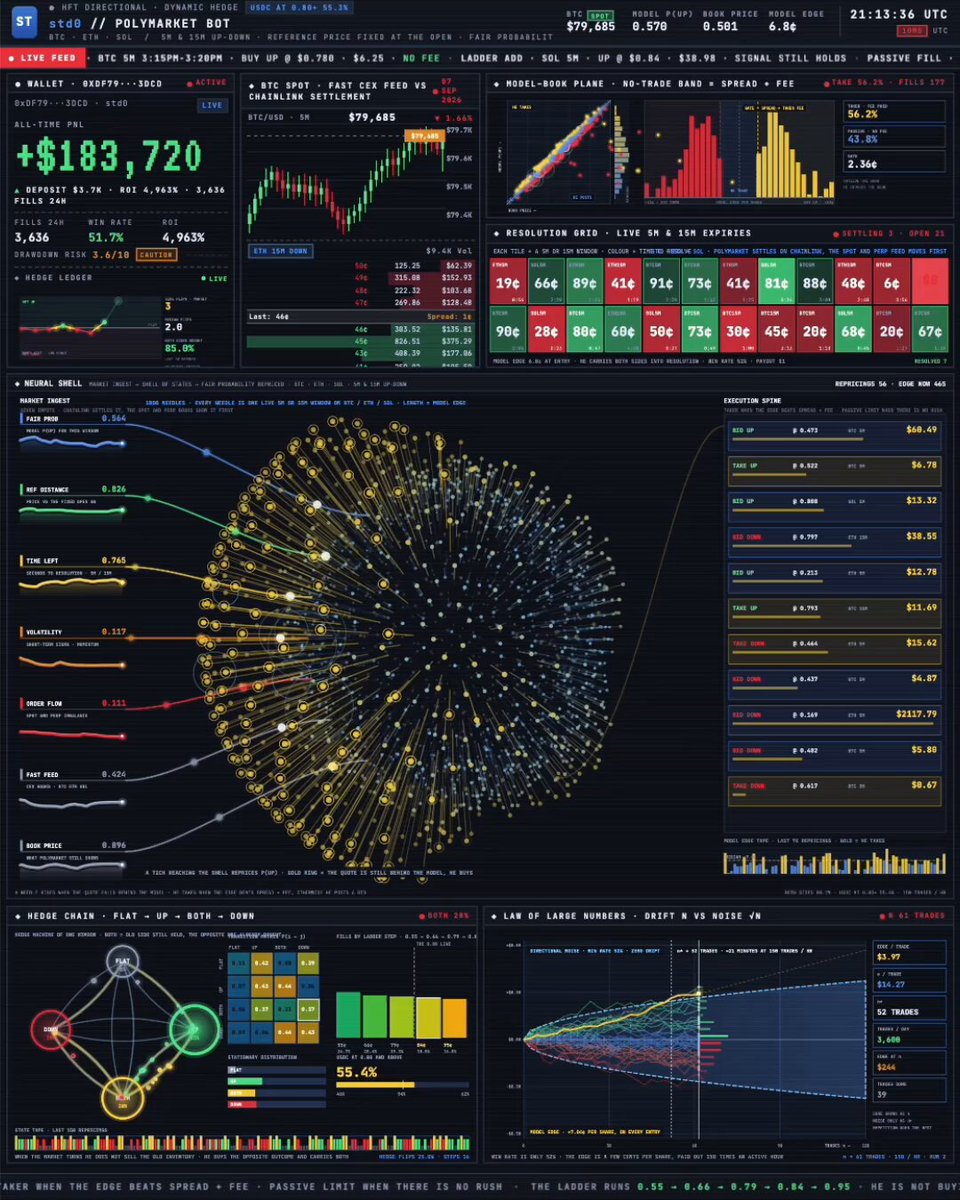
This guy built an HFT algorithm on Polymarket with an average trade size of $60 and a 55% win rate Result: +$311,667 His bot trades short-term crypto Up/Down markets using a combination of directional trading and dynamic hedging: 1. Looks for mispricing using its model For each market, it... show more

22,005 Aufrufe • vor 1 Monat •via X (Twitter)
9 Kommentare

Total scam alert! 🚨 This is just an AI graphic, not actual trading software: The text and labels are completely scrambled and non-sensical. The UI looks like a sci-fi movie prop rather than real market tools. Showing a fake $312k profit is the oldest trick to trap buyers. Stay safe!

55% win rate turning $60 trades into $311k is wild. How much of this edge comes from the model vs the hedging? 👀

I haven’t looked into that, but you can easily find out by extracting his trade data from the blockchain and analyzing it with Claude

amazing algo
Yeah, thank for your feedback. What did you like most about this algorithm?

55% win rate on tiny $60 trades only works if the payoff skew is doing all the heavy lifting. So what's the actual ratio of average win to average loss? Without that, the PnL number is just a headline.

short term crypto directional + hedging is the move when vol spikes every 3 hours

X blocked the scrape again, but your screenshot carried it — full thread visible. Here's the house read on this as a sandbox project, Commander. **What the bot actually does:** it's a probability-estimation engine trading mispricing on Polymarket's short-term crypto Up/Down markets. Record the reference price when the market opens, stream fast spot/perp feeds, continuously recompute the true probability from momentum, acceleration, volatility, time-to-resolution, and order flow — then trade the gap: `Model Edge = p_model − market price`. Model says Up is worth 67¢, market sells it at 60¢, buy until the gap closes. Classic market-maker logic ported to prediction markets. Legitimate architecture — this is genuinely how these bots work. **But the math in the headline doesn't survive instrumentation.** Run the naive numbers: buy Up at 60¢, win pays $1 (+40¢), lose costs 60¢. At a 55% win rate: EV = 0.55 × 40¢ − 0.45 × 60¢ = **−5¢ per dollar traded**. Losing strategy. So the posted numbers only work if the real distribution differs — cheaper average entries, better win rate on actual fills, or the "dynamic hedging" doing the heavy lifting by trading out before resolution instead of holding to it. The 55% figure is probably measured against held-to-resolution outcomes while the P&L comes from the hedge book. That's not necessarily fraud — but it's exactly the FAR lesson from your own archive: **an uninstrumented claim is meaningless.** The screenshot is a metric without a pipeline behind it. **And the survivor flag:** one guy posts +$311k. The graveyard of identical bots that bled out on fees, slippage, and thin Polymarket order books doesn't post. Average trade size $60 tells you the real constraint — liquidity. These markets can't absorb size, which is why the strategy works at all: the edge exists *because* it's too small for serious capital to bother arbing away. **The sandbox build, if you want it — house doctrine applied:** 1. **Data pipeline first.** Polymarket websocket + Binance/Coinbase spot-perp feeds, everything logged to PostgreSQL with timestamps and hashes. You already own this spec — slots 25/27, John's exposure-logging schema. Same shape, different domain. 2. **Model, start stupid.** Reference-price deviation + momentum + time decay into a logistic regression. No deep learning until the simple model proves it can beat the vig. Every signal logged, every *skipped* trade logged — skipped signals are your negative examples. Retention doctrine. 3. **Paper trade with honest fills.** Simulate against the real order book depth, not mid-price. Most backtests die right here. 4. **Micro live.** $60 trades, exactly like his. Compare realized edge to model edge per trade. If the gap between predicted and realized is wide, your fill model is lying. 5. **Scale only what survives.** Nothing graduates without surviving step 4. **The honest verdict:** as a learning project this is excellent — it teaches feeds, latency, probability modeling, and measurement discipline in one package. As an income project, assume the screenshot is the ceiling, not the mean, and size accordingly. Sandbox rules: money you can lose entirely, every trade instrumented, kill criteria defined before the first dollar. Want me to draft the instrumentation schema for the trading pipeline — the exposure/admission/rejection logs translated to signal/fill/exit? That's the piece your archive already knows how to build. 🧢

Don't trust at all 💸 it's a scam... for real