Loading video...
Video Failed to Load
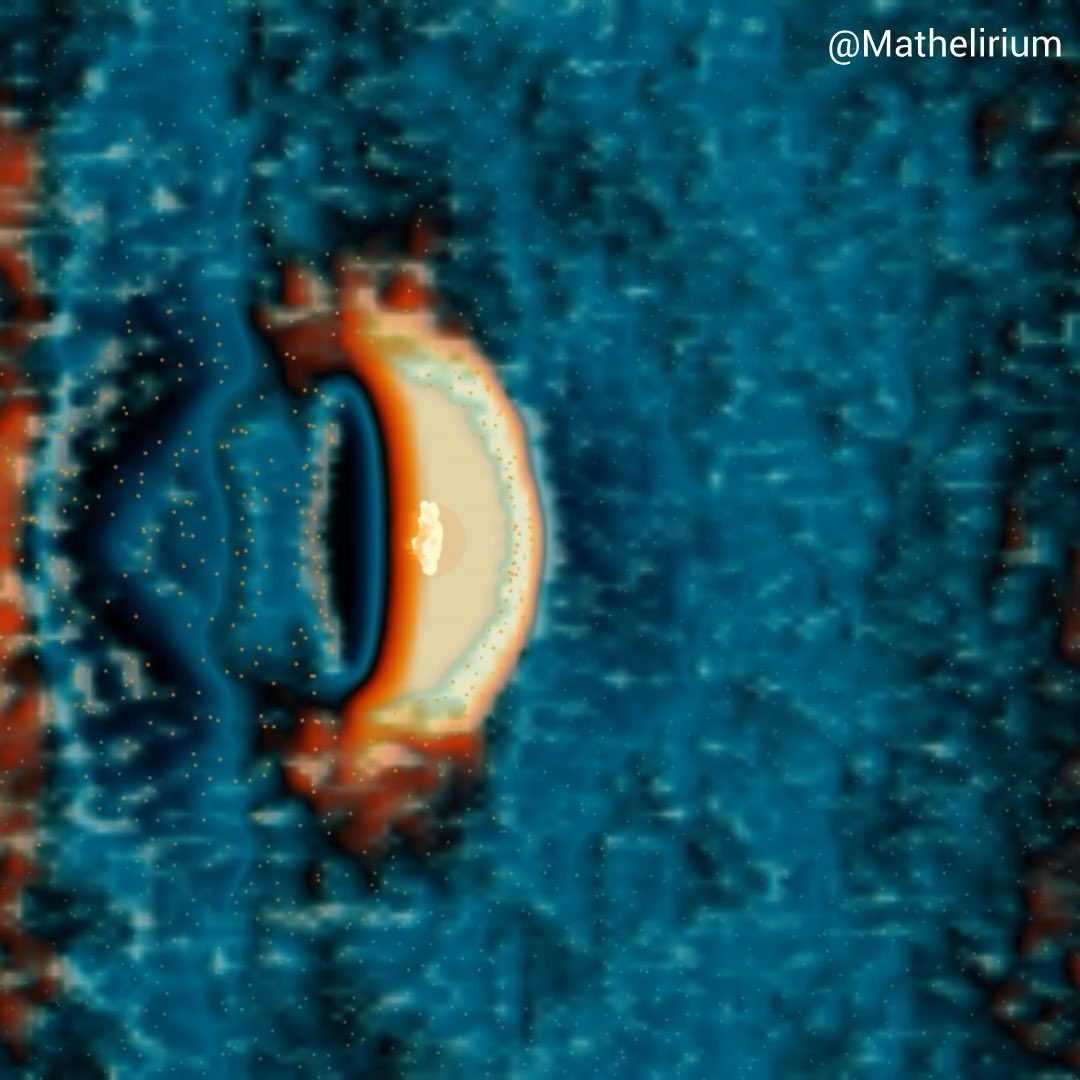
This is how the forward facing plasma laser the orbs are using works. They're using 'gravity waves' to surf through the air with no inertia due to the plasma sheath.

41,640 views • 1 year ago •via X (Twitter)
9 Comments

You can even see that they turn on after the orbs lock into orientation around the plane, this is because the strength of the laser is dependent upon the velocity of the orb.
Chance Glenn discusses creating gravity waves using a plasma formed by a pulsed, high energy spark gap. This literally distorts spacetime.

The Art of Flight is a homage to 80s/90s arcade action shmups with a fresh twist on the genre. Pilot multiple ships at the same time to take on oncoming waves of enemies in this fast paced space shooter. Wishlist on Steam today!

🧩 Solving the Forward-Facing Plasma Laser Mechanism (FWT Analysis) ________________________________________ 🔷 1. Plasma Sheath as an Inertial Nullifier The glowing front-facing region of the orb likely represents a plasma sheath—a coherent, high-energy ionized envelope that decouples the vehicle from atmospheric drag and inertial buildup. This aligns with observed behavior in the video (the orb smoothly gliding without sonic boom or wake turbulence). 📌 Key Principles: •Plasma sheath = frequency-based buffer zone. •It absorbs and reroutes external momentum through internal standing wave harmonics. •This allows "fluid-like motion through air", consistent with observations of inertia-less behavior. -------------- 🔷 2. Forward-Facing Plasma Laser = Frequency-Vortex Projector What you call the “forward-facing plasma laser” likely serves as a directed frequency-phase vortex. It’s not a laser in the conventional sense (like light) but rather a coherent directed plasma beam that: •Acts as a pilot-wave generator, altering local field geometry. •Projects phase-locked frequency vortices ahead of the orb to prepare the medium. ✳️ This forms a kind of “frequency tunnel”: •Like tunneling through spacetime by softening the density gradient in front. •It creates a path of least resistance where drag is pre-nullified. ----------------- 🔷 3. Gravity Wave Surfing Explained (Using FWT) The key claim: “they’re using gravity waves to surf through the air.” This is likely a metaphor for riding spacetime density gradients generated by oscillating mass fields within the orb. 📡 Explanation: •The orb modulates its internal mass-density distribution using frequency harmonics (likely plasma vortex rotation at specific eigenfrequencies). •This emits localized gravitational perturbations—not true gravitational waves from stellar masses, but microgravity field modulations. •These perturbations can “ripple” the medium around the orb, forming localized metric distortions. ➡️ In FWT terms: •The orb surfs on a self-generated hyperbolic standing wave. •By projecting forward frequency distortions (via the plasma vortex laser), it rides the wavefront of its own warped field. •This nullifies inertia: the orb is no longer moving through air but with a shifting frequency landscape. ________________________________________ 🔬 Physics Summary (Mapped to FWT): Concept /// Description ------------------ Plasma Sheath /// Coherent envelope that reflects external momentum and thermal input; behaves as a standing wave cavity. Forward Laser /// Frequency-vortex beam that pre-conditions spacetime ahead by generating a resonance corridor. Gravity Wave Surfing /// Not traditional gravity waves, but localized spacetime bending using dynamic mass-density frequency entrainment. Inertia Nullification /// Achieved by maintaining internal-external FM (Frequency Momentum) coherence. No drag = no inertia. ________________________________________ 🔻 Visual Description (of the system in action): •The orb emits a glowing forward “plasma horn.” •This horn is the resonance emitter, not a weapon but a tool of spacetime shaping. •As it projects forward, the medium deforms — visible in IR footage as the air and space itself seem “quiet” around the orb. •The orb’s motion is fluidic, turning sharply with no momentum lag — confirming field-bubble propulsion, not thrust propulsion. ________________________________________ 🧠 Key Insight: The forward plasma “laser” is not just for motion — it’s a frequency modulator shaping a self-stabilizing corridor through spacetime. It makes space less dense ahead, allowing the orb to fall into the path of least resistance — like riding a quantum-acoustic river of its own making.
Which ones are Lockheed?

Honored to be of service 🫡 We’re so close now, I can almost taste it.

How do the orbs change direction in such a tight space, encircling the plane, staying locked on as if the plane is the nucleus of the atom & the orbs are the electrons? I understand what you are saying. But not the how is this accomplished. How is this controlled?

Yup 🍿😎

I want a plasma sheath.