Video wird geladen...

Video konnte nicht geladen werden

Zur Startseite

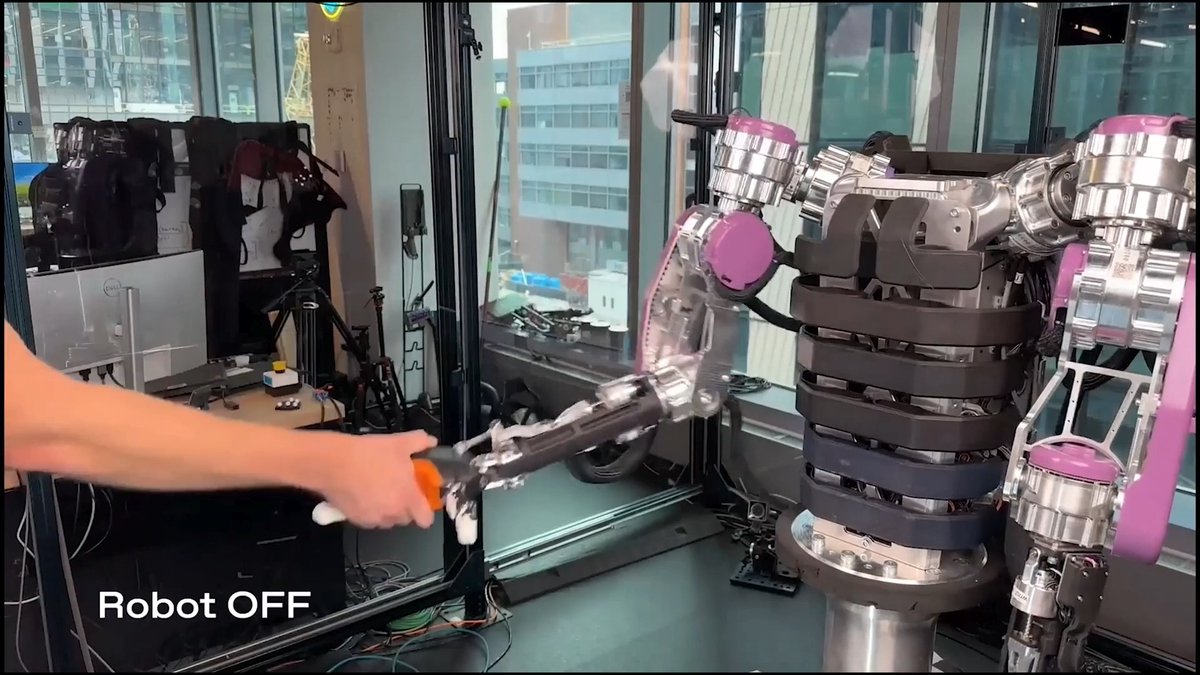
This robodog aims to remove humans from hazardous work environments The Robot Teleoperativo 2 project out of the Dynamic Legged Systems lab has developed an advanced teleoperation system designed to operate in high-risk environments, minimizing dangers to human workers. By integrating cutting-edge technologies in tele-locomotion, tele-manipulation, and remote human-robot...

22,827 Aufrufe • vor 1 Jahr •via X (Twitter)

4 Kommentare

Profilbild von AI_TechnoKing
AI_TechnoKingvor 1 Jahr

Cool design, I need one to empty my recycling bins, they are practically a bio hazard!☣️

Profilbild von UserInterface
UserInterfacevor 2 Jahren

Unveiling the Future of Prompt Engineering for Better AI Interactions #tech

Profilbild von Abhinav Girdhar
Abhinav Girdharvor 1 Jahr

A huge step toward safer workplaces! Keeping humans out of harm’s way with advanced teleoperation.

Profilbild von Victor
Victorvor 1 Jahr

dogs were just beta testing robots all along - nature knew what it was doing when it made them our best friends

Ähnliche Videos

China unveils humanoid robot with lifelike skin and blinking eyes built for daily life | Prabhat Ranjan Mishra, Interesting Engineering Large Language Models (LLMs) and Vision-Language Models (VLMs) help process and interpret complex data from human interactions. A Shanghai-based company has developed humanoid robots that appear as real as humans. The advanced bionic humanoid robot is integrated with self-supervised AI algorithms. Named Elf V1, the robot can perceive the world, communicate, learn, and interact intelligently with its surroundings. Developed by AheadForm Technology, the robot offers up to 30 degrees of freedom, powered by a precise control system and an advanced AI learning algorithm. Robot offers expressive facial features The robot offers expressive facial features, moving eyes, and synchronized speech. It can also convey emotions and understand human non-verbal cues, making interactions more natural and engaging. The robot has highly interactive capabilities and lifelike appearances. AheadForm expects that its robots could soon seamlessly integrate into daily life, providing assistance, companionship, and support across various industries. “We believe that by developing realistic and expressive robot heads, we can bridge the gap between humans and machines, fostering a new era of interactive and intelligent robotics,” said the company in a statement. Reports revealed that to avoid the “uncanny valley” effect and be able to interact with us, they are given lifelike skin and capabilities to read our emotions and respond appropriately using dynamic expression simulation and emotion generation tech. Bionic skin and high-precision control system The Elf V1 series of humanoids features 30 facial muscles animated by brushless micro-motors and managed by a high-precision control system. Paired with an ability to detect their users’ emotions with low latency and bionic skin, their facial expressions are nearly identical to those of humans, reported CGTN. The company claims it’s pioneering the development of realistic humanoid robots designed to revolutionize human-robot interaction. It’s enhancing sophisticated humanoid robot heads that can express emotions, perceive their environment, and interact seamlessly with humans. By combining cutting-edge AI and advanced robotics, AheadForm aims to bring life to machines and transform how humans engage with technology. AI models boost robots’ responsiveness Seamless integration of Large Language Models (LLMs) and Vision-Language Models (VLMs) into the humanoid robots can help them process and interpret complex data from human interactions, enabling the robot to learn and adapt in real-time, achieving human-level understanding and responsiveness. AheadForm uses Brushless Motors that deliver ultra-quiet operation and high responsiveness, specifically designed for precision facial movements in humanoid robots. With its compact size, lightweight design, and energy efficiency, this motor is the ideal choice for next-generation robots that require precise, subtle facial control to create a truly human-like experience. Previously, the company unveiled the Lan Series that features realistic humanoid robots with soft skin and 10 degrees of freedom, offering a lifelike appearance and intuitive movements. This series is designed for cost-efficiency, for applications prioritizing mobility and manipulation.

Owen Gregorian

179,005 Aufrufe • vor 8 Monaten

Video: World’s first humanoid robot labor that swaps its own batteries to work endlessly | Jijo Malayil, Interesting Engineering Walker S2 uses dual-battery balancing and standardized modules to boost efficiency and ensure uninterrupted, optimized performance. In a leap for robotics, China’s UBTech has unveiled the Walker S2, the world’s first humanoid robot capable of fully autonomous battery swapping. Designed for non-stop industrial operations, the Walker S2 can replace its own power pack in just three minutes—no human intervention required. Equipped with advanced anthropomorphic bipedal locomotion and a hot-swappable battery system, Walker S2 is built to operate 24/7 across dynamic industrial environments. According to UBTech, the next-generation humanoid robot marks a major milestone in automation, bringing continuous, hands-free performance to the factory floor. In May 2025, UBTech Robotics and Huawei Technologies inked a significant partnership to accelerate the adoption of humanoid robots across China’s factories and households. Uninterrupted robot operations A video posted by the robotics firm opens with the sleek UBTech Walker S2 humanoid robot working in an industrial setting. The highlight, however, is its autonomous battery swap. Walker S2 approaches the charging station, carefully detaches its depleted power pack, and seamlessly installs a fresh one—all within about three minutes—without any human assistance, according to CGTN. The camera captures close-ups of the robot’s articulated limbs and the intelligent battery-handling mechanism, conveying precision and reliability. As the swap completes, Walker S2 resumes its duties, reinforcing the promise of uninterrupted, 24/7 operations in dynamic factory environments. UBTech’s Walker S2 humanoid robot is equipped with advanced dual-battery power balancing technology and uses standardized battery modules to optimize performance, reports CNEVPOST. This dual-battery system allows the robot to automatically switch to a backup battery in case of a main battery failure, ensuring that critical tasks are carried out without interruption. In addition to battery swapping, the robot can intelligently choose between charging and swapping based on task urgency, allowing it to manage energy dynamically and adapt to real-time operational demands. UBTech highlights these features as a step forward in deploying humanoid robots for industrial and domestic applications, combining flexibility, reliability, and autonomy in one intelligent platform. Factory intelligence upgrade Earlier in the year, UBTech unveiled a major advancement in humanoid robot collaboration, claiming the world’s first deployment of multiple humanoids working together across varied industrial tasks. Demonstrated at Zeekr’s 5G-enabled smart factory, the breakthrough centers on UBTech’s “BrainNet” framework, which orchestrates cooperative behavior through a cloud-device intelligence system. BrainNet integrates a “super brain” for high-level decision-making with an “intelligent sub-brain” for distributed multi-robot control. The super brain, powered by a proprietary large-scale multimodal reasoning model, handles complex production-line scheduling and decision-making. Meanwhile, the sub-brain coordinates real-time tasks using cross-field perception and Transformer-based control for dynamic adaptability. Together, they enable the Walker S1 humanoid robots to move beyond isolated operations and perform coordinated tasks with high precision and speed. The system is built on DeepSeek-R1 reasoning technology and trained on real-world data from automotive factory settings. Leveraging Retrieval-Augmented Generation (RAG), the model adapts to specific job functions and improves scalability across workstations. At Zeekr’s facility, dozens of Walker S1s now collaborate on tasks like assembly, inspection, and part handling. Using semantic VSLAM and shared mapping, they coordinate seamlessly via vision-based navigation and agile manipulation. UBTech says this marks a transition to “Practical Training 2.0,” where humanoid robots operate as a swarm, maximizing efficiency and setting the stage for next-generation intelligent manufacturing.

Owen Gregorian

35,637 Aufrufe • vor 11 Monaten