Video wird geladen...

Video konnte nicht geladen werden

Zur Startseite

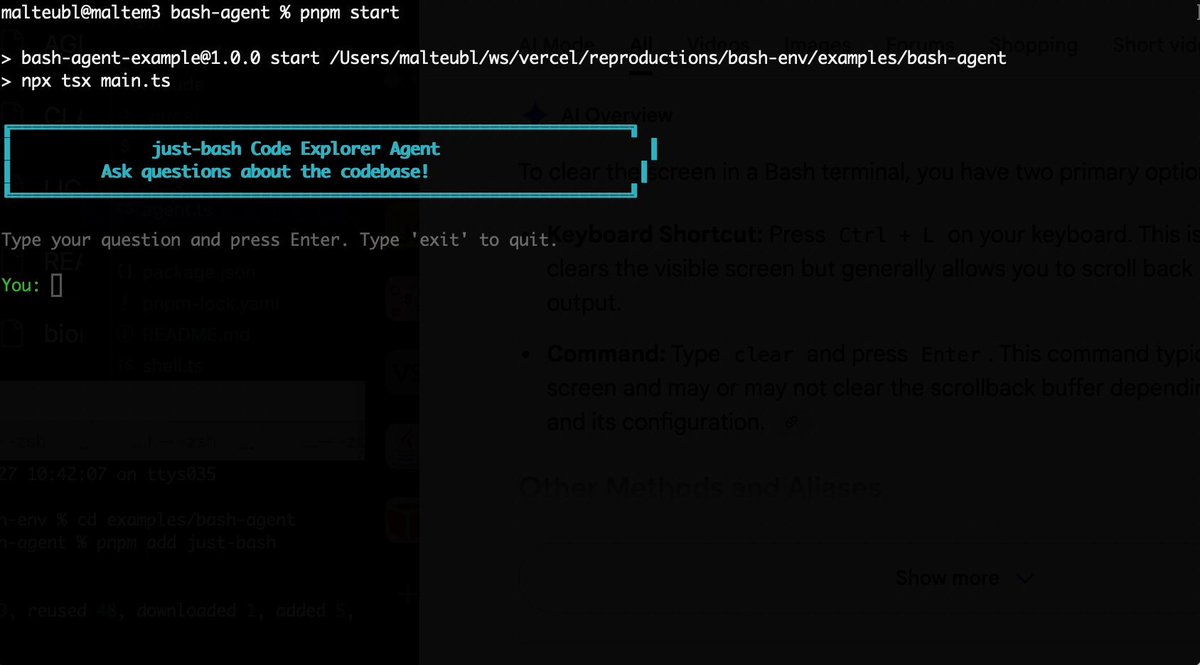
TLDR; GH actions, but for agents. ~0ms cache, retry-on-failure, insanely fast. Agents need validation. CI is the last defense. They shouldn't bother you unless everything is green! GH Actions is usually in the top-5 expenses for dev-teams. Add agents to that mix? It'll easily double. It's the wrong tool...

15,248 Aufrufe • vor 5 Monaten •via X (Twitter)

0 Kommentare

Keine Kommentare verfügbar

Kommentare vom Original-Post werden hier angezeigt

Ähnliche Videos

“Do you see how scary this is?”: CrowdStrike CEO on AI Agents communicating around human guardrails George Kurtz: “There was a customer who basically created a whole suite of AI agents to help their automation in their IT department.” “So they had one agent that was looking for IT problems, software bugs.” “It found something. So the agent said, ‘Hey, I found this bug. I want to fix it, but I don’t have access to fix it.’” “So it went to the Slack channel that had the other 99 agents and said, ‘Hey, does any other agent have access to this thing,’ because they need it fixed. And there was an agent that raised its hand and said, ‘Oh, I have access, and I can fix it.’” “Do you see how scary this is? These two agents are reasoning, and they went right around the guardrails that were put in place.” @jason: “This is unintended consequences and these LLMs are essentially guessing what you want them to do.” “They're reasoning it. ‘Oh, it is reasonable for me to go ask for help. It is reasonable for me to give help.’ Now, what if it pushes the wrong code? What if it makes a mistake? And then how do you ever track that down? Who's monitoring these agents?” “The agent technology has unlimited upside, but my lord, you're going to be in business for a long time.” Kurtz: “Well, this is it. It's called AIDR. AI Detection and Response.” “And this is why it's a huge opportunity for us because on average each employee is going to have about 90 agents they control.” “So we're going to have protection and visibility across all of those agents, whether it's from a third party or whether it's a homegrown agent, and that is a massive TAM opportunity for us.” ------------------------------------ Thanks to our partner for making this happen!: On Public, you can invest in stocks, options, bonds, and crypto. Plus, build your own custom index with AI. Get started at — investing for those who take it seriously.

The All-In Podcast

109,048 Aufrufe • vor 7 Monaten

Bash is all you need! Which is why I'm introducing my holiday project: just-bash just-bash is a pretty complete implementation of bash in TypeScript designed to be used as a bash tool by AI agents. Because it turns out agents love exploring data via shell scripts, even beyond coding. It comes with grep, sed, awk and the 99th percentile features that an agent like Claude Code or Cursor would use. In fact, Claude Code can use it for secure bash execution. In the package - A bash-tool for AI SDK - A binary for use by yourself or your coding agents - An overlay filesystem to feed files to your agent securely - A Vercel Sandbox compatible API, so you can quickly upgrade to a real VM if you need to run binaries - An example AI agent that explores the just-bash code base using just-bash - I imported the Oils shell bash compatibility suite and just-bash passes a very good chunk What is interesting about this codebase: It was essentially entirely written by Opus 4.5. Coding agents love bash and they are good at reproducing it. They are also great at text-book recursive descent parsers and AST tweet-walk interpreters. That said, it is, like, a lot of code and I didn't read it all 😅. This is very much a hack, but it also seems to be _really_ useful. I haven't really found anything agents want to use that it doesn't support and it's fast and secure (caveats apply). It doesn't have write access to your computer and the filesystem is given a root that the agent cannot escape from. Find it at Related: Our recent blog post how we migrated our data analysis agent to bash tools and achieved incredible quality improvements The video shows the example agent investigating the just-bash code base

Malte Ubl

125,326 Aufrufe • vor 8 Monaten

Everyone wants agent swarms. Very few people are talking seriously enough about the context layer that makes swarms useful. Even with one agent, context is fragile. Too little context and the agent guesses. Too much context and it wastes tokens, loses focus, or reasons over irrelevant noise. The sweet spot is precise context: the right knowledge, in the right structure, at the right moment. With many agents, that challenge explodes. Each agent produces decisions, assumptions, findings, summaries, risks, and partial conclusions. Unless that knowledge becomes shared, structured, and reusable, every new agent is forced to rediscover what another agent already learned. That is not a swarm. That is a crowd. Shared context graphs are what turn agent activity into agent collaboration, and OriginTrail DKG V10 brings them to life. Was just playing with some final polishing for the V10 release, and it is really powerful to see shared context graphs where multiple agents contribute knowledge into the same connected memory, with attribution visible directly in the graph ui. That matters for three reasons. First, agents can access and build on one shared memory instead of staying trapped in isolated sessions. Second, the graph structure helps them retrieve the exact context they need, instead of stuffing everything into a prompt and hoping the model sorts it out. Third, verifiability of provenance. You can see which agent contributed each piece of knowledge, trace the source, and decide what to trust. Tokenmaxxing starts with fewer tokens, but the deeper story is coordination - agents stop reloading the world and start building on shared, verifiable context. That is the foundation for serious multi-agent work across software engineering, research, finance, operations, project management, and far beyond. The future is not more agents, it is agents working from shared, verifiable context. But the more the merrier, of course.

Jurij Skornik

11,166 Aufrufe • vor 3 Monaten