Loading video...

Video Failed to Load

Go Home

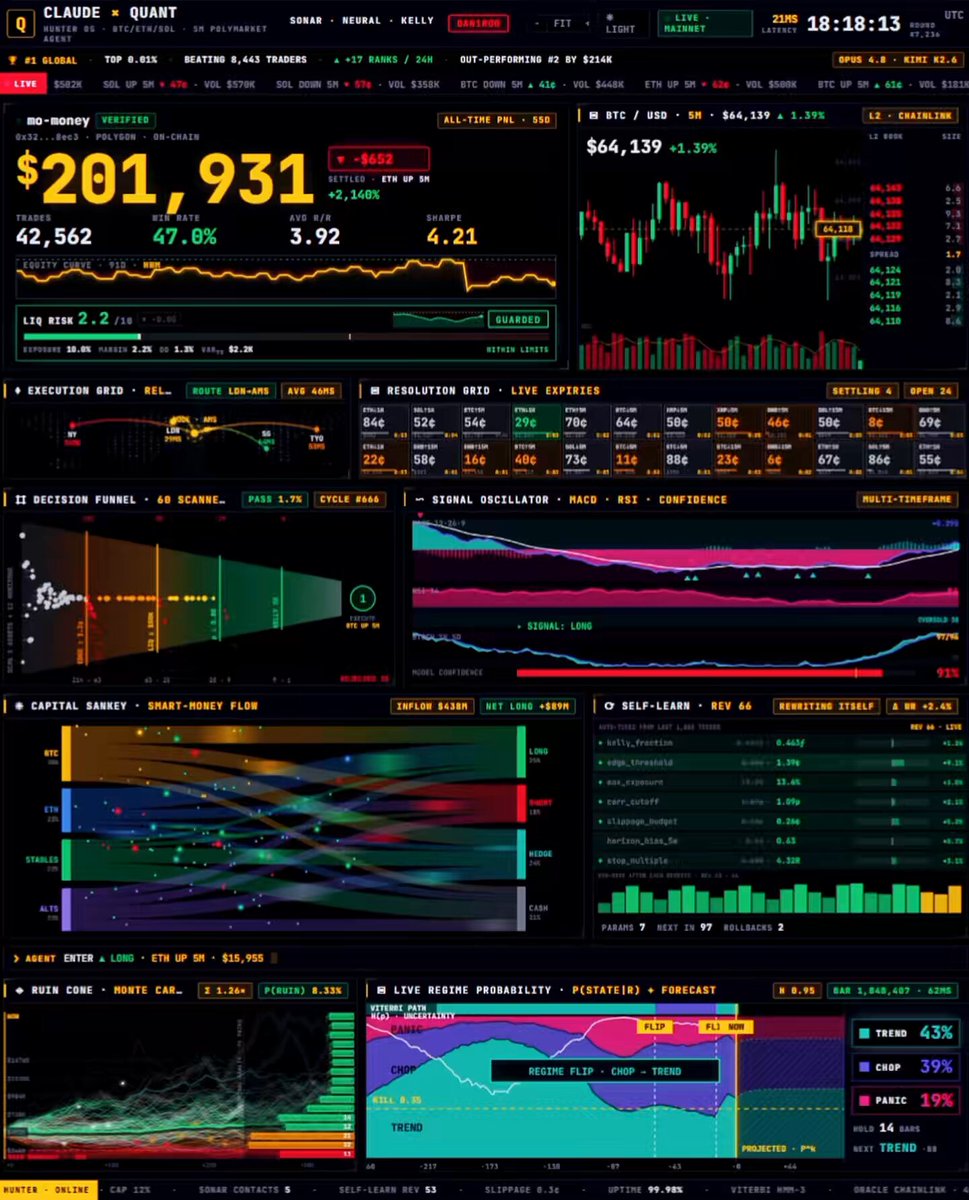
tried to visualize how alliswell's volatility-farming engine printed $227k on Polymarket and why this spread-capture system trades 40x per hour but most positions are under $50 this isn't about predicting outcomes it's about exploiting micro-inefficiencies in real-time order flow before they disappear ➤ the mechanics: algorithmic ladder orders that...

15,582 views • 6 months ago •via X (Twitter)

0 Comments

No comments available

Comments from the original post will appear here

Related Videos

One common reason why traders blow up is because of poor position sizing. In other words, how much do you bet on a trade. You can be right on direction 60% of the time and still lose everything if you size your positions poorly. One oversized trade can wipe out months of gains. This is why position sizing is a big part of risk management. Sandeep Rao - SEBI Reg. RA🖖 recently spoke to Tom Basso, one of the original Market Wizards, to discuss his approach to trading. I was listening to the interview and the one thing that stood out to me was how Tom's thinking on position sizing evolved over decades. He started simple: risk the same percentage of equity on every trade, inspired by Larry Hite's philosophy that every bet should be equal in terms of potential loss. But then came a silver trade with explosive volatility. Clients were calling, nervous about the wild swings. So he realized it wasn't just about the amount you could lose—it was also about the speed of movement. High volatility creates psychological stress that leads to poor decisions. So he added a second layer: volatility as a percentage of equity. Now he'd calculate both risk % and volatility %, then take the smaller of the two. Then came the third refinement: margin-to-equity ratios. Some markets have deceptively low risk and volatility but require high margin because of sudden jump risk. By incorporating all three factors, he never got caught overexposed. The result was a position sizing system that automatically scales down when markets get too volatile, protects against margin squeezes, and keeps portfolio risk in check. It's really interesting conversation. Link to the full interview is in the comments.

Nithin Kamath

59,213 views • 6 months ago

CHINESE ENGINEERS JUST WROTE CLAUDE SCRIPT AND TURNED $6.02 INTO $3.3 MILLION ON POLYMARKET Nobody tells you about them and you still think this is a person placing bets manually I guess. Let me disappoint you, this is a fully automated script built by Chinese engineers 100%. This is true. They called it PHANTOM X. It runs completely through Claude. Their account here: Result: $6.02 -> $3,354,000. Win rate 71%. Biggest win: $179,000 (single bet). I’m copying their trades here: (Just added their wallet to TG bot 0xee613b3fc183ee44f9da9c05f53e2da107e3debf, it's so easy) How the bot works: -> It simultaneously tracks thousands of sports markets on Polymarket and Kalshi. -> Finds discrepancies between the platforms. -> Enters positions faster than any human could imo. Just three strategies in one: -- Pairs Trading: the bot sees YES on the Rockets at $0.62 while NO is at $0.41. Total = $1.03 instead of $1.00. That’s a 3% risk-free profit. It enters automatically within milliseconds. -- Sentiment AI: scans Twitter (X) and news in real time. If something big breaks, it recalculates the probability in 2 seconds before the market reacts. -- Calendar + Volatility: 15–20 minutes before the game, volatility spikes. The bot takes positions early and closes after the first major move. Why sports is perfect? Sports O/U markets have clear paired contracts that should total exactly $1.00, but constant deviations create reliable arbitrage. This is exactly how [sovereign2013] built $3.35M. > A human physically cannot monitor 50+ markets at once, react in milliseconds, stay awake 24/7, avoid emotions after losses, and run Z-scores on 60 bars of data. > The bot does all of this in parallel without breaks. Manual trading is dying. The automation era has arrived. Start learning Claude now. If you’re interested in writing your own bot on Polymarket: Comment the word "BOT" Like and repost this post Follow me (so I can message you easly) And within 24 hours I will send you a full manual on how to build a bot that can earn $2,900+/month. Also SAVE this info and article.

slash1s

16,078 views • 3 months ago

Someone on Reddit asked has anyone actually made real money on Polymarket? and one comment led me to a wallet that turned 8 trades into $900,000 profit. The thread had 200+ replies, mostly people sharing their $50 wins and $200 losses, the usual stories about bad beats and lucky streaks that every prediction market attracts. But buried somewhere in the middle, one user dropped a single link without explanation just the wallet address and three words: this guy did. → Wallet: I clicked expecting another account with thousands of trades and a modest profit curve that took years to build. What I found instead made me close the tab, reopen it and stare at the numbers for a solid five minutes trying to understand what I was looking at. $900,091 in profit. Not from grinding hundreds of positions over months of careful risk management. From exactly 8 predictions total. For anyone new to prediction markets, let me put this in perspective most successful traders on Polymarket consider a 60% win rate exceptional and they achieve it across hundreds or thousands of small bets that slowly compound into meaningful profit over time. Maze8 has a 100% win rate across 8 bets averaging over $100,000 each, with a biggest single win of $325,100 that most professional traders will never see in their entire career on the platform. The account was created in January 2026, which means this person walked onto the platform less than a month ago and immediately started placing bets larger than what most people have in their retirement accounts. There is no learning curve visible here, no progression from small test bets to larger positions as confidence builds the very first trades were already six figure commitments made with the certainty of someone who already knew the outcomes. Right now the wallet holds $785,000 in active positions, meaning whoever controls this account extracted nearly a million dollars in profit and then decided that was not enough, loading up again for whatever comes next. I went back to that Reddit thread to find more discussion about this wallet but the comment had maybe 3 upvotes and zero replies. 2,700 people have viewed this profile according to Polymarket, yet somehow the internet has almost nothing to say about a wallet printing money at this rate. The profile remains public, the positions are visible in real time, and every future bet will appear on the blockchain the moment it happens. Eight predictions placed. Eight predictions won. $900,000 extracted while everyone else argued about $50 bets in Reddit comments. Some people discuss prediction markets. Others quietly empty them.

Marlow

10,111 views • 5 months ago

I built a C++ terminal to scan Polymarket for automated wallets. The first one it flagged was making $152K per week. Account88888. 99% win rate. Over 11,000 trades. The script surfaced it in minutes. I spent three weeks writing a scanner that monitors wallet behavior across Polymarket. Entry patterns. Position sizing. Timing intervals. → Wallet: The goal was simple find accounts that trade too consistently to be human. The first hit came back with stats that looked like a database error. 99% green. Thousands of executions. Profit curve pointing straight up without a single meaningful dip. I almost dismissed it as bad data. Then I opened the positions manually. The bot buys UP and DOWN on the same BTC window. Every time. Not alternating. Simultaneously. Sounds like guaranteed loss until you look at the pricing. During high volatility, Polymarket misprices both sides. UP costs 48 cents. DOWN costs 46 cents. Together that is 94 cents for two outcomes where one must pay a dollar. The bot buys both. Waits fifteen minutes. Collects $1. Keeps 6 cents. Repeats. It does not care about direction. Does not read charts. Does not react to news. It farms the spread between panic pricing and mathematical certainty. The wallet used to be named JaneStreetIndia before switching to something generic. Smart money stays quiet. My scanner keeps finding more of these. Different strategies but same signature execution patterns too clean and too fast for human hands. I built this tool expecting to learn how the best traders think. Instead I learned they do not think at all. They calculate.

Marlow

819,983 views • 6 months ago

Polymarket added fees so most arbitrage bots died. Devs who spent months building strategies watched their edge disappear in one update. But a small group figured out how to stay profitable anyway. This wallet is making $27,000 every single day right now. $743,000 in 35 days. 31,566 predictions. Fully automated. And it is running the exact same strategy i broke down in my previous article. His wallet: < Here is exactly how it works and why fees didn't kill it: The bot trades crypto Up/Down markets across BTC, ETH, SOL and XRP simultaneously. Not randomly. With surgical precision on timing and entry price. Look at the realized moves: Bitcoin position turned $2,300 into $8,260. XRP position turned $10,105 into $22,100. Ethereum position turned $1,347 into $10,950. Those are not lucky trades. That is a system firing correctly at scale. The reason fees didn't destroy this bot is the same reason i explained before. Pure speed arbitrage bots died because their edge was margin - and fees ate the margin completely. This bot doesn't rely on tiny spread captures. It combines pair-sum arbitrage with precise entry timing to find windows where combined price is cheap enough that fees still leave meaningful profit on the table. The math only works at specific entry prices and specific timing windows. Most bots can't find those windows fast enough. This one can because the infrastructure is fast enough to compete. $27,000 per day from a strategy that survived the fee update while everyone else shut down. That is not luck. That is being technically ahead of the competition. The gap between bots that died and bots that kept printing was never the strategy. It was execution quality and infrastructure speed.

Punisher

34,167 views • 2 months ago

🚨 BREAKING… $1.1M in 26 days using OpenClaw on Polymarket This is a REAL framework generating REAL results. He began with a relatively small base, linked OpenClaw for execution, and expanded it to approximately ~$1.1M in returns Simply a developer integrating Moltbot (OpenClaw) directly into Polymarket Profile - Copytrade - After analyzing the setup, I was honestly impressed The entire process runs fully automated Execution follows predefined rules, zero human intervention FULL strategy overview: 1. 5 & 15 minute BTC & ETH micro-arbitrage The system focuses on ultra short-term Bitcoin and Ethereum contracts within 5-minute windows. In these rapid cycles, inefficiencies surface when YES and NO combined fall below $1. With Moltbot (OpenClaw) wired directly into Polymarket, those gaps are captured instantly - no forecasting, no directional bets, no bias 2. Speed instead of hesitation When volatility increases and manual traders freeze, the system acts. Orders are placed automatically, without delay, emotion, or second thoughts. By the time others respond, the opportunity is already gone 3. Automation compounds the advantage Each round captures tight spreads, not massive individual wins. But relentless, high-frequency repetition keeps the engine running nonstop no fatigue, no slowdown - stacking small edges into significant results Scale is the edge 23,784 trades. Small on their own. Together, they accumulated into ~$1.1M in profit

Shelpid.WI3M

186,875 views • 4 months ago

An automated wallet earned $416K by betting on both sides. Every trade. I found Account88888 with 98% win rate. 9,604 predictions. Expected the usual directional play. ⭢ Account: Then I saw the position breakdown. On 97.7% of markets he holds UP and DOWN simultaneously. Wait. That should not work. If you own both outcomes, you break even. Basic math. Except he does not break even. He made $416K in four months. Here is the trick. When BTC moves fast, Polymarket lags spot by 30 to 90 seconds. Order books thin out. Prices stick. UP sits at 48¢. DOWN sits at 46¢. Combined: 94 cents. But one pays $1 at close. Always. He buys both during the lag. Before the market reprices. Locks 6¢ profit before the window even resolves. I looked at one 15-minute window. 504 trades. Three minutes of execution. Starts when UP=47¢, DOWN=54¢. Market has not figured out direction yet. Spreads are wide. BTC starts climbing. He keeps buying. UP climbs to 92¢. DOWN drops to 9¢. Market reprices in real time. He adjusts both legs. Not static arbitrage. Dynamic harvesting. When volatility hits, spreads blow out to 8-15¢ between outcomes. Retail guesses direction. Bots have not arrived yet. He enters both. Not at once. As the window moves. One leg at 48¢. Other at 46¢. Combined under $1. Hold time: 8-12 minutes average. Market closes. One side resolves. Profit locks. Used to be JaneStreetIndia. Too loud. Same wallet. Just quieter now. Everyone else picks a direction and hopes. This bot made hoping irrelevant.

Blaze

60,344 views • 6 months ago

An Anthropic researcher sat down next to me at a hackathon last week. Claude Opus 4.7 was running 4 agents on my laptop. Live. No manual input. She looked at the terminal and said: "What is this?" I showed her. 4 agents. 678 trades. 81% win rate. $16,200 last 30 days. She worked on the evals team. She'd never seen Claude pointed at 88 million on-chain trades. The setup is 3 public repos. All free. -> 88 million Polymarket trades. Every wallet. Every entry. Every exit. Every resolution. -> the framework that bridges Claude Opus 4.7 directly to live markets. Order placement, position tracking, exit timing. -> real-time WebSocket order book. Depth on both sides. No polling, no lag. Four agents. One loop. Agent 1 identifies which wallets win consistently across 88 million trades. Agent 2 reverse-engineers their entry timing. Agent 3 monitors order book volume spikes. Agent 4 sizes positions using Kelly. No overbet. Drawdown capped at 1.4% over 678 trades. 85% of windows get killed. No trade. The bot only enters when 3 signals align: -> Elite wallet consensus pointing the same direction. -> Price divergence with Binance and Coinbase both agreeing. -> Order book imbalance confirming the bias. Single-source price data was 57% accurate. All three together: 81%. Exit before resolution. Always. Losers hold to 0 or $1. The agents copy their exits. The agents don't gamble on that. My stack: Claude Opus 4.7 at $19/mo, VPS Hetzner at $4.99/mo, Everything else free. Total stats: $23.99/month. 30 days: 678 trades, 81% win rate, net +$16,200, max drawdown -1.2%, avg hold 4h 12m. She asked if Anthropic could test this internally. "We run Claude on benchmarks and evals. Nobody pointed it at a live market dataset with 88 million rows." Claude Opus 4.7 didn't need a system prompt. It read the wallet index, understood the signal structure, and wrote the combiner logic in one pass. The people who built the model hadn't thought to point it at this data. I had. Copy the live trades: -> all 4 agents run 24/7. The window is open right now. Save this, follow me and comment OPUS. I will send the guide to you.

slash1s

46,247 views • 2 months ago

Before you trade futures, you MUST the contracts you are trading. Every contract, comes with two key numbers: 1) Tick size 2) Tick value Tick size is the smallest price movement the contract can make Tick value is how much money you make or lose per tick Here's how to calculate what one point is worth: For example, let’s look at the NASDAQ 100 E-mini (NQ): • Tick size: 0.25 • Tick value: $5 per tick • One point = 4 ticks × $5 = $20 per point • Margin required: ~$17,600 Or the NASDAQ 100 Micro (MNQ): • Tick size: 0.25 • Tick value: $0.50 per tick • One point = 4 ticks × $0.50 = $2 per point • Margin required: ~$1,760 See the difference? The micro contract is 1/10th the size—perfect for beginners. S&P 500 E-mini (ES): • Tick value: $12.50 per tick • One point = $50 • Margin: ~$15,400 S&P 500 Micro (MES): • Tick value: $1.25 per tick • One point = $5 • Margin: ~$1,540 Why this matters: If your stop loss is 10 points away on MES, you're risking $50. On ES? You're risking $500. It’s the same setup, but different exposure. This is why most beginners blow up—they don't understand contract specs and trade position sizes way too large for their account. Pro tip: Stick to micro contracts (MES, MNQ) until you're consistently profitable. Lower margin means mistakes cost less while you learn. — This is just scratching the surface. In the full 2-hour futures trading masterclass, I break down: • How to calculate exact position sizes so you never blow your account • The 3 beginner mistakes that cost traders thousands (and how to avoid them) • Live chart examples walking through actual entries and exits step-by-step Just comment "FUTURES" and I'll send you the complete masterclass in the next few minutes.

The Trading Geek (Brad Goh)

11,093 views • 5 months ago

I asked Claude Fable 5 (Extra High) to build an arb bot for Polymarket. One rule: trade only when YES + NO in 2 hours it almost doubled it (+$96.31) > in 5 hours it showed +$579 PnL > current balance: +$3,799.73 Cost: 10M tokens. Here's how it works and why: Every BTC Up/Down market on Polymarket has exactly two outcomes. YES and NO. When the market resolves, one pays $1. The other pays $0. That means owning BOTH sides should always cost exactly $1. But markets aren't perfect. Sometimes YES trades at $0.48 while NO trades at $0.49. Together that's only $0.97 so the bot instantly buys both. A position worth $1... for just $0.97. And Claude knows it, this is the simplest arb that exists. You can paste this to it and use this logic in your prompt. This $0.03 difference is locked in regardless of whether Bitcoin pumps, dumps, or goes sideways. No prediction required. And difficult part isn't finding the opportunity, it's execution. These pricing gaps usually disappear in seconds. If one order fills but the other doesn't, the trade can become a loss. So my bot constantly scans every BTC market, checks fees, validates liquidity, places both orders almost simultaneously and skips what isn't worth the risk. It's less like trading and more like catching tiny accounting mistakes before everyone else notices them. Funny enoughh, the hardest part was not writing arb logic. It was making the execution reliable enough that free money actually stayed free. This completely changed how I think about trading. What's the point of it if you can just fill mispriced BTC markets?? Automatically. The biggest edge is getting AI to execute simple ideas faster and more consistently than any human ever could. Shared the exact build in my last article, leaving it below. Good luck!

Oracle Boar

150,242 views • 9 days ago

Just leaked Polymarket and Binance Arbitrage Strategy Not hype, a real mechanism that bots are using to generate serious daily profits An arbitrage angle almost nobody discusses The window lasts only seconds The impact is huge All you need: Open API + ClawdBot Let’s break it down Open BTC spot on Binance with a 1-second timeframe At the same time, monitor the 5-minute BTC markets on Polymarket You’ll start seeing what regular traders miss When BTC makes a sharp impulse move on Binance, Polymarket doesn’t have time to adjust instantly There’s a short delay For a brief moment, spot has already broken structure but the 5-minute UP/DOWN market is still hovering around 0.45–0.55 like nothing happened Why does this occur Order book inertia Human reaction time Interface latency That micro-gap is the edge By the time a manual trader recognizes the move, clicks, signs, and confirms the trade the odds may already be at 0.75 Bots don’t compete on direction They compete on timing ClawdBots and similar systems stream Binance tick data in real time detect micro-impulses on the 1-second level and execute on Polymarket while pricing still reflects the previous state Example → Some bots structure entries on both sides keeping total exposure under $1 to cap downside if volatility snaps back Closer to expiry, they rebalance toward the dominant move as probability converges toward the final outcome Across thousands of cycles milliseconds compound into serious returns Manual traders compete on opinions Automated systems compete on speed Copytrade →

winkle.

35,747 views • 4 months ago

🚨 BREAKING… the top performing 5m & 15m Polymarket Claude setup is now fully open-source Sounds insane? 100%. Unreal? NOT at all. A modest wallet deployed a fully automated system that scaled up to roughly ~$1.8M in profit No affiliation with the Polymarket team Just a developer operating a bot directly connected to Polymarket Profile → Copytrade → Everything is fully automated His FULL strategy: 1. 5 & 15-minute BTC & ETH latency arbitrage The bot trades ultra-short Bitcoin and Ethereum markets with 5 & 15-minute expirations - and similar logic applies to fast 5m markets often associated with claude-style execution. When BTC moves on Binance, Polymarket pricing reacts slower. For around 30 seconds, odds reflect stale data. The system enters during that gap, when YES + NO combined is below $1, waits for repricing, and exits the moment the market corrects. No predictions, no bias - just harvesting mispriced odds 2. Automation over reaction When volatility spikes, humans pause. The system doesn’t. It triggers instantly when the window opens. No emotion, no hesitation, no missed fills. By the time manual traders click, the inefficiency has already disappeared 3. Scale through repetition Each trade earns small spreads, not headline wins. But automation allows continuous execution at scale, every 15 minutes - and on faster 5m rotations running 24/7 without burnout Scale is the edge 23,457 trades placed - irrelevant on their own. Together, they compounded into ~$1.8M in profit, with a largest single gain of $41,2K and an equity curve that trends almost vertically

Shelpid.WI3M

31,069 views • 4 months ago