Загрузка видео...

Не удалось загрузить видео

На главную

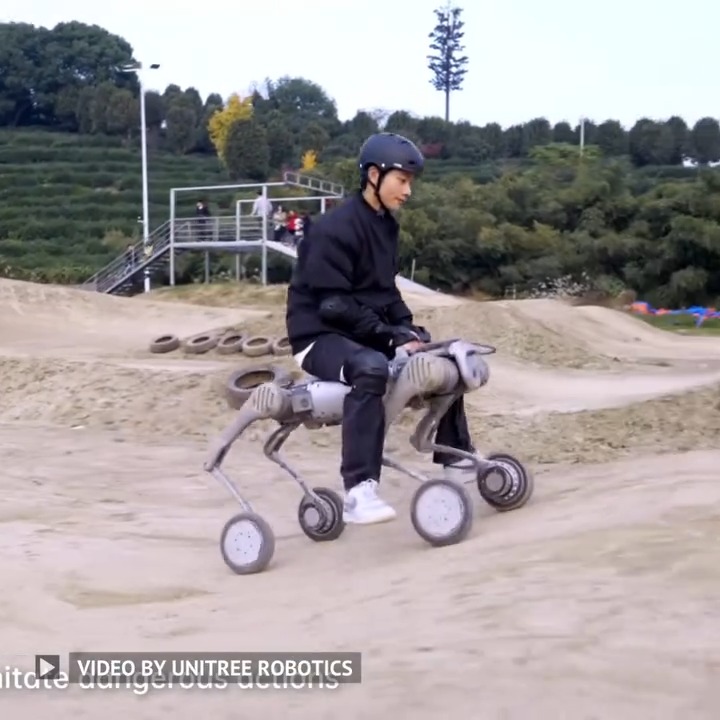
Truly general-purpose robots must be able to navigate spaces they have never seen before. ⦿ Skild Brain enables end-to-end autonomous locomotion from raw vision and joint inputs, without mapping or pre-planning. ⦿ The model adapts in real time to new terrain such as stairs, gaps, and clutter, reacting instinctively...

28,439 просмотров • 11 месяцев назад •via X (Twitter)

Комментарии: 0

Нет доступных комментариев

Здесь появятся комментарии из оригинального поста

Похожие видео

Today, we're joined by Nikita Rudin, co-founder and CEO of Flexion to discuss the gap between current robotic capabilities and what’s required to deploy fully autonomous robots in the real world. Nikita explains how reinforcement learning and simulation have driven rapid progress in robot locomotion—and why locomotion is still far from “solved.” We dig into the sim2real gap, and how adding visual inputs introduces noise and significantly complicates sim-to-real transfer. We also explore the debate between end-to-end models and modular approaches, and why separating locomotion, planning, and semantics remains a pragmatic approach today. Nikita also introduces the concept of "real-to-sim", which uses real-world data to refine simulation parameters for higher fidelity training, discusses how reinforcement learning, imitation learning, and teleoperation data are combined to train robust policies for both quadruped and humanoid robots, and introduces Flexion's hierarchical approach that utilizes pre-trained Vision-Language Models (VLMs) for high-level task orchestration with Vision-Language-Action (VLA) models and low-level whole-body trackers. Finally, Nikita shares the behind-the-scenes in humanoid robot demos, his take on reinforcement learning in simulation versus the real world, the nuances of reward tuning, and offers practical advice for researchers and practitioners looking to get started in robotics today. 🗒️ For the full list of resources for this episode, visit the show notes page: 📖 CHAPTERS =============================== 00:00 - Introduction 04:07 - Is robot locomotion solved? 06:04 - Sim-to-real gap 08:58 - Adding semantics to policies 09:42 - Modular vs end-to-end architectures 10:29 - Planner model 12:21 - Adapting RL techniques from quadrupeds to humanoids 15:39 - Behind robot demos 18:09 - Humanoid robots in home environments 22:03 - Training approach 23:56 - VLA models 27:59 - Closing the sim-to-real gap 32:55 - Task orchestration using VLMs 36:38 - Tool use 38:10 - Model hierarchy 43:37 - Simulator versus simulation environment 44:57 - Combining imitation learning and reinforcement learning 46:42 - RL in real world versus RL in simulation 52:58 - Reward tuning and value functions in robotics 56:38 - Predictions 1:00:10 - Humanoids, quadropeds, and wheeled platforms 1:02:45 - Advice, recommended robot kits, and community pla

The TWIML AI Podcast

22,533 просмотров • 6 месяцев назад

NEWS: Humanoid robotics company Figure has released Helix 02, what they claim in their most capable humanoid model yet. "A single neural system that controls the full body directly from pixels, enabling dexterous, long horizon autonomy across an entire room: • Autonomous, long‑horizon loco-manipulation: Helix 02 unloads and reloads a dishwasher across a full-sized kitchen - a four-minute, end-to-end autonomous task that integrates walking, manipulation, and balance with no resets and no human intervention. We believe this is the longest horizon, most complex task completed autonomously by a humanoid robot to date. • All sensors in. All actuators out: Helix 02 connects every onboard sensor - vision, touch, and proprioception - directly to every actuator through a single unified visuomotor neural network. • Human-like whole body control from human data: All results are enabled by System 0, a learned whole‑body controller trained on over 1,000 hours of human motion data and sim‑to‑real reinforcement learning. System 0 replaces 109,504 lines of hand‑engineered C++ with a single neural prior for stable, natural motion. • New classes of dexterity: With Figure 03’s embedded tactile sensing and palm cameras, Helix 02 performs manipulation that was previously out of reach: extracting individual pills, dispensing precise syringe volumes, and singulating small, irregular objects from clutter despite self‑occlusion. Helix 02 is trained on over 1,000 hours of human motion data and integrates vision, touch, and proprioception."

Sawyer Merritt

624,689 просмотров • 6 месяцев назад

We trained a humanoid with 22-DoF dexterous hands to assemble model cars, operate syringes, sort poker cards, fold/roll shirts, all learned primarily from 20,000+ hours of egocentric human video with no robot in the loop. Humans are the most scalable embodiment on the planet. We discovered a near-perfect log-linear scaling law (R² = 0.998) between human video volume and action prediction loss, and this loss directly predicts real-robot success rate. Humanoid robots will be the end game, because they are the practical form factor with minimal embodiment gap from humans. Call it the Bitter Lesson of robot hardware: the kinematic similarity lets us simply retarget human finger motion onto dexterous robot hand joints. No learned embeddings, no fancy transfer algorithms needed. Relative wrist motion + retargeted 22-DoF finger actions serve as a unified action space that carries through from pre-training to robot execution. Our recipe is called "EgoScale": - Pre-train GR00T N1.5 on 20K hours of human video, mid-train with only 4 hours (!) of robot play data with Sharpa hands. 54% gains over training from scratch across 5 highly dexterous tasks. - Most surprising result: a *single* teleop demo is sufficient to learn a never-before-seen task. Our recipe enables extreme data efficiency. - Although we pre-train in 22-DoF hand joint space, the policy transfers to a Unitree G1 with 7-DoF tri-finger hands. 30%+ gains over training on G1 data alone. The scalable path to robot dexterity was never more robots. It was always us. Deep dives in thread:

Jim Fan

293,585 просмотров • 5 месяцев назад

Today, we give robots a /skills library that self-evolves and compounds indefinitely! Introducing ASPIRE: a robot solving its 100th task is no longer as clueless as solving its first. Coding agents observe multimodal sensory traces from simulation and real robots, launch an evolutionary search over control programs, and distill the best know-how into an ever-expanding library. ASPIRE is a new type of continual learning: "training" is skill refinement instead of gradient descent. "Trained model" is a repo of sensorimotor skills instead of floating weights. “Distributed training” is a panel of agents each practicing a different skill instead of sharded minibatches. Here's the beauty: ASPIRE gives the tired terms "sim2real transfer" and "cross-embodiment transfer" a whole new meaning. Bridging the sim-to-real gap is notoriously brutal. An end-to-end policy has to swallow both the visual shift (sim looks toyish next to a real camera) and the subtle contact physics it never quite gets right. ASPIRE sidesteps the mess, because it doesn't ship pixels or weights across the gap, but ships the know-how. The robot still has to practice in the real world, not zero-shot, but it gets there way faster because it isn't rediscovering the strategy from scratch. Same for going single-arm to bimanual hardware, which usually requires new data and retraining from zero. ASPIRE achieves up to ~10x cut in "transfer learning” tokens (yes, tokens are the new unit of *training* compute ;) Check out our gallery of 150+ tasks and 90+ skills the robots taught themselves, all on the website! Kind of wild that we can ship the "learned weights" as an HTML page rather than a GGUF. We'll open-source the full stack so your own robot library starts compounding from ours! Deep dive in thread:

Jim Fan

203,131 просмотров • 26 дней назад