Video wird geladen...

Video konnte nicht geladen werden

Zur Startseite

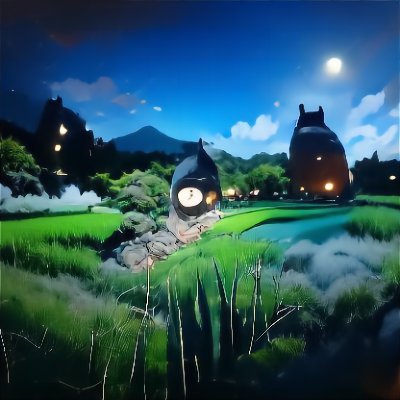
TurboEdit Instant text-based image editing discuss: We address the challenges of precise image inversion and disentangled image editing in the context of few-step diffusion models. We introduce an encoder based iterative inversion technique. The inversion network is conditioned on the input image and the reconstructed image from the previous...

16,062 Aufrufe • vor 2 Jahren •via X (Twitter)

2 Kommentare

Profilbild von Zongze Wu
Zongze Wuvor 2 Jahren

Thank you for sharing our paper. Our webpage is Joint work with Nick Kolkin, Jon Brandt, @rzhang88, @elishechtman

Profilbild von Silvio S.
Silvio S.vor 2 Jahren

Woah @blovereviews

Ähnliche Videos

InstantDrag Improving Interactivity in Drag-based Image Editing discuss: Drag-based image editing has recently gained popularity for its interactivity and precision. However, despite the ability of text-to-image models to generate samples within a second, drag editing still lags behind due to the challenge of accurately reflecting user interaction while maintaining image content. Some existing approaches rely on computationally intensive per-image optimization or intricate guidance-based methods, requiring additional inputs such as masks for movable regions and text prompts, thereby compromising the interactivity of the editing process. We introduce InstantDrag, an optimization-free pipeline that enhances interactivity and speed, requiring only an image and a drag instruction as input. InstantDrag consists of two carefully designed networks: a drag-conditioned optical flow generator (FlowGen) and an optical flow-conditioned diffusion model (FlowDiffusion). InstantDrag learns motion dynamics for drag-based image editing in real-world video datasets by decomposing the task into motion generation and motion-conditioned image generation. We demonstrate InstantDrag's capability to perform fast, photo-realistic edits without masks or text prompts through experiments on facial video datasets and general scenes. These results highlight the efficiency of our approach in handling drag-based image editing, making it a promising solution for interactive, real-time applications.

AK

71,232 Aufrufe • vor 1 Jahr

Blended-NeRF: Zero-Shot Object Generation and Blending in Existing Neural Radiance Fields paper page: Editing a local region or a specific object in a 3D scene represented by a NeRF is challenging, mainly due to the implicit nature of the scene representation. Consistently blending a new realistic object into the scene adds an additional level of difficulty. We present Blended-NeRF, a robust and flexible framework for editing a specific region of interest in an existing NeRF scene, based on text prompts or image patches, along with a 3D ROI box. Our method leverages a pretrained language-image model to steer the synthesis towards a user-provided text prompt or image patch, along with a 3D MLP model initialized on an existing NeRF scene to generate the object and blend it into a specified region in the original scene. We allow local editing by localizing a 3D ROI box in the input scene, and seamlessly blend the content synthesized inside the ROI with the existing scene using a novel volumetric blending technique. To obtain natural looking and view-consistent results, we leverage existing and new geometric priors and 3D augmentations for improving the visual fidelity of the final result. We test our framework both qualitatively and quantitatively on a variety of real 3D scenes and text prompts, demonstrating realistic multi-view consistent results with much flexibility and diversity compared to the baselines. Finally, we show the applicability of our framework for several 3D editing applications, including adding new objects to a scene, removing/replacing/altering existing objects, and texture conversion.

AK

62,768 Aufrufe • vor 3 Jahren