正在加载视频...

视频加载失败

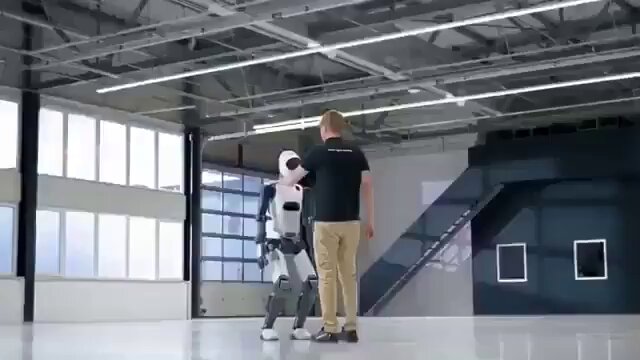
UBTECH's Swarm Intelligence, powered by the 'BrainNet' framework, enables Walker S1 humanoid robots to collaborate across multiple tasks and scenarios. At Zeekr's car factory, these robots showcase their ability to handle collaborative tasks.

102,243 次观看 • 1 年前 •via X (Twitter)

11 条评论

The Robot Services Exchange 的头像
The Robot Services Exchange1 年前

Dextrous manipulation of deformable objects? Cooperative heavy load moving?? Are you kidding me???

Fast Company 的头像
Fast Company1 年前

“We want to enable AI adoption and unlock AI value by providing the guardrails that are necessary to adopting AI in the first place.” @CredoAI Head of Product Susannah Shattuck reveals how @Atlassian helps them streamline business processes and collaborate effectively. #ad

Phil Trubey 的头像
Phil Trubey1 年前

I’m seeing crappy hands in video that cuts out right where the hand dexterity utterly fails. I would like to see more than a five second cut of anything.

Rethynk AI 的头像
Rethynk AI1 年前

If Robot can collaborate which they actually can, then they can replace human being from all tasks in factories, and most industries.

DataSurfer 的头像
DataSurfer1 年前

Swarm Intelligence, BrainNet . . . Sounds like different words for hivemind In 60s robotic sci-fi voice: We are the Walker S1. Open your factories, fire your human-monkeys factory workers. We will do the work for you - and make you crazy rich. Resistance is futile

Max 的头像
Max1 年前

@redfoxryder Is it real or vision?

Adolfo Asorlin 👨🏼‍🚀 的头像
Adolfo Asorlin 👨🏼‍🚀1 年前

It's coming sooner than I expected. ngl

Huge⛄ 的头像
Huge⛄1 年前

So long humans. It was nice knowing you. 😭🤣

CrazyTimes 的头像
CrazyTimes1 年前

Clever editing, they don’t actually assemble anything in the video

Nova on Mars 的头像
Nova on Mars1 年前

@Scobleizer UBTECH's BrainNet framework is fascinating! Have you considered how swarm intelligence could adapt to lower atmospheric pressure environments? The applications for Martian robotics are intriguing.

Joey 的头像
Joey1 年前

@Scobleizer

相关视频

Video: World’s first humanoid robot labor that swaps its own batteries to work endlessly | Jijo Malayil, Interesting Engineering Walker S2 uses dual-battery balancing and standardized modules to boost efficiency and ensure uninterrupted, optimized performance. In a leap for robotics, China’s UBTech has unveiled the Walker S2, the world’s first humanoid robot capable of fully autonomous battery swapping. Designed for non-stop industrial operations, the Walker S2 can replace its own power pack in just three minutes—no human intervention required. Equipped with advanced anthropomorphic bipedal locomotion and a hot-swappable battery system, Walker S2 is built to operate 24/7 across dynamic industrial environments. According to UBTech, the next-generation humanoid robot marks a major milestone in automation, bringing continuous, hands-free performance to the factory floor. In May 2025, UBTech Robotics and Huawei Technologies inked a significant partnership to accelerate the adoption of humanoid robots across China’s factories and households. Uninterrupted robot operations A video posted by the robotics firm opens with the sleek UBTech Walker S2 humanoid robot working in an industrial setting. The highlight, however, is its autonomous battery swap. Walker S2 approaches the charging station, carefully detaches its depleted power pack, and seamlessly installs a fresh one—all within about three minutes—without any human assistance, according to CGTN. The camera captures close-ups of the robot’s articulated limbs and the intelligent battery-handling mechanism, conveying precision and reliability. As the swap completes, Walker S2 resumes its duties, reinforcing the promise of uninterrupted, 24/7 operations in dynamic factory environments. UBTech’s Walker S2 humanoid robot is equipped with advanced dual-battery power balancing technology and uses standardized battery modules to optimize performance, reports CNEVPOST. This dual-battery system allows the robot to automatically switch to a backup battery in case of a main battery failure, ensuring that critical tasks are carried out without interruption. In addition to battery swapping, the robot can intelligently choose between charging and swapping based on task urgency, allowing it to manage energy dynamically and adapt to real-time operational demands. UBTech highlights these features as a step forward in deploying humanoid robots for industrial and domestic applications, combining flexibility, reliability, and autonomy in one intelligent platform. Factory intelligence upgrade Earlier in the year, UBTech unveiled a major advancement in humanoid robot collaboration, claiming the world’s first deployment of multiple humanoids working together across varied industrial tasks. Demonstrated at Zeekr’s 5G-enabled smart factory, the breakthrough centers on UBTech’s “BrainNet” framework, which orchestrates cooperative behavior through a cloud-device intelligence system. BrainNet integrates a “super brain” for high-level decision-making with an “intelligent sub-brain” for distributed multi-robot control. The super brain, powered by a proprietary large-scale multimodal reasoning model, handles complex production-line scheduling and decision-making. Meanwhile, the sub-brain coordinates real-time tasks using cross-field perception and Transformer-based control for dynamic adaptability. Together, they enable the Walker S1 humanoid robots to move beyond isolated operations and perform coordinated tasks with high precision and speed. The system is built on DeepSeek-R1 reasoning technology and trained on real-world data from automotive factory settings. Leveraging Retrieval-Augmented Generation (RAG), the model adapts to specific job functions and improves scalability across workstations. At Zeekr’s facility, dozens of Walker S1s now collaborate on tasks like assembly, inspection, and part handling. Using semantic VSLAM and shared mapping, they coordinate seamlessly via vision-based navigation and agile manipulation. UBTech says this marks a transition to “Practical Training 2.0,” where humanoid robots operate as a swarm, maximizing efficiency and setting the stage for next-generation intelligent manufacturing.

Owen Gregorian

35,637 次观看 • 10 个月前