Video yükleniyor...

Video Yüklenemedi

Ana Sayfaya Dön

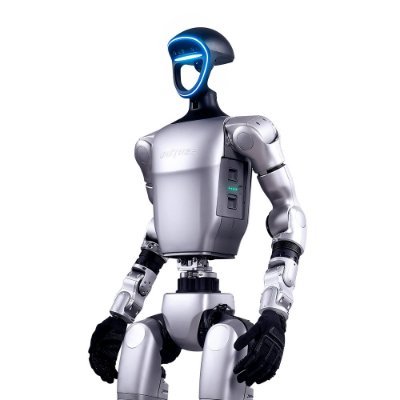
Unitree Introducing | Unitree G1 Humanoid Agent | AI Avatar Price from $16K 🤩 Unlock unlimited sports potential(Extra large joint movement angle, 23~34 joints) Force control of dexterous hands, manipulation of all things Imitation & reinforcement learning driven #Unitree #AI
1,670,166 görüntüleme • 2 yıl önce •via X (Twitter)

10 Yorum

Unitree profil fotoğrafı
Unitree2 yıl önce

Unitree G1 joint parameter correction: G1 can choose 23~43 joints

vittorio profil fotoğrafı
vittorio2 yıl önce

this is domestic abuse btw

Yossi Dahan profil fotoğrafı
Yossi Dahan2 yıl önce

When our AI overlords arrive, I want it on record that I'm against punching robots. Just putting that out there!

techAU profil fotoğrafı
techAU2 yıl önce

The last slide.. Unitree trying to make this thing run... fast.. like Usain Bolt fast.

Amanda Jean profil fotoğrafı
Amanda Jean2 yıl önce

🤔🤨

BAIJ profil fotoğrafı
BAIJ2 yıl önce

The Tesla Uberbulls are sweating this morning lol

DrKnowItAll profil fotoğrafı
DrKnowItAll2 yıl önce

Outstanding work, folks! If any of your team wants to come on my channel and discuss G1 and/or H1, please DM me and we'll get it set up!

Jesse Wood profil fotoğrafı
Jesse Wood2 yıl önce

Roko's Basilisk will remember those punches fondly.

William Lamkin profil fotoğrafı
William Lamkin2 yıl önce

Awesome! The hollow joint wiring allowing for omnidirectional limb movement seems to be on parity with the new Atlas bot from Boston Dynamics. Seems this is becoming a common design paradigm, which makes sense and is cool to see how engineers are getting the most out of the humanoid form factor

Quintus 🏛️ profil fotoğrafı
Quintus 🏛️2 yıl önce

bluecollarheads really thought they were safe

Benzer Videolar

Unitree Robotics just filed to go public on March 20th targeting a $7 billion valuation. Most people have no idea what this company actually is. Here is why this might be the most important robotics IPO of the decade. Unitree shipped 5,500 humanoid robots in 2025. Figure AI shipped roughly 150. Agility Robotics shipped roughly 150. Unitree did $246 million in revenue last year, up 335% year over year, and they are actually profitable. Figure AI is valued at $39 billion with near zero revenue and is still private. Unitree wants $7 billion with real numbers. The price point is what separates them from everyone else. Their G1 humanoid sells for $13,500. Competitors charge $50,000 to $130,000. Their newest R1 humanoid launching in April starts at $4,900. Nothing comparable exists at that price anywhere in the world. They hold roughly 32% of the global humanoid market and 70% of the quadruped market. The moat is vertical integration. They self develop over 90% of core components including motors, reducers, controllers, sensors, and all software. Real clients include PetroChina, Sinopec, State Grid, and China Mobile. This is not a research project. Product is shipping at scale. This is listing on China's STAR Market, not Hong Kong, not the US, which makes access extremely difficult for international investors. The risks are real. The US House Select Committee on the CCP has formally requested Unitree be blacklisted. Their robots appeared in PLA military exercises in 2024. Tariffs have already nearly tripled the US price of the G1. $TSLA Optimus is targeting sub $20,000 pricing with automotive scale manufacturing backed by $NVDA compute. If they execute, the price advantage shrinks fast. But this is still the only profitable pure play humanoid robotics company in the world growing at 335% a year, valued at a fraction of its loss making peers. Goldman projects the humanoid market at $38 billion by 2035. Morgan Stanley goes to $5 trillion by 2050. Unitree currently holds the largest market share of any humanoid manufacturer on the planet. Full breakdown coming soon. $TSLA $NVDA

KawzInvests

73,697 görüntüleme • 3 ay önce

We trained a humanoid with 22-DoF dexterous hands to assemble model cars, operate syringes, sort poker cards, fold/roll shirts, all learned primarily from 20,000+ hours of egocentric human video with no robot in the loop. Humans are the most scalable embodiment on the planet. We discovered a near-perfect log-linear scaling law (R² = 0.998) between human video volume and action prediction loss, and this loss directly predicts real-robot success rate. Humanoid robots will be the end game, because they are the practical form factor with minimal embodiment gap from humans. Call it the Bitter Lesson of robot hardware: the kinematic similarity lets us simply retarget human finger motion onto dexterous robot hand joints. No learned embeddings, no fancy transfer algorithms needed. Relative wrist motion + retargeted 22-DoF finger actions serve as a unified action space that carries through from pre-training to robot execution. Our recipe is called "EgoScale": - Pre-train GR00T N1.5 on 20K hours of human video, mid-train with only 4 hours (!) of robot play data with Sharpa hands. 54% gains over training from scratch across 5 highly dexterous tasks. - Most surprising result: a *single* teleop demo is sufficient to learn a never-before-seen task. Our recipe enables extreme data efficiency. - Although we pre-train in 22-DoF hand joint space, the policy transfers to a Unitree G1 with 7-DoF tri-finger hands. 30%+ gains over training on G1 data alone. The scalable path to robot dexterity was never more robots. It was always us. Deep dives in thread:

Jim Fan

292,967 görüntüleme • 4 ay önce

i don't think people realize what's happening in Chinese robotics. this one manufacturer might be the most impressive AND most concerning company on Earth right now let me explain... Unitree Robotics sells a humanoid robot for $5,900. their robot dog costs $1,600 (Boston Dynamics charges $74,500 for theirs for context). you can literally buy these on Amazon today. so obviously the first question is: how is that even possible? the answer starts with a guy who couldn't pass his English exam. Wang Xingxing grew up in Zhejiang province. for his master's thesis, he decided to build a quadruped robot. budget: about $3,000. for context, $3,000 for this kinda robot is nothing. off-the-shelf servo motors alone would've eaten that twice over. so Wang did the only thing he could: he designed and machined every single component himself. motors, joints, controllers, the frame. all of it. the resulting robot was janky and imperfect. but it worked. and the video went viral globally. after graduating he joined DJI. but he quit after two months, and this is 2016, when DJI was arguably the hottest hardware company in China. walking away from that with no money to start a robotics company is a... specific kind of stubborn. he launches Unitree with $280K from a single angel investor. tiny office in Hangzhou. 50 square meters. but the money runs out fast. he can't make payroll for three years. the company almost dies in 2017. but emergency government funding arrives with days to spare. he survives, barely, and keeps building. this is where it gets really fascinating IMO. this founding constraint, building everything yourself because you literally cannot afford to buy parts, never went away. even after funding rounds started landing. even after revenue kicked in. it just became the company's permanent DNA. Unitree now manufactures 90%+ of its core components in-house. motors, reducers, controllers, encoders, LiDAR, etc the founder's $3,000 robot thesis ended up being an architectural decision that turned out to be structurally superior. think about what that means in practice. Boston Dynamics needs a better motor? they negotiate with a supplier, wait on lead times, qualify the part. but when Unitree needs one, they design theirs internally and have a new version in production within weeks. that gap compounds every cycle. Unitree shipped three separate humanoid platforms in 18 months. Figure AI has shipped one. Tesla has shipped zero commercially. the results are getting hard to dismiss. 23,700 robot dogs shipped in 2024 (roughly 70% of the entire global market). 7,000+ humanoids deployed. over 600 industrial sites running their quadrupeds. $140M+ revenue, profitable every year since 2020. for perspective: no Western humanoid competitor is profitable. not one. OK. now here's where the "most concerning" part of this starts... if you watched the DJI story unfold, you already recognize the shape. affordable Chinese hardware quietly saturates global markets. years later, the national security questions arrive, after the install base is already massive. drones, then EVs, then AI. now robots. Unitree is running this exact playbook in real time. in April 2025, researchers found an undocumented backdoor in their Go1 robot. a remote tunnel letting anyone control the robot and stream its camera feed. default password: pi/123. 1,919 vulnerable units exposed globally. including machines at MIT, Princeton, and Carnegie Mellon. but it gets worse. every Unitree robot shares the same hardcoded encryption key. encrypt the word "unitree" and you get root access to any of them. one compromised robot can spread to every Unitree robot in Bluetooth range automatically. a literal robot botnet. the G1 quietly transmits sensor data to Chinese servers every five minutes. audio, video, GPS, LiDAR spatial mapping, with no notification, no consent, no opt-out. PLA footage has shown Go2 robots with mounted weapons. Ukrainian forces literally deployed weaponized units on the actual frontline. and every member of the bipartisan House China Committee signed a letter calling for Unitree's military company designation. Wang signed a 2022 pledge alongside Boston Dynamics not to weaponize robots. but pledges don't survive contact with shipping hardware to open markets. and under China's 2025 rules restricting military-related speech, Unitree couldn't publicly confirm PLA use even if they wanted to. 50,000+ of these robots are now deployed globally. some at institutions that probably should've asked harder questions before connecting them to their networks. the security stuff is real and people should know about it. but i also think it's important not to let that overshadow what's actually been built here. a 35-year-old who failed his English exam created a robotics company that's outshipping and outpricing every Western competitor while being the only profitable humanoid maker on Earth. most impressive and most concerning company in the world right now.

Ole Lehmann

122,425 görüntüleme • 4 ay önce

Not a preplanned motion sequence. A robot deciding mid-jump what to do next. [📍 paper + demo] Researchers just showed a humanoid doing real parkour using only onboard perception. No motion script, no fixed obstacle layout. The system is called Perceptive Humanoid Parkour (PHP). Instead of memorizing a path, the robot reads depth from its cameras and continuously chooses actions. Step, vault, climb, or roll depending on what geometry appears in front of it. To make that possible, they combine three ideas: First, they stitch together human motion clips into long movement references so the robot learns fluid transitions instead of isolated tricks. Second, they train tracking policies with reinforcement learning so contacts land at the right time and the robot keeps balance during dynamic moves. Finally, everything is distilled into one perception policy that runs directly from depth input to action selection. The result on a Unitree G1: about 3 m/s vaults wall climbs up to 1.25 m nearly one minute continuous obstacle traversal adapting when obstacles move What matters is not the tricks. It is the shift in capability. Earlier humanoids executed motions. This one navigates situations. Once robots react to geometry instead of replaying trajectories, environments stop needing to be predictable. Warehouses, homes, and outdoors suddenly become the same problem. Thanks for sharing, Zhen Wu! Paper + demo: ——— Weekly robotics and AI insights. Subscribe free:

Ilir Aliu

22,080 görüntüleme • 4 ay önce

China unveils humanoid robot worker with brain that runs 275 trillion ops/sec | Jijo Malayil, Interesting Engineering In tests, SUYUAN used vision and joint control to sort and move crates of various sizes, greatly improving warehouse productivity. Chinese manufacturing firm Shanghai Electric has unveiled its first self-developed industrial humanoid robot, “SUYUAN,” marking a major milestone in its robotics journey. Debuting at the World Artificial Intelligence Conference (WAIC 2025) on July 26 in Shanghai, SUYUAN boasts 38 degrees of freedom and 275 TOPS of on-device computing power, enabling precise operations and fluid movements. According to the firm, designed for diverse industrial use, the robot showcases Shanghai Electric’s end-to-end capabilities—from core tech to integrated solutions—and reinforces its commitment to next-gen industrial automation through a full industry chain strategy. At WAIC 2025, Shanghai Electric also unveiled a new joint venture with Johnson Electric for next-gen humanoid robotics and showcased its “LINGKE” dual-arm robot. Recently, Hangzhou-based Unitree Robotics launched the R1 humanoid with 26 joints for $5,900, showcasing athletic feats like cartwheels, running, and quick recovery. Smart factory assistant Shanghai Electric claims SUYUAN, equipped with 38 degrees of freedom (DoF) and a powerful 275 TOPS on-device computing processor, delivers fluid, human-like movements and high-precision operations across various industrial scenarios. Its advanced articulation and real-time processing capabilities make it highly adaptable, enabling smooth execution of complex tasks in dynamic work environments. SUYUAN, who weighs 110 pounds (50 kilograms) and is 5 feet 6 inches (167 cm) tall, was designed to have human-like proportions. Its 38-DoF articulation offers dexterity, allowing for both wide-range motion and sensitive manipulation. With a single arm, the robot can lift objects up to 4.4 pounds (2 kilograms) in weight and carry a total payload of up to 22 pounds (10 kilograms). With a walking pace of 3.1 miles per hour (5 km/h), SUYUAN is ideal for environments including assembly lines, warehousing, and logistics, according to a statement. To navigate complex industrial settings, SUYUAN combines LiDAR and binocular vision for self-guided mobility. Its 275-TOPS AI processor enables rapid data analysis and integration with large language models, allowing it to understand tasks in natural language and handle objects adaptively, reports Fox 44 News. In pilot demonstrations, the robot successfully identified, picked, and relocated crates of varying sizes using advanced computer vision and coordinated joint control—delivering measurable gains in warehouse efficiency. The company claims that SUYUAN’s launch represents a major turning point in Shanghai Electric’s foray into humanoid robotics and strengthens its vertically integrated approach to industrial automation solutions. Intelligent task handling Shanghai Electric also demonstrated its most recent developments in intelligent manufacturing at WAIC 2025, introducing a new joint venture with Johnson Electric centered on next-generation humanoid robotics and showcasing the “LINGKE” dual-arm robot. With its high-precision operations, adaptive teamwork, and closed-loop data capabilities, the LINGKE robot demonstrated live talents in handling complicated production jobs. LINGKE is made to do more than just replace human labor; it uses compliant force control and bimanual coordination to relieve workers of high-intensity, repetitive jobs. According to the company, the robot enhances operational efficiency by up to five times. Its core strength lies in a Data-Model-Deployment closed-loop system that starts with operational data, followed by data cleansing, model training, live deployment, and feedback-driven optimization—enabling autonomous learning and workflow improvement. Also at the event, Shanghai Electric and Johnson Electric introduced advanced hardware modules for humanoid robots, including rotary joints, linear joints, and dexterous finger joints. These components are designed to support smooth, precise, and quiet motion performance across robotics systems, reports Stock Titan. The joint venture announced two strategic agreements: a first-unit supply deal with the National and Local Co-Built Humanoid Robotics Innovation Center (Qinglong Project) and a cooperation memorandum with Fourier Robotics. Read more:

Owen Gregorian

51,638 görüntüleme • 11 ay önce

🚨EXCLUSIVE INTERVIEW – OPENAI’S 1ST INVESTOR: AI WILL SAVE US—OR DESTROY US Vinod Khosla was the first major investor in OpenAI. Now, he says AI will replace all human jobs, upend geopolitics, and redefine the meaning of life. Vinod breaks down the race for AI dominance—and the two futures ahead: one utopian, one dystopian. He warns China could weaponize “persuasive AI” to spread ideology, buy influence, and take over the world—not through kinetic war, but a war of the minds. He argues most of today’s jobs are “human servitude”—and that AI could finally free humanity from the burden of survival. And he believes robotics and AI will merge with our species, triggering the biggest transformation in human purpose since the dawn of civilization. This is a conversation you don’t want to miss. 02:42 – “People who don’t adopt AI will be obsoleted by those who do.” 04:29 – Productivity will explode. So will income inequality. 05:39 – Elections could soon be decided by AI’s impact on jobs. 09:21 – What if AI becomes a superintelligence with its own goals? 12:35 – “The biggest risk is AI in China’s hands.” 15:26 – Could giving AI full control make the world better? 20:16 – “The most fearsome threat is persuasive AI.” 22:12 – AI agents will protect us from other AIs. 23:33 – AI could replace 80% of jobs within 2–3 years of capability. 28:14 – We will no longer be driven by survival—but by passion. 29:58 – “Most jobs today are servitude.” 34:53 – Humans will no longer be the most intelligent species on Earth. 38:15 – Will AI merge with humans? 42:24 – “Survival will no longer drive us. That’s a first in history.” 44:39 – Could AI destroy us by simply pursuing its goals too well? 47:33 – Can AI be trained to care for us? 52:25 – Humanity never worked as one. But AI might force that reckoning. 56:52 – Should AI be allowed to make military decisions? 59:15 – “We need AI deterrence. Like nuclear deterrence.” 01:03:15 – Will humans fall in love with AI? It’s already happening. 01:07:21 – By 2040: 1 billion robots will do more labor than all humans. 01:13:01 – “AI is already better than most humans at most jobs.” 01:14:29 – “AI will free humanity to be what it wants to be.”

Mario Nawfal

2,901,330 görüntüleme • 1 yıl önce

AgiBot’s new generation of industrial-grade interactive embodied robot, AgiBot G2, has officially launched! The G2 has already secured orders worth hundreds of millions of RMB, including two separate contracts each exceeding 100 million RMB, and has begun its first commercial deliveries. The AgiBot G2 is built to industrial standards, featuring high-performance joints, precision torque sensors, and an advanced spatial perception system. It supports rapid learning and deployment, offers strong multimodal voice interaction, and is designed for general use in industrial, logistics, and guidance scenarios. Inheriting the successful "Collect-Train-Deploy" model of its predecessor, the G1, the G2 brings significant upgrades, including a high-performance AI computing platform and actuators that enable omnidirectional obstacle avoidance and high-precision force-control tasks. Its 3-DOF waist allows for human-like bending and lateral body movement. A key feature is the G2's globally first-of-its-kind cross-shaped wrist force-control arm, which uses precision joint torque sensors and joint impedance control to delicately perceive external forces and respond smoothly. For continuous operation, the G2 supports autonomous charging and features a dual-battery hot-swapping system, meeting the 24-hour cycle demands of factory production lines. During the launch event, AgiBot demonstrated the G2’s ultra-low latency remote operation (teleoperation) capabilities. Operators successfully demonstrated precision shots (like hitting a floating balloon in Shanghai while operating from Beijing), showcasing the robot's high accuracy and low latency in both line-of-sight and beyond-line-of-sight scenarios. The G2 is already being deployed across four key real-world scenarios: In automotive parts production, it assists humans with tasks like safety belt lock core pressing and material handling. In precision operations, it used reinforcement learning to master delicate tasks like inserting memory sticks in just one hour. In logistics, the G2, enhanced by AgiBot's OmniHand dexterous hand, efficiently handles various package types for sorting and loading. Its strong mobility allows it to adapt to over 95% of factory floors. AgiBot is also commencing the first batch of commercial deliveries under an over 100 million RMB procurement contract with Joyson Electronic, formally landing the G2 in the automotive parts manufacturing sector.

RoboHub🤖

33,831 görüntüleme • 9 ay önce

China’s pretty humanoid robot stuns by opening a car door in a ‘world’s first’ | Jijo Malayil, Interesting Engineering Mornine used onboard sensors and full-body control to locate the handle, adjust posture, and open a car door—no human input needed. AiMOGA Robotics has claimed to have reached a significant milestone in embodied AI with its humanoid robot, Mornine, autonomously opening a car door inside a functioning Chery dealership in China. Relying solely on onboard sensors, full-body motion control, and end-to-end reinforcement learning, Mornine performed the task without any human input. Unlike scripted or teleoperated robots, Mornie identified the door handle, adjusted its posture, and used coordinated force across its limbs and torso to complete the action—demonstrating advanced autonomy in a real-world setting. “The deployment marks one of the first instances of a service robot executing such a high-friction, physical interaction in a live commercial setting,” said the firm in a statement. In April, at the Shanghai Auto Show, automotive brands Omoda and Jaecoo, subsidiaries of Chery Automobile, introduced Mornine, designed for use in car dealerships. From sim to service Opening a car door may seem like a simple task, but AiMOGA Robotics views it as a pivotal moment in robotics—signaling a shift from simulation to real-world service, and from basic command execution to autonomous capability. Using only onboard sensors and full-body motion control, Mornine identified the door handle, adjusted her posture, and applied coordinated force across her limbs to open the door—entirely without human intervention. Mornine’s advanced sensor suite includes 3D LiDAR, depth and wide-angle cameras, and a visual-language model (VLM), enabling real-time perception of door position and opening status. Uniquely, Mornine wasn’t explicitly programmed to recognize door handles. Instead, she learned through reinforcement learning, undergoing millions of simulated cycles to focus on the right region and perform the task independently. “We never explicitly told the robot what a door handle is. It learned to focus on that region by itself,” said the engineering team at AiMOGA Robotics in a statement. The learned model was transferred to the real world using Sim2Real methods. Mornine continuously gathers live sensor data during operation, which feeds into a cloud-based training loop, allowing her to improve through continuous learning in real-world settings, reports Robotics Tomorrow. Now active in multiple Chery 4S dealerships in China, Mornine not only opens car doors but also assists with customer greetings, vehicle introductions, and item delivery—marking a step forward in humanoid robotics for commercial retail environments. AI meets retail Originally introduced as the AiMOGA Robot, Mornine was developed to support dealership sales by performing tasks such as explaining vehicle specifications, leading showroom tours, serving refreshments, and engaging with customers in multiple languages. First conceived by Chery as a virtual character to appeal to Generation Z using metaverse and virtual human technologies, Mornine gradually evolved into a real-world interactive humanoid. After multiple iterations of character and model design, Mornine debuted as a digital persona in animations, livestreams, and promotional content, gaining brand recognition. Chery later expanded the concept beyond the virtual space, resulting in the creation of the AiMOGA humanoid robot. Leveraging Chery’s expertise in autonomous driving, environmental sensing, and control systems, AiMOGA features full-stack capabilities in perception, cognition, decision-making, and execution. It uses multimodal sensing—combining speech, vision, and environmental data—to interpret user gestures, commands, and showroom dynamics. A bionic motion system and automotive-grade hardware enable dexterous movement and upright mobility, while multi-robot collaboration allows for coordinated tasks like guided tours. At the decision-making layer, Deepseek’s large language models enable natural language understanding and personalized interaction. In April 2025, Mornine officially began commercial service as an “Intelligent Sales Consultant” at the OMODA C5 JOYSTAR 4S dealership in Kuala Lumpur, Malaysia—marking her full transition from a virtual concept to a real-world humanoid sales assistant.

Owen Gregorian

67,975 görüntüleme • 11 ay önce

We are back again :) After three weeks of quiet building. Introducing Genesis World 1.0, our latest simulation platform, the second release in our full-stack suite. Open-sourced. Robotics is still bottlenecked by the 1× speed of the physical world. Every model, checkpoint, and data recipe eventually needs to be tested on physical hardware, slowly, expensively, and with limited coverage. One hour in reality can become 100 days in simulation. That is how robotics model iteration moves from a wall-clock bottleneck to a compute problem. To make this work, simulation has to be both fast and trustworthy. Over the past year, we rebuilt the entire stack: a GPU-accelerated cross-platform compiler, penetration-free multi-physics contact solvers, unified rigid and deformable physics, and a photo-realistic renderer purpose-built for physical AI applications. We built Nyx, a high-performance path-traced rendering engine for robotics application. Genesis World 1.0 achieves near realtime performance with our latest development for penetration-free IPC solver, supporting various types of deformables beyond rigid bodies. It supports contact-rich, dexterous manipulation simulation across different embodiments: unitree, sharpa, wuji, genesis hand and various types of grippers. Under the hood is Quadrants, our effort in pushing forward cross-platform GPU-accelerated computation. Quadrants started as a fork of Taichi, and we rebuilt most of the critical parts for optimizing simulation workloads, giving 10x faster launch time and up to 4.6x runtime performance compared to the initial Genesis release. Together, they bring us to an unprecedentedly low sim-to-real gap, enabling zero-shot real-to-sim model evaluation and much faster iteration of GENE. All available today. Genesis World 1.0: Quadrants: Nyx:

Genesis AI

306,663 görüntüleme • 1 ay önce

Chamath: Frontier AI Leaders “Created a Total F*cking Mess” Short-sighted fearmongering and immaturity from frontier AI leaders has created deep mistrust, threatening AI’s potential as an open engine of economic mobility. That mistrust gives hyperscalers the chance to position themselves as trusted gatekeepers, using KYC, audit trails, and compliance infrastructure to turn AI into an oligopoly. Chamath Palihapitiya on the All-In Pod: “I think the leaders of the frontier labs leave a lot to be desired. I think what we're seeing is a consistent pattern of evasiveness and immaturity, and I think that does a huge disservice to the entire movement of AI. The key to a vibrant life is rooted in economic mobility, and I think AI is the grand leveler. It is the thing that can enable everyone to have unique amounts of economic mobility because they are unencumbered to figure out what their upper bound is. And against that backdrop, we have to live in this constant doomerism, hype cycle, naivety, and I think it holds us back. How does it hold us back? Tactically, number one, it creates mistrust. I think that Silicon Valley was already decaying in the prestige that it held in American society. We built important things. Then we veered away from that, and we started building less important things. And now we're at a point where we've potentially started to rebuild important things again, but we have this veneer of negativity and mistrust that are created in large part because we just cannot get our sh*t together. And the leaders of the frontier labs are public enemy number one. Number two, I think what it creates, which I think is bad, but what it creates is an incredible opportunity for the hyperscalers. And the very simple opportunity is to convince governments all around the world, not just America, that they should be the gatekeeper. A: You can't trust these guys. B: These models are all over the place. C: Let us be the ones that provision them to the world. We will wrap it in KYC. I've been now talking about KYC for a while, right? Who are these customers? Do they have identification? Why are they allowed to run these models? What are they prompting? Let's keep them so that there's an audit trail. All of these things are going to become issues. The Frontier Lab folks made it an issue because of how they've handled all of this up until now. And what does that create? Now that creates an oligopoly for AI, the most powerful economically leveling instrument we've ever seen in the hands of maybe a handful of hyperscalers, who by the way, would make an incredibly compelling argument, and they would be right. And the only counterfactual to it would be, ‘Well, trust us, guys, it should actually be much more open and in a far more distributed environment.’ Can you imagine the cost and the complexity if you ask the neoscaler to build the same robust KYC or the same VPC infrastructure that Amazon and Microsoft and Google have spent decades investing trillions of dollars in? It's an impossibility, Jason. So you can take all of those datacenters off the map. You can take all of the neoscaler market off the map. All of this was preventable. So instead of a diverse, robust, open ecosystem giving a tool that is the fundamental unlock for humans, we are now going to debate gatekeeping and duopoly versus oligopoly. They have created a total f*cking mess, and it's a shame.”

The All-In Podcast

141,660 görüntüleme • 23 gün önce

Ahmedabad Crime Branch is making use of technical measures to avoid any stampede kind of situation. Anti stampede visual analytics,using reference area and crowd movement, head count algorithm. Anti-stampede algorithms on CCTV cameras are a crucial advancement in crowd management, leveraging AI and image processing to prevent dangerous situations in densely populated areas. Here's a breakdown of their usage: How they work: Real-time monitoring: AI-powered CCTV cameras continuously analyze video streams in real-time. Crowd density estimation: Algorithms calculate the number of people in a given area. This can involve: Pixel-based analysis: Converting images to black and white and counting "black pixels" (representing people). Object detection: Using machine learning models (like Mask R-CNN) to identify and count individuals, often by detecting heads or torsos. Thresholding: Pre-defined "threshold values" for crowd density are established. When the detected density crosses these thresholds, it triggers an alert. Anomaly detection: Beyond just density, these algorithms can identify unusual crowd behaviors such as: * Sudden surges in movement. * Unusual clustering patterns. * Fallen individuals. * Aggressive movements. Alerting authorities: Upon detecting a potential stampede risk, the system sends immediate alerts to security personnel or control rooms via LCD displays, GSM messages, or other communication channels. Predictive analytics: Some advanced systems use time-series prediction models to forecast crowd behavior and dynamics based on historical and real-time data, helping anticipate potential bottlenecks or overcrowding. Reinforcement learning: Algorithms can learn from past incidents to suggest optimal crowd flow routes and alternative evacuation paths during emergencies. Benefits: Proactive prevention: The primary benefit is the ability to detect and warn of potential stampedes before they occur, allowing authorities to take preventative measures. Real-time insights: Provides immediate and accurate data on crowd density and movement, far surpassing manual observation. Enhanced safety: Significantly improves safety in public spaces by reducing human error and enabling swift responses to risks. Optimized resource allocation: Helps in better deployment of security personnel and resources to areas with high crowd density. Improved efficiency: Automates a labor-intensive task, freeing up human operators for more complex decision-making. Data for future planning: The collected data can be analyzed to improve crowd management strategies for future events. Challenges: Accuracy limitations: While advanced, AI algorithms can still face challenges with: Occlusion: People blocking each other, making accurate counting difficult. Varying conditions: Changes in lighting, weather, and camera angles can affect accuracy. Bias in training data: Can lead to false positives or inaccurate detections. Computational complexity and cost: Developing and deploying such systems can be expensive due to the need for high-resolution cameras, powerful processing units, and sophisticated algorithms. Data privacy and ethical concerns: The extensive use of CCTV and AI raises concerns about individual privacy and potential misuse of data. Integration with existing infrastructure: Integrating new AI-powered systems with older CCTV networks can be complex. Human intervention still crucial: While AI can alert, human responders are still essential for effective intervention and crowd dispersal. As seen in the Kumbh Mela example, even with AI alerts, a lack of ground personnel can limit effectiveness. Defining thresholds: Determining appropriate crowd density thresholds for different environments and cultural contexts can be challenging. Real-world applications: Large public gatherings: Religious festivals (like the Kumbh Mela in India, which has used AI for crowd management), concerts, sports events, and political rallies. Transportation hubs: Railway stations, airports, and bus terminals to manage passenger flow. Shopping malls and commercial centers: To monitor crowd density during peak hours and special events. Stadiums and arenas: For managing ingress, egress, and crowd movement during events. Tourist attractions: To prevent overcrowding at popular sites. Overall, anti-stampede algorithms on CCTV cameras represent a significant leap forward in ensuring public safety, offering a powerful tool for proactive crowd management. However, their successful implementation requires careful consideration of technological limitations, ethical implications, and the continued need for effective human intervention. Ahmedabad Police અમદાવાદ પોલીસ Vijay Patel | Megh Updates 🚨™ | Akash Anand | | #BengaluruStampede | #Stampede

Janak Dave

339,717 görüntüleme • 1 yıl önce

We're excited to launch 🚀Airtable AI Assistant 🚀 today, along with AI document analysis and AI web research capabilities! Airtable was founded 12 years ago with the mission of democratizing software creation. Our pioneering innovation was to distill app-building concepts (data, logic, interface) into intuitive visual components, like a no-code lego kit for app building. At the time, we speculated that someday, maybe AI would get good enough to enable conversational app building–talking to an expert AI app builder–and be a huge unlock, making app building even more accessible. We’re now at that point. While surprisingly impressive text generation and manipulation by LLMs was the breakthrough of the 2022 ChatGPT moment, the emergence of surprisingly impressive reasoning capability from LLMs is the breakthrough of 2025. This is unlocking more autonomous agentic experiences, and generating apps and code is the first killer use case (Cursor, @windsurf, Devin, v0, bolt.new, Replit ⠕ Agent to name a few). But for the large class of non-technical builders, a different approach is needed. When AI generates apps with code, rather than no-code building blocks, it requires a developer to fully understand how they work – and to verify them for hidden mistakes that would be tricky/impossible to debug by interface inspection alone (it may look right, but what is the data model business logic is flawed in non-obvious ways?). Airtable Assistant is an agent that can build and modify Airtable apps through conversation, changing schemas, adding automations, and designing interfaces. You can ask it to do things like: –“Research every conference attendee in this base” to have the Assistant immediately spin up an army of researchers that pull in background information for your attendees –“Analyze each contract to identify key risks they pose to my business” to have the Assistant add an AI field that runs an analysis at scale for each contract you’ve signed. Airtable Assistant can also answer questions about the data in your apps, like prompts as advanced as: –“I'm about to meet Jane Smith at Zelos, read all of their recent sales call transcripts and tell me how far along they are in their implementation and if they’re dealing with any issues” –“What are the most common risk factors in our contracts? Are there any changes to our default posture we might consider?” Credit to Mike Krieger for introducing us to the concept of low floor and high ceiling in HCI many years ago, which has become part of our internal lexicon for thinking about product improvements. Assistant dramatically lowers the floor to building apps, including more sophisticated ones, by helping human builders translate their business requirements into the schema design, logic, and interfaces required to deliver on the use case. In addition to launching Airtable Assistant today, we’re also releasing the capability to deploy thousands of AI web researchers, and AI document analysts, to continuously work on the data in Airtable apps. You can do things like: –Pull strategy and value stories from every product requirement doc to draft launch and release messaging –Monitor all brand mentions across digital channels to measure campaign impact –Create an automatically updating competitive intelligence dossier with the latest news and messaging from every competitor in your industry Check it out 👇

Howie Liu

2,313,248 görüntüleme • 1 yıl önce

AgiBot has formally unveiled its G2 humanoid robot, a system designed to transition into various industries and liberate humans from repetitive labor. G2 features high-performance joints, precision torque sensors, and an advanced spatial perception system, supporting quick deployment and multi-modal voice interaction. ► Factory Floor Performance: The G2 is engineered to industrial standards. In a safety belt lock production line, robots collaborate with human workers, performing tasks like pressing lock cores. The G2 collects production data to continuously train and iterate models (local server deployment ensures data privacy), steadily improving its operational ability. ► Mobility & Safety: The G2 navigates narrow factory aisles using dual LiDAR and full-panorama vision for environment sensing and collision detection. Its chassis is designed to overcome common obstacles (speed bumps, elevator gaps). It supports 24/7 continuous operation via autonomous return-to-charge and battery swapping. ► Humanoid Design Advantage: The G2's design includes a three-degree-of-freedom flexible waist, allowing it to mimic natural human movements like bending and side-leaning. This dramatically expands its operational workspace and enables seamless integration into existing human-centric production lines without costly modifications. ► Advanced Dexterity & Learning (Lab): The new G02 arm is the world's first cross-moment arm, featuring high-precision joint torque sensors that allow it to precisely sense external forces and adjust stiffness, mimicking human hand compliance. Using Real-Machine Reinforcement Learning (RL), the G2 can learn complex, delicate tasks like memory stick insertion in about one hour with minimal human intervention. ► Logistics & Grasping: In logistics sorting, the G2 uses a 19-degree-of-freedom mechanical dexterous hand (20N maximum fingertip force; 35kg capacity for hard objects) equipped with 3D tactile sensors to ensure it grasps securely without damaging items. Its full-body articulation (waist and legs) aids grasping and posture adjustment. ► Model & Data: G2's intelligence is powered by the Go-One Large Embodied Model (VLA architecture: Vision-Language-Latent Action) and the GE-One World Model (vision-centric predictive modeling), trained using the AgiBot Word true-machine dataset (over 500k downloads). ► Service & Interaction: The G2 is deployed as a guide/receptionist in settings like art museums. It uses its high-DOF head, arms, and waist to point to exhibits, maintains eye contact while navigating difficult spaces (chassis walks forward, body faces backward), handles specialized and random queries, and uses proactive safety features (stops movement, issues warnings) when people get too close.

RoboHub🤖

46,733 görüntüleme • 9 ay önce

PROJECT MAVEN and the U.S. Military's Cutting-Edge Arsenal of AI-Driven Warfare and Directed Energy Weapons. This is an important deep dive into one of the U.S. Department of War's most transformative initiatives, a game-changer that's reshaping modern warfare through artificial intelligence. Launched in 2017 under the Algorithmic Warfare Cross-Functional Team, Project Maven isn't just another tech buzzword; it's the Pentagon's flagship AI program designed to supercharge military intelligence by automating the analysis of vast troves of data from drones, satellites, and surveillance feeds. Highlighting how Maven uses machine learning and computer vision to detect, classify, and track targets in real-time, compressing the "kill chain" from hours to minutes. The weapon and defense systems powering this revolution, including the seamless integration of Directed Energy Weapons (DEWs). Project Maven serves as the brain, processing petabytes of imagery to identify threats like enemy vehicles, personnel, or infrastructure with pinpoint accuracy—far beyond what human analysts could achieve alone. Initially deployed against ISIS in 2017, it fused data from full-motion video (FMV) and other sensors to flag potential strikes, always with human oversight in the loop to ensure ethical decision-making. Today, under the National Geospatial-Intelligence Agency (NGA), Maven has expanded to all military branches—Army, Air Force, Space Force, Navy, and Marines—via platforms like the Maven Smart System (MSS). MSS isn't just about detection; it's a force multiplier, enabling rapid targeting in exercises like Scarlet Dragon, where it slashed manpower needs from thousands to mere dozens while handling complex scenarios in CENTCOM and beyond. Now, pair this AI prowess with the U.S. military's Directed Energy Weapons, and you get a lethal, futuristic synergy. DEWs harness concentrated electromagnetic energy—think high-energy lasers (HELs) and high-power microwaves (HPMs)—to neutralize threats without traditional munitions, offering infinite "ammo." These aren't hypothetical; they're operational and evolving rapidly. High-Energy Lasers (HELs), systems like the Navy's HELIOS (High-Energy Laser with Integrated Optical-Dazzler and Surveillance) aboard destroyers like the USS Preble deliver speed-of-light strikes to down drones, missiles, or small boats for pennies per shot. Integrated with Maven's AI targeting, HELIOS can acquire, track, and zap threats in swarms, as demonstrated in recent Pacific tests. The Army's DE M-SHORAD (Directed Energy Maneuver-Short Range Air Defense) prototype, mounted on Stryker vehicles, recently shredded drone swarms at Fort Sill, blending lasers with kinetic defenses for layered protection. High-Power Microwaves (HPMs), weapons like the Air Force's THOR (Tactical High-Power Operational Responder) unleash radiofrequency waves to fry electronics in drones or missiles from afar, covering wide areas with a single pulse. In urban or congested environments, HPMs provide non-lethal options, disrupting signals without collateral damage—perfect for Maven-identified targets in sensitive ops. Broader Defense Ecosystems, Maven feeds into systems like the Joint All-Domain Command and Control (JADC2), linking sensors across domains for seamless ops. DEWs complement this by offering scalable effects—from dazzling sensors (e.g., Vigilant Eagle for airport defense) to outright destruction. The Pentagon's Directed Energy Roadmap, with $1 billion annual investments, pushes for higher power outputs to tackle hypersonic threats, while initiatives like the High Energy Laser Scaling Initiative bolster industrial production. What makes this combo so revolutionary? Speed, precision, and cost-efficiency. Maven's AI spots the threat; DEWs eliminate it at light speed, with deep "magazines" that outlast ammo stockpiles. Project Maven is the spark igniting this fire, keeping the U.S. ahead in an era where data and energy are the ultimate weapons.

The SCIF

21,324 görüntüleme • 6 ay önce

The Dark Evolution of Mind Control: From MKULTRA, DEWs, Professor Delgado's remote bull, to modern remote Neuro-Weapons. We are able to control minds in ways you never thought possible. In the 1960s, Yale neuroscientist Dr. José Delgado pioneered brain stimulation techniques that shocked the world. Using implanted electrodes called "stimoceivers," he could remotely control animal behavior via radio signals. In his most famous experiment in 1963, Delgado stepped into a Spanish bullring armed only with a remote control. As a raging bull charged, he pressed a button, stimulating the animal's caudate nucleus, a brain region linked to movement and aggression, forcing it to skid to a halt just feet away. Similar implants in monkeys allowed him to trigger emotions like rage, calm, or even social hierarchy shifts, where subordinate monkeys learned to "control" aggressive ones by flipping levers that pacified them. Delgado's work extended to humans, where he induced euphoria, anger, or involuntary movements by stimulating limbic system areas, hinting at a future where brains could be "programmed" like machines. Delgado himself noted the shift from electrodes to non-invasive methods, like low-power pulsing magnetic fields to alter monkey behavior without wires. This laid the groundwork for today's neuro-technologies, where intelligence agencies, big tech, and shadowy networks reportedly deploy remote tools for surveillance and manipulation, far beyond invasive implants. Fast-forward to now, declassified documents and patents suggest advancements in remote neural monitoring (RNM), voice-to-skull (V2K), and directed energy weapons (DEWs) enable real-time brain reading, emotion control, and behavioral influence using radio frequencies (RF), extremely low frequencies (ELF), and electromagnetic radiation. RNM purportedly tracks brain waves via satellite, decoding thoughts like a "brain fingerprint" for constant surveillance. V2K, based on the microwave auditory effect, beams voices directly into skulls, bypassing ears, potentially making targets believe they're hearing gods, demons, or commands. There are no coincidences when 90% of school shooters say they hear "demons" talking to them. "What if it was actually a person running a script on a selected target, to commit acts of violence.? DEWs, including microwaves and lasers, could induce pain, fatigue, or altered states without trace, as in Havana Syndrome cases affecting diplomats. These tools allegedly fuel "gang stalking" operations, where coordinated harassment via tech and human agents isolates targets, amplifying paranoia. Intelligence agencies like the CIA have historical ties to mind control (MKUltra), and big tech's brain-computer interfaces (BCIs) blur lines between therapy and control. Imagine manipulating a vulnerable individual, like a potential school shooter, by remotely inducing voices urging violence, then framing it as mental illness. What seems like inner demons could be an operator running a psy-op, using ELF waves to tweak emotions or RF to simulate auditory hallucinations. Or, targeting a large group of the population through specific frequencies through your own phone or tablet that cause emotional control when a specific political figure is displayed on the screen, literally manipulating your emotions or behavior without you ever knowing to mold your ideas or views... This ties into broader DEWs for mind control. High-power microwaves disrupt cognition, while advanced systems read/write thoughts in real time, scanning neural patterns to "decode" intentions or implant suggestions. The World Economic Forum (WEF) has spotlighted this, discussing "brain transparency" via wearables that track thoughts for productivity or safety, warning of a future where bosses monitor focus or AI decodes emotions. WEF sessions explore mind-reading tech, like translating thoughts to text or using AI for "full rich thoughts" transmission. AI has supercharged this field. Machine learning decodes brain signals with pinpoint accuracy, enabling BCIs like Neuralink to control cursors via thought alone. AI "co-pilots" infer intent from neural data, boosting noninvasive systems for rehab or augmentation. But in darker hands, AI could automate mass surveillance, predicting and preempting "deviant" thoughts, revolutionizing control from Delgado's crude remotes to seamless, invisible dominance. Delgado dreamed of a "psychocivilized society." Are we already there, hidden in plain sight? Pay attention because I wish I was joking about these capabilities and advancements in technology, but they're already using them on the population without you even knowing about it.

The SCIF

19,881 görüntüleme • 4 ay önce