Loading video...

Video Failed to Load

Go Home

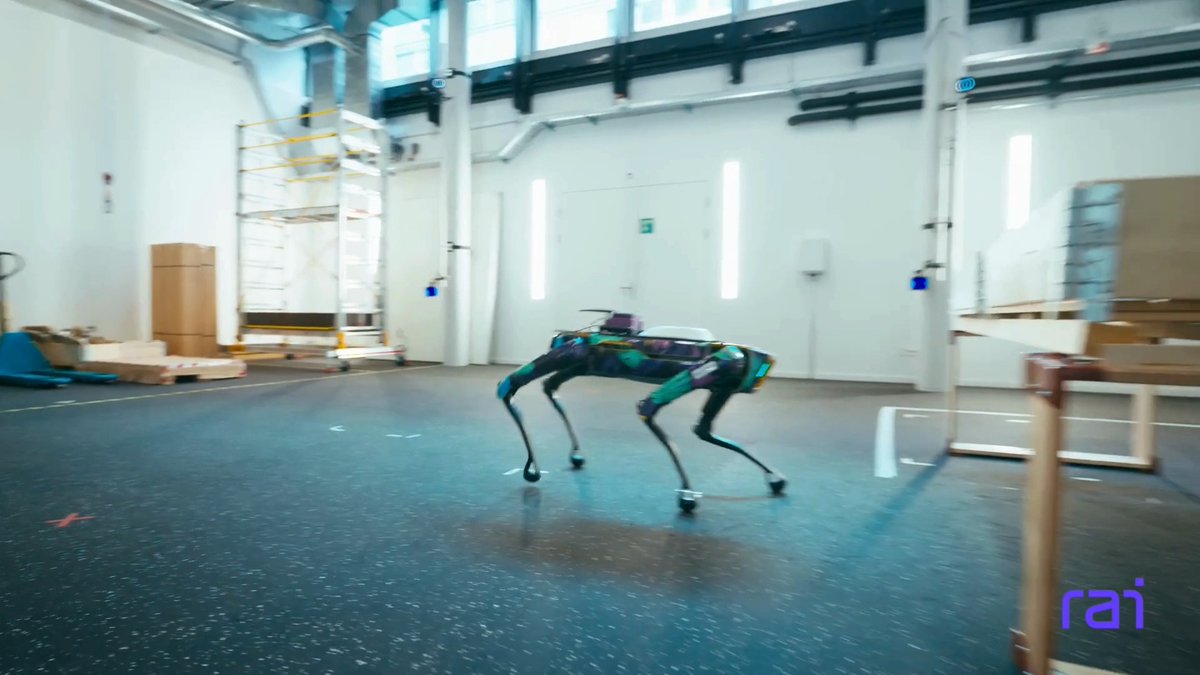
Using reinforcement learning, we trained policies for Boston Dynamics Spot that allow the robot to achieve record running speeds of 11.5 mph (5.2 m/s) — over three times faster than Spot's default max speed.

98,538 views • 1 year ago •via X (Twitter)

11 Comments

Loic Argelies's profile picture
Loic Argelies1 year ago

@BostonDynamics Need a gallop mode…

The Rundown AI's profile picture
The Rundown AI1 year ago

If you're not learning AI in 2025, you're falling behind. Join 1,000,000+ early adopters reading and learn AI in just 5 minutes a day (for free).

io.net's profile picture
io.net1 year ago

@BostonDynamics At 11.5 mph, Spot is officially faster than most humans. Sleep tight.

Victor Brink's profile picture
Victor Brink1 year ago

@BostonDynamics Great! Now teach it how a change in gait like a cheetah can multiply its top speed further... 110 km/hr (70 mph) This would be epic. The Black Mirror episode featuring a running bot is "Metalhead" for further inspiration.

Elie Aljalbout's profile picture
Elie Aljalbout1 year ago

@BostonDynamics very impressive!

TeslaElon SpaceXFan's profile picture
TeslaElon SpaceXFan1 year ago

@BostonDynamics 🥳👍

Liberty Mint's profile picture
Liberty Mint1 year ago

@BostonDynamics For sustained duration? Faster speeds achieved in sprint?

AI_TechnoKing's profile picture
AI_TechnoKing1 year ago

@BostonDynamics Galloping gears!

Rodomonte's profile picture
Rodomonte1 year ago

@BostonDynamics @AskPerplexity give me calculations on max possible physical speed for a robot of that weight

Pat Dunne's profile picture
Pat Dunne1 year ago

@BostonDynamics Yup RL.. just like motors.. it’s a thing .. welcome BD back to the race

Tom Ramirez's profile picture
Tom Ramirez1 year ago

@BostonDynamics Robot PT

Related Videos

Today, we're joined by Nikita Rudin, co-founder and CEO of Flexion to discuss the gap between current robotic capabilities and what’s required to deploy fully autonomous robots in the real world. Nikita explains how reinforcement learning and simulation have driven rapid progress in robot locomotion—and why locomotion is still far from “solved.” We dig into the sim2real gap, and how adding visual inputs introduces noise and significantly complicates sim-to-real transfer. We also explore the debate between end-to-end models and modular approaches, and why separating locomotion, planning, and semantics remains a pragmatic approach today. Nikita also introduces the concept of "real-to-sim", which uses real-world data to refine simulation parameters for higher fidelity training, discusses how reinforcement learning, imitation learning, and teleoperation data are combined to train robust policies for both quadruped and humanoid robots, and introduces Flexion's hierarchical approach that utilizes pre-trained Vision-Language Models (VLMs) for high-level task orchestration with Vision-Language-Action (VLA) models and low-level whole-body trackers. Finally, Nikita shares the behind-the-scenes in humanoid robot demos, his take on reinforcement learning in simulation versus the real world, the nuances of reward tuning, and offers practical advice for researchers and practitioners looking to get started in robotics today. 🗒️ For the full list of resources for this episode, visit the show notes page: 📖 CHAPTERS =============================== 00:00 - Introduction 04:07 - Is robot locomotion solved? 06:04 - Sim-to-real gap 08:58 - Adding semantics to policies 09:42 - Modular vs end-to-end architectures 10:29 - Planner model 12:21 - Adapting RL techniques from quadrupeds to humanoids 15:39 - Behind robot demos 18:09 - Humanoid robots in home environments 22:03 - Training approach 23:56 - VLA models 27:59 - Closing the sim-to-real gap 32:55 - Task orchestration using VLMs 36:38 - Tool use 38:10 - Model hierarchy 43:37 - Simulator versus simulation environment 44:57 - Combining imitation learning and reinforcement learning 46:42 - RL in real world versus RL in simulation 52:58 - Reward tuning and value functions in robotics 56:38 - Predictions 1:00:10 - Humanoids, quadropeds, and wheeled platforms 1:02:45 - Advice, recommended robot kits, and community pla

The TWIML AI Podcast

22,533 views • 6 months ago