Video yükleniyor...

Video Yüklenemedi

Ana Sayfaya Dön

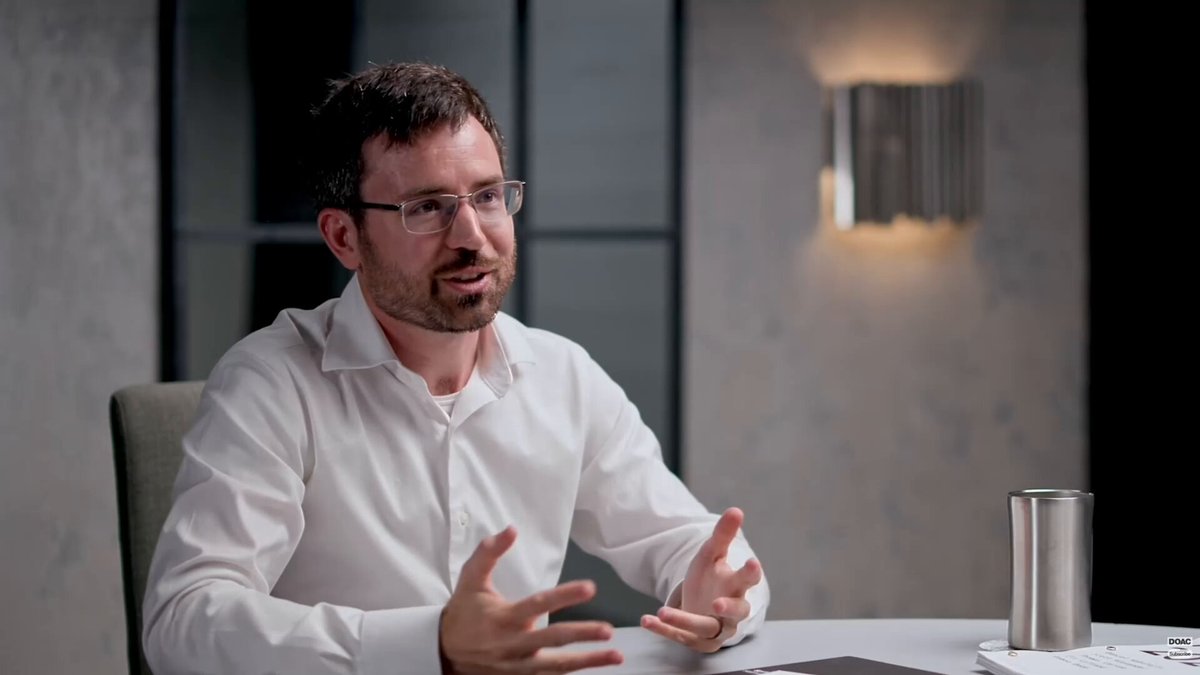
Vinod Khosla on why he does not really prefer "AI co-pilots". Because he thinks "humans get in the way of co-pilots", which slows everything down and blocks real change. He says workers like accountants and programmers do not actually want co-pilots, because they feel their jobs are at risk...

38,438 görüntüleme • 3 ay önce •via X (Twitter)

0 Yorum

Yorum bulunmuyor

Orijinal gönderinin yorumları burada görünecek

Benzer Videolar

Eric Schmidt, former Google CEO, on why top programmers won't be replaced by AI, they'll be amplified by it: He starts with an observation about the existing hierarchy in software: "The very top programmers were worth 10 times more than the ones right below. There's something special about the mathematical reasoning skills of programmers." Rather than flattening that gap, he argues AI will widen it: "Those people will become more valuable, not less valuable, because these systems need to be controlled by humans at the moment. Those people will be capable of grasping the parallelization and the activities of this." To show what this amplification actually looks like in practice, Eric shares a story from a startup he's involved with. He was talking to one of the programmers there, who works on UIs, about his daily workflow: "He said, 'I write the spec of what I want and then I write a test function, an evaluation function. And then I turn it on.' I said, 'What time?' And he goes, '7:00 in the evening.' And I go, 'Okay. What do you then do?' Well, he has dinner with his wife and he goes to sleep." Eric continues: "I said, 'Do you wake up?' Said, 'No, I sleep very well.' 'When does it finish?' 'Oh, 4:00 in the morning.' And then he gets up, has breakfast, you know, does whatever he does, and then he sees what's been good." Eric Schmidt calls the whole thing "mindboggling." The story captures what amplification really means. The programmer isn't writing less code. He's producing a night's worth of work while asleep, because the machine is running on his spec, his tests, his judgment of what "good" looks like. The leverage belongs to those who can define the problem precisely, write the tests that matter, and recognize good output when they see it.

Big Brain AI

15,319 görüntüleme • 5 ay önce

There is a very small action in The Lord of the Rings: The Fellowship of the Ring that I find increasingly unsettling the more closely I look at it: when Saruman reveals the Palantír, Gandalf immediately pulls the cloth back over it. One man wants to look. The other wants to cover up the very thing that allows him to see more. Why? If the Palantír is a tool that allows someone to see across great distances, shouldn't a wise person want to know as much as possible? And yet this scene suggests a paradox: sometimes the danger does not lie in knowing too little, but in becoming too convinced that what we know is enough to draw a conclusion. Saruman is the clearest example of this. When he shows the Palantír to Gandalf, Saruman says: “I have seen it.” The sentence sounds like a declaration of knowledge. I have seen it. I know what is happening. I understand Sauron’s power. But that is precisely the problem: seeing one thing is not the same as seeing the whole truth. The Palantír gives Saruman a wider field of vision, but a wider field of vision does not necessarily mean a complete perspective. Saruman can see Sauron’s rising power, the scale of the threat, and things an ordinary person could never see. But he cannot see everything that will ultimately determine the outcome of the war. He does not see Frodo. He does not know how far a small Hobbit can go. He does not know how loyalty, friendship, sacrifice, and seemingly insignificant choices will shape the course of history. In other words, Saruman has more information, but that does not mean he possesses the whole truth. And this is where the Palantír becomes such an interesting image of the trap of knowledge. Because information does not draw conclusions by itself. Human beings do. Saruman sees that Sauron is powerful. From that, he reasons that Sauron will win. Then, from “will win,” he arrives at “cannot be resisted.” And finally: “We must join with him.” Notice the word “must.” Saruman does not say, “I want to stand with Sauron.” He says, “We must.” A personal choice is transformed into an inevitability imposed by reality itself. That is Saruman’s real tragedy. He does not need to stop thinking in order to become corrupted. On the contrary, he continues to reason. He continues to analyze. He continues to speak in the language of rationality. He even calls his choice wisdom: “It would be wise, my friend.” And this is where intelligence begins to become a trap. Saruman has constructed a chain of reasoning in which every path leads to the same conclusion: Sauron is too powerful, therefore resisting him is futile; if resistance is futile, then cooperation is the practical choice; and if that is the practical choice, then surrender can be called wisdom. He is no longer using reason to search for the truth. He is using reason to protect a conclusion he has already accepted. That is a particularly dangerous form of self-justification: when a person begins to call what they fear something they “must” do, and then calls their surrender “reason.” And this is why Gandalf’s reaction to the Palantír is so significant. He does not argue with Saruman that knowledge is bad. He simply says: “A Palantír is a dangerous tool.” Then he covers it. Gandalf understands something Saruman has forgotten: being wise does not mean always wanting to see more. It means knowing the limits of your own understanding. There are things we need to know. But there are also things we need to recognize that we cannot fully control in the way they affect us. Gandalf does not cover the Palantír because he is afraid of the truth. He covers it because he understands that not everything we can see should be looked at in whatever way we choose. Especially because Gandalf also says: “We do not know who else may be watching.” That line completely changes the meaning of the orb. The Palantír is not merely a window through which we can look out at the world. It is also a window through which someone else can look back at us. Saruman thinks he is using the tool to observe Sauron. But eventually, Saruman himself becomes trapped in a relationship he no longer controls. This is the paradox of power: we think we are holding the tool, until we realize that the tool has begun to shape the way we see the world. And from here, the two Wizards stand before the same problem but respond to it in completely different ways. Saruman looks at Sauron’s power and concludes: We cannot win. Gandalf looks at the same thing but refuses to accept that conclusion. Not because Gandalf knows for certain that they will win. But because he understands that no one has the right to turn a possibility into a destiny simply because they cannot yet see a way out. That is why Gandalf’s question cuts so deeply: “When did Saruman the Wise abandon reason for madness?” Gandalf does not ask: “When did you become evil?” He asks: “When did Saruman the Wise abandon reason?” Because Saruman’s fall begins with the very thing that once made him powerful: his intelligence. Intelligence itself is not the problem. The problem begins at the moment a person believes their intelligence has become great enough that they no longer need to question themselves. And perhaps that is what makes the Palantír such an intriguing symbol. It is an orb designed to see far into the distance. Yet the farther Saruman sees, the narrower his world becomes. He sees Sauron and no longer sees the possibility of resisting Sauron. He sees power and no longer sees courage. He sees war and no longer sees the small people who might change its outcome. Gandalf, meanwhile, sees less, but leaves room for more possibilities. And perhaps this is the deepest difference between the two. Saruman wants a complete view of the world so that he can be certain about the future. Gandalf accepts that the future cannot be seen in its entirety. One seeks certainty. The other accepts the limits of knowledge. And in Tolkien’s world, it is the second person who remains free. Because sometimes the most dangerous thing is not that we do not know enough. It is that we know a little, reason a great deal, and then begin to believe that our conclusion is the whole truth. Saruman is not defeated by the Palantír simply because he looks into it. He is defeated by what happens afterward: he allows what he sees to become the limit of what he can imagine. And Gandalf, through an action so small that it could almost be overlooked, simply pulls the cloth back over the Palantír. As if reminding us: Wisdom does not always mean seeing more. Sometimes wisdom means recognizing that the very way we see can deceive us.

🎼🌺Music Love♥️

15,487 görüntüleme • 1 ay önce