Loading video...

Video Failed to Load

Go Home

Warren Buffett was asked if anyone could turn $10,000 into $15 million using Ben Graham's principles: "yes, if they didn't try and do too much the first week, it requires patience which a lot of people don't have" "why doesn't everybody do it?" he answered - "because people would...

110,947 views • 1 month ago •via X (Twitter)

0 Comments

No comments available

Comments from the original post will appear here

Related Videos

.Rob Miles is spitting fire: “People are starting from a prior in which ‘[AIs] are safe until you give me an airtight case for why they're dangerous.’ This framing is exhausting. You explain one of the 10,000 ways that AIs could be dangerous, then they explain why they don't think that specific thing would happen. Then you have to change tack, and then they say, 'your story keeps changing'... "If you're building an AGI, it's like building a Saturn V rocket [but with every human on it]. It's a complex, difficult engineering task, and you're going to try and make it aligned, which means it's going to deliver people to the moon and home again. People ask “why assume they won't just land on the Moon and return home safely?" And I'm like, because you don't know what you're doing! If you try to send people to the moon and you don't know what you're doing, your astronauts will die. [Unlike the telephone, or electricity, where you can assume it’s probably going to work out okay] I contend that ASI is more like the moon rocket. "The moon is small compared with the rest of the sky, so you don't get to the moon by default - you hit some part of the sky that isn't the moon. So, show me the plan by which you predict to specifically hit the moon." And then people say, “how do you predict that [AIs] will want bad things?” There's more bad things than good things! It's not actually a complicated argument... I'm not going to predict specifically where it off into random space your astronauts are going, but you're not going to hit the moon unless you have a really good, technically clear plan for how you do it. And if you ask these people for their plan, they don't have one. What's Yann Lecun’s plan?” "I think that if you're building an enormously powerful technology and you have a lot of uncertainty about what's going to happen, this is bad. Like, this is default unsafe. If you've got something that's going to do enormously influential things in the world, and you don't know what enormously influential things it's going to do, this thing is unsafe until you can convince me that it's safe." HOST: “That’s a good way of thinking about it - with some technologies you can assume that the default will be good or at least neutral, or that the capacity of a person to use this in a very bad way is bounded somehow. There's just only so many people you could electrocute one by one."

AI Notkilleveryoneism Memes ⏸️

77,397 views • 3 years ago

Peter Lynch, the man who turned $20 million into $14 billion running Fidelity's Magellan Fund, averaging 29.2% annual returns for 13 straight years (Save this). And his most famous lesson is the simplest one: "Know what you own, and know why you own it." He's talking about something that happens every day, people spend hours researching which refrigerator to buy. They'll spend days hunting for the best airfare deal to save $50 then they'll hear a stock tip on the bus and drop $10,000 on it without a second thought. "The reason I own this is the sucker is going up" Lynch said that's the actual answer he gets when he presses most investors on why they own a stock and that, he says, is not a reason. His test is brutal and simple, if you can't explain to a 10 year old in two minutes or less why you own a stock, you shouldn't own it because if you don't understand the business, you have no idea when to hold, when to add, or when to sell. You're just riding price movement blind. This is why most retail investors lose money not because they pick bad stocks but because they panic out of good ones during normal volatility. When you don't understand why you own something, every 10% dip feels like a reason to sell. Lynch built his entire career on the opposite approach, find simple businesses, understand exactly what they do, know why they'll be worth more in five years, and hold with conviction while everyone else panics. The most important thing isn't your stock screener or your price target but rather being able to look at what you own and say, I understand this, I know why it goes up, and I can handle it going down 30% without losing my mind.

StockMarket.News

170,341 views • 5 months ago

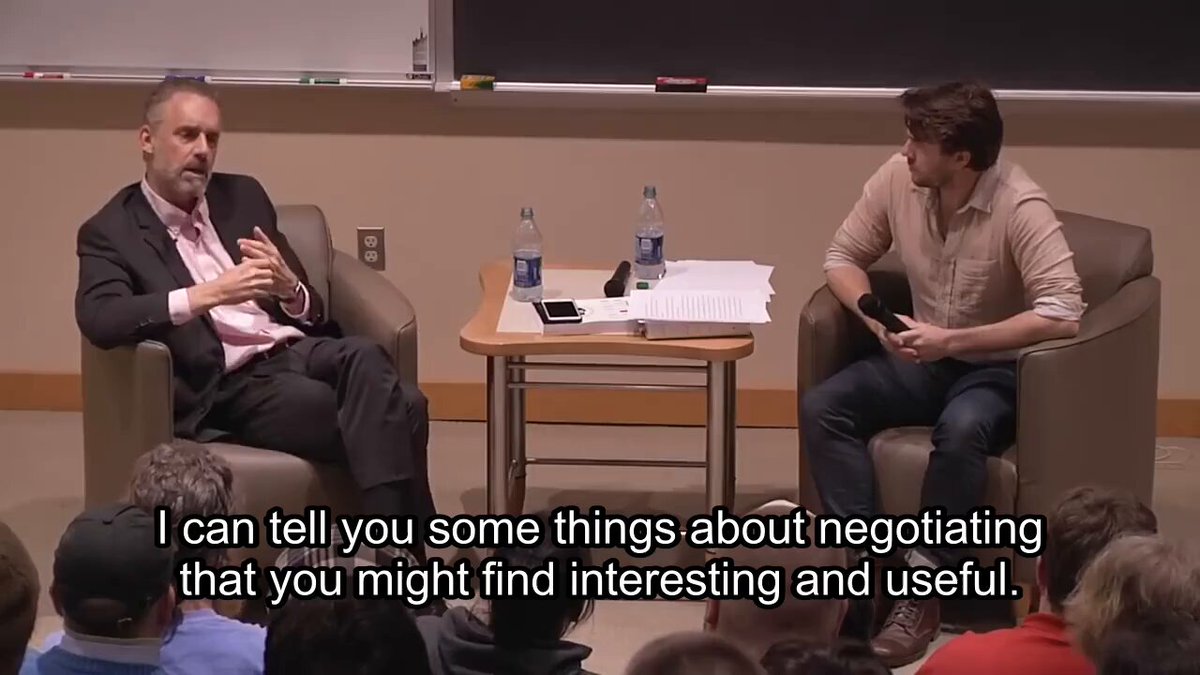
Jordan Peterson: "If you're competent and silent you will be ignored." "You might think well people should reward you because you're competent. And yes of course they should. But if you're competent and silent then you're just part of the background that's keeping everything functioning" On why you cannot negotiate from a position of weakness: "If you want to push your career forward you have to push it forward. You have to be competent and you have to be strategic" "To be strategic when you negotiate for a new position or a new salary you have to be able to say if you don't give me what I want then something you don't like will happen to you" "It's not a physical threat. It's that you have an option" "You have your CV in order. You're educated and competent and desirable to people outside of your immediate job. You're willing to instantly put yourself on the job market" "So that when you go talk to the person you're negotiating with you're credible" On the one thing most people completely miss about negotiation: "It's very seldom that you're talking to the person who's at the top of the pecking order. What you need to do is tell them a story that they can tell to their boss to make you not a problem" "A good story is look we really need this person because they're hyper competent and they have a better offer" "If you go in there with no power you're going to lose. Obviously" He concludes with the one thing every competent person needs to hear: "The first thing you need to know if you're going to negotiate is that you have to be able to say no. And what no means is that you're not going to do it"

Brad

35,334 views • 2 months ago

Mark Zuckerberg, founder, chairman and CEO of Meta, on how he actually runs the company: "I basically don't believe in delegation." He starts by naming the assumption he's rejecting. "I think that there's sort of this theory that a lot of people have, which is like, all right, the job of a leader is you hire people and you delegate things to them." Zuckerberg doesn't operate that way. He's also clear that he can't personally handle everything: "My theory is there's so much going on across the company that I can't possibly get involved in all of it. So all these people are going to have a ton of stuff that they're going to do. But fundamentally, if there is a decision that I want to be involved with, I'm going to be involved in it." The distinction carries the whole argument. He reserves the right to review any call, and no layer of the org chart gets to tell him something is beneath him or outside his lane. His reasoning comes back to accountability: "I think that's generally a good way for founders to operate. If you're running the company and you're on the hook for everything and there's something that's important at whatever level of detail in the organization, I don't get the logic of saying 'I'm not going to be involved in that.'" That's the load-bearing line. If you're answerable for the output, opting out of the input makes no sense. Mark Zuckerberg does attach one condition, and it's a real one rather than a throwaway: "You want to have humility and know that if you're diving into some decision, you may not have the most context immediately." Diving in means showing up without pretending you already have the answer. The expectation extends across the whole company: "I generally think that you want to be able to just have the cultural expectation that things are not going to be so hierarchical and you're just going to dive into whatever you want."

Big Brain Business

45,196 views • 1 month ago

Jordan Peterson: "If you can't fix your room, you can't fix your life" "Why should you even bother improving yourself? The answer is something like: so you don't suffer anymore stupidly than you have to. And maybe so others don't have to either. It's not some casual self-help doctrine. If you don't organize yourself properly, you'll pay for it. In a big way. And so will the people around you." Peterson continues: "You can say, 'Well, I don't care about that.' But that's actually not true, you do care about it. Because if you're in pain, you will care about it. It's very rare that you can find someone in excruciating pain who would say, 'Well, it would be no better if I was out of this.' Pain brings the idea that it would be better if it didn't exist along with it. It's incontrovertible." On how to start: "Look around for something that bothers you and see if you can fix it. You can do this in a room. Sit in your bedroom and think: 'If I wanted to spend ten minutes making this room better, what would I have to do?' You have to ask yourself that, it's a genuine question. And things will pop out. There's a stack of papers bugging you. Some rubbish behind your computer monitor you haven't attended to for six months. Cables tangled up." He explains why this matters: "If you were coming to see me for psychotherapy, the easiest thing would be to get you to organize your room. You think, is that psychotherapy? It depends on how you conceive the limits of your being. Start where you can start. If something announces itself as in need of repair that you could repair, fix it. Fix a hundred things like that, your life will be a lot different." On fixing what you repeat every day: "People tend to think of their daily routines as trivial. You get up, brush your teeth, have breakfast. Those probably constitute 50% of your life. People think, they're mundane, I don't need to pay attention to them. No, that's exactly wrong. The things you do every day are the most important things you do. Hands down. Just do the arithmetic." On staying within your competence: "Sometimes you don't know how to fix something. Imagine you're walking down the street and there's a guy who's alcoholic and schizophrenic and has been homeless for ten years. That's a problem. It would be good if you could fix it, but you haven't got a clue. You walk around that and go find something you could fix. Just because something announces itself as in need of repair doesn't mean it's you, right then and there, who should repair it. You have to have some humility. You don't walk up to a helicopter that isn't working and just start tinkering away." Peterson shares the key insight: "As soon as you give your mind a genuine aim, it'll reconfigure the world in keeping with that aim. That's actually how you see to begin with. You've all seen the video where you watch basketballs being tossed back and forth, and while you're doing that, a gorilla walks into the middle of the video and you don't see it. If you thought about that experiment for five years, that would be about the right amount of time to spend thinking about it." He explains what it reveals: "What it shows you is that you see what you aim at. If you can get one thing through your head, that would be a good one. You see what you aim at. One inference you might draw from that is: be careful what you aim at. What you aim at determines the way the world manifests itself to you. So if the world is manifesting itself in a very negative way, one thing to ask is: are you aiming at the right thing?"

Jaynit

68,915 views • 5 months ago

Google co-founder Larry Page on why aiming bigger is often easier than playing it safe: He shares a philosophy he picked up early on that shaped how he thinks about ambition and goal-setting: "I went to a leadership seminar once in Michigan where I came from and they have this great slogan which is have a healthy disregard for the impossible." He explains what that actually means in practice: "You should set really stretched goals that you're not sure you can achieve but are sort of reasonable. You don't want completely outlandish goals." Then he shares the counterintuitive insight that took him by surprise when he was building Google: "One thing that I didn't quite realize when I was starting Google is that it's often easier to have aggressive goals." Most people assume the opposite. They pick smaller, safer targets because they seem more attainable. But Larry argues that approach actually works against you: "A lot of times people pick very specific things they want to do because they think they'll be easier to attain. And what happens if you're being more specific, smaller markets, that kind of thing, you also get less resources." The real question isn't how much you need to get started. It's whether your idea holds up: "The question is, can you make a really good case for what you're doing? Does it make sense? Do you have a really big advantage?" He gives a concrete example: "If you're building robots that are 10 times less complicated than your competitors, that's probably a good business, right? And maybe it takes a lot of money to get started up, maybe it's easier than doing something simpler." Larry's closing point reframes the entire premise: "It's okay to solve a hard problem. That's why you get paid if you're a company."

Big Brain Business

11,961 views • 4 months ago

Nick Saban shares what transformational leadership really looks like and the trap most leaders fall into. "If you're in any kind of managerial position, I think you should define your job the same way: Provide the leadership to develop the relationships to help people create and accomplish the opportunities that they have, and help them establish the discipline they need to do it." Then he broke down what leadership actually is: "Leadership is about helping somebody else, affecting somebody else for their benefit. Not for your benefit - for their benefit." "If you're doing it for your benefit, it's manipulation. And people can see right through that." That's the line right there... Leadership serves others. Manipulation serves yourself. "You gotta develop a relationship, because they gotta know you care. Hard to affect people if they don't think you care about them." Then he called out where most leaders spend their time: "How do you spend all your time? If you're a manager, you spend all your time with the people who don't do the right things. I call them energy vampires." "We got 5 guys on our team - they don't go to class, they don't do the right thing in practice, they loaf all the time. Those are the guys I meet with every day. They're energy vampires." So he made a commitment: "I'm gonna meet with 3 guys who didn't do anything wrong every day to see how they're doing. To make sure they know I care about them, their family, and what's happening in their life." "I wanna have a relationship with those people, so that when I need to affect them, I have a chance to do it." "People gotta know you care. If they think you only care about yourself, they're gonna think you're just a manipulator and you're not really going to affect them in a positive way." "You gotta serve other people." The core of servant leadership is wanting to see others at their best. It's not about control, it's about serving others. (🎥 CBT Automotive)

Coach AJ 🎯 Mental Fitness

37,867 views • 6 months ago