Loading video...

Video Failed to Load

Go Home

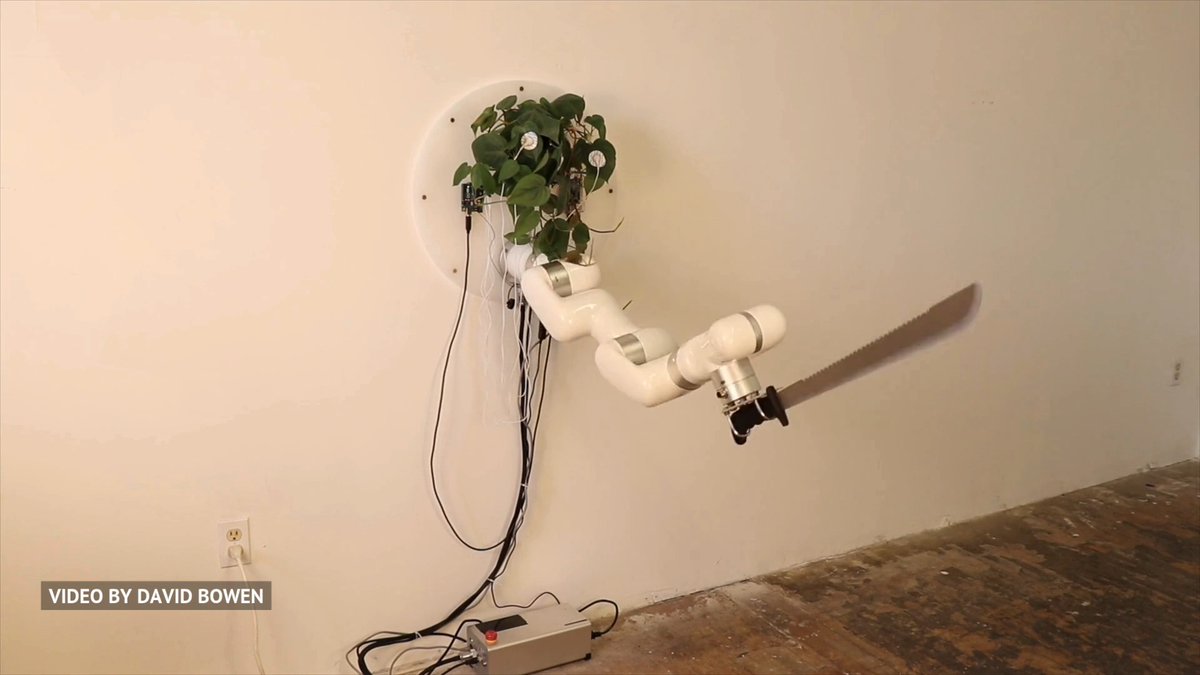
We built a Spiking Neural Network (SNN) to fully control a physical robot arm (6-DOF), and it's running entirely on a Raspberry Pi (no HAT). In our approach, the SNN starts untrained and drives the servos directly, learning in real time through local learning rules (no backprop or gradient...

30,215 views • 5 months ago •via X (Twitter)

0 Comments

No comments available

Comments from the original post will appear here

Related Videos

Experiments in progress. The one on the right has been learning for ~3 hours, the one in the middle for ~1 hour, and the one on the left just started a few minutes ago. The initial motivation for making the physical Atari was just to commit ourselves to a subset of algorithms that can make progress in this setup. This commitment rules out algorithms that require billions of samples to learn (or worse, require multiple environments running in parallel). Atari games are simple enough that we should be able to show learning on them in a short amount of time with no prior knowledge. Since then, I've realized that this setup is also a good way to compare different paradigms in robotics in a principled way. These paradigms are sim2real, learning from tele-operated data, and learning directly on the robots. So far, I have observed that getting sim2real to work reliably is hard. It requires tweaks that don't scale. Policies that can play perfectly in simulation fall apart because of latencies and the messiness of the real world. These aspects could be modeled to improve the simulation, but not without sinking significant human engineering hours. I have higher hopes for learning from tele-operated data, but that requires a human to learn the task first. These experiments are on my to-do list. I have to learn to play some of the games well through the robot. I’m half-decent at playing Pong and Ms Pacman now. Learning directly on robots is looking like the most promising approach. This approach takes away pesky distribution shifts and makes it possible to have algorithms that continually improve with more data and time without any human intervention. It feels great to let experiments run overnight and wake up to find improved policies. With learning on robots, I should, in principle, be able to go on a long vacation and come back to find better policies for complex tasks beyond Atari games. Whether that is possible with current learning algorithms is a different question.

Khurram Javed

52,110 views • 7 months ago

This is one-shot assembly: you show examples of what to build, and the robot just does it. (see original post: To share more on how this works, the robot is controlled in real time by a neural network that takes in video pixels and outputs 100Hz actions. The video below is part of the raw input passed directly into the model. I also like this view (at 1x speed) because it shows more of the (I think very cool) subtle moments of dexterity near the fingertips 👌 One-shot assembly seemed like a dream even just a year ago — it's not easy. It requires both the high-level reasoning of "what to build" (recognizing the geometry of the structures presented by the human), and the low-level visuomotor control of "how to build it" (purposefully re-orienting individual pieces and nudging them together in place). While possible to manually engineer a complex system for this (e.g. w/ hierarchical control, or explicit state representations), we were curious if our own Foundation model could do it all end-to-end with just some post-training data. Surprisingly, it just worked. Nothing about the recipe is substantially different than any other demo we’ve run in the past, and we’re excited about its implications on model capabilities: • On contextual reasoning, these models can (i) attend to task-related pixels in the peripheral view of the video inputs, and (ii) retain this knowledge in-context while ignoring irrelevant background. This is useful for generalizing to a wide range of real workflows: e.g. paying attention to what’s coming down the conveyor line, or glancing at the instructions displayed on a nearby monitor. • On dexterity, these models can produce contact-rich "commonsense" behaviors that can be difficult to pre-program or write language instructions for e.g. rolling a brick slightly to align its studs against the bottom of another, re-grasping to get a better grip or to move out of the way before a forceful press, or gently pushing the corners of a brick against the mat to rotate it in hand and stand it up vertically (i.e. extrinsic dexterity). These aspects work together to form a capability that resembles fast adaptation — a hallmark of intelligence, relevant for real use cases. This has also expanded my own perspective on what's possible with robot learning, using a recipe that's repeatable for many more skills. This milestone stands on top of the solid technical foundations we’ve built here at Generalist: hardcore controls & hardware, all in-house built models, and a data engine that "just works." We're a small group of hyper-focused engineers, and hands-down the highest talent-density team I’ve ever worked with. We're accelerating and scaling aggressively towards unlocking next-generation robot intelligence. Building Legos is just one example, and it's clear to me that we're headed towards a future where robots can do just about anything we want them to. Its coming, and we're going to make it happen.

Andy Zeng

49,317 views • 10 months ago