Video wird geladen...

Video konnte nicht geladen werden

Zur Startseite

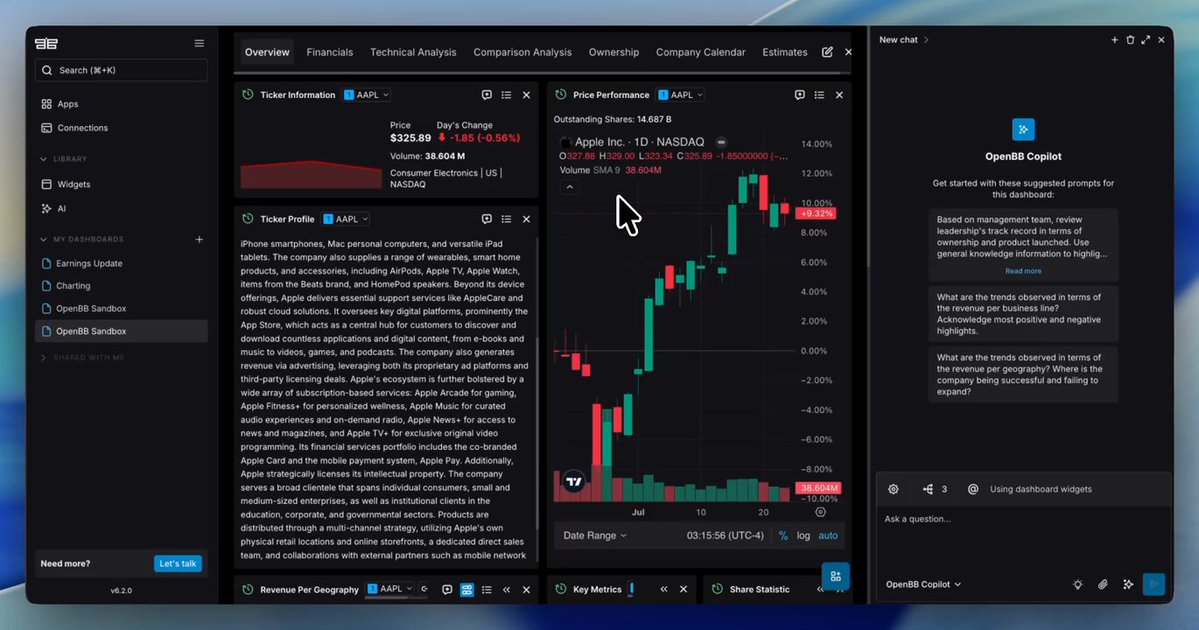
We built an open-source Bloomberg that you talk to like ChatGPT🤯 It lets you query financial data in English: - Markets (stocks, crypto, FX) data📈 - Deep dives into SEC filings📁 - Instant charts & reports✅ - Insider transactions for companies💰 🔗

32,915 Aufrufe • vor 6 Monaten •via X (Twitter)

0 Kommentare

Keine Kommentare verfügbar

Kommentare vom Original-Post werden hier angezeigt
Ähnliche Videos

.Josh Wolfe: Anybody Using DeepSeek App Is 'Absolute Fool' "Anybody using the DeepSeek app is an absolute fool. If you're using DeepSeek on companies like Together Compute, one of Lux's companies, which can get rid of the CCP censorship, then it's probably okay. But remember, the open-source movement is something we deeply believe in. Most great technologists, entrepreneurs, and venture capitalists are on the side of open source. The closed-source models that have consumed tens of billions of dollars are the ones that are really going to be at risk. When you look at Hugging Face, a major repository, or Together Compute, Runway ML, and a lot of Lux's companies, they have been pioneers in open source. Now, why am I not worried about open source, even with the DeepSeek model? As long as you don't have the CCP censorship on it, the models with their open weights allow people to run on their proprietary data. This means companies like pharma or defense companies that have their own siloed, proprietary data—think about Bloomberg with their proprietary longitudinal data, or Meta with their data—are the ones who will have the edge. Even as open source takes hold, these companies will still dominate. I’m not worried about open source being the problem. I’m more concerned about people overfunding closed models with no proprietary source. A lot of capital is going to be burned there, and we’re already seeing that with people worried about OpenAI in some aspects."

Josh Caplan

40,039 Aufrufe • vor 1 Jahr

Your agents can't keep up with real-time data. Especially when it's scattered across dozens of sources. Most teams waste weeks building custom connectors for every database, API, and data warehouse. Then they build ETL pipelines to sync everything. By the time your agent retrieves the data, it's already outdated. Picture this: Your Postgres database updated 5 minutes ago. Your MongoDB collection changed 2 minutes ago. Your agent is still pulling from yesterday's snapshot. This is why most production RAG systems fail. There's a better approach: MindsDB is an open-source AI platform with a federated data engine that lets you query multiple data sources in real-time using SQL - without moving any data. Here's what makes it different: ↳ Your data stays in place. No ETL pipelines or data duplication ↳ Query Postgres, MongoDB, REST APIs, and more using consistent SQL ↳ JOIN across different sources in real-time with a unified interface ↳ Works with both structured and un-structured data And here's the best part: You don't even need to write SQL. Just describe what you want in plain English, and MindsDB converts it to SQL automatically. The system does all the heavy lifting. The breakthrough for AI agents is simple: When data updates at the source, your agent gets fresh results immediately. No sync delays. No stale embeddings. No custom code for each integration. You can literally write a SQL query that joins a Postgres table with a MongoDB collection and gets live results. This is what production AI applications need but rarely get. In this video, I give you a complete walkthrough of what we just discussed and how to actually do it. Make sure you watch this till the end. I've shared the link to MindsDB's GitHub repo in the next tweet!

Akshay 🚀

65,672 Aufrufe • vor 9 Monaten

Google open-sourced MCP Toolbox for Databases. I gave it access to everything else. For context, Google's MCP Toolbox for Databases is an open-source server that lets AI agents securely query structured databases like PostgreSQL and MySQL through the MCP protocol However, most enterprise knowledge doesn't actually live in databases. It's scattered across emails, Slack threads, GitHub repos, Salesforce records, customer reviews, and internal docs. So Agents can't see any of it, which means they're working with a fraction of the context they need. I fixed that using MindsDB. It acts as a universal SQL layer that sits on top of all your data sources: structured, semi-structured, and unstructured. This means you can query Salesforce, Gmail, GitHub, S3 files, Jira, and 200+ more sources using SQL syntax. The clever part is how it connects to the MCP Toolbox. MindsDB exposes everything through MySQL, so from the Agent's perspective, it's just running SQL and getting context back. It doesn't know or care that the data came from five different sources behind the scenes. This setup unlocks some powerful capabilities: → One SQL interface for dozens of enterprise sources → Cross-datasource joins (combine GitHub and CRM data in a single query) → Built-in ML capabilities for working with unstructured data → Simple MCP tools that now have massively expanded reach In the video below, the Agent queries GitHub data and a customer review database in one SQL query. So what used to require ETL pipelines and weeks of engineering effort now happens instantly. At the end of the day, AI agents are only as useful as the data they can access. This gives them a lot more to work with. I have shared the GitHub repo in the replies, where you can find more details about this.

Akshay 🚀

39,331 Aufrufe • vor 6 Monaten