Video wird geladen...
Video konnte nicht geladen werden
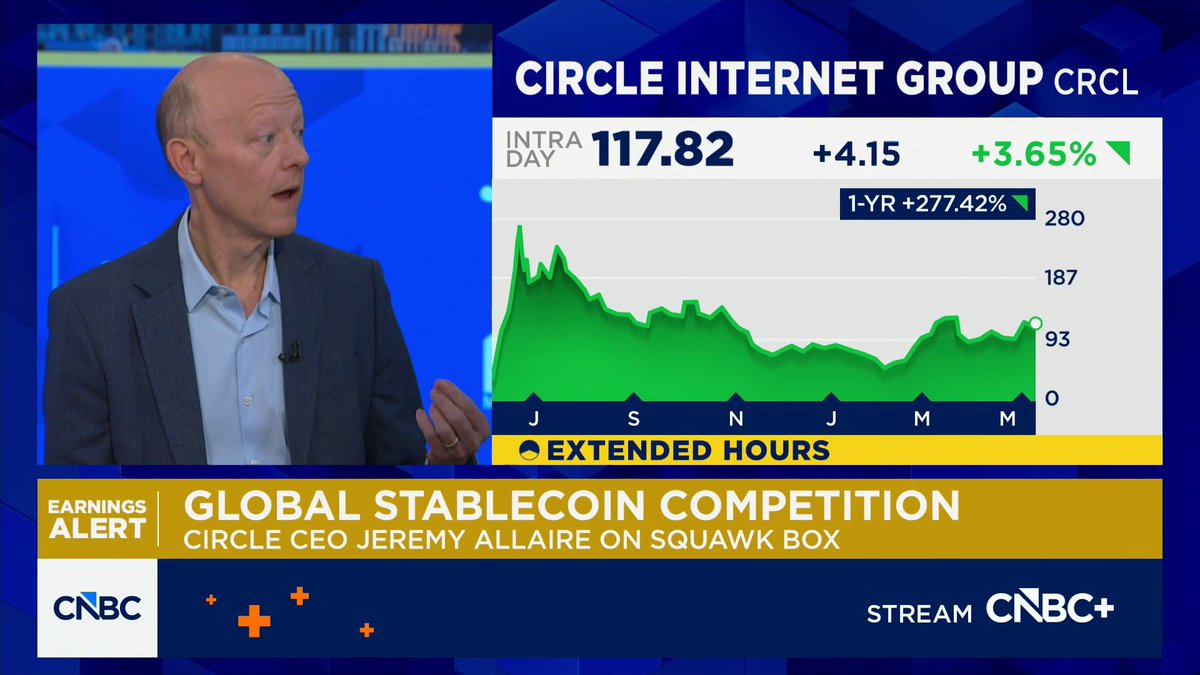
"We had this philosophy when we started Circle that over the long run—the marginal cost of storing and moving value would go to zero, and that the business model of charging fees for payments would collapse." — Circle CEO Jeremy Allaire - jerallaire.arc "You don't get charged for your... show more

62,939 Aufrufe • vor 6 Monaten •via X (Twitter)
0 Kommentare
Keine Kommentare verfügbar
Kommentare vom Original-Post werden hier angezeigt


![Apple's Eddy Cue reveals the logic behind charging $0.99 a song when the company launched iTunes Store in 2003, despite the fact that Apple would lose money at that price: "There were two keys to $0.99 that we really believed in, and people didn't see." "Number one is when the price is $0.99, and it's consistent, you never have to think about price." "The second thing was that people could never do that, because at $0.99, if you're charging a credit card, you would lose money. Because credit cards have a fixed fee and a percentage that you pay." "Well, the fixed fee and the percentage you pay on a $0.99 song was like a quarter, and the vast majority of the [rest of] the money went to the labels. So every time we'd sell a song, we'd lose money. Nobody wanted to do that." "What we decided to do is, as we were building this — and it was a huge discussion, because we would lose a ton of money — we said, 'Look, this thing is amazing. You're not going to buy just one song, you're going to buy a lot of songs.'" "'And when you do that, instead of closing the transaction on every single one, why don't we just combine them over a period of time? Let's keep the transaction open for a period of time — let's call it 24 hours, or 8 hours. And everything you buy, we're just going to give you, then we're going to charge you at the end.'" "And that's exactly what happened. Very few transactions were just $0.99. Most of the transactions were multiple dollars. And the fixed fee didn't matter."](https://image.24vids.com/tw-2039434372953293245/amplify_video_thumb/2039434193009258496/img/PEMcV_Lkw-E9ijrW.jpg)


![.John Coogan says the recent reporting on Meta's 'tokenmaxxing' is less of a sign of bad incentives at the company, and more of a tell about its potential strategy for more vertical integration: "I think it makes clearer the strategy with MSL. Because it's clear that they're spending hundreds of millions of dollars on this, just for internal code-gen tooling — like, running their business." "They are going to spend an inordinate amount of money on frontier inference, and so [by] training a model there, they will be able to amortize the training cost of the next model they build not just over, 'Can they get a product out that goes viral and becomes its own standalone chat app that people pay for.'" "Just on the internal usage, they could be running a multi-billion-dollar token bill that they would have to pay another lab. And so if they develop that internally, it's pure vertical integration." "And then you also have everything that's happening on the actual ad targeting and content delivery side..." "The big question has been like, 'Is Meta going to be able to launch an entirely new AI product like Vibes or something like that?'" "And this is a data point that, to me, says they don't need to. Because just from a pure vertical integration [perspective], the investment in MSL can pencil out."](https://image.24vids.com/tw-2041681256518447150/amplify_video_thumb/2041681190445551616/img/9uXnvMMyViTCsv39.jpg)


