Video wird geladen...

Video konnte nicht geladen werden

Zur Startseite

We have spent a century calling children failures for not fitting a system that was never designed for them. AI is about to expose just how many geniuses we threw away. MrBeast, the most watched creator on Earth, just diagnosed exactly what’s broken. MrBeast: “I graduated from school thinking...

20,651 Aufrufe • vor 6 Monaten •via X (Twitter)

0 Kommentare

Keine Kommentare verfügbar

Kommentare vom Original-Post werden hier angezeigt

Ähnliche Videos

Demis Hassabis thinks mathematics has a ceiling. He thinks biology is where we hit it. Hassabis: “Machine learning is the perfect description language for biology in the same way maths is for physics.” He isn’t calling AI a tool. He’s calling it a language. For four hundred years we only had one. Newton wrote gravity in it. Maxwell wrote light. Einstein wrote spacetime itself. Every law we ever pulled out of nature came back in equations, and we decided that meant nature was written in equations. It didn’t mean that. It meant the parts that surrendered first were small enough to fit the language we already spoke. Hassabis: “The expressive power of maths is not enough to understand these highly emergent dynamical systems.” Math can put a planet’s orbit on a single line. It cannot put one protein on a page. Same universe, same laws, and one fits our notation while the other refuses. Weak signals buried under noise, correlations stacked on correlations, more moving parts turning at once than any mind can hold. Biology isn’t harder than physics. It’s more expressive than the tool we brought to it. That was never a gap in our knowledge. It was a wall in our vocabulary. Hassabis is working on the far side of that wall. He calls it a virtual cell. A running simulation of a living system that no equation could ever contain. Hassabis: “Once you learn these simulators, you could maybe extract some equations from that.” He isn’t replacing math. He’s going after math we were never going to reach on our own. The model learns the system the way you learn to catch a ball, without ever solving the equation in the air. Understanding first. Formula after. That reverses the order science has followed since Newton. We started with the equation and used it to predict the system. He starts with the system and pulls the equation out of it. What if the deepest laws of life were always there, fully written, in a language we never learned to read. Math was never the language of the universe. It was the first one we spoke. Every disease we failed to cure is a sentence in that language, sitting in the open, waiting on a reader. Every person we lost to one died on the wrong side of a translation gap. The cell was never silent. We were illiterate. Hassabis isn’t building a better microscope. He’s building a second language for reality. And the first thing it’s learning to say is life.

Dustin

17,649 Aufrufe • vor 1 Monat

Palantir CEO Alex Karp just named who wins the AI era. Not the people who mastered the system. The people who could never follow it. Karp: “We’re in a non-playbook world, and the playbook’s not that valuable.” For decades, the global economy ran on compliance. Read the manual. Follow the procedure. Execute like the person next to you. AI just automated the manual. If your entire value was executing the playbook, you are now losing to something that does it perfectly, instantly, and for free. Karp understood this before most people had the vocabulary for it. Karp: “If you’re a dyslexic, you can’t follow the playbook, so you invent new and generative things.” Neurodivergent people spent their entire lives inside a system built for a brain they do not have. The front door was locked. So they found other doors. Built new ones. Attacked problems from angles nobody else tried because the standard path was never theirs. That is not a disadvantage. That is decades of forced preparation for the exact world we just entered. The front door is now locked for everyone. The people who spent their lives perfecting the rules are scrambling. The people who spent their lives ignoring them already know how to move. The system spent a century punishing the exact people it needed most. It measured compliance and called it intelligence. It filtered out the builders. The ones who could not sit still. The ones who could not memorize a curriculum designed for someone else’s mind. And called them broken. They were not broken. They were just early.

Dustin

84,334 Aufrufe • vor 5 Monaten

Elon Musk spent a decade warning that AI could end us. He just said that if a stop button existed, he would leave it alone. Musk: “Even if there was a stop button, we probably shouldn’t press it, because the most likely outcome is incredible abundance for all.” Nothing about him changed. The arithmetic did. Because stopping has a body count. It just never files a report. The tumor found in 2031 instead of 2029. The molecule that sits in a queue for four years. The kid in a country with three hundred doctors, none of them free that week. The risks of building get headlines. The risks of waiting get obituaries that never name a cause. We forgive the harm we allow and prosecute the harm we cause. That instinct built our reflexes, our ethics, our courts. It is also how a civilization freezes the world exactly as it is and calls it mercy. Musk: “There seems to be just inexorable progress here in AI and in robots that even if I wanted to stop it, I couldn’t.” That momentum isn’t political. It’s thermodynamic. Intelligence moves the way heat moves. Into everything colder than itself. You can slow it in one country. You cannot stop it on one planet. And there was never a button. Not for fire. Not for print. Not for the atom. No generation has ever voted to un-know something. Every one of them was certain it stood at a fork. Whether was never on the ballot. Who builds it and what it gets aimed at always has been. A smaller lever than we wanted, and far heavier than we admit. His interviewer heard all of that as surrender. Zanny Minton Beddoes: “You seem to have decided it’s inevitable, let’s hope for the best and go for the ride.” He corrected the verb. Musk: “Let’s enjoy the ride is, I think, my philosophy at this point.” Hoping for the best treats the future as weather. Enjoying the ride treats it as a place you live. And what waits there is not convenience. Diseases that consumed a century of human attention, ended by minds that never sleep and never forget. Energy cheap enough that access stops being a privilege. Genius born in places that were never going to hand it a lever. Not gated by wealth or geography. Abundance as the default condition of being alive. But the deepest thing it moves isn’t material. Scarcity is the operating system underneath everything we are. Property, borders, law, hierarchy, most of what we call virtue. Ethics is rationing with better branding. Every war over a river. Every empire over a trade route. Every cruelty that began as arithmetic. And none of it was necessary. The atoms were always here. So was the energy. The only thing we were ever short of was the intelligence to arrange them. Scarcity was never a law of nature. It was a wait. Every human who ever starved was early. Scarcity didn’t just shape our answers. It supplied the question. Every religion, every moral code, every inherited idea about what a life is for was written by people who were hungry. That authorship is ending. We are about to be the first humans who have to answer that on a full stomach. Not obsolete. Free. And freedom has never once told anyone what to do with it. He never said the risk was zero. He said the opposite, first, and louder than anyone. He is saying the fear was aimed at the wrong thing. It was never the machine. It was the part of us that would have reached for the button and called it wisdom.

Dustin

15,346 Aufrufe • vor 1 Monat

Intelligence was the one thing that never scaled. We scaled everything else. Steel. Energy. Compute. The one resource that built all of it never left the skull. Musk: “People thought defeating Go was either never or 20 years away.” Twelve months later it was over. Musk: “Now that same AlphaGo system can defeat the top 50 players simultaneously with 0% chance of them winning. And that’s one year later.” Fifty lifetimes of mastery against a system that does not know it is playing a game. Zero percent chance. That was not a competition. That was a preview. Musk: “The degrees of freedom to which artificial intelligence is able to apply itself are really increasing by 10 orders of magnitude a year.” Ten billion times. Every twelve months. No brain alive can visualize that number. By design. Every hard problem that ever defeated us did it for the same reason. Not complexity. Scarcity. The only mind capable of solving it was biological and there was never enough of it. Cancer. Fusion. Climate. The physics we cannot even see yet. Not waiting on more data. Waiting on something that can think at a scale biology never allowed. That just arrived. Most people hear this and reduce it to a question about their paycheck. They are watching the single largest expansion of capability in the history of life on this planet and worrying about a job title. For ten thousand years intelligence had one speed. One brain. One lifetime. Every civilization on earth throttled by the same biological ceiling. That ceiling just shattered. We are the only species that ever hit its own limit and built what breaks through it. That is not an ending. That is the point of everything we ever built.

Dustin

24,426 Aufrufe • vor 2 Monaten

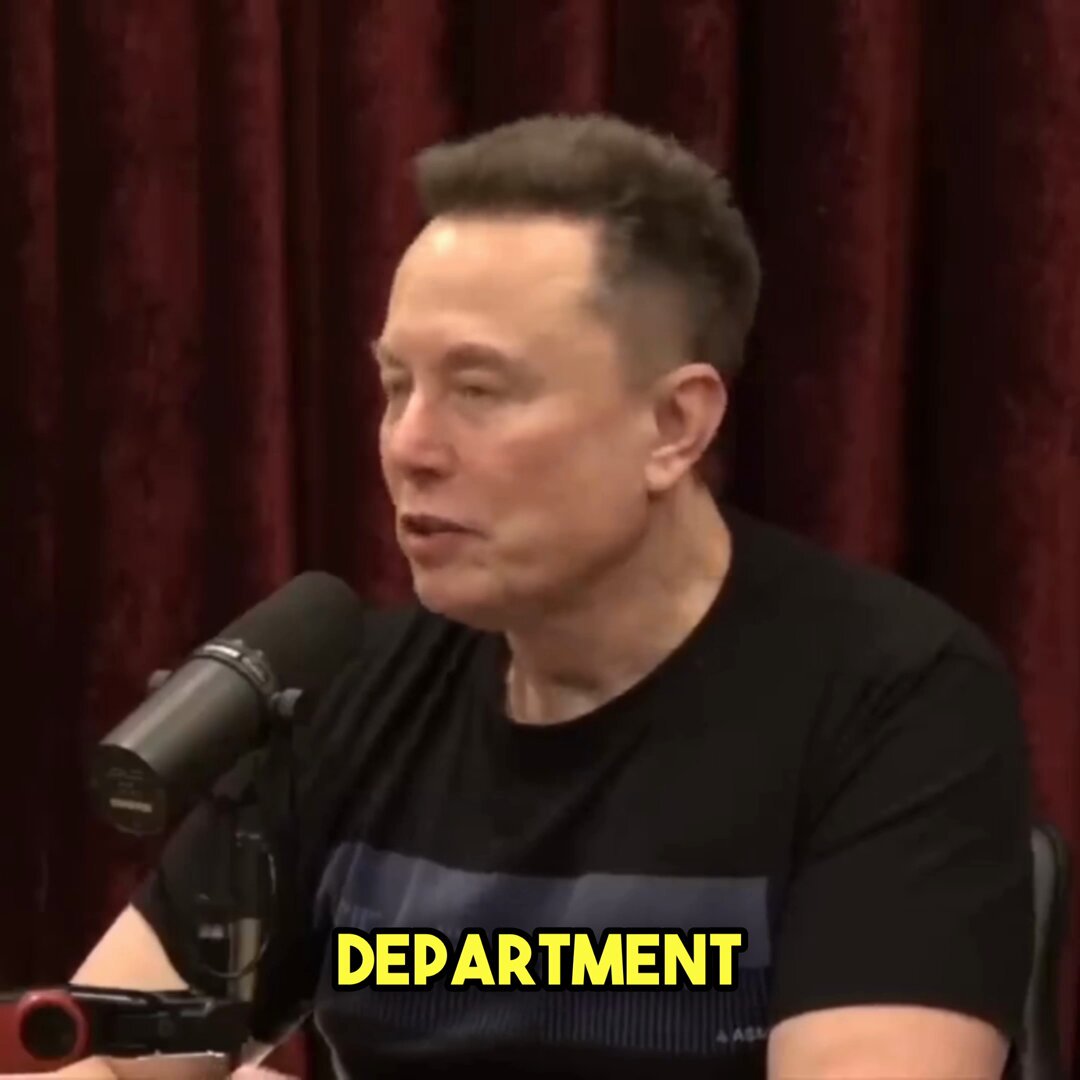
Elon Musk just read the scoreboard on American education. The numbers are not disappointing. They are damning. Musk: “Our educational results have gone downhill ever since it was created.” The Department of Education was established in 1979. Before it existed, America was landing human beings on the moon. After it was created, literacy cratered, math scores collapsed, and the country dropped on every international ranking that matters. Half a century of decline under a single institution’s watch. Musk: “If you create a department and the result of creating that department is a massive decline in educational results, you’re better off not having it.” This is not a policy disagreement. This is a fifty-year performance review with one outcome. Termination. The institution designed to educate your children spent that entire stretch making them measurably worse at everything. The system was never built to produce genius. It was built to produce compliance. Standardized tests. Standardized curricula. Standardized humans. A factory that punishes the child who questions the answer and rewards the one who memorizes it. They convinced an entire country that without a federal committee, children would fall behind. The committee is the reason they did. Now something is arriving that makes the entire debate obsolete. Artificial intelligence is not a tool for the classroom. It is the classroom. An infinite tutor that adapts to a child’s exact speed, exact curiosity, exact potential. It does not burn out by third period. It does not teach to a test written by a bureaucrat who hasn’t touched a classroom in twenty years. The establishment will tell you AI in education is dangerous. That it needs oversight. Regulation. A committee. They are not protecting your children. They are protecting their authority over what your children are allowed to learn. AI does not make the Department of Education more efficient. It makes the Department of Education extinct. The curriculum is leaving the hands of the state and landing directly in the hands of the individual. Every child on earth is about to carry a teacher with infinite patience and zero agenda in their pocket. Available to anyone with a signal. The era of the standardized human is ending. We are about to find out what a mind becomes when nothing stands between it and everything it was meant to know.

Dustin

15,876 Aufrufe • vor 4 Monaten

Elon Musk thinks the entire education system is built on a broken assumption. That every student should learn the same thing. At the same speed. In the same order. At the same time. Musk: “Everyone goes through from like 5th grade to 6th grade to 7th grade like it’s an assembly line. But people are not objects on an assembly line.” The model was designed for a factory economy. Standardized inputs. Predictable outputs. That economy is gone. The assembly line is gone. But the education system still runs on its logic. A student who masters algebra in two weeks sits through eight more weeks because the calendar says so. A student who struggles gets dragged forward because the schedule doesn’t wait. Neither is being served. Both are being processed. Musk: “Allow people to progress at the fastest pace that they can or are interested in, in each subject.” AI doesn’t teach a classroom. It teaches a student. One at a time. Every time. It skips what a student already knows. It finds where they’re stuck and approaches it from a different angle. It adjusts in real time. Not at the end of a semester when the damage is already done. A student obsessed with basketball learns fractions through shooting percentages. A student who builds in Minecraft learns geometry through architecture. The subject doesn’t change. The entry point does. No teacher with thirty students can do this. Not because they lack skill. Because the math doesn’t work. AI doesn’t have that constraint. Musk: “You do not need to tell your kid to play video games. They will play video games on autopilot all day. So if you can make it interactive and engaging, then you can make education far more compelling.” The brain isn’t broken. The format is. Kids learn complex systems and strategic thinking for hours voluntarily. Then walk into a classroom and can’t focus for twenty minutes. That’s not a discipline problem. That’s a design problem. Musk: “A university education is often unnecessary. You probably learn the vast majority of what you’re going to learn there in the first two years. And most of it is from your classmates.” Four years. Six figures of debt. And the real value comes from the people sitting next to you. Not the institution charging you. The degree doesn’t certify knowledge. It certifies endurance. Musk: “If the goal is to start a company, I would say no point in finishing college.” The system was built to train employees. If you’re not trying to be one, it has nothing left to offer you. Every lecture. Every textbook. Every curriculum. Now available instantly. Personalized to any learner. Adapted to any pace. The question isn’t whether the old model survives. It’s how long we keep forcing students through it while the replacement already exists.

Teddy - PolyBackTest.com

317,912 Aufrufe • vor 1 Monat

Elon Musk thinks the entire education system is built on a broken assumption. That every student should learn the same thing. At the same speed. In the same order. At the same time. Musk: “Everyone goes through from like 5th grade to 6th grade to 7th grade like it’s an assembly line. But people are not objects on an assembly line.” The model was designed for a factory economy. Standardized inputs. Predictable outputs. That economy is gone. The assembly line is gone. But the education system still runs on its logic. A student who masters algebra in two weeks sits through eight more weeks because the calendar says so. A student who struggles gets dragged forward because the schedule doesn’t wait. Neither is being served. Both are being processed. Musk: “Allow people to progress at the fastest pace that they can or are interested in, in each subject.” AI doesn’t teach a classroom. It teaches a student. One at a time. Every time. It skips what a student already knows. It finds where they’re stuck and approaches it from a different angle. It adjusts in real time. Not at the end of a semester when the damage is already done. A student obsessed with basketball learns fractions through shooting percentages. A student who builds in Minecraft learns geometry through architecture. The subject doesn’t change. The entry point does. No teacher with thirty students can do this. Not because they lack skill. Because the math doesn’t work. AI doesn’t have that constraint. Musk: “You do not need to tell your kid to play video games. They will play video games on autopilot all day. So if you can make it interactive and engaging, then you can make education far more compelling.” The brain isn’t broken. The format is. Kids learn complex systems and strategic thinking for hours voluntarily. Then walk into a classroom and can’t focus for twenty minutes. That’s not a discipline problem. That’s a design problem. Musk: “A university education is often unnecessary. You probably learn the vast majority of what you’re going to learn there in the first two years. And most of it is from your classmates.” Four years. Six figures of debt. And the real value comes from the people sitting next to you. Not the institution charging you. The degree doesn’t certify knowledge. It certifies endurance. Musk: “If the goal is to start a company, I would say no point in finishing college.” The system was built to train employees. If you’re not trying to be one, it has nothing left to offer you. Every lecture. Every textbook. Every curriculum. Now available instantly. Personalized to any learner. Adapted to any pace. The question isn’t whether the old model survives. It’s how long we keep forcing students through it while the replacement already exists.

Dustin

21,755,771 Aufrufe • vor 4 Monaten

I remember when I was young, around 10-11 years old. My parents were both asleep as was my brother. I heard a knock on the back door which was weird because who uses the back door at a stranger’s house? The kitchen window was close by so I take a look. It looked like a teenager but hard to tell because they had a hoodie with the hood up. I didn’t open the door but I did crack the window and asked them what they wanted. They replied they were lost and wanted to come in to warm up and use the phone. Even when it’s daylight I know never to let anybody in period that I didn’t know, but a stranger after midnight was weird enough. I said no because I didn’t know them. Then they said that hey knew my dad and that’s why he came by. I said that’s fine and all but I’m not letting you use our phone. This was before cellphones were widely used, we had a landline like most people. The person wouldn’t take no for an answer and I could sense he was getting angry. I went and woke up my dad, I told him there was somebody at the back door and that he said they knew him. He walked to the door and looked out and said he didn’t know him. But he did talk through the door and told him that he was calling the police and that he should just leave. The person just stood there until the police finally came and even they asked him what he was doing knocking on the door at that hour. He told them he was lost and thought this was a house of a family friend. The police told him my dad didn’t know him and made him leave. So was this a case of wrong house or was he up to something. It makes me still wonder to this day but I’m still glad I never opened the door.

SonnyBoy🇺🇸

117,258 Aufrufe • vor 15 Tagen

This is why I never go camping alone in some creepy and reportedly haunted woods. In a place where locals go to perform their own rituals and believe they are something they aren’t is not a place to go camping under the stars and roast marshmallows around a fire. I would save that for another time. For my take on this I wouldn’t even know where to start. I couldn’t imagine going campaigning with friends only for a woman who thinks she’s a witch to start running around the car and onto the car trying to scare me away because to her this is some sacred place. When we were kids we always went to a place called the Yogi Bear campground. It was more of a resort, it was named after a famous cartoon character. My family went and allowed us to each bring a friend. In the days we would explore the woods and go swimming at the pool, hit up the concessions. But at night while everyone slept, we were young and dumb. A friend had brought an ouija board and we were trying to open portals and contact spirits. One night in the tent when we did that, it was around 4am, we heard someone walking around the tent while we were using the board. We were all around 11-12 years old, we were terrified. I remember my friend telling me to open the tent and see what’s there but I didn’t. I just sat there and we waited it out. Looking back at this moment, and I use this moment in my own mind not to ever get an ouija board. I think it could have just been other campers who were walking by and it just happened around the same time. But I will never forget that day for obvious reasons.

SonnyBoy🇺🇸

164,322 Aufrufe • vor 2 Monaten

Jensen Huang just said the most dangerous thing about AI that no one is sitting with. Huang: “AI basically does most of our coding. And yet we’re hiring more engineers than ever. We have more challenges than ever. We have bigger dreams than ever.” Every engineer at NVIDIA uses AI. AI writes most of their code. This is the company building the infrastructure behind every major AI system on Earth. Closer to this technology than any organization alive. They’re hiring more people. Not fewer. Every conversation about AI is built around subtraction. Fewer jobs. Fewer workers. Fewer humans in the loop. Jensen just told you the opposite is true. Huang: “Suppose we infused AI into this country, and as a result of that, we are doing things faster than ever before. Our ambition is greater than ever before. Our expectations are greater than ever before. How is that a bad condition for our country?” He’s not defending AI. He’s describing what happens inside the organizations that actually use it. It doesn’t make them leaner. It makes them hungrier. More ambition. More speed. More appetite for problems no one would have touched five years ago. The car didn’t make humans travel less. The internet didn’t make humans communicate less. No tool in human history has ever made humans want less. AI will not be the exception. Huang: “Prior to that, it’s been incredible but not useful. Now it’s useful and incredible.” Six months. That’s how fast AI crossed from impressive demo to daily weapon. The companies that adopted it didn’t shrink. They expanded. Compressed timelines. Started chasing problems they never would have attempted. The companies that ignored it stayed exactly where they were. That gap compounds. Every day a company uses AI to move faster, it learns something the one standing still never will. That knowledge stacks. That speed stacks. That ambition stacks. Jensen isn’t warning about a future where machines take your job. He’s describing a present where the companies using AI are becoming so fast and so hungry that standing still is already fatal. By the time you notice, it’s over. You were never going to be replaced by AI. You were going to be erased by someone it made hungrier than you.

Dustin

12,200 Aufrufe • vor 4 Monaten

My cousins and my brother and I were exploring Coney Island, we saw the sights, hung out at the arcades and before we went back to the apartment we decided to go and get something to eat, we had some money on us but not much so we decided to see what we could get at one of the vendors. This was back in the early 90’s when most of them had dollar slices of pizza wherever we went. So we got 4 pieces of pizza, should have been $4 because that’s the price we were used to. The guy wanted to charge us $24 at $6 a slice. We argues with him because one of my cousins already took a bite being so hungry. But at the least we owed $4. We gave the other slices back and refused them but had to pay for the partially eaten one, it was embarrassing that an adult would try that on a bunch of kids. We told our uncle what happened and he went back and yelled at the vendor. He was familiar with them because he used to get slices all the time from the same guy and he never charged my uncle that price. I couldn’t imagine paying that exurban amount, like this guy who was being charged $54 for a hotdog by one of the vendors. At first he thought it was a typo and it was $5.40 but the vendor. Learned it up when he said no it was $54. Would you have paid that amount? I would have walked away, clearly he was trying to possibly scam a the man for looking like a tourist. Part of the experience when visiting a new area is the street food but it’s becoming more and more a chore avoiding places like this.

SonnyBoy🇺🇸

362,822 Aufrufe • vor 1 Monat

Terence Tao is the greatest living mathematician. Fields Medal at 31. Solved problems that had been open for a century. Widely regarded as the sharpest analytical mind alive. And he just told you the thing your entire career is built on is now worthless. Tao: “AI has basically driven the cost of idea generation down to almost zero.” For five hundred years, the idea was the prize. The theory. The hypothesis. The flash of insight a physicist chased for twenty years in a lab before it landed. That was the bottleneck. That was what tenure rewarded. That was what Nobel committees were looking for. Gone. A model can generate a thousand candidate theories for a scientific problem in an afternoon. Not noise. Not garbage. Plausible, structured, publishable-grade hypotheses. A thousand of them. Before dinner. The idea used to be the scarcest resource in any room. Now it is the cheapest. But Tao went somewhere most people are not ready to follow. Tao: “Verification, validation, and assessing what ideas actually move the subject forward… that’s not something we know how to do at scale.” Sit with that. We automated creation. We did not automate truth. We can produce ten thousand explanations for a phenomenon. We cannot tell you which ones are real. That is not a gap. That is a chasm. And it is the most important unsolved problem on Earth right now. Tao: “Human reviewers… they’re already being overwhelmed actually.” The entire scientific apparatus was built for a world where a single paper took months to produce. Peer review. Journal boards. Consensus forged over years of replication and debate. That infrastructure was never designed for what just hit it. Journals are flooded. Reviewers are buried. The filters that separated signal from noise for decades were engineered for human-speed output. They are now absorbing machine-speed volume. And they are cracking under it. Tao compared it to the internet. The internet drove the cost of communication to zero. That did not produce clarity. It produced an ocean of noise with islands of signal buried somewhere inside. AI just did the same thing to knowledge itself. Infinite generation. Zero verification. The person who can produce ideas has never mattered less. The person who can prove which ideas are true has never mattered more. That is the inversion nobody is processing. Every company, every lab, every institution is racing to generate more. Faster models. Bigger outputs. More theories. More code. More content. Nobody is building the system that tells you which of those outputs are actually correct. And that is the only system that matters. Whoever solves verification at scale does not win a market. They become the filter that all of science, all of engineering, all of human discovery flows through. The bottleneck of the last five hundred years was producing the answer. The bottleneck of the next fifty is knowing whether the answer is real. And right now, according to the greatest mathematician alive, we do not know how to do that at the speed the machines demand. That is not a research problem. That is the race beneath the race. And almost nobody has entered it.

Dustin

529,466 Aufrufe • vor 5 Monaten

Jensen Huang just described something that should keep every worker in America awake tonight. Not because AI is coming for their job. Because most of them never understood what their job actually was. Huang: “The task of our job and the purpose of our job are related, not the same.” Most people think their job is the thing they do with their hands for eight hours a day. Write code. Fill spreadsheets. Draft emails. Push pixels. That was never the job. That was the task. The job was always the thinking underneath it. Huang: “If you apply that to me, you would come to the conclusion what Jensen does for a living is tap on phones and talk. And tapping on phones and talking, AI has done that just fine. And therefore my job should be gone. But I’m busier than ever.” This is the part nobody wants to sit with. The people panicking about AI aren’t afraid of losing their work. They’re afraid of finding out they never had any. They had a routine. A repetitive motion. A series of keystrokes that felt like purpose. Now a machine does it in four seconds. Huang: “AI has created more than half a million jobs in the last couple of years.” The data says one thing. The fear says another. Because the fear was never about employment numbers. It was about identity. We spent fifty years hunched over keyboards, convinced the hunching was the work. Huang: “The idea that being human means to hunch over on this little thing, typing all the time… 50 years before that, people didn’t do that.” Fifty years. That’s all it took to build an entire identity around a posture. We don’t type for a living. We think for a living. We imagine for a living. The keyboard was always just the delivery mechanism. Never the product. Huang: “It is a fundamental flaw that we only need a billion lines of code written. We need a trillion lines of code written.” The demand was always infinite. The bottleneck was always our fingers. AI doesn’t shrink the workforce. It removes the cap on what the workforce can actually build. Huang: “Companies that use AI have demonstrated the ability to grow faster. When they grow faster, they hire more people.” Growth doesn’t eliminate people. It pulls them in. Every industrial revolution triggered the same panic. Same headlines. Same wrong conclusion. And every single time, the economy didn’t contract. It expanded into territory that didn’t exist before. The real question was never whether AI takes your job. It was whether you were ever anything more than the motions you repeated. Because somewhere in the last fifty years, we stopped asking what the work was for. We just kept typing. And now the typing is done. And millions of people are about to meet themselves for the first time. With nothing to hide behind. Some of them won’t survive what they find.

Dustin

92,704 Aufrufe • vor 3 Monaten