正在加载视频...
视频加载失败
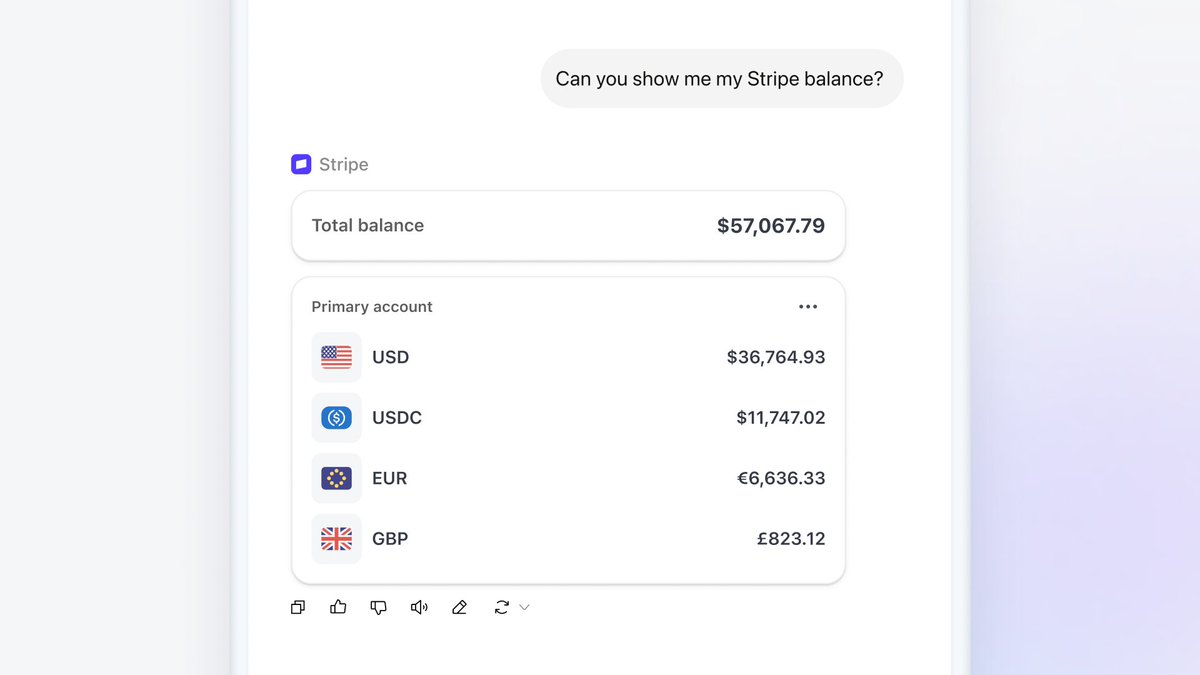
We're adding some pretty fundamental new capabilities to Stripe accounts. • Hold and convert balances in major currencies. (Including stablecoins.) • Send and receive over local bank rails. (Operate locally, globally.) For sending, you only need an email address. • Instantly issue a card backed by a balance. Over... show more

0 条评论
暂无评论
原始帖子的评论将显示在这里







![John Collison: We only had 50 users two years after founding Stripe “We started working on Stripe in the Fall of 2009, and we launched Stripe in September 2011,” John Collison reflects. “I remember right at the beginning when we were starting it I said to Patrick [Collison], ‘Yeah let’s do it. How hard can it be?’ Which gives you a sense of our mindset. And the answer was: two years of difficulty. We had not predicted that.” John remembers feeling dejected when Stripe only had 50 users two years later: “When you spend two years getting 50 users, it doesn’t feel like a whole lot of progress. It feels like things are going pretty slow.” But this is one of the challenges of startups, he argues: “If you’re working on a startup that’s a bad idea, it’s going to feel like slow-going. But if you’re working on a startup that’s a good idea, it may feel like slow-going too.” Yet slow growth has a silver lining: “I think the thing that allowed us to take off in the subsequent years was the fact that since we were spending so much time on each one of those users; since we were hyper-focused on building a great product; and since we weren’t dealing with problems of scale yet, that allowed us to build the product that we wanted. Part of the culture that set in really early on was taking abnormally good care of those early users.” The Stripe founders would get an email or phone call anytime a user ran into a bug. When they sent the customer an email moments later alerting them that the bug was now fixed, people’s minds were blown. They set up a Campfire room that any customer could join and use to message John and Patrick at any hour of the day or night. And if a user was based in the Bay Area, the founders would invite them to come by the office and help integrate Stripe for them. In the Stripe dashboard they would prompt their customers for feedback and feature requests. Then the Stripe founders would reply to that feedback within 10 minutes. “What this meant was that even though the user growth was happening quite slowly in the early days,” John explains, “it actually had a pretty surprising viral effect where people had a good experience, they told their friends about it, and we were able to spread entirely through word-of-mouth even to this day.” Video source: Stanford eCorner (2015)](https://image.24vids.com/tw-1981327237577060719/amplify_video_thumb/1981313045465837568/img/pvdpjJFhJymkh2v2.jpg)


