Video wird geladen...

Video konnte nicht geladen werden

Zur Startseite

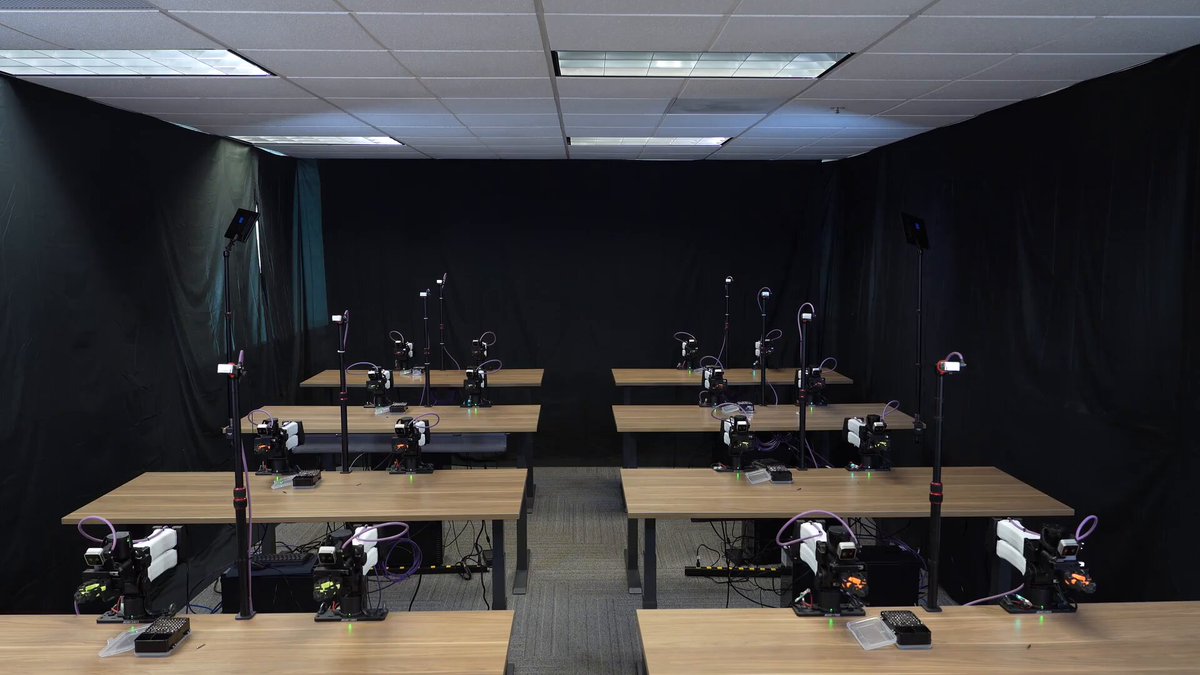
We’re excited to launch Instance – a success detector for robot rollouts! Describe your task and drop in a dataset, and it judges success/fail on each rollout with detailed subtask captions– it’s more accurate than Claude Opus 4.8, at a fraction of the latency. This is just the first...

66,754 Aufrufe • vor 2 Tagen •via X (Twitter)

0 Kommentare

Keine Kommentare verfügbar

Kommentare vom Original-Post werden hier angezeigt

Ähnliche Videos

I made Physical AutoResearch sound simple (conceptually), but it took a village to pull off and lots of design thinking into the robot /loopcraft. The hardest part is everything we need to setup *before* pressing Enter. Here's a behind-the-scene tour: 1. Safety harness Letting 8 robots run unattended overnight means safety has to be more than a hint in the system prompt. ENPIRE hardwires it in 2 layers: (1) hard kinematic limit that trips an immediate task failure and auto-resets as soon as a robot leaves its safety envelope, and (2) a torque-limited compliant gripper so a bad contact or misaligned insertion ends in a safe stall, instead of crushing the robot or the object at hand. We make safety more conservative than usual so humans can sleep tight. In reality, we still need a few human operators to watch over the "robots of loving grace". 2. Definition of /done An agent that can edit its own reward will game it for sure. ENPIRE fixes the goalposts before the fleet can move them. Here's the recipe: Collect a few minutes of success & failure demos -> Ask agent to write code using computer vision tools to classify success and measure against groundtruth -> Agent hill-climbs on classifier until reliably good -> This classifier becomes the real-time reward function that directly computes on sensor streams -> *Freeze* the reward function before AutoResearch. It's sacred, enshrined in a Gym env that no one can touch. 3. System telemetry design Robot-seconds is by far the scarcest resource, followed by GPU-seconds, and finally tokens. We instrument all three and surface them to ENPIRE for live resource awareness rather than letting it hill-climb in a vacuum. We define: - Mean Robot Utilization ("MRU"): the fraction of wall-clock time when the robot is actively executing an experiment. Otherwise the hardware is sitting idle and waiting for the next code commit. - Mean Token Utilization ("MTU"): tokens consumed per minute, our proxy for how hard the agent is actually thinking. A low MTU means the agent is stalled, waiting on a robot rollout to finish instead of doing research. - GPU utilization: fraction of wall-clock time when GPU is active. ... and evaluate on two budget-to-outcome metrics: 1. Tokens-to-Success: token budget the fleet burns to complete /goal. 2. Time-to-Success: wall-clock time to /goal

Jim Fan

104,132 Aufrufe • vor 28 Tagen

Dr Fei-Fei-Li explains with a simple example how everyday household chores are so extremely difficult for Robots. "If you tell a robot to open the top drawer and watch out for the vase, this is actually a really hard task for robots." because the robot must ground language into the real world. Words like "top", "drawer", and "vase" are abstract. The system has to map them to 3D locations, objects, and relations in a noisy scene. This requires robust perception, object recognition, and spatial reasoning under uncertainty. The robot also lacks human commonsense. "Watch out" implies predicting consequences, estimating clearances, and understanding that vases are fragile. Encoding such priors, like how heavy a drawer is or how a vase might tip, is very complex and difficult without rich world knowledge. Learning the behavior from rewards is tough. The success signal is very sparse here, so naive exploration almost never stumbles on a full success sequence. This makes policy learning sample inefficient and brittle, especially when the environment changes between training and deployment. A sparse reward situation is when the agent only gets a success signal at the very end, and gets little or no feedback along the way. If a robot must open a drawer without hitting a vase, it might get reward only if the drawer ends up open and the vase is intact. Every partial try before that looks the same to the learner, reward equals 0. --- From "DSAI by Dr. Osbert Tay" YT channel

Rohan Paul

342,553 Aufrufe • vor 8 Monaten