Loading video...

Video Failed to Load

Go Home

What does work look like when you have more agent employees than teammates? Buzz is the closest answer I've seen. An open source app built on an open protocol, out of Block. I have no affiliation with any of it. It's close. It's not there yet, but it's close....

16,314 views • 27 days ago •via X (Twitter)

0 Comments

No comments available

Comments from the original post will appear here

Related Videos

This is really mind blowing and everyone in America needs to hear this Tucker Carlson interview on SSRIs, antidepressants and mental health chemical imbalances “You can stick needles into people's spine and you can draw out fluid and you can look at the metabolites of things like serotonin and you can get depressed people and undepressed people and say, Is there any difference in the actual amount of serotonin floating around in the brain? Every time they've done this, they have not found that there is any difference between depressed and undepressed people.” “There's no difference?” “There is no difference, because that's why we don't use any biological markers in the diagnosis of any psychiatric conditions. No brain scans, no blood tests. They're not useful because there are no ways, you know, like actual biological ways to differentiate depressed people from undepressed people.” “Are you serious?” “Absolutely, and the way they justify it was, well, okay, so we haven't found it yet, but it must be a medical problem and we're eventually gonna find it. And rather than admitting that, in the meantime, we'll just tell people it's a chemical imbalance because it's an easy, it's, it's an easy kind of like metaphor for them to understand and it helps us dish out the drugs without people asking too many questions.” “But it's untrue. It's untrue. Therefore, physicians should not say that or they should lose their medical license.”

Wall Street Apes

678,381 views • 1 year ago

Rick Rubin: "Make what you love, not what you think people will like" "If you want to live in a creative way, which will benefit everything in your life, be a better person in your family, do a better job starting a new business, it's all the same. I don't really know anything about music. It's more a way of looking at the world and wanting it to be the best it could possibly be. And doing whatever it takes to be the best it could possibly be." Rubin shares how his career happened: "From the beginning, I never thought any of the things I'm doing were possible or realistic. I just did things out of the love of them, thinking I would have real jobs. That my passion would be my hobby, and I'd have a job to support my hobby. And it just magically turned out different than that without me knowing it was possible." On why some things connect and others don't: "The stars line up at certain times for certain things to happen. Sometimes you can make something great, and it doesn't connect for whatever reason. Sometimes you make two things you think are the two best things you've ever made. One of them connects with the world. One of them doesn't. And it might not have anything to do with what's in the art. It might be that it came out the same day as something else. Or there was a bigger story at the time. There's so much to it that we don't understand." He continues: "All we can do is make something good and put it out and hope for the best. That's all there is. We never know why things work. Even if you make a piece of art and it works, you may not know why." On talent versus work ethic: "There are a lot of talented people who never make it because they don't have the work ethic. It's not just talent, talent's a piece. And you could argue for some people, the work ethic trumps the talent." Rubin explains what real collaboration is: "Having worked with a lot of bands, I see there's often this friction where people are trying to get their idea in. That's not a collaboration. A real collaboration is when everyone who's there is working together towards whatever is the best thing for the whole. Whether it's your idea or someone else's idea, it doesn't matter. If you're invested in the collaboration, you want the best idea to win. You don't want your idea to win." On what makes art great: "What makes it great is the personal. With all of its imperfections. With all of its quirkiness. That's what makes it great. How you see the world that's different from how everyone else sees the world. That's why you're an artist. That's your purpose in sharing your work with the world." He warns against being derivative: "There are these derivative voices where they're finding what they think other people want to hear, and they start saying it because they've heard other people say similar things that are now successful. Even if they have some short-term success doing that, it's not revolutionary. It doesn't change the world. It doesn't last. The people who you first see and you might not like that you come to like because you don't understand them at first, those are the ones that change the world. Those are the ones you dedicate your fandom to for life." Rubin shares his philosophy on taste: "You can't second-guess your own taste for what someone else is going to like. We're not smart enough to know what someone else is going to like. To make something thinking, 'Well, I don't really like it, but I think this group of people will like it,' it's a bad way to play the game of music or art. You have to do what's personal to you. Take it as far as you can go. Really push the boundaries. And people will resonate with it if they're supposed to resonate with it." He describes creativity as catching waves: "We're really talking about magic. The universe conspiring on our behalf if we let it. Being in this flow of catching these waves that anyone can catch. If you're trying to catch it, you're open to it, you see it coming, you take off on every chance you get. And sometimes the ride happens. It's remarkable how it happens. It doesn't come from preconception. It's not an idea. It's through the doing." Rubin explains how ideas exist in the universe: "Have you ever had that experience where you have an idea for something, you don't do it, and then six months later you see someone else has done it? It's not because they took your idea. It's that it's time for that, and you can act on it or not. The best artists are the ones who have the best antenna for this material that's available. It's coming through. The best comedians see the best jokes. They see them coming. We all live in the same world; the way you see it, you have the best joke because you see it best." He closes with how to stay open: "If we listen to what's going on around us, you can overhear a conversation in a coffee shop, and it is the setup for an idea you're working on. You hear a phrase you don't commonly use. My experience is: when you are open and looking for these clues in the world, they're happening all the time. And they're happening often right when you need them."

Jaynit

109,182 views • 4 months ago

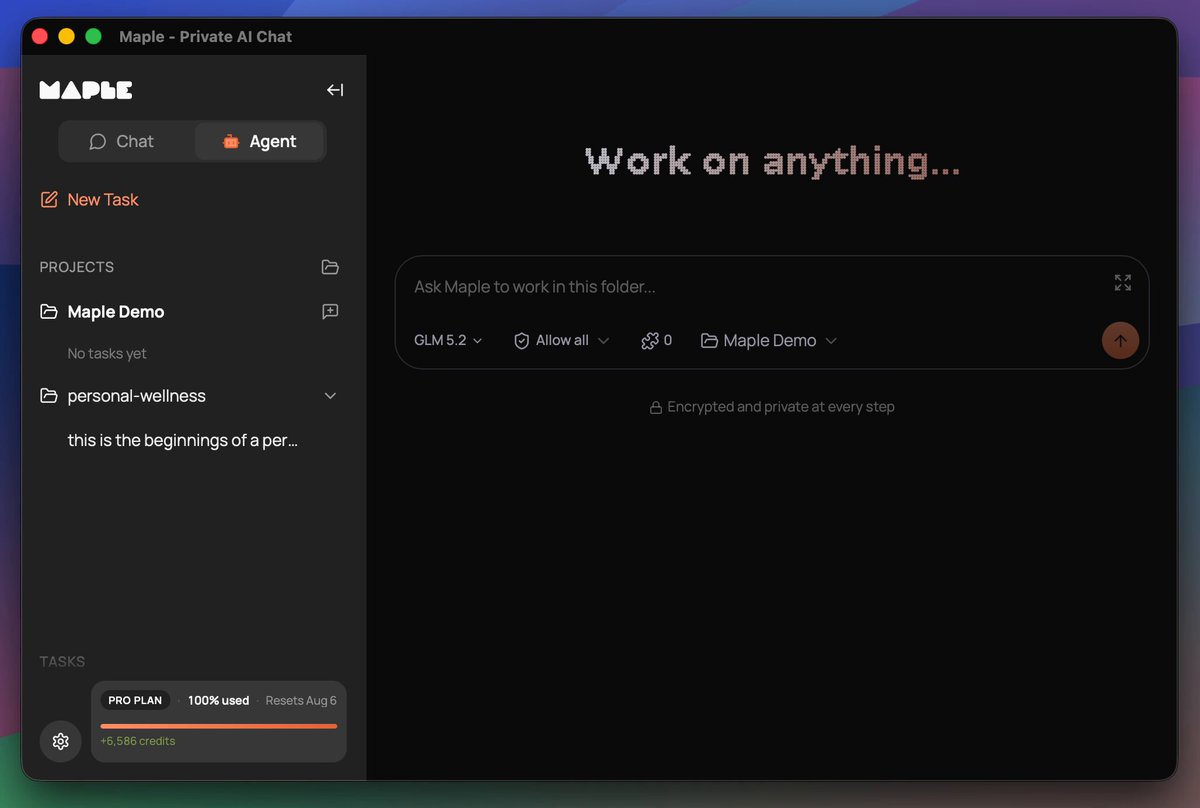
Maple is preparing for the release of a co-working agent. You install it locally and it works with your files, whether it's office work or building websites and apps. It's a turnkey solution, as easy as Claude Code, that keeps your data secure and private, no data sharing with closed AI labs. This is THE sovereign AI app for individuals and businesses who want powerful AI while retaining ownership of their information. Why build an agent into the Maple app when other agents already exist? Easy, we want to give you control over your work. We don't have a business plan that incorporates making money off our users' data. In the age of AI, your information, whether it's personal or company trade secrets, is the single thing that differentiates you from everyone else. We all have access to AI that can build a professional website for selling shoes. But your strategy and network for how you sell shoes should not be shared with your competitors. Sovereignty is the path to protecting what makes you, you. Maple sits at the intersection of Usability and Sovereignty. Maple gives you the best tools that are both easy to use and maintain your data sovereignty. Sovereign for one, sovereign for all. It has been a journey to get here. We brought to market the very first personal chatbot with end-to-end encryption using TEEs in late 2024. Prior to that there were proofs of concept but no full product offerings. Every other AI chat product on the market handled your data in plain text, either selling you a service to get your data or asking you to trust that they won't snoop on you. Quickly people found Maple and latched onto its open-source code and verifiable encryption. We didn't stop there. You may remember earlier this year we teased a product called "Maple Agent" and opened up a waiting list. That product is a mobile app that acts as your AI "friend", maintaining one long continuous chat, and getting to know you over time. I dislike using the word "friend" there, but it's the best way to convey the UX in a few words. AI is a tool, always has been, always will be. Any kind of friendly personality on top is just synthetic. In our testing, the UX of Maple Agent is really powerful for what it does. Think about the many short AI chats you have in your favorite app, whether it's looking up a historical fact or asking advice about a topic. With Maple Agent, those all go away in favor of the long-running chat with the friendly agent. It's like you have your own personal assistant who knows you so well and can look up anything for you. When I ask AI certain questions, I want to ask an expert who already understands my situation so I'm not repeating myself for the 100th time. That's the amazing value the personal agent brings to the table. We still see great utility for a personal agent like the "Maple Agent". Thousands of people on the waiting list, hoping to get their hands on it, agree that the concept is worth exploring and trying out. We were constrained in launching it due to a few circumstances, one of them being access to the scale of compute needed to power it. We have a clear path laid out for how to get there, but today is not the day to execute on that. It will be in the near future. Instead we have a different agent ready to go that we think is also incredible. We now have an agentic harness inside of the Maple Research app. This thing is a powerhouse. It even builds and publishes its own software releases. The agent in Maple Research works with your local filesystem, speaks to the largest open models running in TEEs, utilizes local models for certain tasks, is compatible with MCP tools, has an API for connecting to anything you need, and also supports the ACP protocol, which means it can be extended in the future to speak to other tools like Claude Code, Codex, and local models running on your own hardware. A big unlock for us was the Goose Development Kit, which powers the core of our agent harness. More on that to come as we publish articles and documentation later about the agent. The agent inside Maple Research doesn't have a name. At least not yet, not sure if it ever will. For now we call it "Chat Mode" and "Agent Mode". Think of this as the workhorse, the truck, the heavy lifter. Our other "Agent", the phone app, is your sidekick in your pocket, ready to help with quick things and ongoing conversations about life. I am incredibly excited about the Maple Research Agent. While I'm already seeing great results using it for internal work items, I'm especially thrilled about the personal health and wellness work it's doing for me. I know there are plenty of apps out there for compiling wellness data, but I'm having it build a tool tailored specifically for what I need, without the extra fluff. And none of my health data is being donated to the closed AI labs or sent to advertisers. I know that the AI logic is not being silently adjusted to fit the whims of a large corporation that has paid for product placement. It's me, state of the art AI, and my data. That's how I want it. Maple's new agent makes that possible. We can't wait for you to try it out. If you want early access, comment here, email us, reach out in some way. To those on the other agent waitlist, you're already in the queue. Thanks for reading this lengthy update. :)

Mark

44,707 views • 1 month ago

Open source software is GREAT. But "open source" AI is NOT like software - it's VERY different. Rob Miles cuts through the bullshit: ROB: Oh, hey, Meta. I heard Llama's weights leaked. That's rough, man. Information security's hard. How you holding up? META: Oh, we're great. Yeah, we're fine. We... actually, that was deliberate. We meant to do that. ROB MILES: Oh, really? META: Yeah... well, the second time anyway. It's called open source. Look it up. ROB MILES: Oh. Well, I love free and open source software, but do those principles really apply to network weights? How does that work? META: Open source is good for users because it lets them read the source code and see what the program is really doing and how it works. ROB MILES: Wait, have you found a way to tell how a model works by looking at its weights? META: No. But, it lets developers all over the world spot bugs in the code and submit patches. ROB: Wait, people are fixing bugs in Llama's weights? META: Well, no. People can fine tune it themselves, though. ROB: ?? Other companies offer fine tuning through APIs. ... So, hang on, if you can't actually read the code and know what it's doing, then network weights are effectively a compiled binary. So, in what sense is this open source? Why not call it like public weights? Why call it open source at all? META: I love open source. ROB: Well, I know a lot of your employees do, but you don't love anything. You're a giant corporation. What's in it for you? META: I love, love open source.

AI Notkilleveryoneism Memes ⏸️

107,362 views • 2 years ago