Загрузка видео...

Не удалось загрузить видео

На главную

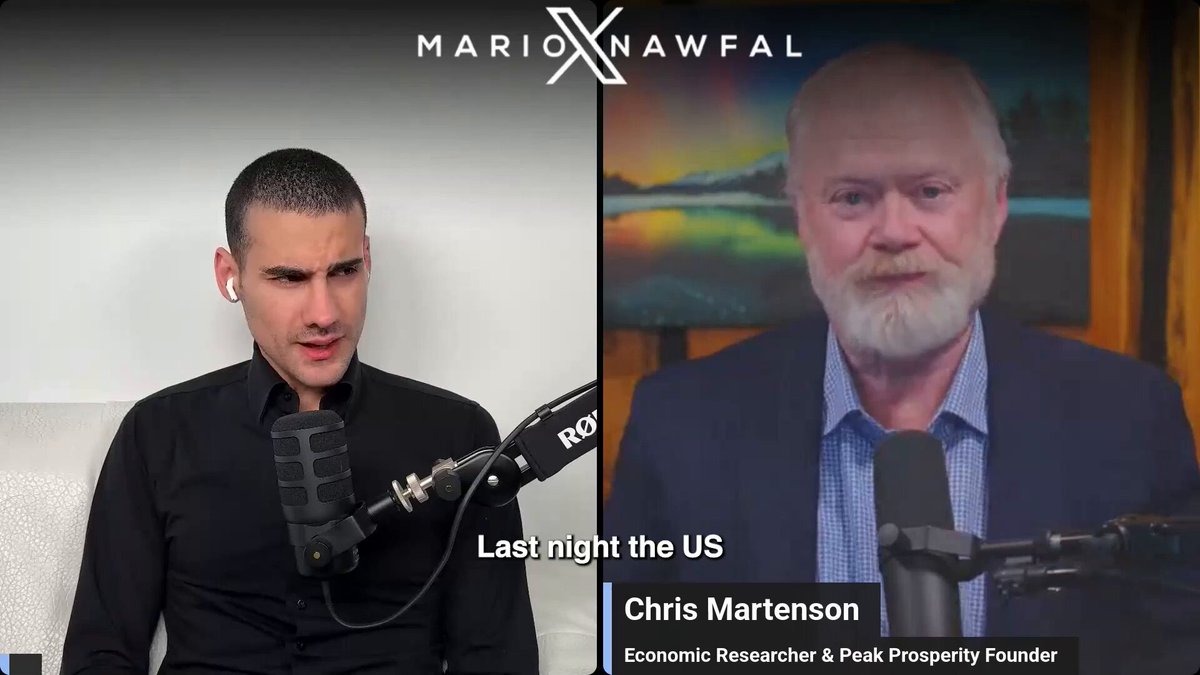
🇺🇸🇮🇷 What happens when a war starts putting pressure on systems far beyond the battlefield? I sat down with Chris Martenson to make sense of a situation that is becoming increasingly difficult to understand through individual headlines. We started with oil. Despite attacks on shipping, disruptions across multiple regions...

294,436 просмотров • 21 дней назад •via X (Twitter)

Комментарии: 0

Нет доступных комментариев

Здесь появятся комментарии из оригинального поста

Похожие видео

🇮🇷🇺🇸 Iran is turning Hormuz into the price of ending the war, and the U.S may now face an impossible choice. Shipping through the Strait has reportedly fallen from roughly 130–140 vessels a day before the war to just SIX yesterday, and the positions on both sides appear to be getting further apart. Iran is now tying the full reopening of Hormuz to a much bigger package of demands: End the war and blockade, release frozen Iranian assets, and secure a broader regional ceasefire encompassing Lebanon and Gaza. Only then does the Strait fully reopen. Iran and Oman may be getting closer to agreeing HOW shipping would operate through Hormuz, but that doesn't mean Tehran has agreed to actually reopen it yet. And while the diplomacy drags on, the physical situation is getting worse. Kpler figures suggest oil flows have fallen to around 2.2 million barrels per day, compared with roughly 20 million barrels of oil and petroleum products transiting daily before the war. Which brings us to what may be the biggest strategic shift of the entire conflict. According to a U.S military intelligence assessment, Iran's strategic priority may increasingly be moving away from its nuclear program, and toward control of Hormuz itself. Think about what that means. For decades, Iran sought deterrence through its nuclear program, ballistic missiles and regional allies. But this war may have accidentally handed Tehran something capable of inflicting immediate economic pain on the entire world: Hormuz. "The Strait of Hormuz IS their nuclear weapon." Not literally as a military deterrent, but economically, the leverage is extraordinary, and that leaves Trump with horrible options. Accept some version of Iran's demands and potentially end the war with Tehran exercising MORE authority over Hormuz than it had before the fighting began. Or attempt to break Iranian control militarily. But the U.S military assessment warns that doing so could be lengthy, costly, and deadly, with no guarantee it would even work. The Iran war may not actually be ending; it may simply be frozen, with both sides waiting for the moment when they think they can win the next round.

Mario Nawfal

366,811 просмотров • 21 дней назад

ABC’s George Stephanopoulos attempted to trip up Secretary of State Marco Rubio by asking the same question about Venezuela three different times. “What is the legal authority for the United States to be running Venezuela?” And three times, Rubio shut him down. RUBIO: “I explained to you what our goals are and how we’re going to use the leverage to make it happen.” “As far as our legal authority on the quarantine, simple. We have court orders. These are sanctioned boats, and we get orders from courts to go after and seize these sanctions. Is a court not a legal authority?” STEPHANOPOULOS: “Is the United States running Venezuela right now?” RUBIO: “Well, I’ve explained once again, I’ll do it one more time.” “What we are running is the direction this is going to move moving forward, and that is we have leverage.” “This leverage we are using and we intend to use. We started using already. You can see where they are running out of storage capacity. In a few weeks, they’re going to have to start pumping oil, unless they make changes.” “That leverage that we have with the armada of boats that are currently positioned, allow us to seize any sanctioned boats coming into or out of Venezuela loaded with oil or on its way in to pick up oil.” “We can pick and choose which ones we go after. We have court orders for each one.” “That will continue to be in place until the people who have control over the levers of power in that country make changes that are not just in the interest of the people of Venezuela but are in the interest of the United States and the things that we care about.” “The legal authority is the court orders that we have.”

Overton

213,086 просмотров • 8 месяцев назад

🇺🇲🇮🇷 Forget whether Trump bombs Iran again. The real problem is that the U.S. has no clean way out. Economic Researcher Chris Martenson believes the U.S. has reached a strategic dead end after months of confrontation with Iran. His argument starts with the Strait of Hormuz. Officials keep saying the waterway is open. Reality says otherwise. Oil volumes are still depressed, insurers remain nervous, and tanker traffic never bounced back. The economic squeeze never actually ended. That leaves Trump with two bad options: Escalate with a shrinking inventory of long-range precision missiles and invite retaliation across the Gulf… or cut a deal that effectively admits Iran still holds the keys to the world’s most important oil chokepoint. Neither one looks like a win. The bigger risk, Martenson says, isn’t missiles. It’s money. Japan imports nearly all of its oil. Higher energy prices have pushed inflation higher, driven up Japanese bond yields, and put pressure on the yen. That matters because Japan has long provided the cheap funding that helped lubricate global financial markets through the yen carry trade. As that system comes under stress, Washington has reportedly been forced to step in to stabilize markets and prevent additional pressure on U.S. Treasuries. In other words, the Iran confrontation is no longer a regional fight. It’s turning into a live stress test of the financial system that has underwritten American power for decades. If he's right, history may remember this not as a regional war, but as the moment geopolitics and global finance collided. Chris Martenson

Mario Nawfal

265,043 просмотров • 28 дней назад

#WATCH | On situation in Venezuela, US Secretary of State Marco Rubio says, "...Three-fold process in Venezuela. Step 1 is the stabilisation of the country; we don't want it descending into chaos. Part of that stabilisation, and the reason why we understand and believe that we have the strongest leverage possible is our quarantine. Two more ships were seized today. We are in the midst right now and about to execute on a deal to take all the oil - they have oil that is stuck in Venezuela. They can't move it because of our quarantine and because it's sanctioned. We are going to take bwteen 30 and 50 million barrels of oil. We are going to sell it in the market place at market rates, not at the discounts Venezuela was getting. That money will then be handled in such a way that we will control how it is dispersed in a way that benefits the Venezuelan people...The second phase will be a phase of what we call recovery - ensuring that American, western and other companies have access to the Venezuelan market oil that is fair, also at the same time, we begin to create the process of reconciliation nationally within Venezuela so that the Opposition forces can be released from prisons or brought back to the country, and we begin to rebuild civil society. The third phase will be one of transition. Some of these will overlap, I have described this to them in great detail. We will have more detail in the days to follow but we feel like we are moving forward here in a very positive way." (Video Source: Reuters)

ANI

23,143 просмотров • 7 месяцев назад

🇺🇸🇮🇷 The world may be approaching an energy crisis worse than the Great Depression, and this time governments can't print their way out of it. Most people compare today's global financial risks to 2008, but economist Chris Martenson says that's the wrong comparison. The banking crisis was ultimately a financial problem, and governments responded by creating trillions of dollars, euros and pounds to stabilise the system. You can debate whether that was wise, but it worked because the problem was financial. This time, he warns, the problem will be physical. If the Strait of Hormuz and Bab el-Mandeb remain disrupted, the world doesn't just lose oil; it loses diesel, jet fuel, lubricants, natural gas, petrochemicals, and fertiliser. The countless industrial inputs that keep supply chains, factories, farms and transport networks operating. And as Chris put it: You can't print missing molecules. That's why he believes this crisis is fundamentally different. If those physical resources become scarce, printing more money doesn't solve the problem; it simply means more money is chasing fewer real goods. And according to Chris, we're already seeing early signs of that reality beneath the surface. While many people focus on crude oil prices, he says the real warning is coming from refined products like diesel, where shortages are becoming increasingly visible and supply chains are beginning to tighten. His concern is that policymakers are treating this like another financial crisis when it's actually an energy crisis. And those require completely different solutions that no one seems to be addressing yet. Chris Martenson

Mario Nawfal

286,738 просмотров • 1 месяц назад

David Friedberg Explains Why AI Will Break Every Economic Model: Will Output Surpass Consumptive Capacity? I think fundamentally, if you're driving productivity with AI, you're driving leverage on human time and leverage on capital. The question is, how quickly can you drive that up? And that's a function of how much consumption there is, how much capacity there is for consumption. So if your earnings are the same, but things are getting more expensive, you're not happy. If your earnings go up by 10% and things stay the same price, you got 10% more than you had last year, you're gonna be happy. I just think all humans are driven by this need to consume more each year than they did last year. So I think for me, that's the lower limit on consumptive capacity in the world. The question that we're now facing, which we've never faced in human history before, is there an upper limit on consumptive capacity? Because AI creates such a profound shift in productivity and in leverage that normally you would say, “Hey, when we get a new tool or we get new leverage in a system, we build a new technology, we can make more with less.” Therefore, everyone gets access to more things for the same price or the cost of things that they consume come down by a certain price. But there may be a situation now where the ability to make stuff exceeds the capacity to consume stuff, and that is something that I don't think we’ve faced before. And I think that's where a lot of the models start to break. Just general economic models, just general productivity models and general social models. And this goes to the point about, like, what is everyone going to do? In the same way that I think we've argued that maybe SaaS was a transitory business phenomenon that existed between the foundation of the internet and the era of AI, it may be the case that knowledge work in general is also a transitory phenomenon that only existed between the foundation of the computer, or computing tools, and the existence of AI, generally speaking. And if all of that goes away very quickly, and all of those people can be redistributed and recast into doing other higher level, more creative things, their productivity goes up by 100x, is there really a consumer on the other end of all of that productivity? Is there really enough consumptive capacity? And I think that's the profound question that we all face.

The All-In Podcast

81,878 просмотров • 6 месяцев назад

🇺🇸 Philip Pilkington says the biggest consequence of the Iran war may have nothing to do with missiles. It could be the beginning of the end for the U.S. dollar. His argument starts with an uncomfortable fact. Everyone is watching the Strait of Hormuz. Almost nobody is watching Japan. Japan is the largest foreign holder of U.S. Treasuries, but its financial system is under enormous strain. Pilkington says Washington has already taken extraordinary steps to stop the crisis spreading, effectively creating an international version of quantitative easing to keep the dollar system stable. He thinks that's the real story. "The pressure is building." Even if the missiles stop tomorrow, he argues the economic damage won't. The Strait of Hormuz remains disrupted, energy markets remain distorted, and inflationary pressure is beginning to ripple through some of America's closest allies, starting with Japan and South Korea. Then comes the prediction. Pilkington believes the Iran crisis has accelerated a shift that was already underway: the gradual erosion of dollar dominance. He points to growing discussion of a new Bretton Woods-style monetary system, the expansion of renminbi financing, and signs that financial institutions are beginning to prepare for a world where the dollar is no longer the unquestioned centre of global finance. His warning is stark. "If we sat down here and did this interview in 10 years' time... we'll be living in a different world." For Pilkington, the Iran war is far from being just another Middle East conflict. The event that may force the world to confront the slow collapse of the post-1945 financial order. Philip Pilkington

Mario Nawfal

273,290 просмотров • 26 дней назад