正在加载视频...

视频加载失败

🌀🌌 What if gravity isn’t really a force? Einstein’s general relativity gives us a radically different picture: mass and energy curve the fabric of spacetime, and objects follow paths shaped by that geometry. Even light bends when passing through strongly curved spacetime. In this view, planets aren’t simply being...

23,995 次观看 • 2 天前 •via X (Twitter)

0 条评论

暂无评论

原始帖子的评论将显示在这里

相关视频

A common misconception in physics is that gravity must be negligible at the quantum scale because its measured strength appears weak compared to electromagnetism and the strong nuclear force. However, this perception arises from considering gravity only in its weak field limit. Obviously, it will appear weak under such conditions, but the situation changes when we consider regions of high mass-energy density. For example, when examining strong gravitational fields near black holes, the force becomes immensely powerful. With this in mind, lets re-examine unification and gravity at the quantum scale: Following our holographic mass solution, elementary particles like protons are found to be microscopic Schwarzschild black holes and their mass-energy density is sufficient to create a gravitational curvature equivalent to the strong nuclear force. The vacuum energy density of space provides enough energy to maintain these structures through Planck-scale dynamics, preventing their rapid evaporation via Hawking radiation, so they are ultra-stable. These discoveries, expounded in our studies like The Origin of Mass and the Nature of Gravity, available to download for free on CERN's Zenodo preprint server-🔗 -demonstrate that what we observe as distinct fundamental forces are in fact manifestations of a unified force operating at different scales, where quantum vacuum fluctuations significantly curve spacetime (the curvature being gravity) with the resulting encapsulation generating screening effects that modulate the apparent strength of gravity from its fundamental high-energy state, which results in nuclear confinement forces, to its familiar weak-field behavior that appears as regular Newtonian gravity.

Nassim Haramein

19,882 次观看 • 1 年前

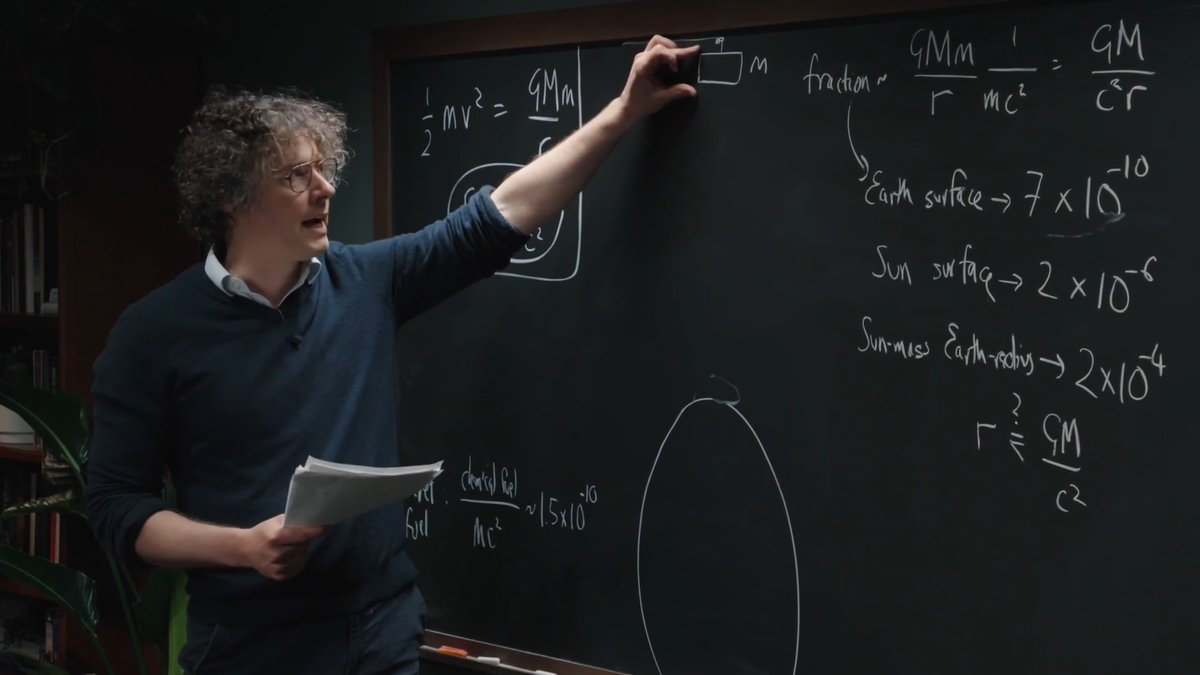
Adam Brown (Adam Brown) is back! General relativity is said to be the most beautiful idea the human mind has ever produced. Most of us will never get to fully appreciate its elegance by taking the 20-lecture graduate course Adam taught on it at Stanford. But in the video below, Adam distills the key idea at its heart so clearly and compellingly that even I could keep up lol. At the core of general relativity, Einstein is trying to figure out the principle behind a particular coincidence: that the mass that resists acceleration and the mass that gravity pulls on just happen to be exactly the same. Adam then leads us through the path of insight which Einstein called his “happiest thought.” Then Adam lectures on black holes. First, by showing how even under special relativity you could create a perpetual motion machine if black holes weren't truly black. And then, by explaining why the observations of an infalling observer and a distant bystander to the black hole would be so radically different Adam leads Blueshift, the team at Google DeepMind cracking science and reasoning. Which gave us the opportunity to discuss at the very end how close we are to AIs that could rediscover general relativity from scratch. Stay till the close for some philosophy of science. 0:00:00 – The coincidence that led Einstein to general relativity 0:16:42 – Gravity is a consequence of curved spacetime, not a force 0:31:46 – Why black holes prevent unlimited energy extraction 0:47:12 – Black holes are the ultimate power plants 1:13:50 – What falling into a black hole would actually feel like 1:18:51 – The three ways we know black holes are real 1:24:21 – The first time we saw gravity bend light 1:29:33 – How far can AI get without experimental evidence? Look up Dwarkesh Podcast on YouTube/Spotify to watch. Enjoy!

Dwarkesh Patel

653,756 次观看 • 1 个月前

The Elusive Concept of Time. Your instincts treat time like a background meter the whole universe shares. Relativity does not take time away, it forces you to earn it operationally. Events are points. Motion is a curve through them. A clock is not a metaphor, it is a worldline with a number attached to it. Two observers can disagree on which distant events are simultaneous, and nothing contradictory happens, because causal structure is still pinned down by light cones and invariants. Even in weak gravity the rule shows up. A clock deeper in a gravitational potential ticks more slowly relative to one far away. Near a compact object the difference becomes hard to ignore. Add rotation and spacetime itself picks up a twist. That twist is frame dragging, not a new force, just geometry telling you that time and angle are coupled in a rotating spacetime. In the animation You are watching a geometry lesson disguised as a black hole scene. The fabric is a visualization of the field shaping clock-rates and the paths light can take. The ripples are driven by local proper time, so their phase visibly slows as you approach the horizon. The accretion disk is lensed through Kerr ray tracing, and its brightness is pushed by redshift and beaming so the approaching side can flare while the receding side dims. Beacon points at different radii pulse at different rates, so you can see time dilation without any labels. The bead ring is a redshift tracer, with intensity scaled by a g³ proxy so deeper emission arrives weaker and shifted. The math breakdown Start with what a clock actually measures. Proper time τ is the accumulated time along an observer’s worldline. In special relativity, the invariant interval is ds² = c² dt² − dx² − dy² − dz² Along a timelike path, dτ = (1/c) √(ds²) = √( dt² − (1/c²)(dx²+dy²+dz²) ) If the observer moves with speed v, so dx²+dy²+dy²+dz² = v² dt², then dτ = dt √(1 − v²/c²) That is time dilation as geometry. The moving clock accumulates less τ between the same pair of events. Now add gravity. General relativity replaces the flat interval with a metric gᵤᵥ that depends on position: ds² = gᵤᵥ dxᵘ dxᵛ For a stationary clock in Schwarzschild geometry (mass M), the time component is g_tt = −(1 − 2GM/(rc²)) If the clock sits at fixed r (no spatial motion), ds² = g_tt c² dt², so dτ = dt √(1 − 2GM/(rc²)) Closer to the mass means a smaller factor, so the clock ticks more slowly relative to a clock far away. That is the rule used to drive the fabric phase in the animation. Now connect time to light. A gravitational field shifts photon frequency. Between an emitter at rₑ and an observer at rₒ, f_obs / f_emit = √( (1 − 2GM/(rₑ c²)) / (1 − 2GM/(rₒ c²)) ) For a far-away observer rₒ → ∞, f_obs / f_emit = √(1 − 2GM/(rₑ c²)) Deeper emission arrives redshifted. Lower frequency. Lower energy per photon. In the render, the disk intensity uses a Kerr-derived redshift factor g (clipped for stability). The bead ring uses a simple radiative proxy I_obs ∝ g³ I_emit to make that effect visible. Finally, why rotation looks like a twist. A rotating black hole is Kerr geometry. The key structural change is a nonzero g_tφ term, which couples time to angle. That coupling is frame dragging in equations. Near the hole, being stationary is not the same notion everywhere, because the local inertial frames are being pulled around the spin axis. So the moral stays clean. Time is not a universal substance flowing everywhere at one rate. It is what clocks accumulate along worldlines. Light cones constrain what can influence what. Invariants are what everyone agrees on. The rest is operational detail that only feels universal because our daily corner of the universe is slow and mild. #GeneralRelativity #Gravity #FrameDragging #BlackHoles #Spacetime

Mathelirium

149,835 次观看 • 6 个月前