Loading video...
Video Failed to Load
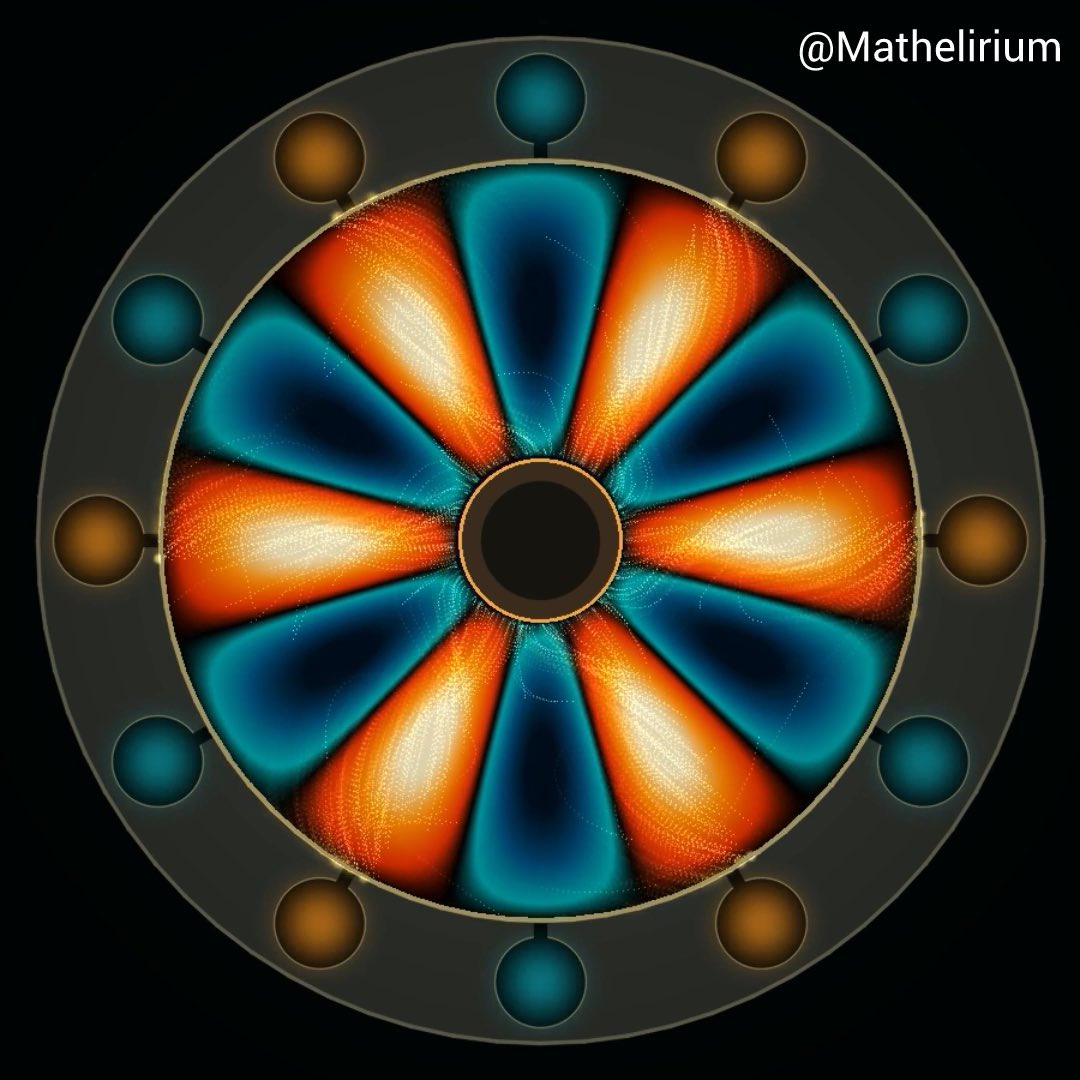
What you seeing here is helium undergoing auto-ionization. The atom starts in a doubly excited quantum state that is unstable because it lies inside the continuum of ionized states. The simulation evolved a coupled discrete-continuum Hamiltonian. The central structure is the surviving bound part for the helium. The expanding... show more

11,145 views • 27 days ago •via X (Twitter)
23 Comments

Quantum mechanics gets visually strange here. ⚛️ The expanding shells aren’t physical electron clouds flying outward—they represent probability amplitude entering the continuum as autoionization occurs. A beautiful simulation of how an unstable quantum state decays into an emitted electron.

coupled discrete-continuum approaches tend to explode near the auto-ionization threshold without careful damping

It looks like what it feels like to conceive of an idea.

Doubly exciting

Man you probably got this question a lot already but.. where do you make these visualizations? Any tips for someone wanting to get better at it?

Ever rendered any video in Python?
Actually no, I've just dabbled in three.js So you're telling me you're going at it raw like that? 😂😂
Yes, 😂 I use matplotlib or vtk.

looks kinda like what i imagine the electron field(s) would appear as; if it were seen through an ultra-sound-like device, or a depth-finder sorta scan... 🤷🏼♂️ glad someone's working on it!

👍👍👍

Beautiful

love it here is my view of the hypersurface lol

Wut

This is beyond me. Is this rust?
Python VTK
Thank you sir!

Can u post more on this

I dont understand what is the meaning of that

The helium auto-ionization clip plots a two-electron probability density, so both “knots” pulse and shed shells together. That is half the event shown twice: one electron stays bound, one leaves — not both going wild at once. A classical picture would show one core tightening and one structure departing. Every frame is a 50/50 overlay: half right, half wrong, and classically incorrect.

the double excitation must be incredibly short-lived given that auto-ionization pathway is just sitting there waiting

макродвиж - вероятности микродвиж - амплитуда вероятностей

🤩

You have real fun, i see ! Great !


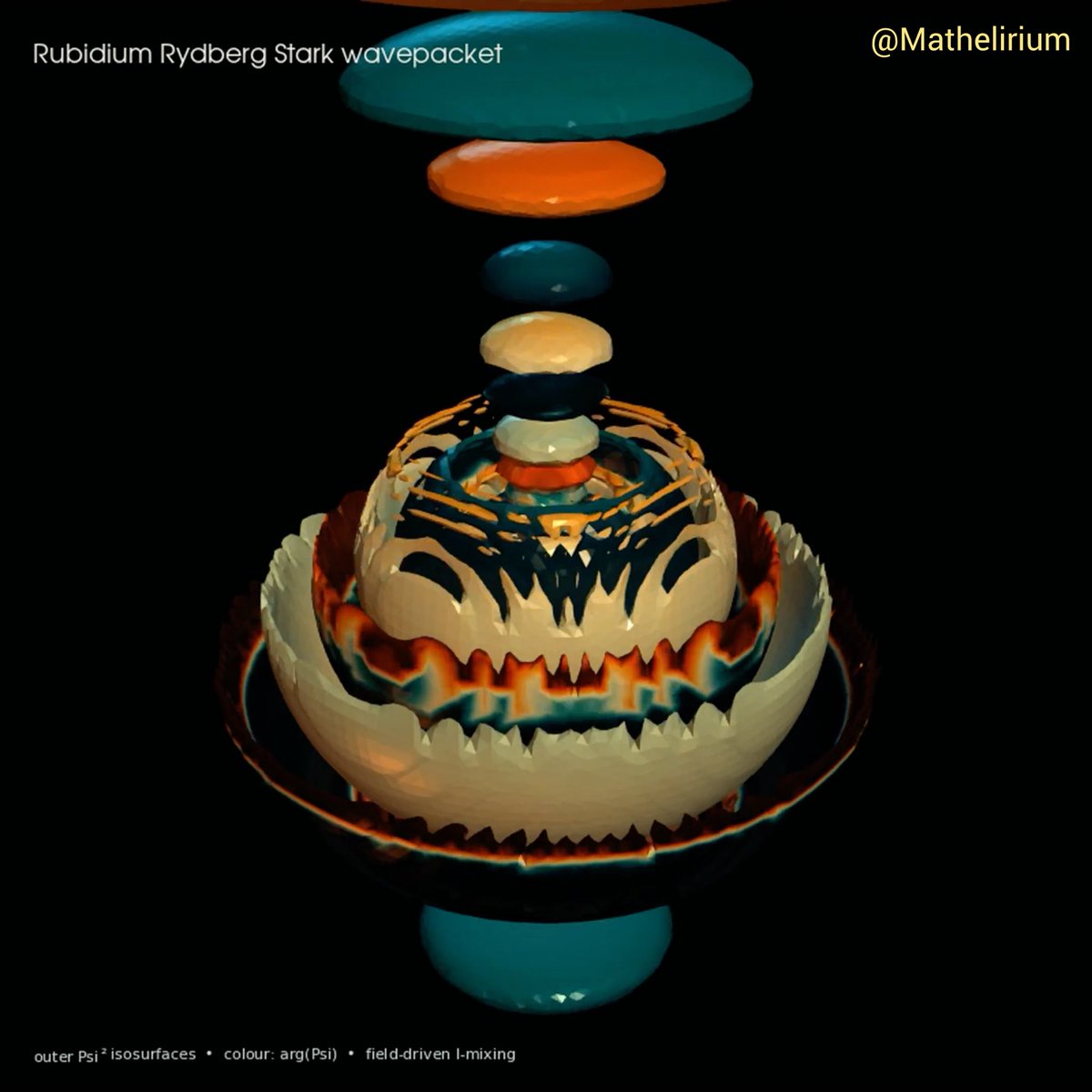


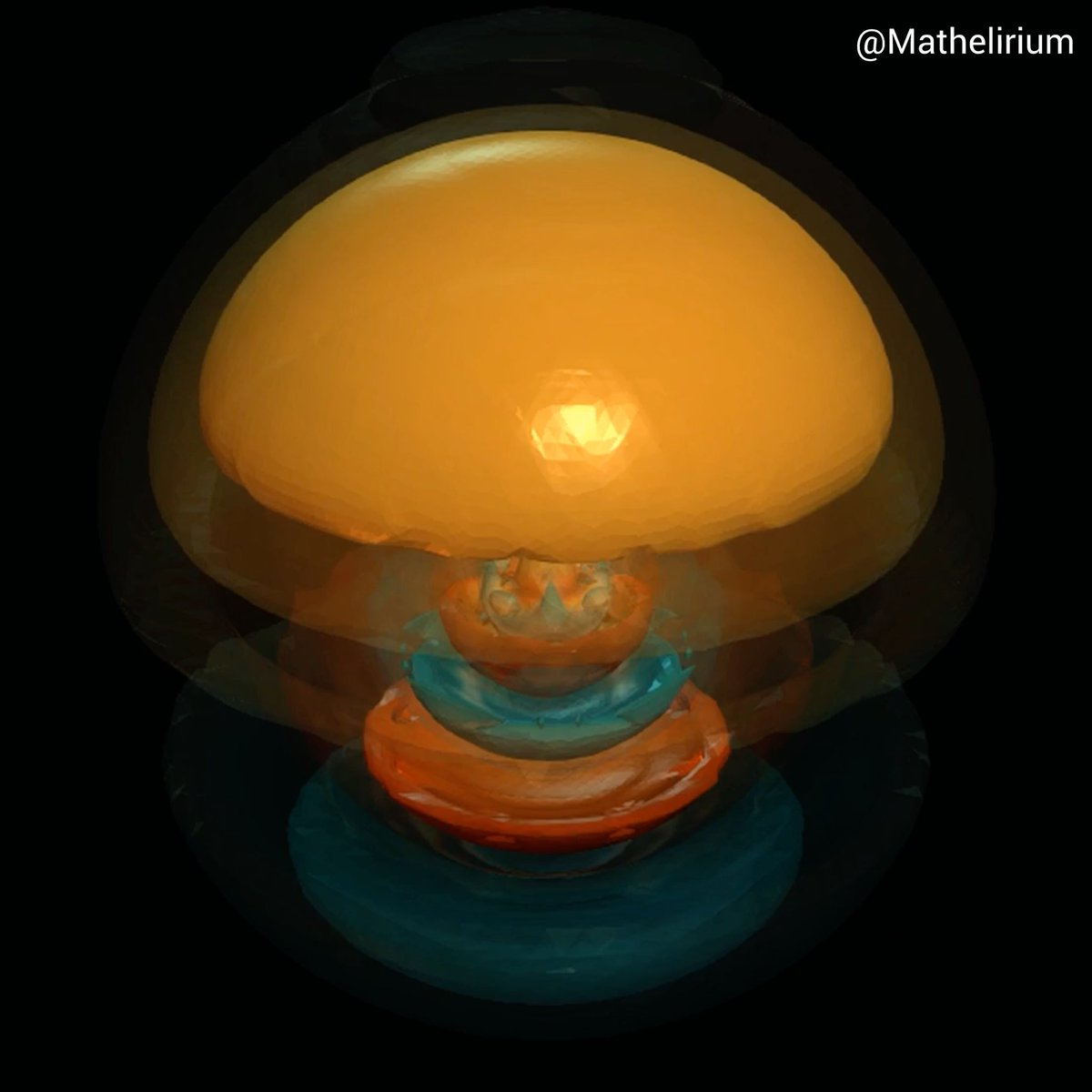



![Quantum Mechanics Series Lecture 4 Lecture 1 established that ρ(x,t) = |ψ(x,t)|² behaves like a conserved probability density. Lecture 2 showed what drives that flow. We also saw that writing ψ = r exp(iθ) makes the probability current proportional to the phase gradient, making it clear that phase geometry literally steers the motion. Lecture 3 then showed that the centroid of that flow can move almost classically when the packet is tight and the external potential is smooth. However, that raises yet another question. If the centroid can look classical, why does the full wave still spread, bend, split, and interfere in ways no classical particle cloud would? This is because the wave is not driven only by the external potential. It is also driven by its own curvature. Write ψ(x,t) = r(x,t) exp(iθ(x,t)) with ρ = r². Then Schrödinger’s equation gives two coupled real equations. One is the continuity equation you already know. The other looks like a Hamilton-Jacobi equation, but with one extra term: Q = −(1/2m) ∇²r / r This is the so-called Quantum Potential. It depends entirely on how the amplitude bends across space. So, the wave is being shaped not only by V(x,t), but also by the geometry of its own envelope. In the animation, the upper surface is still |ψ| and its skin is still colored by arg(ψ). The glowing threads still trace the probability current. But now a second membrane hangs underneath. That lower membrane encodes the quantum potential Q itself. The porcelain bead marks the quantum centroid. The amber bead follows a classical centroid under the same external V. When those paths separate, the lower membrane tells you why. The difference is not magic but the extra term classical mechanics does not have. The math breakdown: Start from Schrödinger evolution in units with ħ = 1: i ∂ψ/∂t = [ −(1/2m) ∇² + V(x,t) ] ψ Write the state in polar form: ψ = r exp(iθ) Then ρ = |ψ|² = r² From the imaginary part, you recover probability conservation: ∂ρ/∂t + ∇·j = 0 with j = (1/m) Im(ψ* ∇ψ) = (ρ/m) ∇θ So the local velocity field is v = j / ρ = ∇θ / m Now take the real part of Schrödinger’s equation. That gives ∂θ/∂t + |∇θ|² / (2m) + V + Q = 0 where Q = −(1/2m) ∇²r / r This is the classical Hamilton-Jacobi equation with one extra term. That extra term is what makes quantum motion locally different from classical motion. Take a gradient of that phase equation and use v = ∇θ / m. Then the flow obeys an Euler-like equation: ∂v/∂t + (v·∇)v = −(1/m) ∇(V + Q) In other words, there are really two forces in the problem. One comes from the external potential V. The other comes from the wave’s own curvature through Q. That is why Ehrenfest is only approximate. The centroid can still satisfy d⟨x⟩/dt = ⟨p⟩/m d⟨p⟩/dt = −⟨∇V⟩ but the internal shape of the packet evolves under the combined influence of V and Q. When the packet stays broad and smooth, Q is gentle and the motion looks more classical. When the packet develops sharp curvature or interference structure, Q becomes strong and the classical picture breaks down. That is what this scene is designed to show live. #QuantumMechanics #Wavefunction #SchrodingerEquation #BornRule #ProbabilityCurrent #ContinuityEquation #Phase #EhrenfestTheorem #QuantumPotential #Madelung #HamiltonJacobi #MathematicalPhysics #Mathematics #Physics](https://image.24vids.com/tw-2044118124148973661/amplify_video_thumb/2044117901251072000/img/IXBMEKzfYfpY_xGi.jpg)


