正在加载视频...

视频加载失败

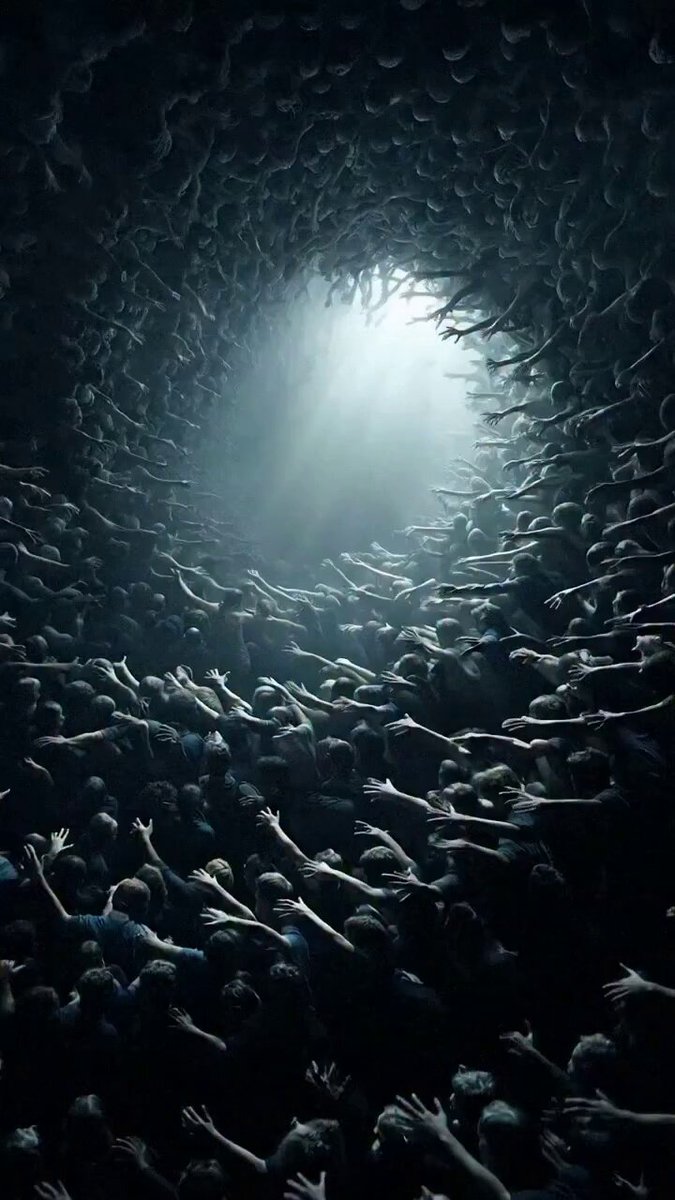
When several metronomes are placed on a common movable surface, each begins with its own rhythm. There is no coordinating signal, no external clock, and no instruction for order. Yet their motion converges. The oscillators settle into a shared rhythm that none of them possessed individually. This behavior is...

15,387 次观看 • 8 个月前 •via X (Twitter)

0 条评论

暂无评论

原始帖子的评论将显示在这里

相关视频

Do you think that by the folly of man, the glory of God can be diminished? . I tell you, no kingdom of this earth, no rebellion of heart, no blasphemy of tongue can ever tarnish the majesty of the Almighty. His glory is not made by the hands of men, nor is it undone by their defiance. . Consider the arrogance of those who refuse to kneel, who claim that their disbelief can unmake the Creator. They are like madmen in a darkened cell, scratching the word ‘darkness’ upon the walls as though, by their crude mark, they could blot out the sun. But tell me, does the sun diminish because it is unseen by the blind? Does its light falter because a lunatic curses its name? No, my friend. The sun remains, burning with relentless brilliance, giving life to all who dwell beneath it, whether they acknowledge it or not. . So it is with God. His glory is eternal, unshaken by the denial of men. He is the architect of the heavens, the One who breathed life into dust and set the stars upon their courses. His majesty does not depend on our worship, yet it is we who are diminished when we turn away. For in refusing to see His light, we do not extinguish it—we only cast ourselves into the shadow of our own making. . Know that to deny God is not an act of power but of despair. It is the rejection of hope, the refusal to see the beauty written into the very fabric of existence. A man who scribbles darkness upon the walls of his soul does not conquer the light, he only blinds himself to it. Yet even in his rebellion, God’s glory shines undimmed. For the sun does not cease to rise because a man refuses to look upon it. And God does not cease to reign because His children wander from His embrace. . If you ever find yourself in doubt, remember this: the defiance of man is but a whisper against the roar of eternity. The glory of God is as unyielding as the mountains and as boundless as the sea. It is woven into the sunrise, the turning of the seasons, the song of creation itself. You cannot destroy it. You cannot unmake it. You can only choose whether to bask in its light or to linger in the shadows. . Take heart, then and do not be swayed by the noise of those who mock the divine. For their words are as fleeting as the wind but the glory of God is eternal. Acknowledge Him not because He needs your praise but because your soul needs His light. Worship Him not as a favor to the Almighty but as a declaration that you see, that you understand, that you are humbled by the grandeur of the One who crafted all that is and all that ever will be. . God’s glory is not diminished by denial, nor is it amplified by praise. But you, my friend—you are elevated when you bow before the Eternal. You are strengthened when you trust in the One who holds the stars in place. And you are transformed when you abandon the shadows of pride and step into the radiance of His truth. . Remember this always: the lunatic may scrawl his defiance but he cannot extinguish the light. The doubter may deny the sun but he cannot halt its rise. And the world may rage against the King of Kings but it cannot dethrone Him. Stand firm, therefore, as one who walks in the light of God. Let your life be a testimony that His glory endures forever, unshaken, unyielding and undeniable. . For in the end, my friend, it is not God who is diminished by our defiance. It is we. And it is not the sun that falters when we turn away—it is the world that grows colder in its absence. #ChristIsKing #WeAreTheStorm

The Redeemed

56,372 次观看 • 1 年前

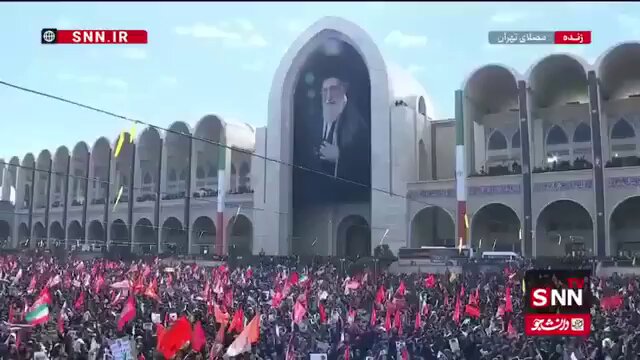
The Funeral as Statecraft What Khamenei’s Funeral Reveals About Iran’s Political Imagination By Abdulhameed Al-Ghobain States are rarely understood by listening to their rulers speak from podiums. Official language has its own duties: to reassure allies, confuse adversaries, discipline society, and preserve the appearance of control. The deeper life of a state is found elsewhere — in its arguments, its institutions, its old fears, its strategic habits, and in the rituals through which it turns defeat, victory, and even death into political meaning. Ali Khamenei’s funeral should be read in that light. In politics, a funeral is never only a funeral. It is a stage of continuity, a test of succession, a rehearsal of loyalty, and sometimes a declaration that the system intends to outlive the man who embodied it. Iran is not simply burying a leader. It is showing, once again, its ability to turn mourning into mobilization, grief into legitimacy, and a body into a political message. Many outside observers still misread Iran because they reduce it to what is easiest to see. In Washington, Iran is usually discussed through a familiar triad: the nuclear file, armed proxies, and clerical rule. In Arab capitals, the vocabulary is often narrower still: militias, sectarian expansion, and interference. None of this is false. It is simply not enough. It describes what Iran does, not how Iran thinks. Iran is not merely “a state of mullahs.” That phrase may work on television; it fails as analysis. The Islamic Republic is religious, Persian, revolutionary, bureaucratic, and pragmatic at the same time. It speaks in the language of Shiite political theology while carrying the memory of Persian statehood. It claims revolutionary purity while practicing careful regional patience. It can denounce the West in the morning, negotiate with it in the afternoon, and leave the evening sermon to make the two-sound consistent. This mixture is one of Iran’s political strengths. The Islamic Republic has learned how to turn sect into language, nationalism into structure, and negotiation into a room where time, pressure, and ambiguity can be managed. Time, for Tehran, is not empty duration. It is an asset. Many Arab political systems have not kept up with that rhythm. Too often, strategy begins only when the crisis becomes visible. The event arrives, settles in, builds networks, acquires allies, and only then does the commentary begin. Officials warn that the moment is “critical.” Analysts announce that the region is “volatile.” Television studios rediscover history just after it has entered the room. Iran does not operate with that lateness. It does not look at its Arab neighborhood as a collection of borders and formal sovereignties. It looks for openings: social fractures, sectarian vocabularies, weak institutions, anxious minorities, neglected peripheries, failed states, and elites willing to bargain with their own vulnerability. This is not praise. It is description. To understand Iran is not to admire it. It is to stop being surprised by it. Khamenei’s funeral therefore raises a question larger than succession. The issue is not only who follows him, which faction gains ground, or how the crowd behaves in the public square. Those questions matter, but they do not go far enough. The deeper question is whether the idea that sustained his rule can adjust after him. Can the Islamic Republic reproduce legitimacy without the man who served as its central symbol? Will it harden in the name of continuity, or become more flexible in the name of survival? Iran’s modern history suggests that rigidity and pragmatism are not opposites in Tehran’s political vocabulary. They are often paired instruments. When escalation is useful, Iran escalates in the name of principle. When compromise is useful, it compromises in the name of higher interest. The language can always be revised later. States that survive decades of pressure do not survive because they are pure. They survive because they know when to turn purity into posture and necessity into doctrine. Machiavelli understood that power is not managed by good intentions, but by a cold reading of fear, interest, ambition, and human weakness. Ibn Khaldun, writing from another civilizational world, understood that rule is not built by sermons alone, but by solidarity, coercive capacity, organization, and the ability to bind people into a durable political order. Iran’s ruling system has absorbed both lessons in its own way. It preaches, but it also organizes. It invokes heaven, but it studies the terrain. It speaks of martyrdom, but it counts leverage. This is why Abdolkarim Soroush matters for anyone trying to understand Iran beyond its security architecture. Soroush did not matter because he held power. He mattered because he exposed the point at which every religious state becomes vulnerable: the moment religion is converted into an instrument of rule. His central distinction is simple and dangerous. Religion is one thing; religious knowledge is another. Religion belongs to the realm of the sacred. Religious knowledge, however, is human, historical, fallible, and changeable. It is shaped by language, philosophy, science, politics, and by the limits of those who interpret. This does not attack faith. It attacks the monopoly over faith’s interpretation. For a clerical state, that is not a seminar-room argument. It is a political earthquake moving slowly beneath the floor. If religious knowledge is human, no cleric, institution, or state can claim final ownership of divine meaning. Revelation may remain sacred, but the apparatus speaking in its name loses immunity. The jurist becomes an interpreter, not the owner of truth. The state can no longer turn its preferred interpretation into political destiny without being questioned. That is why Soroush matters in the post-Khamenei moment. His thought shows that Iran’s struggle is not only over succession, sanctions, regional influence, or the nuclear file. It is also over who has the right to define religion politically. The Islamic Republic’s most serious vulnerability may not be a foreign army or a protest movement alone. It may be the slow erosion of the claim that the state’s interpretation of religion is indistinguishable from religion itself. Here Soroush approaches Michel Foucault in effect, if not in method. Power does not always need a prison when it controls the definition of truth. It is enough to decide what counts as religion, patriotism, treason, loyalty, and betrayal, then allow bureaucracy to do the rest. Hannah Arendt’s “banality of evil” was not a theory about monsters alone. It was about ordinary functionaries performing their duties with clean paperwork and a quiet conscience. In an ideological state, coercion often arrives well dressed: a stamped order, a solemn sermon, a classified file, and an archive that never apologizes. Still, Iran should not be mistaken for a frozen theocracy. It is a conflicted society with competing memories and ambitions: clerics, guards, merchants, reformists, nationalists, technocrats, students, exiles, and ordinary citizens who live between exhaustion and pride. Its state is repressive, but its society is not intellectually dead. Its official ideology is rigid, but its political practice is often tactical. Its revolutionary language is old, but its institutions have learned how to survive in a hostile environment. That combination makes Iran difficult to read and dangerous to underestimate. It is neither as invincible as its supporters imagine nor as brittle as its enemies often hope. It makes mistakes. It overreaches. It miscalculates. It provokes resistance. It pays heavy prices. But it learns inside a project. Too many of its rivals learn inside regret. This distinction matters for Western policymakers as much as for Arab governments. Counting missiles is not the same as understanding strategy. Mapping militias is not the same as understanding the political theology and historical imagination that make those militias useful. Tracking negotiations is not the same as understanding why Tehran often treats negotiation less as a conclusion than as a room in which time can be managed. The Arab world, in particular, has paid a high price for reading Iran mainly through the smoke of conflict. When Iran moves in Iraq, it is called interference. In Lebanon, influence. In Yemen, danger. All of this is true, but it is the vocabulary of outcomes. It does not explain the machine. The machine is deeper: Iran knows how to turn an idea into an apparatus, an apparatus into a state, and a state into a network of influence. Many Arab states have too often done the reverse. They turn the state into a speech, the speech into a ceremony, the ceremony into an image, and then ask, years later, where the state went. This is not merely a failure of courage. It is a failure of institutional imagination. A region that treats thinkers as conference decoration, security risks, or quotable ornaments should not be surprised when others produce strategy while it produces commentary. The post-Khamenei moment should therefore be read as a test not only for Iran, but for those who claim to understand it. Iran may speak the language of revenge. It may open channels of negotiation. It may do both in the same week. That would not be contradiction. It would be statecraft. Iranian pragmatism is not the opposite of ideology; it is one of ideology’s instruments. The fist and the smile often belong to the same hand. For Washington, the temptation will be to focus on succession, nuclear leverage, regional escalation, and elite factionalism. These are necessary concerns. They are not enough. The harder task is to understand how Iran’s ruling idea mutates under pressure. For Arab capitals, the challenge is even sharper: to stop reading Iran as a series of shocks and begin reading it as a structure. Khamenei’s funeral should not be read only as a funeral. It should be read as a mirror. Iran is burying a leader while testing the transition of an idea. Its rivals can count the mourners, study the protocol, and debate the optics. Or they can ask the more difficult question: what kind of political imagination allows a state to turn even death into continuity? There are no real surprises in politics for those who read before the shock arrives.

عبدالحميد الغبين

22,372 次观看 • 2 个月前

Australia Day is back and we’re not sorry. Not because history didn’t happen, but because a nation that must apologise before it even asserts the right to exist has already been weakened. Australia Day matters because it is one of the last moments where Australians are meant to affirm, without qualification, that this country exists, belongs to its people, and has a future worth defending. Many people in the West have absorbed the belief that because members of their civilisation may have committed atrocities, it is therefore morally bankrupt in its entirety. Its culture, art, history, and achievements are treated as tainted, permitted only after a moral warning label is attached. Celebration is allowed only if it is preceded by confession. This manifests physically. Monuments are vandalised or torn down. ANZAC memorials are defaced. The national flag is burnt in public. These acts are rituals of delegitimisation. They signal that the nation itself is something to be dismantled rather than led to new glories. This kind of denigration is far more corrosive than criticism from outside. External attacks can be resisted. Internalised shame cannot. When people are taught from childhood that their presence is morally suspect, self-assertion is interrupted by apology. Every sentence begins with “I’m not this, but…”. Every boundary is softened before it is even stated. Millions do this instinctively, every day. Australia Day sits directly at the centre of this struggle. It has been hollowed out into a ritual of qualification; celebrate, but only after you apologise. Yet a nation cannot defend borders, continuity, or identity if it doubts its own legitimacy. If the land is never truly yours, then neither are the symbols, the monuments, nor the future they represent. So we say no, we’re not sorry. We are Australians and this continent is ours.

auspill

26,872 次观看 • 8 个月前

There is something truly remarkable about the third movement of Ludwig van Beethoven’s Piano Sonata No. 14 in C-sharp minor, Op. 27 No. 2. It is one of the most famous piano movements in the world. Yet if we try to find a simple melody that can be easily hummed, we may notice something fascinating: this movement is not built around a memorable melody in the usual sense. There is no long, gentle singing line. There is no simple theme that immediately settles into the listener’s memory. Instead, Beethoven creates a world of intense motion: notes rushing forward without rest, powerful chords filled with tension, and waves of sound constantly rising and colliding with one another. So what gives this movement such extraordinary vitality after more than two centuries? The answer does not lie in how many notes Beethoven wrote. It lies in the way he transformed the smallest elements into a tremendous source of energy. Beethoven did not write this movement merely for listeners to remember a melody. He wrote it so they could feel a force in motion. From the very first notes of the Presto agitato, Beethoven draws the listener into a world without rest. The broken chords of C-sharp minor (C♯–E–G♯) continuously move across the keyboard. Taken individually, these notes are not extraordinary. But Beethoven was not concerned with the power of each single note. He was concerned with the relationship between them. One note leads naturally to the next. One small movement creates a larger movement. A continuous stream of sound emerges, like a force that cannot be stopped. This is one of Beethoven’s greatest artistic secrets: his ability to take simple materials and transform them into an idea of immense scale. Like a small seed that grows into a great tree, a few basic notes in Beethoven’s hands can become an entire world of emotional depth. When listening to this movement, many people are first captivated by its speed. The endless rushing passages of the piano create the impression of a storm gathering strength. But speed itself is not the true source of power. If it contained only rapid notes, the music might impress us for a moment but would struggle to become a lasting masterpiece. What makes Beethoven different is that he transforms speed into an expression of will. Above, the right hand moves continuously like an unstoppable current of energy. Yet beneath it, the left hand provides strong accents, creating a sense of weight and stability. One side represents movement. The other represents gravity. One force pushes forward. The other prevents the entire structure from collapsing. It is this contrast that creates the feeling of a tremendous power under control. Not a chaotic storm. But a storm with form. One of Beethoven’s deepest principles lies in the way he uses tension. The music constantly creates the feeling that it is searching for a place to return. The harmonies are not completely settled. The changes in harmony leave the listener with a sense of anticipation: what will happen next? When will this stream of energy finally be released? Yet Beethoven does not rush toward the answer. He holds the listener in this state of expectation long enough so that when balance finally appears, it carries greater meaning. This is not only a principle of music. It reflects a profound human experience. We often recognize the value of peace more clearly after passing through turbulence. Calmness has little meaning if we have never experienced tension. Light becomes more visible when it appears after darkness. The most remarkable aspect of this movement is that Beethoven never allows emotion to destroy form. On the surface, the music is intense and forceful, but beneath it lies an extraordinarily disciplined structure. The movement follows the principles of sonata form: an idea is introduced, developed, transformed, and eventually returns in a new state. Small motifs repeatedly appear, but each return carries a different meaning. Repetition does not mean standing still. It becomes the foundation for growth. This is also a principle found throughout nature. A river remains a river, yet the water within it is always moving. A heartbeat repeats itself, yet that repetition is what sustains life. Beethoven works in the same way. He does not create greatness by constantly searching for something new. Instead, he discovers depth by developing his original ideas until they reach their fullest expression. The beauty of the third movement of the Moonlight Sonata is not only found in the music itself. It reflects a broader principle. In nature, the strongest forces are often not forces without order. A storm may have tremendous destructive power, yet it still follows the laws of the atmosphere. A mountain remains standing not because it is untouched by forces, but because its internal structure is strong enough to withstand pressure. A healthy body does not exist because nothing changes, but because millions of small processes work together within a shared order. Beethoven achieves the same thing through sound. He takes thousands of small finger movements, hundreds of relationships between notes, and transforms them into a unified structure with direction and purpose. He does not eliminate conflict. He organizes conflict. He does not weaken power. He creates a form large enough to contain it. What distinguishes great artists in the classical tradition is not only technical mastery. It is their ability to perceive the inner structure of a work. In Murray Perahia’s interpretation, listeners do not experience only the speed and intensity of the movement. They also sense the balance beneath it: the precision of rhythm, the logic of harmonic movement, and the connection between each small part and the entire architectural design. Perahia does not attempt to make Beethoven more dramatic than he already is. Instead, he allows Beethoven’s own structure to reveal its strength. Because a great performer does not stand before a work to overshadow it. They become a means through which the inner beauty of the composition can be revealed more clearly. If we were to search for a single principle that defines the greatness of this movement, perhaps it would be this: A great power, when placed within a great order, becomes beauty. Beethoven does not transform anger, tension, and conflict into something softer. He preserves their full force, but builds a structure strong enough to carry them. Therefore, what listeners experience is not merely fingers racing across the keys. They experience something deeper: a storm that still has a shape, an energy that still possesses order, and a struggle that can become beauty. That is why the third movement of the Moonlight Sonata continues to move people across generations. Because behind those powerful sounds is not only a display of technical brilliance. It is an image of a fundamental principle of life: The greatest strength is not strength without control. It is strength that discovers the perfect form of its own expression.

🎼🌺Music Love♥️

19,104 次观看 • 2 个月前

What if the "flaws" in a system are actually the source code of its intelligence? In new work, we argue that invention behaves like a phase transition driven by exactly this dynamic: novelty is a thermodynamic response to constraint failure. When a system can no longer resolve its inputs within its current degrees of freedom, it is forced to expand its representational space - introducing new effective variables to restore feasibility. Thus innovation is not an accident; it is what a viable system does when the old model stops closing. This allowed us to extract the shared mechanics behind diverse phenomena: rote discovery, creativity, and the spark of insight. We show that symmetry breaking is the new optimization. We exhaustively mapped the topological landscape of matter and musical systems and found that the stabilizing vector is selective imperfection: a specific topological regime that rejects both sterile perfection and incoherent randomness. Strikingly, whether in the Hall-Petch strengthening of high-entropy alloys, function-driving geometry of proteins, or the cultural evolution of musical scales, the corridor for maximum coherence and adaptability is defined by a calculated defect. The physics of resilience and the mathematics of beauty appear to be running the same algorithm. This allows us to hack the vibrational stack by treating vibration as a universal isomorphic operator. We are liquefying the boundary between matter, sound, and intelligence, creating an epistemic inversion: listening becomes a form of seeing and creating. We are translating femtosecond molecular vibrations into audible spectra to design de novo proteins by creating direct lines of communication between Bach and deep-time evolution, and using the "glitch" logic of biology to build swarm AI. The distinction between a spider web’s stress tensor and a musical composition is collapsing; both are generative acts of world-building under constraint. For AI, the implication is straightforward: interpolation is not invention. True structural invention requires systems that can metabolize constraint failure - treating it as the exact point where new degrees of freedom are born. With this machines overcome the old paradigm of simply analyzing the world but are building it. We are operationalizing this via small-world topology. When these new degrees of freedom are born, they don't form a random mess; they snap into global coherence via small-world wiring. We found that this specific connectivity of balancing local motifs with long-range shortcuts is the architectural prerequisite for genuine world-building. Preprint with the full analysis to follow - stay tuned. On to 2026, excited to see what it brings!

Markus J. Buehler

67,445 次观看 • 8 个月前

Ostriches are intensely social animals who understand their world through movement contact and the presence of their flock. They do not experience life with human concepts or human language but they do experience fear safety comfort and distress in ways that are clear measurable and deeply felt. When ostriches live together they learn the shapes sounds and movements of the birds around them. They feel secure when the flock is calm and they become anxious when others show signs of alarm. Their sense of safety depends entirely on the stability of the group. Any threat to one member of the flock creates a wave of fear through all of them. Because of this the emotional impact of violent handling and mass killing is not limited to the bird that is struck but spreads through every ostrich who sees hears or senses it. When force and confinement are imposed on them the birds experience a level of fear that overwhelms their natural coping behaviors. Ostriches respond to danger with flight or alert stillness and when neither response is possible they enter a state of acute stress that includes trembling pacing vocalizing or freezing in place. Their hearts race their muscles tense and their entire body prepares to escape. When they are surrounded or trapped they cannot understand why the danger cannot be avoided. The sense of helplessness for a prey animal is not a thought but a physical shock that floods them with stress and panic. To a creature who survives through movement and awareness the loss of space and the inability to flee is a form of suffering in itself. The abuse of forcing ostriches to witness the injury or death of familiar flock mates creates another layer of distress. These birds recognize individuals. They notice when one of their companions collapses or cries out. They become restless and agitated when a bird they know is harmed. They remain close to fallen birds and often attempt to investigate or stay near them because their instinct pushes them to stay with the group even when the group is being destroyed. The emotional meaning of this moment is not symbolic but immediate. The flock is breaking apart. The cues of danger multiply. The birds see others in pain or falling and their own fear grows with each new sign of suffering. When violent killing happens around them ostriches sense it as the collapse of their only system of safety. They are not built to make sense of destruction happening in their own flock. Instead they respond with escalating panic. Their bodies show it clearly through rapid breathing frantic shifts in posture and attempts to move closer to surviving flock mates. They do not understand why the danger continues or why the people near them are the source of harm. The stress they experience is intense enough to cause physical shock. Their final moments are dominated by confusion fear and the overwhelming instinct to escape a threat that cannot be avoided. The public often imagines large animals as numb or unaware but ostriches feel the world with a sensitivity shaped by millions of years as prey animals. Their eyes are sharp their hearing is attuned to stress in others and their bodies react strongly to fear and pain. When dozens or hundreds of birds are subjected to violence in a confined area every ostrich feels the fear of the others. The suffering does not happen to them one by one but as a shared experience of terror. This is an experience that no animal should ever be forced to endure. The reality is not clinical or quick. It is emotionally devastating to the animals caught in it because it destroys the flock bond that is their only sense of stability and then it destroys the birds themselves. Understanding this matters because it shows that the harm done to these animals was not only physical but deeply emotional. The ostriches suffered long before any final action was taken against their bodies. They suffered through fear they could not escape through the panic created by the collapse of their flock and through the helplessness of being unable to understand why the world around them suddenly turned violent. Recognizing this is essential because it reveals the true scale of what was done. This was not a neutral procedure. This was the infliction of terror on beings capable of feeling it powerfully. The public deserves to know that these birds were not indifferent creatures. They were living animals who felt fear and confusion and distress and whose final experiences were shaped by violence they could not comprehend or escape.

Vote Canada

55,531 次观看 • 10 个月前

An egregore is not merely a mystical idea; it is a living psychological structure. From a psychoanalytic lens, it can be understood as a shared mental ecosystem. The accumulated thoughts, emotions, fears, and longings of a group that, through repetition, begins to operate as an autonomous force. Just as the personal unconscious stores unresolved experiences and symbolic narratives, the egregore functions as a collective psyche in motion. It sustains itself through belief, emotional investment, ritualized behavior, and constant reinforcement. The more it is fed, the more real it becomes. Its influence is subtle but pervasive. Anyone entering its field begins to feel, think, and behave in alignment with its logic, often mistaking borrowed impulses for personal choice. This is why patterns echo across families, ideologies, and institutions. What appears individual is frequently inherited from the group mind. In clinical work, this emerges when a person carries guilt, obligations, or symptoms that did not originate with them alone, but were transmitted through relational and symbolic networks. The egregore is the architecture through which these imprints are organized and passed on. To recognize an egregore is to abandon the illusion of psychological isolation. Each of us is woven through invisible currents of memory, meaning, and desire. The “self” is not a closed system, but a dialogue; constantly shaped by the collective field speaking through us, even in silence.

𝚃𝙷𝙴 𝚆𝙷𝙸𝚃𝙴 𝚁𝙰𝙱𝙱𝙸𝚃

17,369 次观看 • 9 个月前

Among the most famous works of Wolfgang Amadeus Mozart, Eine kleine Nachtmusik is often regarded as one of the quintessential examples of the Classical style. Over generations, the piece has not only appeared frequently on concert stages but has also been widely used in the teaching of music history and aesthetics. What gives it such a special place is not technical display or overwhelming effects, but its ability to make listeners immediately perceive a clear musical order from the very first notes. The first impression is one of structural clarity. As soon as the opening theme sounds, the musical phrases are organized into balanced and coherent units. Each musical idea has a clear beginning, a process of development, and a natural point of rest before moving on to the next phrase. Listeners therefore do not merely receive individual melodies; they quickly sense a purposeful forward motion. The music advances with the natural flow of a well-organized dialogue, in which each phrase prepares the next while simultaneously completing the meaning of the one before it. What is remarkable is that Mozart does not create appeal through complexity. The opening theme is built from short, easily recognizable motifs that are continually developed through subtle variations in rhythm, pitch, and harmony. New ideas do not deny or replace previous material; instead, they seem to emerge naturally from what the listener has just heard. As a result, the entire movement maintains a feeling of being both familiar and constantly in motion, avoiding both monotony and any sense of fragmentation. If melody brings vitality to the surface of the music, the balance of the whole work is sustained by the relationship between the voices. No single instrument tries to detach itself from the ensemble to become the absolute center. The string parts continuously support, respond to, and complement one another, creating a texture in which each element retains its own role while serving the unity of the entire piece. Listeners thus perceive not only the beauty of individual melodic lines, but also the connections between them as parts of a single whole. Harmony also plays a decisive role in this impression. Points of tension are always carefully prepared and logically led toward resolution. Whenever the music moves away from the tonal center, Mozart simultaneously constructs a path that brings it back to a state of balance. Therefore, although the movement is always full of energy, listeners rarely feel unsettled. Motion and stability are not opposites; they coexist within a unified structure. From these details, the organizing principle of the entire work gradually emerges. Mozart does not construct beauty by choosing between power and elegance, between motion and order, or between diversity and unity. He allows these seemingly opposing elements to coexist and support one another. The melody is always moving yet never loses direction. The individual parts maintain their own character without separating from the whole. Harmony creates tension but always points toward balance. Every element develops, yet all development occurs within an organized structure. Thus, the enduring vitality of Eine kleine Nachtmusik comes not only from its memorable melodies or its elegant surface beauty. The long-term value of the work lies in the way Mozart organizes all the musical material around a consistent principle: beauty does not arise when all elements are the same, but when each element fulfills its role completely within a shared order. It is precisely this unity of structure, motion, and balance that has led generations of classical music lovers to cherish the piece as one of the most representative expressions of Western Classical art.

🎼🌺Music Love♥️

19,374 次观看 • 2 个月前

ALL THIS CONSTRUCTION OF THE VISIBLE WORLD IS AT ITS ROOTS DESIGNED IN THE INVISIBLE WORLD Before language, before numbers, before thought, there was form. Not arbitrary, but precise. Not invented, but revealed. Sacred Geometry is the blueprint beneath all becoming—the hidden grammar of light, sound, and matter. It is the spiral of galaxies and the whorl of a shell. It is the vesica that births light, The triangle that gives rise to stability, The square that anchors space, And the pentagram that mirrors life’s golden proportion. Sacred Geometry does not merely decorate creation, it structures it. It governs the growth of leaves, the pulse of waves, the rhythm of your breath. It reveals that harmony is not a concept, it is a code. A flower blooms not by chance, But by a silent obedience to phi. A crystal aligns not at random, But by listening to the quiet song of symmetry. This is not mysticism, it is order. This is not dogma, it is design. Sacred Geometry is where the visible and the invisible meet: Where math becomes art, Where number becomes movement, Where space becomes spirit. To study it is not only to learn, it is to remember. That beauty is not a luxury. It is the signature of coherence. And when we align with it, We don’t just build structures. We become them. Everything that has form in this dimension is made up in its essence of sacred geometry. All this construction of the visible world is at its root designed in the invisible world.

🧬Maxpein🧬

13,405 次观看 • 1 个月前

The first movement of Violin Concerto in E minor, Op. 64 is one of Felix Mendelssohn-Bartholdy's most celebrated works. It is admired for the lyrical, vocal quality of its melodies and the coherence of its structure. Yet the enduring vitality of the movement arises not from these qualities alone, but from the way Mendelssohn shapes the entire work as a continuous process of development, in which each musical idea grows from material already established while simultaneously preparing the way for what follows. It is this organic continuity that gives the movement its distinctive persuasive power. To understand why, one must begin with its most concrete musical details. The first striking feature is Mendelssohn's decision to introduce the solo violin almost immediately, rather than reserving an extended orchestral introduction in the manner of the Classical concerto tradition. The violin enters at once with the principal theme, unfolding a melody that is long, supple and unmistakably song-like. From the opening bars, the listener does not feel as though the narrative is waiting to begin; rather, one is drawn into a musical process that already seems to be in motion. This manner of opening establishes a sense of continuity from the very outset and defines the character of the movement as a whole. The violin's melodic writing is built chiefly from stepwise motion interspersed with moderate leaps. Instead of presenting isolated musical gestures, Mendelssohn shapes his phrases into long, flowing arcs, each seeming to arise naturally from the one before it. As one motif reaches its conclusion, its closing notes frequently become the point of departure for the next. The ear therefore seldom perceives the music as a sequence of detached units, but rather as a single line of development unfolding from within itself. Equally significant is Mendelssohn's treatment of his musical motifs. He rarely introduces an entirely new idea only to abandon the old. Instead, previously stated motifs are continually transformed through changes of pitch, rhythm, expression or harmonic setting. When a familiar motif returns in a new guise, the listener immediately recognises its relationship to what has already been heard while simultaneously perceiving its transformation. It is this union of familiarity and renewal that allows the music to develop without ever seeming fragmented. Rhythm likewise plays an essential part in sustaining this continuous movement. Between the violin's expansive lyrical phrases appear short, flexible rhythmic figures that provide constant forward impetus. These patterns, however, never unfold at random. They are frequently repeated with subtle adjustments of accent or metrical emphasis, sufficient to maintain momentum while preserving a sense of unity. The listener therefore experiences an unbroken impulse of progression without any impression that the musical thread has been interrupted. At a deeper level, it is the harmony that gives the entire process a clear sense of direction. Mendelssohn creates moments of tension through passing harmonies, non-chord tones and carefully judged modulations into closely related keys. Yet each expansion is meticulously prepared and ultimately resolved back to stable tonal centres. The ear continually rediscovers its tonal point of reference and thus never loses sight of the broader trajectory of the movement. The orchestra is organised according to the same principle. It serves not merely as accompaniment to the solo violin but frequently receives, echoes and develops the motifs first introduced by the soloist. As musical ideas pass from violin to orchestra and back again, the listener perceives not two independent voices but a single musical thought unfolding through contrasting colours. The dialogue between soloist and orchestra therefore creates not opposition but an ever richer expansion of the musical structure while preserving its essential unity. As the movement unfolds, the listener is drawn not only to the beauty of its melodies but also to the relationships between them. Each idea leads naturally to the next, so that the entire movement appears as an organic whole in continual expansion rather than a succession of isolated episodes. Its persuasive power lies not in any single memorable passage, but in the coherence of the process as a whole. At a deeper level, the first movement embodies not merely a principle of musical composition but a broader principle of living systems. The work is constructed as a process in which no element exists in isolation. Each motif inherits material from its predecessor, is transformed into a new form, and in turn becomes the foundation for subsequent development. It is precisely this uninterrupted sequence of inheritance and transformation that gives the music its vitality. The same principle may be observed in the workings of the natural world. Life is sustained not by isolated parts but by continuous cycles of exchange and mutual support. The human body functions in this manner. Oxygen passes from the lungs into the bloodstream; the blood carries it to every cell where energy is produced, before returning the products of metabolism to continue the cycle. Each stage depends upon the one before it while simultaneously preparing the conditions for the next. No single link exists solely for itself; each both receives from and contributes to the others. Should one essential link in this cycle be broken, the entire system gradually loses its capacity to sustain itself. Life endures not because its individual parts exist independently, but because an unbroken cycle binds them together into a unified whole. The first movement of the concerto is organised according to a comparable principle. Melodies do not simply appear and disappear; they become the material from which subsequent motifs are fashioned. These motifs are reshaped through new rhythmic and harmonic contexts before being taken up, expanded and returned by the orchestra to the solo violin. No idea is detached from the larger process. Every element receives material from what precedes it while preparing the conditions for what follows. Through this continual exchange, inheritance and transformation, Mendelssohn creates a musical cycle in which each idea both nourishes and is nourished by the others. It is perhaps because the movement reflects such a principle that it possesses so natural and compelling a character. Its beauty resides not merely in individual melodies or episodes of development, but in the way every musical element remains connected within a continuous cycle of motion, where each part both receives from and supports the rest, preserving the unity of the whole. This is the deepest source of the first movement's enduring power. Mendelssohn does not assemble a succession of disconnected ideas; he creates a living organism in which every musical element continually inherits, transforms and sustains the others. It is this unbroken cycle that has endowed the concerto with its lasting vitality and enabled it to continue moving listeners across generations.

𝗖𝗹𝗮𝘀𝘀𝗶𝗰𝗮𝗹 𝗠𝗲𝗹𝗼𝗱𝗶𝗲𝘀

13,077 次观看 • 2 个月前

"There are no entertaining moments in 'Mirror' (1975). In fact I am categorically against entertainment in cinema: it is as degrading for the author as it is for the audience." --- Andrei Tarkovsky Full Excerpt: "'Mirror' (1975) is an autobiographical film. The things that happen are real things that happened to people close to me. That is true of all the episodes in the film. But why do people complain that they cannot understand it? The facts are so simple, they can be taken by every one as similar to the experience of their own lives. But here we come up against something that is peculiar to cinema: the further a viewer is from the content of a film, the closer he is; what people are looking for in cinema is a continuation of their lives, not a repetition. There are no entertaining moments in the film. In fact I am categorically against entertainment in cinema: it is as degrading for the author as it is for the audience. The purpose of 'Mirror', its inspiration, is that of a homily: look, learn, use the life shown here as an example. There are so many films now, and they are all so different, that very soon it will be impossible to plan for distribution to cinemas. That will be the beginning of a new phase in the development of film, which is after all the youngest art form, it is only about seventy years old. Films will start to be handed out as cassettes, people will take them home, every viewer will find himself face to face with the film he particularly likes. And what of cinema, the mass medium, you may ask ? Mass is not a criterion of quality. The same could be said about the number of people involved in the making of a film. Numbers are not the point. A small team working together is preferable to a large collective. Another question: What is going to happen to Mirror? We don't know yet. For the moment the film is only being shown in three cinemas, and they started with two. They are trying it out first, because the organs responsible for distribution are afraid it might be a failure. When they heard that people sat on and wouldn't leave, one of the highly placed distribution officials observed that normal people leave the cinema." [A talk by Tarkovsky in the Building Institute, 1975 about his film 'Mirror' (1975)]

DepressedBergman

206,278 次观看 • 8 个月前

Physicist: Consciousness DOES NOT Come From The BRAIN The prevailing materialist paradigm asserts that consciousness is a byproduct of neural activity, a mere epiphenomenon of biochemical interactions in the brain. However, this reductionist view crumbles under deeper scrutiny, as it fails to account for the vast spectrum of consciousness, from transcendent mystical states to near-death experiences and non-local awareness. Consciousness is not confined within the brain; rather, the brain is a transceiver, a finely tuned instrument that receives and modulates the vast ocean of awareness permeating the cosmos. Just as a radio does not generate the music it plays but instead decodes signals from an unseen field, the brain is an interface between the physical realm and the infinite, omnipresent field of consciousness. Mystic science, in alignment with ancient wisdom and cutting-edge quantum research, reveals that consciousness is fundamental-an organizing principle of reality itself. Walter Russell's work echoes this truth, demonstrating that mind is primary and matter is a consequence of its rhythmic pulsations. The brain, much like a crystalline matrix, is structured to interpret and shape consciousness into coherent experience, but it does not generate it. In this light, consciousness is not local, nor is it constrained by the physical form. It is the unseen architect behind the rhythms of existence, the hidden intelligence orchestrating the grand cosmic symphony to believe that the brain creates consciousness is akin to believing that the eye creates light or that a mirror generates the image it reflects. It is not the origin but the instrument. As mystic scientists, we recognize thay true awakening lies in shifting our perception from brain-centered awareness to the realization that we are conduits of an eternal intelligence, woven into the very fabric of existence. Consciousness is not inside us—we are inside it. ✨🙌🏾💫 © Dr. Jason Yuan

🧬Maxpein🧬

45,371 次观看 • 11 个月前

Among the greatest masterpieces of Western classical music, very few works have been as extensively studied and analyzed as Symphony No. 5 in C minor, Op. 67 by Ludwig van Beethoven. The fame of the work is often associated with its famous four-note opening motif. However, the true source of the symphony’s greatness does not lie in those four notes themselves. It lies in a chain of closely connected principles, developed from those four simple notes, extending from musical structure to human psychology, and at a deeper level, opening up philosophical reflections. To understand why this symphony has moved audiences for over two centuries, we need to proceed step by step from the surface to its deepest layers. 1. The visible musical detail: The four-note motif The symphony opens with one of the simplest musical ideas in history: Three short notes. One long note. What matters is not the pitch of the notes, but their internal structure. As Charles Rosen and Donald Francis Tovey have pointed out, the value of this motif is not that it is a famous melody, but that it is a rhythmic and structural “cell” capable of virtually unlimited self-development. Rather than functioning merely as an opening theme, it becomes the “DNA” of the entire work. The audience hears only four notes. But in that very moment, Beethoven has already established the principle that governs the entire symphony. 2. Structural principle: A self-generating musical system As the work develops, the motif no longer functions as a conventional melody. Its rhythm, its tension, and its structural proportions gradually permeate every layer of the music. Theme. Transition. Harmony. Orchestration. Form. Everything begins to operate according to the same underlying principle. The listener no longer perceives separate musical ideas. They are hearing a single principle continuously reorganizing itself in different forms. This is one of Beethoven’s greatest innovations. He does not build the symphony from multiple independent ideas. He allows the entire work to grow from a unified principle. 3. The listener’s experience: A sense of necessity This unity produces a particular effect. When every musical event develops naturally from what came before, the listener gradually gains the sense that everything is necessary. No detail appears randomly. No section could be arbitrarily replaced. Every conflict demands resolution. Every modulation seems driven by the internal logic of the music. Donald Francis Tovey called this feeling “dramatic necessity.” The music makes the listener feel that it could not unfold in any other way. The listener is no longer hearing a sequence of sounds. They are witnessing the operation of a system with its own internal logic. 4. Psychological root: The human desire for order But why does this sense of necessity move the listener so deeply? Part of the answer lies in how humans perceive the world. Human beings have a natural tendency to seek patterns, unity, and meaning in their experiences. When what initially seems complex gradually reveals itself as part of a unified whole, the mind experiences a profound sense of satisfaction. What moves the listener is not only that the music is beautiful. It is that they perceive a transformation from chaos to order. They realize that all conflicts, interruptions, and instabilities ultimately find their place within a meaningful totality. Thus, the symphony responds to one of the most fundamental tendencies of human cognition: The desire to discover unity beneath what appears fragmented. 5. Philosophical layer: Order emerging from conflict At a deeper level, the symphony can also be interpreted in light of an idea that appears in many classical philosophical traditions. Since ancient Greece, many philosophers have viewed beauty as the manifestation of inner order within what appears complex. The concept of cosmos originally meant not only “the universe,” but also a harmonious order in which each element finds its proper place within the whole. Seen through this lens, Symphony No. 5 does not merely resolve musical conflicts. It also evokes the image of an order gradually emerging from those very conflicts. The journey from C minor to C major is not only a tonal transformation. It is a journey from a state of tension to a state of unity. Whether or not Beethoven consciously intended this symbolic layer, the music nevertheless produces this experience for many listeners. It creates the sense that beneath apparent chaos there exists a deeper order. 6. The deepest root of greatness Thus, the greatness of Symphony No. 5 does not lie simply in its famous four-note motif. Nor does it lie solely in Beethoven’s mastery of harmony, rhythm, orchestration, or sonata form. The true greatness of the work lies in the fact that all structural levels serve a single artistic purpose. A simple rhythmic motif becomes an organizing principle. That organizing principle creates the necessity of the entire structure. This necessity produces a sense of unified order. And that sense of order touches one of humanity’s oldest aspirations: The hope that behind all conflict, instability, and fragmentation in life, there exists a deeper order, a unity, and a meaning that can be recognized. Therefore, Symphony No. 5 is not only an outstanding musical achievement. It is an artistic experience in which the listener does not merely hear order. They perceive the very process by which order is formed. That is why the work has transcended the era in which it was composed. It does not speak only to the human ear. It also speaks to one of the deepest longings of the human mind: That behind complexity there is always unity. Behind conflict there is always reconciliation. And behind what appears chaotic, there is always an order gradually being revealed.

🎼🌺Music Love♥️

15,420 次观看 • 2 个月前