Загрузка видео...

Не удалось загрузить видео

На главную

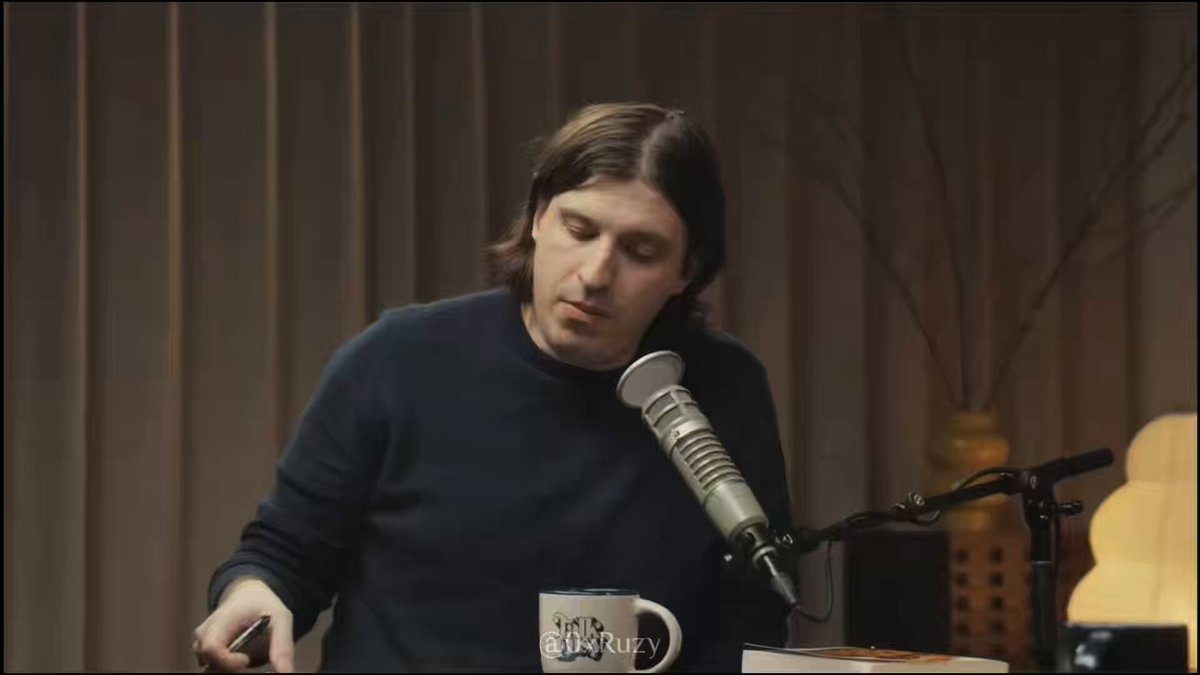
Why Christopher Nolan chose everyday American accents and Travis Scott over traditional cinema voices, and why he says the old way has absolutely no logic. Interviewer: I’m curious about the use of American accents. It felt like an intentional choice. Christopher Nolan: To me, I didn't want to look...

65,668 просмотров • 1 месяц назад •via X (Twitter)

Комментарии: 0

Нет доступных комментариев

Здесь появятся комментарии из оригинального поста

Похожие видео

John David Washington says he showed up 30 minutes late to Christopher Nolan's house, barely understood the script the first time he read it........and still walked away with the lead role. Josh Horowitz: "Again, this crazy, amazing honor opportunity. Not many people get to be the protagonist, literally, in a Chris Nolan movie." "Does he deliver a script? Is it a conversation? How does it go down?" David Washington: "Yeah, I was told to be at his house at a certain time, and we're gonna talk about something. That was it." "I was in there like, maybe he's doing research for something else... We talked about movies and we talked about like how I love the movie, like movies. We talked about our love for films and, and just life and sports and stuff like that." "So after the meeting, I was like... I was thirty minutes late to the meeting. I was running up to the gate and like sweating profusely... And Emma greets me at the door, his wife, producing partner, and she's just laughing." "I think she could see how panicked I was... But we end up staying two and two and a half hours, and then after that, I got the call saying, 'Uh, will you be the protagonist?'" "I went crazy. We went, we had like three dinners, like it was like a Super Bowl... I felt like I made the Hall of Fame." On reading the script in Nolan's office: "I'm in Christopher Nolan's office reading a script of his. What is my life? ...I didn't understand that shit. Like, it took about three some plus hours to read it, you know?" "But I really did sincerely understand there's a way into the character... I kinda liked it. I can create, we can create together, and he kinda left that to me. He really trusted me with that. And I really love him for it because he didn't have to." "That's Christopher Nolan. He has his way... But it was quite the opposite. He wanted me to use my instincts."

Dunmola♋

50,144 просмотров • 20 дней назад

A 26-year-old Tom Cruise on failure, risk, and refusing the "movie star" label: In a 1988 interview around the release of Rain Man, the interviewer pushes Cruise on whether fame has made him emotionally guarded — suggesting that "just out of necessity as a movie star, there is some part of you that has to be cut off." Cruise pushes back immediately: "You have to understand, it's not about being a movie star. This whole interview and every time we sit down — you ask me this, and every time I tell you that there isn't a part of me that's cut off. It is about the work. Being a movie star is a wonderful thing that has happened, but that's not how I approach choosing a film or how I approach my life." He insists he still lives a normal life — going to the movies, the gas station, grocery shopping. No entourage mythology. No mystique. Just work. The interviewer then tries another angle, noting that Cruise has "one of the nicest reputations in Hollywood" but doesn't let people get real close. Cruise's response is disarmingly simple: "I feel like I'm letting you pretty close. I'm doing this to help promote the films and I don't really hold back that much, but there are certain things I don't want to talk about or that aren't important for people to hear." It's not guardedness. It's boundaries — and at 26, he already knew the difference. When asked about confidence and whether it ever gets shaken, Cruise is surprisingly candid: "All the time. Sometimes I look back and wonder where I got off going to New York to say I'm going to be an actor." But then he reveals the mindset that arguably built one of the most durable careers in Hollywood history: "What has helped me is that I don't treat failure as a personal, horrendous defeat. If something didn't work, I want to know why it didn't work so I can evaluate it, learn from it, and lift myself up." b No dramatics. No ego protection. Just a feedback loop: fail, understand why, adjust, move forward. And when the interviewer points out that he seems to court danger — with racing, with risky career moves Cruise doesn't deny it: "I guess I like to have everything on the line. I like to feel that there is something at stake, and I really enjoy that."

History Nerd

56,275 просмотров • 1 месяц назад

From THE GOD DEBATE: Me: Why should you care for the needy? Why should you donate blood? Why should you refrain from murder and robbery? You can't possibly say that the only reason to do it is because God will punish you in an afterlife. If God's back was turned, does that mean it would be okay to kill and rob or let people drown or starve? I can think of plenty of secular reasons to do it. Namely, I would not want to be left to starve or drown or die of lack of blood. I would not want to be the victim of murder or robbery. There's nothing special about me, and therefore what I demand of everyone else, I have to accept for myself. It is clear that we would all be better off in a world where everyone helped each other and refrained from hurting each other compared to a society where everyone was a rapacious psychopath. That's why we should be moral. God has nothing to do with it. Ross Douthat (Ross Douthat): What happens in Dr. Pinker's argument is that as an heir of Jewish and Christian civilization, he imports, as this kind of commonsensical position, metaphysical propositions about the existence of these human rights that no one has ever seen of or heard of. He cannot show me a human right under a microscope. He cannot prove to me in a mathematical theorem why segregation was wrong, why it was wrong to murder people in the gulag or the concentration camp for the sake of a better tomorrow. He asserts that it's necessary for, again, sort of decency and order and so on, and often it is, but there has to be a stronger reason when you find yourself in a position where what the society says is out of joint with what you think are the fundamental truths about the universe.

Steven Pinker

79,917 просмотров • 4 месяцев назад

Neil Oliver: "Al Gore and and and the rest of them, they've all got beachfront property...I think the reality is that they know, like the rest of us do, that yes we have climate change, the climate is changeable, the climate is variable like it always has been. But this nonsense about a climate crisis and about a world at boiling point and a world about to burst into flames is errant nonsense." "Putting solar panels everywhere and then the next thing is let's turn down the power of the sun. There's no joined up thinking about it at all. And it is gross hypocrisy. If any of these people meant it, if any of these people, they speak so passionately about the danger that we're all in, they would be living the life themselves as an example. That's how you lead." "It's like Saint Francis of Assisi, you know, was born into wealth. He was he was a rich man's son and he lived the life of a rich man's son until until he got religion, until he got Christianity, and then he gave away everything. And he lived a life of poverty, and he insisted that all of his followers live a life of poverty thereafter. Now that's how you do it. That's that's the way that you get that message across." "You live the life first. And if if by living that life you inspire other people, then they live likewise. But the fact that these people want to preach this nonsense from the bridge of the private jets, or from their goodness only knows what nuclear powered submarines that they want to cut about the world in is just rank hypocrisy." "I've reached a point in my life where I have faith in next to no one. I look out to everyone who's to whom I have to listen on the, coming out of the official mouthpieces. And I find almost all of them completely intolerable."

Camus

17,019 просмотров • 1 год назад

David Friedberg: The Eric Swalwell allegations were widely known about by California insiders, but held back for the perfect moment. Was this a hit job to clear the path for a preferred candidate in California? “Back in December, when it was first rumored that Swalwell was going to run for governor, I started making some calls to various folks to be like, ‘Hey, what do we think of this guy? Is he going to be a good candidate?’ I spoke to several people who independently told me that there's knowledge about this guy sending pics to employees, and that this guy has a bunch of stuff that's going to come out about him. And I largely kind of dismissed it, because I was like, if this is true, this would've all come out already. If multiple people are telling me about this, then I've got to assume that it's a rumor that's being used to block him from running for governor. And then everything that I had been told started to come out in the last week. So the striking aspect of all of this for me was how much knowledge there was about these various incidents with the guy, how so many people had this knowledge, and how no one had actually brought the knowledge to bear. Which begs the question, why did they not do what was right by the victims? Or, why did the victims sit on the sidelines waiting for the right moment to all come out together? These were all being held back purposefully and deliberately for a very particular moment in time when they were all brought forward to be used. And that's what was so striking to me is just how coordinated all of this was. My sense of it is that there are certain insiders, and he's not an insider. Katie Porter, I think, is who the Democratic establishment wants to be governor. She's an insider to national Democrats, she's an insider to California Democrats, and I think that she's the preferred candidate.”

The All-In Podcast

34,980 просмотров • 3 месяцев назад

Christopher Nolan on Robin Williams's creepy performance in "Insomnia" (2002): "Nolan: You wouldn't notice him sitting next to you on the bus. To me that's why he's so creepy, because he's a very ordinary guy who's crossed this line and he's trying to figure out where that's going to take him, I've seen his performance in this movie, one way or another, thousands of times at this point, and it's totally real. It absolutely stands up to multiple viewings. Most performances don't. Most performances, after you've watched them and watched them and watched them, you start to see the tricks. It starts to get stale. Interviewer: What isn't ordinary about the character is that his mind is so meticulous. Watching Williams, you get the sense that everything he does is premeditated, even when he's winging it. Nolan: Right. but if you watch the film again, if you step outside Pacino's perception of the situation, he's not as sharp as you think he is. Al is progressively strung out. He's missing things. Interviewer: So was it hard to get such a reserved performance out of the famously hyperactive Williams? Nolan: I didn't find it so, to be quite honest. What I found was that all of the control he has as a performer- that allows him to create these various characters be they manic or whatever -- it's exactly the same control that allows him to reign it in." (Christopher Nolan's interview with Rob Blackwelder, Splicedwire, 2002) P.S: On this day, 24 years ago, "Insomnia" (2002) was released in the USA and Canada.

DepressedBergman

45,737 просмотров • 2 месяцев назад