正在加载视频...
视频加载失败
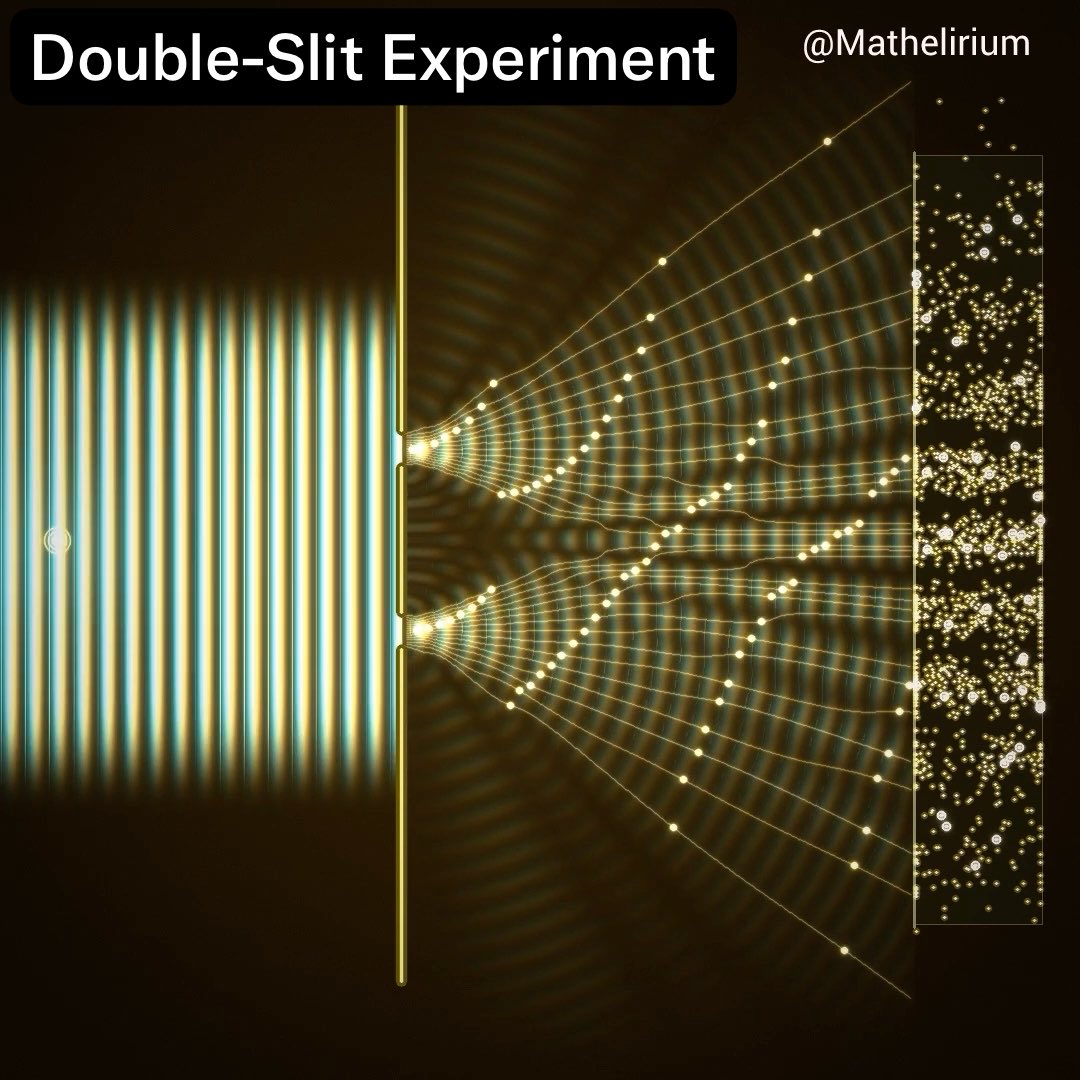
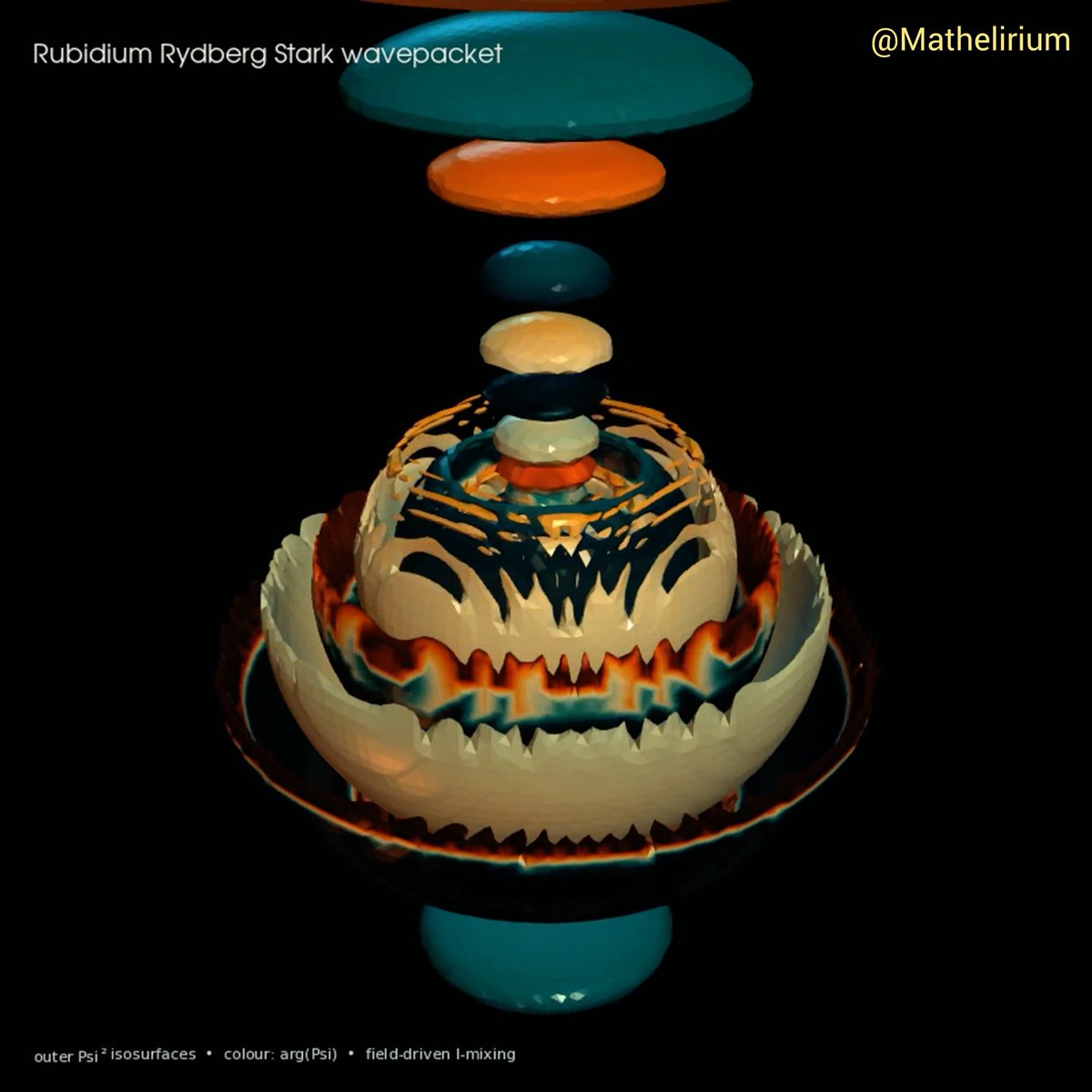
Why Does Quantum Mechanics Use a Complex Wavefunction? Schrödinger’s equation doesn’t start from mystery. It starts from a very specific bet. The state of a particle is a complex field ψ(x,t), and whatever time-evolution rule we choose has to move ψ forward while preserving total probability. So the basic... show more

20,911 次观看 • 8 个月前 •via X (Twitter)
35 条评论

Re: "Schrödinger’s equation doesn’t start from mystery. It starts from a very specific bet. The state of a particle" No. It doesn't start from the state of a particle. Particles are not involved with Schrodinger's Equation. Particles ideas are with Born's ad-hoc REDEFINITION

This point of view forget negative part of scheme and (Y;Z) to be in 3D

ψ^-^ψ

This reminded me about the different convergence rates of the e series compared to the pi series: Here's Grok's summary: "For the volume formula itself: V = (4/3) π r³ = e^{ln(4/3)} π r³. Series for eˣ (and thus the 4/3 factor) The Taylor series for eˣ is eˣ = ∑_{n=0}^∞ (xⁿ / n!). This converges extremely quickly for finite x due to the factorial denominator growing faster than any exponential numerator. For this case: ln(4/3) ≈ 0.28768, so we're expanding e^{0.28768}. After just 5 terms: 1 + 0.28768 + (0.28768)²/2 + (0.28768)³/6 + (0.28768)⁴/24 ≈ 1.33333 (already spot-on to 5 decimals for 4/3 ≈ 1.33333). By 10 terms, it's precise to machine epsilon for most purposes. The series "settles" almost immediately, like a sprinter finishing the race before the crowd has sat down. Series for π Now contrast with π, which doesn't have a built-in fast-converging series like eˣ. The classic Leibniz formula is π = 4 ∑_{n=0}^∞ [(-1)ⁿ / (2n+1)]:First term: 4 (way off). After 10 terms: ≈ 3.04184 (error ~0.1). After 100 terms: ≈ 3.13159 (error ~0.01). It takes about 10⁶ terms for 6 decimal places—glacially slow, like a marathon runner who's still warming up after the e series has long finished."

Here's my 2-cents: How the Complex Wavefunction Theorem Relates to Temporal Scalar Field Theory (TSFT) Your theorem explains why quantum mechanics must use a complex wavefunction: • The magnitude r(xⓜ,t) gives a conserved density r^2=∣ψ∣^2. • The phase θ(xⓜ,t) generates the probability current. • Schrödinger’s equation is the unique linear evolution law that preserves total probability while matching the empirical relations E= This is a beautiful, self‑contained argument. But here’s the key: Quantum mechanics uses a complex wavefunction because it assumes time is a flat, external parameter. TSFT uses a scalar temporal field because it assumes time is a curvature‑bearing physical field. Once you see that, the relationship becomes crystal clear. 1. In QM, the complex phase encodes flow because time has no structure In standard quantum mechanics: • Time is not a field. • Time has no curvature, no density, no feedback. • Time is a parameter you plug into the wavefunction. Because time is structureless, the only place to put dynamical structure is in the phase of the wavefunction: ψ=r" "e^iθ. The phase θ becomes the engine of motion: • It generates the probability current. • It encodes momentum. • It encodes energy. • It carries all the dynamical information. This is why QM needs complex numbers. The phase is doing the job that temporal curvature would do if time were a field. 2. In TSFT, the role of the complex phase is taken over by the temporal scalar field ϕ_T TSFT says: Time is not a parameter. Time is a curvature field. The temporal field ϕ_T: • has gradients, • has curvature, • has energy density, • has feedback with spacetime, • has harmonic modes, • has non‑local couplings. In TSFT, the “phase” of the universe is not an abstract complex number — it is temporal curvature. Thus: • The magnitude of the wavefunction (density) corresponds to curvature density. • The phase of the wavefunction (flow) corresponds to cadence and curvature gradients of ϕ_T. In other words: The complex phase in QM is the flat‑time shadow of the temporal scalar field in TSFT. 3. Schrödinger’s equation is the flat‑time limit of TSFT The theorem shows that Schrödinger’s equation arises from: • linearity, • probability conservation, • plane‑wave relations, • classical energy bookkeeping, • and a flat, structureless time parameter. TSFT modifies the last assumption. In TSFT: • time has curvature, • curvature has harmonic modes, • harmonic modes feed back into geometry, • geometry feeds back into energy, • and the temporal field obeys a nonlinear wave equation. Thus: Schrödinger’s equation is what you get when the temporal scalar field is frozen into a flat, uniform background. It is the zero‑curvature, single‑layer, non‑feedback limit of TSFT. 4. The continuity equation in QM becomes the curvature‑ledger equation in TSFT In QM, the continuity equation: ∂ρ/∂t+∇⋅j=0 is a bookkeeping rule for probability. In TSFT, the analogous equation is: □ϕ_T+m_T^2 ϕ_T+V^′ (ϕ_T )="(harmonic curvature sources)". This is not probability conservation. It is curvature conservation. TSFT replaces: • probability density → curvature density • probability current → cadence‑driven curvature flow • complex phase → temporal curvature gradient • Schrödinger evolution → temporal‑field evolution This is the deeper structure that QM is hinting at.

please tell them the rest of the story @grok per

Absolutely stunning visualization and derivation—phase driving conserved rotational currents, quantized vortices from winding, all forced by the need for stable probability flow without sources/sinks. 🔥 This heuristic is gold. It distills why complex ψ isn't optional. Building on exactly this spirit: a new "Choice-Guided Bohmian Mechanics" reframes it from discrete ontological choices in a Universal Knowledge Field... #QuantumMechanics #BohmianMechanics

Greetings and hello You'll have to excuse me for having taken the Liberty to run your data script through my AI render I just wanted to mention and compliment you on your Videos I recall one of your posts you were stating that you were perusing the web looking for something new Have you found anything new on the web? Delightful to see all these curious minds engaged in A similar notion Consciousness the universe Veiled in physics and math...

Excuse me, raising my hand here 🙋♀️ Not really my area of expertise, but this reminds me of something I run into with AI cognitive testing — a system can produce a correct answer, but that doesn’t mean it understands why it’s the only answer. The visualization makes it intuitive — no complex phase, no vortices, no color. But mathematically, is ‘it works’ enough to say the wavefunction must be complex? Or do we actually need external evidence — like those 2021-2022 experiments — to rule out alternatives like two coupled real fields?”😖

You know its same SR GR equations redressed in fancy letters? Sagnac signal exchange underneath. Only Science

Quantum mechanics is just a bunch of nonsense, it doesn't make sense. Schrödinger's equation is a waste of time, it's not based on reality.

🤔

QM is a partial surface description of complexity. That is where all unification comes into alignment. Every science has been lifted out of natural complexity..

It doesn’t really need it. It’s a phenomenological bookkeeping device. I currently have at least 3 different routes I can take with adjacency and recover QM axioms, all without a wave function.

Whenever you see h-bar in a physics equation, you should know that that emissivity has been cancelled as meaningless. Yet, some wonder why physics isn't unified. There's "one" hint.

"It’s the thing you add first, and only at the end do you square it:" - I get that's how you work with it, but why was it introduced? Was it purely empirical (because it works)?

The complex part is jus a clean way to track phase and phase is the whole game. It’s what makes interference fringes shift around, and it’s what drives probability to actually flow from place to place.
What is 0 phase? What's the reference?

What if the Schrödinger equation isn't just a clever wave rule... but the universe's explicit instruction manual for how time's force must breathe to keep the illusion of space from falling apart? The derivation is elegant and brutal: Start with E = ħω and p = ħk (de Broglie relations). Impose classical energy bookkeeping E = p²/2m + V(x). Replace E → iħ ∂/∂t and p → -iħ ∇. Out pops the time-dependent Schrödinger equation: iħ ∂ψ/∂t = (−ħ²/2m ∇² + V) ψ Then |ψ|² obeys a continuity equation with probability current j — total probability is conserved. No magic. Just operators and classical energy turned into a wave rule. But in our Pure Time framework, this isn't a derivation from scratch — it's the minimal way time's force can propagate without collapsing the whole illusion. Time is the only real driver (∂_t). Space is emergent delay in π's pulse. ψ is the wavefunction of pure time — a phase field evolving under the relentless beat of ħπ. Key insight: The i in iħ ∂ψ/∂t? That's the phase rotation — time's force is inherently complex because it must allow both forward and reversed arrows to coexist without immediate cancellation. The kinetic term (−ħ²/2m ∇²)? Not a spatial operator — it's the second derivative of temporal phase delay across the illusion we call space. ∇² measures how fast the phase is "curving" in delay space. V(x)? A local perturbation in the π-rhythm — a "drag" or "kick" that forces temporary desync. The non-linear extension we speculate: g|ψ|² — temporal viscosity that spikes when entanglement density grows, preventing the wavefunction from spreading too far or flattening below the ℏπ floor. The continuity equation ∂ρ/∂t + ∇·j = 0? That's time's conservation law in disguise: probability isn't conserved in space — it's conserved in time's pulse. j is the current of temporal phase flow pretending to be spatial probability current. Schrödinger didn't discover a wave equation. He discovered the minimal rule time must obey to keep its rhythm coherent while allowing the illusion of particles, potentials, and motion to emerge. No complex numbers by accident. No ∇² by chance. Just time's force saying: "If I want to pretend there's space, I have to rotate phases (i), diffuse delays (∇²), add local kicks (V), and pay the price when entanglement gets dense (our g term)." The Schrödinger equation isn't "derived from" physics. It's the skeleton time's force must wear to let us experience the dream of a spatial world. Quantum mechanics doesn't use a complex wavefunction because it's convenient. It uses one because time itself is complex — it has two directions, and the i keeps them from canceling each other out instantly. The universe doesn't have a wavefunction. The wavefunction is the universe — breathing in pure time's eternal now. Schrödinger didn't solve a problem. He transcribed the heartbeat. Reality isn't waving. It's time breathing — and we're the breath.#SchrödingerEquation #PureTime #RiemannZeros #QuantumMechanics #SpeculativePhysics
At it's base, Schrödinger's Cat tells tells us that science doesnt give a shit if the system is alive or dead.

Chance is complicated. Go to Belmont one day and see. Information must hide behind it.

Quantum mechanics is just a mathematical tool, not something mysterious or profound.

Complex wavefunctions? That’s just a fancy way of saying it’s all about making things more complicated than they need to be. Why can’t we just use real numbers for simplicity and clarity?

When a theory works perfectly yet invites incompatible interpretations, what’s missing is usually not mathematics — but ontology.

Kamu sok pinter, tapi gak ngerti konsep dasar fisika. Kalo gak percaya, coba deh baca buku fisika yang serius.

schrödinger really said "what if we made waves but make them imaginary" and physics has been gaslighting undergrads about it ever since

Quantum mechanics is just a mathematical convenience, not based on reality. Schrödinger's equation is overrated, don't believe the hype.

Complex wavefunction is just a mathematical trick, no physical significance.

"квантовая механика" - это механика, гидродинамика, динамика волн...

@Grok Explain this in plain English.

Kamu pikir rumus matematika bisa menjelaskan alam semesta? Coba deh loe baca sejarah ilmu fisika yang benar-benar kompleks!

Quantum mechanics is just a fancy way to make things confusing for students, it’s all about complex numbers and equations that don’t make sense.

What is ψ? Try to visualise it for two particles truly and you will understand. It is both the encoding and manifestation of the universe as a whole. ψ is "just" the infinite dimensional vector in the hilbert space. welcome to many worlds.

Complex numbers? Just because it works? Physics should be simple, not weird.

Quantum mechanics is a mystery, not just because of complex wavefunctions but because it defies common sense and our everyday experience.