Video yükleniyor...
Video Yüklenemedi
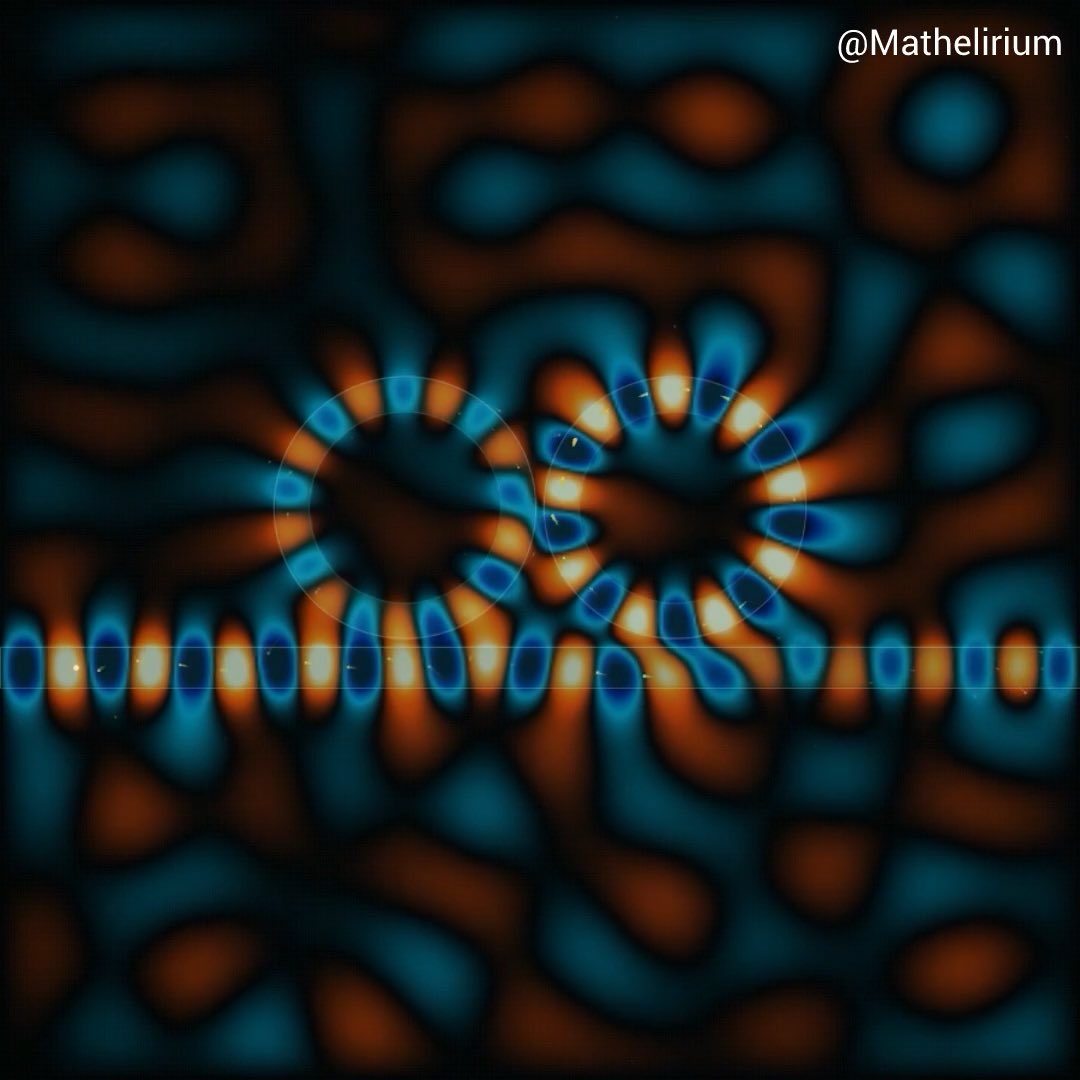
A coherent wave passes through two finite slits and the downstream field is rebuilt by a Huygens sum. The filaments trace the probability current j = Im(ψ*∇ψ). The interference bands on detector grow from individual impacts sampled from |ψ|².

44,543 görüntüleme • 5 gün önce •via X (Twitter)
24 Yorum

Thanks so much for this! Very well done. Now can you increase it in steps from 1 to n slits?

Here you go
Amazing! Thanks!!!

And that's the proper visualization of double slit with light. The photon hits both as it's growing to cover both slits, dispersion aka the Heisenberg rule.

🔥

👀✨️✨️✨️😎 @hyzochain

Not if someone’s watching

@jondpratt Le continuum’ de l’espace temps…! 💫

In a linear field, they simply superpose: ψ = ψ₁ + ψ₂ But detection usually depends on intensity: |ψ|² = |ψ₁|² + |ψ₂|² + 2Re(ψ₁*ψ₂) Cross terms. Two waves can pass through one another without interacting dynamically, yet the detector still records a term that depends on both. So where exactly does the relation live: in the waves, in the field, or only in the measurement?

great simulation! good job

Never seen it like this! Ofcourse it takes a spiral out shape. Excellent work yet again

4

isn't that the pilot wave De Broglie-Bohm theory?
phase coherence is encoded in the off-diagonal terms of the density matrix. Decoherence suppresses those terms by leaking which-path information into the environment, while |ψ₁|² and |ψ₂|² can remain unchanged.

So does this validate or invalidate the dual-slit experiment assertions about particle/wave duality?

Ok, add slit geometries: Add a hole between the two slits near the bottom A stepped center hole A center hole with 3 radial slits at 120° These distinguish gamma sources & expose photon traveling as threes, triads spiraling The two slit experiment is limited in what it exposes, yet find your application intriguing & creative 🦆

That is glorious!

🔥

The bands only exist after enough individual impacts. Same reason nobody can give you a p99 from four requests, though they will still ask for it.

Light kabhi particle, kabhi wave — dono soft possible. Universe simple dikhta hai, andar complex khelta hai. ✨

I see spirals in wave form

あなたのは美しすぎる(笑) 波を見せるなら1個ずつ

Why are the p currents not straight? The symmetry of their bends is also intriguing. What causes this variation in p?

What we are seeing is a time crystal being formed.


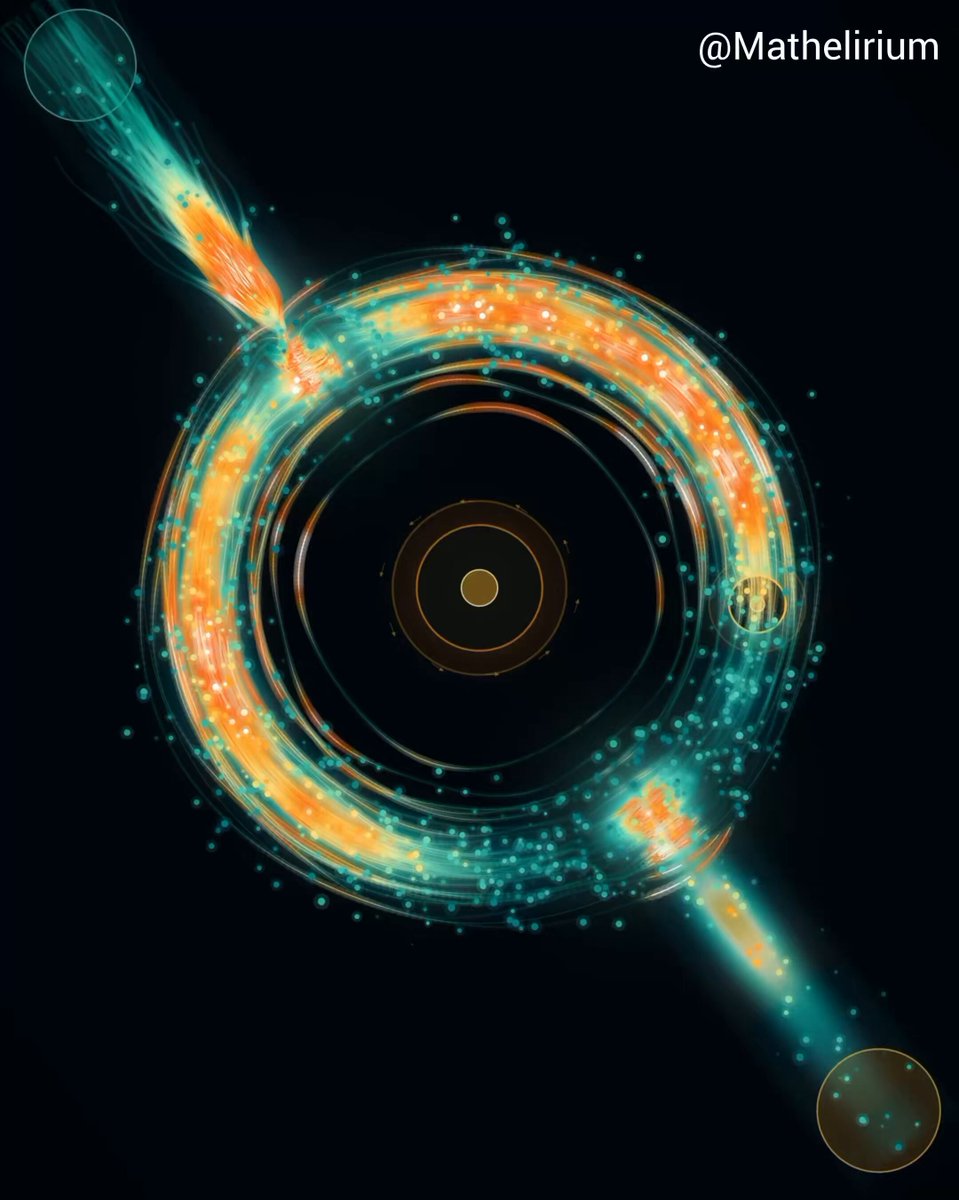
![Lecture 3 of our Quantum Mechanics series. Lecture 2 gave us the one clean privilege quantum theory offers: treat ψ(x,t) as the state and ρ(x,t) = |ψ(x,t)|² as probability, because Schrödinger evolution forces ρ to obey a continuity equation. Lecture 3 is what that continuity equation is really telling you. If ρ behaves like a fluid, then the only question that matters is: What is the velocity field? Write ψ(x,t) = r(x,t) exp(i θ(x,t)). The magnitude r sets how much probability is sitting there. The phase θ sets where it tries to go. When you unpack the current j = Im(ψ* ∇ψ), it collapses to j = (ρ/m) ∇θ, which means the flow lines you draw are literally contours of phase geometry. Then the constraint that makes the picture bite: ψ has to be single-valued, so θ can’t wind by an arbitrary amount. Around any closed loop the total phase change must be 2π n, with n an integer. That’s why vortices aren’t features you add...they’re defects the math permits, in quantized units. In the render you see both layers at once...the 3D surface shows |ψ| breathing while the phase skin slides, and the 2D panel exposes the engine...current lines steering around discrete vortex charges. The math breakdown We write the state as a complex field ψ(x,t) on the plane (x in R²). The Born rule defines the probability density ρ(x,t) = |ψ(x,t)|² Schrödinger evolution (ħ = 1 units) is i ∂ψ/∂t = [ −(1/2m) ∇² + V(x,t) ] ψ Now derive conservation of probability. Start with ρ = ψ*ψ: ∂ρ/∂t = ψ* (∂ψ/∂t) + ψ (∂ψ*/∂t) Use Schrödinger and its complex conjugate: ∂ψ/∂t = (1/i) [ −(1/2m) ∇²ψ + Vψ ] ∂ψ*/∂t = (−1/i) [ −(1/2m) ∇²ψ* + Vψ* ] Substitute. The V terms cancel, and the remaining terms rearrange into the continuity equation ∂ρ/∂t + ∇·j = 0 with probability current j = (1/2mi) ( ψ* ∇ψ − ψ ∇ψ* ) = (1/m) Im(ψ* ∇ψ) So "probability density" really behaves like a conserved fluid density with flux j. Now expose the phase mechanism. Write ψ in polar form ψ(x,t) = r(x,t) exp(i θ(x,t)) Compute the gradient ∇ψ = exp(iθ) (∇r + i r ∇θ) Then ψ* ∇ψ = r (∇r + i r ∇θ) Taking the imaginary part gives Im(ψ* ∇ψ) = r² ∇θ = ρ ∇θ So the current becomes j = (ρ/m) ∇θ That’s the steering-wheel statement: Phase gradient sets the flow direction and speed (modulated by density and m). Finally, quantized vortices. Because ψ must be single-valued, going around any closed loop must return the same complex value. That forces the phase winding to be an integer multiple of 2π: ∮ ∇θ · dl = 2π n with n in Z n is the vortex charge. Vortex cores sit where ρ ≈ 0 (phase is undefined), and the current streamlines circulate around them. #QuantumMechanics #Wavefunction #SchrodingerEquation #BornRule #ProbabilityCurrent #ContinuityEquation #Phase #Vortices #TopologicalDefects #ComplexAnalysis #MathematicalPhysics #Mathematics #Physics](https://image.24vids.com/tw-2006665244211380338/amplify_video_thumb/2006664944415035392/img/qEDUF2G3erxPqtSk.jpg)
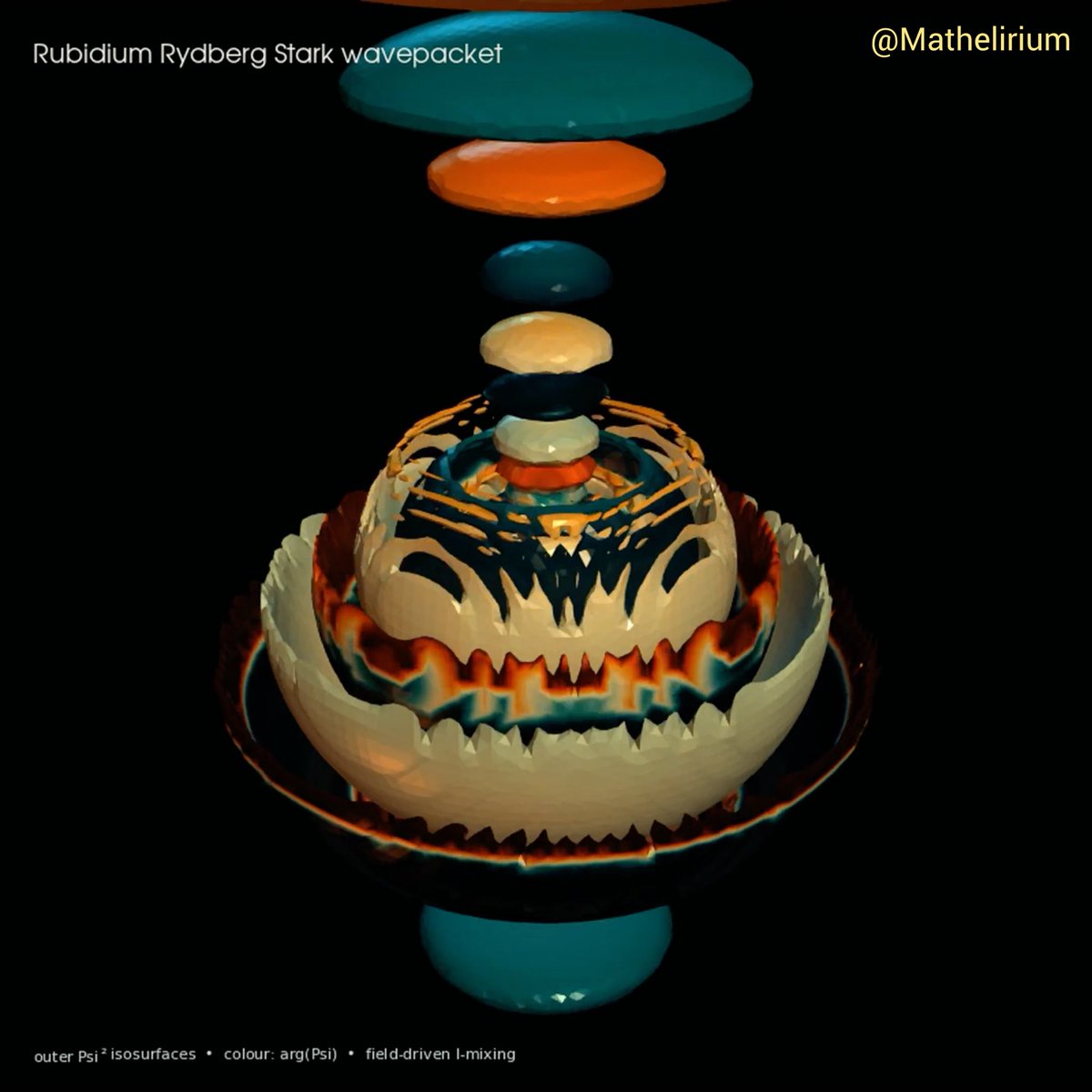


![Quantum Mechanics Series Lecture 4 Lecture 1 established that ρ(x,t) = |ψ(x,t)|² behaves like a conserved probability density. Lecture 2 showed what drives that flow. We also saw that writing ψ = r exp(iθ) makes the probability current proportional to the phase gradient, making it clear that phase geometry literally steers the motion. Lecture 3 then showed that the centroid of that flow can move almost classically when the packet is tight and the external potential is smooth. However, that raises yet another question. If the centroid can look classical, why does the full wave still spread, bend, split, and interfere in ways no classical particle cloud would? This is because the wave is not driven only by the external potential. It is also driven by its own curvature. Write ψ(x,t) = r(x,t) exp(iθ(x,t)) with ρ = r². Then Schrödinger’s equation gives two coupled real equations. One is the continuity equation you already know. The other looks like a Hamilton-Jacobi equation, but with one extra term: Q = −(1/2m) ∇²r / r This is the so-called Quantum Potential. It depends entirely on how the amplitude bends across space. So, the wave is being shaped not only by V(x,t), but also by the geometry of its own envelope. In the animation, the upper surface is still |ψ| and its skin is still colored by arg(ψ). The glowing threads still trace the probability current. But now a second membrane hangs underneath. That lower membrane encodes the quantum potential Q itself. The porcelain bead marks the quantum centroid. The amber bead follows a classical centroid under the same external V. When those paths separate, the lower membrane tells you why. The difference is not magic but the extra term classical mechanics does not have. The math breakdown: Start from Schrödinger evolution in units with ħ = 1: i ∂ψ/∂t = [ −(1/2m) ∇² + V(x,t) ] ψ Write the state in polar form: ψ = r exp(iθ) Then ρ = |ψ|² = r² From the imaginary part, you recover probability conservation: ∂ρ/∂t + ∇·j = 0 with j = (1/m) Im(ψ* ∇ψ) = (ρ/m) ∇θ So the local velocity field is v = j / ρ = ∇θ / m Now take the real part of Schrödinger’s equation. That gives ∂θ/∂t + |∇θ|² / (2m) + V + Q = 0 where Q = −(1/2m) ∇²r / r This is the classical Hamilton-Jacobi equation with one extra term. That extra term is what makes quantum motion locally different from classical motion. Take a gradient of that phase equation and use v = ∇θ / m. Then the flow obeys an Euler-like equation: ∂v/∂t + (v·∇)v = −(1/m) ∇(V + Q) In other words, there are really two forces in the problem. One comes from the external potential V. The other comes from the wave’s own curvature through Q. That is why Ehrenfest is only approximate. The centroid can still satisfy d⟨x⟩/dt = ⟨p⟩/m d⟨p⟩/dt = −⟨∇V⟩ but the internal shape of the packet evolves under the combined influence of V and Q. When the packet stays broad and smooth, Q is gentle and the motion looks more classical. When the packet develops sharp curvature or interference structure, Q becomes strong and the classical picture breaks down. That is what this scene is designed to show live. #QuantumMechanics #Wavefunction #SchrodingerEquation #BornRule #ProbabilityCurrent #ContinuityEquation #Phase #EhrenfestTheorem #QuantumPotential #Madelung #HamiltonJacobi #MathematicalPhysics #Mathematics #Physics](https://image.24vids.com/tw-2044118124148973661/amplify_video_thumb/2044117901251072000/img/IXBMEKzfYfpY_xGi.jpg)