
How I Write Clips
@PerellClips • 2,911 subscribers
I interview the world's top writers. New episodes every Wednesday, and this is a feed of the very best clips. My personal account: @david_perell
Videos

Academics write for each other, not for people. Steven Pinker has spent over four decades doing the opposite, and thinks current academic writing is "enormous wasted effort." "There's an awful lot of brilliant work, really smart people in academia. Why are they doing it? Just to entertain each other? Taxpayers pay for it. It should be accessible. Why should I have to read a paragraph five or six times? It gets under my skin when academics devote so much brainpower into the scholarship and then just blow off the essential task of letting the world know what you've done."
How I Write Clips865,601 просмотров • 2 месяцев назад

Ezra Klein: "Having AI summarize a book or paper for me is a disaster. It has no idea what I really wanted to know and wouldn't have made the connections I would've made. I'm interested in the thing I will see that other people wouldn't have seen, and I think AI typically sees what everybody else would see. I'm not saying that AI can't be useful, but I'm pretty against shortcuts. And obviously, you have to limit the amount of work you're doing. You can't read literally everything. But in some ways, I think it's more dangerous to think you've read something that you haven't than to not read it at all. I think the time you spend with things is pretty important." Ezra Klein
How I Write Clips2,054,877 просмотров • 5 месяцев назад

"Most people can't write. I'm not saying that to be an asshole. It's just the reality. I think I'm a good writer. But I read García Márquez and I'm like, holy shit. I couldn't do that if you paid me a billion dollars and gave me 20 years. Most people can get to a certain level. You can push, you can learn. But you have to understand what you're good at, and go for that. When I read writers trying to do creative dramatic leads and it's just not working. It's like, you're clearly good at X. Focus on X." — Nick Bilton
How I Write Clips716,132 просмотров • 2 месяцев назад
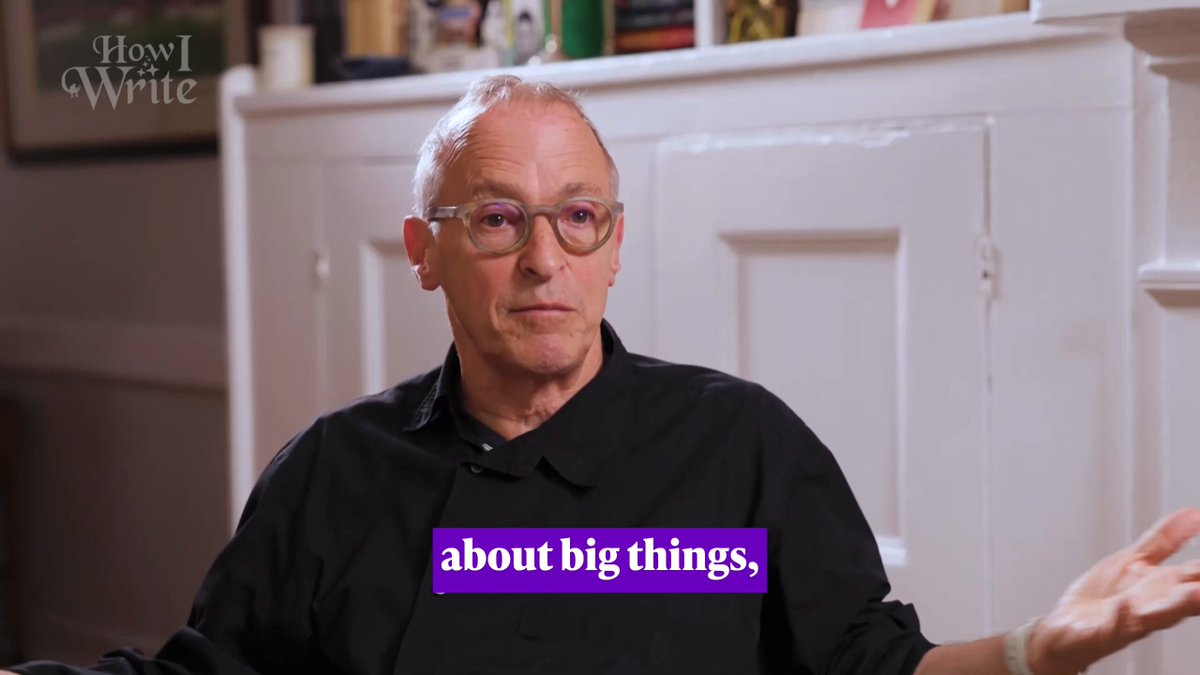
David Sedaris thinks that if we just lived for the plot, we'd have material to write anything. He explains: "My friend asked me what I did in the afternoon. I said, 'I went to the post office.' He replied, 'Why would you do that? You don't even need to go to the post office. If you have something you want mailed, you have the hotel called FedEx and they come and pick it up.'" "I don't want to live like you. I want to go to the post office. And I went to the post office and it was remarkable. Or sometimes you go to the post office and the person is just grumpy and you can even get something out of that." "I wanna live. I wanna be out there. I don't wanna sit at home and order everything online, and use all the shortcuts."
How I Write Clips395,515 просмотров • 1 месяц назад


"We've been homogenizing writing since long before AI." Ocean Vuong says: "It coincided with the rise of the newspaper. The newspaper needed to be standardized after the Civil War because it was completely reckless. Exclamation marks were everywhere. Sure it was beautiful but for information delivery, it was terrible. So the English started to become tamed. It became efficient. It went for clarity. It had to have enough brevity to keep room for advertising. And this comes from the newspaper model. There are plenty of works that are written beautifully from that but it's done incredible damage to young writers' imaginations because the sentence has now been so timid."
David Perell Clips955,313 просмотров • 4 месяцев назад

Dave Kitson was an ok football player. Yet, his book outsold David Beckham, Frank Lampard, and Steven Gerrard's combined. Harry Dry on the copywriting principle that explains why: "I think it's a foundational copywriting principle: what can I do that no one else is doing that people care about? Kitson had a bad career. All these guys wrote books about their careers playing for England. Kitson didn't have any of that. He thought: 'I've been in the Premier League. So I'll tell some truths. I'll do an undercover. I'll tell you this player's got a gambling addiction. This is what it's like when England go abroad and everyone's going out.' But no one wants to read a book by Dave Kitson. So instead, he signed it as The Secret Footballer. Kitson's product is objectively so much worse than David Beckham's. But just by positioning it, just by a little bit of storytelling, he could outsell him. That's copywriting."
David Perell Clips151,188 просмотров • 2 месяцев назад

Elon Musk is so famous you'd think you've heard it all. So when Jimmy Soni interviewed him, he opened with the one question that humanizes him. Jimmy asked about Greg Kouri, a close friend and early investor in Elon's first company, Zip2. Greg died at a very young age: "I said, Elon, I want to begin our interview a little bit differently. I had read about this gentleman that had helped you early on in your life. I found his widow, and we talked. Can you talk about him? There's a pause. And he goes, 'Oh my god.' He gave me this minute long meditation on Greg and their friendship and everything that it meant to him. Nobody's talking to him about Greg Kouri. The human beings that I interview, they have lives that exist outside of the very narrow frame of reference that we see them for. What's the thing that they never get talked about that reveals something about their character?"
How I Write Clips157,551 просмотров • 2 месяцев назад

"The greatest piece of American art ever made is Absalom, Absalom." Wright Thompson says: "Faulkner gets something so essentially right about the South. It's a place where the conflict that exists inside the hearts of every human being is played out on the landscape in an external way that almost never happens. The South is one of the few places in the world where the interior becomes manifestly exterior. You know how they have energy vortexes in Sedona? Likewise, the South is one of those places where the thing cracks open and the big subterranean human ideas — the conflict in the heart of every human being burst into physical action on the actual physical land. William Faulkner could see that. He had that Sixth Sense. One of the reasons that book resonates with people across generations is that he's describing something you've instinctually felt but never had the vocabulary to describe."
How I Write Clips279,919 просмотров • 4 месяцев назад

Indifference kills humor. Which is funnier: "This coffee is ok" vs. "This coffee is so bad even Dunkin' wouldn't serve it" Tom Segura explained this to me: "Being annoyed is funny. My seven-year-old is annoyed all the time, and he's hilarious. Sometimes I wonder, 'Why are you so annoyed?' Then he'll say something like, 'What's this table doing in the middle of the room? I keep running into it!' It's a funny perspective to be bothered by furniture. Complaining is definitely funny. What's not funny is total indifference. When it comes to being funny, you simply have to have an opinion.
David Perell Clips175,940 просмотров • 3 месяцев назад

Here's how to tell a better story at your next dinner conversation. Tom Segura calls it the "way in" "One of the big things people always talk about when doing standup is having a story but wondering about the 'way in.' The reason for telling a story is often as important, if not more so, than the story itself. You could just say, 'One time, I was almost the spokesman for Subway. Here's what happened.' But on stage, I started by saying, 'I'm so grateful to be performing here. I thought the highlight of my career was when I booked the campaign to be the spokesman for Subway.' Right there, you give yourself a reason to tell the story. You have a story, but you need to figure out your way in. Figure out a reason for saying it. Don't get lazy about those moments; figure out why." The way into a story is by tying it to stakes; the stakes are what make the person across from you lean in and ask, "What happened?"
How I Write Clips172,431 просмотров • 3 месяцев назад

Just write the bad sentence. Pixar's Andrew Stanton on why it's more important to do the work, even if it sucks, than to talk about the great work you'll make (and never do it): "There's a term for it: whistling on the steps of Carnegie Hall. Most people spend more time telling you the symphony they're going to write than the symphony is written. Finish the sentence. I don't care if it doesn't have an ending, or a middle. Just freaking write the sentence. It's gonna be bad. You don't get to the nice sentence until you've written the bad sentence. Writing is rewriting." "It's chipping away at the marble. Every time you decide not to, you're not practicing. So you're just going to be that much less practiced."
How I Write Clips82,508 просмотров • 1 месяц назад

Kurt Vonnegut explained conflict in one sentence. "He said: make sure on every page, every character wants something, even if it's only a glass of water. And to me is the distilled essence of writing, and that's conflict. It's what you want." "I look at a page and say, do I have Kurt's advice covered here? Does everybody want something?" "I had Bosch as a smoker, and it's a society where you're not supposed to smoke. He always wanted a cigarette, but he couldn't have one. That was my little way of making sure there was conflict on every page." -Michael Connelly
How I Write Clips63,879 просмотров • 1 месяц назад

Walking makes you more creative Daniel Pink says: "The research on walking is unbelievable. There's a famous study where they put people in a chair and they put people on a treadmill, and they do the "alternative uses for an object test." Basically, you give somebody something mundane like a brick and ask: How many different uses can you have for the brick? You can use it as a door stop. You can use it as a step ladder to reach something you can't reach. You can use it as a paper weight. The people who were walking on a treadmill generated like three times as many ideas as the people sitting in a chair. Wow. It's unbelievable. They were just in a treadmill in a laboratory." Daniel Pink
David Perell Clips231,225 просмотров • 5 месяцев назад

John F. Kennedy was one of America's best speechwriters, and his secret weapon was a rhetorical trick called Chiasmus. Some examples: 1) "Ask not what your country can do for you; ask what you can do for your country." 2) "Mankind must put an end to war, or war will put an end to mankind." 3) "Let us never negotiate out of fear, but let us never fear to negotiate." All of these follow the same pattern. The lesson is that humans love symmetry. Both in buildings like the Taj Mahal or St. Paul's Cathedral, and with language when we have symmetrical sentences like the ones JFK used to use so often.
How I Write Clips163,825 просмотров • 5 месяцев назад

Tim Ferriss: "I think reputation is the new gold." "I have policies for all sorts of things in my life, and a lot of them are around this scarce resource, which is very easily destroyed: reputation." "There is a certain finite amount of trust that any person can put into other people, and they're gonna choose the people with the highest signal of credibility for them." "I really try to think very carefully, often very slowly, about decisions, so that I can play the long game of credibility. It just means if you ask someone, do you trust Tim's recommendations, their answer is going to be yes as often as possible. And you have to turn down a lot for that."
How I Write Clips50,473 просмотров • 1 месяц назад

The better AI writing gets, the less we'll want to read it. Life of Pi author Yann Martel explains why: 1) AI Inflation "Once you know it's AI, then suddenly it's like special effects in movies. I find my kids when they watch movies with special effects, they'll just shrug because we know a computer can generate anything. So a sort of inflation sets in where we're less impressed. Then you have a great actor who's just acting with no special effects and it's like, wow, that works. What really has an impact is the actor emoting the authenticity of that." 2) AI Aversion "I think publishers are going to start saying, 'hey, it cannot be beyond spell check and maybe minimal AI, but you cannot use AI.' I think readers will agree with that, and that the ones who cheat on that will be seen as cheaters. They're not going to get published, but even if they do, they won't be read. They're not going to win prizes, they're not going to win good reviews. It'll be pointed out that this is not the way to do it."
How I Write Clips92,557 просмотров • 3 месяцев назад

Nobody likes to be lectured. And yet nearly everything we consume online; politics, self-improvement, finance, is exactly that. Morgan Housel has sold 11 million books doing the opposite. "Nobody likes someone to basically say: 'hey, idiot, you've done it wrong the whole time, and if you had done it my way, you'd be in a better spot.'" He never tells you what to do. He just tells stories about psychology, how people actually behave with money. "Nobody likes to be shamed. If you give them enough stories about psychology, they'll figure it out for themselves."
How I Write Clips64,851 просмотров • 2 месяцев назад

What's wrong with writing with AI? Alain deBotton says: "I don't just write to produce a certain numbers of words. I write in order to honor certain feelings, and AI can't know those feelings because it's not me. It doesn't know what I want to say. And if I simply give my writing over to AI, it will crush my nascent sense about what it is I really want to say."
How I Write Clips94,348 просмотров • 4 месяцев назад

Pixar's Andrew Stanton uses this technique to create unforgettable characters: "I often give characters spines, meaning the way they're wired up no matter what's going on in life. It's the core of you." "Michael Corleone, his spine is to please his father, and that never goes away even after his father dies in the second Godfather movie." "WALL-E's spine was to find the beauty." I heard a similar idea from Wright Thompson, who's known for his profiles: "A profile is figuring out what is the central complication in any person's life. How do they go about solving it in every single thing that they do?" "If you can get clear on that, and then have that motif, that theme show up in all the stories, now you have the conflict, you have the tension, you have a story, you have an arc, and everything comes together."
How I Write Clips40,552 просмотров • 1 месяц назад

Creative workshops can be destructive because you get too much feedback. It's all over the place. The people giving you advice don't actually know you. Ocean Vuong says that in his workshops, people aren't allowed to critique other writers for the first few weeks. He says: "When you suspend critique, people are more willing to let the novelty of themselves come into the room. So we just put things in the center. When we look at a poem or short story, we simply talk about what we notice. And then once we know each other's tendencies, we can gear our feedback towards others." The importance of knowing someone before we give them feedback is obvious in other parts of life. For example, you would never walk up to a stranger on the street and instantly give them fashion advice. But that's exactly what we do in creative workshops.
David Perell Clips78,544 просмотров • 4 месяцев назад