Alvaro Cintas's banner
Alvaro Cintas's profile picture

Alvaro Cintas

@dr_cintas • 132,341 subscribers

Educating about AI, Cybersecurity and Technology | Professor | PhD in Computer Science & Engineering

Shorts

The xAI API is incredible. I just created an AI assistant that can fetch news content from URLs and write a post about it on my own writing style. Super simple to set up and you can try free. Here’s how:

The xAI API is incredible. I just created an AI assistant that can fetch news content from URLs and write a post about it on my own writing style. Super simple to set up and you can try free. Here’s how:

15,386,078 görüntüleme

Grok 3 is an incredible AI coding assistant. After a couple of hours and +1000 lines of code generated, I have now a fully functional 2D vertical jumping game. With different heroes, monsters, platforms, difficulties, and lives. Here are the prompts and process I followed:

Grok 3 is an incredible AI coding assistant. After a couple of hours and +1000 lines of code generated, I have now a fully functional 2D vertical jumping game. With different heroes, monsters, platforms, difficulties, and lives. Here are the prompts and process I followed:

4,213,651 görüntüleme

🚨 BREAKING: OpenAI just announced their new Text-To-Video model called Sora. Look at these 10 insane examples: 1. Space movie trailer featuring a man wearing a red wool knitted motorcycle helmet

🚨 BREAKING: OpenAI just announced their new Text-To-Video model called Sora. Look at these 10 insane examples: 1. Space movie trailer featuring a man wearing a red wool knitted motorcycle helmet

3,610,988 görüntüleme

your AI agent can watch any video now - paste a URL and it sees every frame, hears every word, all for free 🤯 bradautomates/claude-video gives Claude the ability to watch YouTube, Loom, TikTok, local files - anything yt-dlp supports what people actually use it for: → analyze a competitor launch - what hook, what visuals, what structure → debug from a screen recording - Claude reads the exact frame where it breaks → summarize a 49-min talk in 30 seconds with frame-accurate timestamps → strip the hype from product videos - "what's actually new, skip the pitch" the mechanism: yt-dlp pulls free captions first (zero cost). ffmpeg extracts frames at scene-aware intervals - not uniform sampling, so you don't waste tokens on 12 identical frames of the same slide. Claude reads every frame as an image with timestamp markers. Groq Whisper only kicks in when a video has no caption track how to set up (3 min): > claude code: /plugin marketplace add bradautomates/claude-video then /plugin install watch@claude-video > or npx skills add bradautomates/claude-video -g for codex, cursor, gemini cli > dependencies auto-install on macOS via brew two caveats: free captions cover most but not all videos. past 10 min use --start/--end for focused sections or the token-burner mode for full coverage your buddy still watches every tutorial at 2x speed taking manual notes. you paste a URL and your agent extracts the substance in seconds for $0

your AI agent can watch any video now - paste a URL and it sees every frame, hears every word, all for free 🤯 bradautomates/claude-video gives Claude the ability to watch YouTube, Loom, TikTok, local files - anything yt-dlp supports what people actually use it for: → analyze a competitor launch - what hook, what visuals, what structure → debug from a screen recording - Claude reads the exact frame where it breaks → summarize a 49-min talk in 30 seconds with frame-accurate timestamps → strip the hype from product videos - "what's actually new, skip the pitch" the mechanism: yt-dlp pulls free captions first (zero cost). ffmpeg extracts frames at scene-aware intervals - not uniform sampling, so you don't waste tokens on 12 identical frames of the same slide. Claude reads every frame as an image with timestamp markers. Groq Whisper only kicks in when a video has no caption track how to set up (3 min): > claude code: /plugin marketplace add bradautomates/claude-video then /plugin install watch@claude-video > or npx skills add bradautomates/claude-video -g for codex, cursor, gemini cli > dependencies auto-install on macOS via brew two caveats: free captions cover most but not all videos. past 10 min use --start/--end for focused sections or the token-burner mode for full coverage your buddy still watches every tutorial at 2x speed taking manual notes. you paste a URL and your agent extracts the substance in seconds for $0

311,088 görüntüleme

I took the AI video prompts from Sora and tested them on DALL•E 3. Look at these 10 amazing results: 1. Two pirate ships battling each other as they sail inside a cup of coffee

I took the AI video prompts from Sora and tested them on DALL•E 3. Look at these 10 amazing results: 1. Two pirate ships battling each other as they sail inside a cup of coffee

2,548,803 görüntüleme

🚨 China has released an AI employee that runs 100% locally. It can do research, code, build websites, create slide decks, and generate videos.. all by itself. And it comes with its own computer. 100% Open Source.

🚨 China has released an AI employee that runs 100% locally. It can do research, code, build websites, create slide decks, and generate videos.. all by itself. And it comes with its own computer. 100% Open Source.

457,644 görüntüleme

Perplexity Comet is scary GOOD. This agentic browser connects to your apps and does everything you want autonomously. 10 powerful use cases👇: 1. Summarize and provide me all the links of this video

Perplexity Comet is scary GOOD. This agentic browser connects to your apps and does everything you want autonomously. 10 powerful use cases👇: 1. Summarize and provide me all the links of this video

787,049 görüntüleme

NVIDIA just made AI detect objects 10x faster by deleting one step. It's called LocateAnything, and it removes the biggest bottleneck no one else was fixing in vision-language models. Normally a model builds each bounding box one coordinate token at a time. 100 objects means thousands of tokens before an answer. NVIDIA scrapped that: their Parallel Box Decoding predicts the whole box in a single forward pass, as one atomic unit. → 12.7 boxes/sec on one H100 → 10x faster than Qwen3-VL → +3.8% F1 on LVIS, accuracy up, not down → 3B params, runs on one consumer GPU Treating the box as one unit keeps its coordinates tied together, which is why accuracy climbed instead of falling. One model handles detection, GUI grounding, OCR, and document understanding, ready for computer-use agents, robotics, and document pipelines. 100% open source, weights, code, demo, and paper all live.

NVIDIA just made AI detect objects 10x faster by deleting one step. It's called LocateAnything, and it removes the biggest bottleneck no one else was fixing in vision-language models. Normally a model builds each bounding box one coordinate token at a time. 100 objects means thousands of tokens before an answer. NVIDIA scrapped that: their Parallel Box Decoding predicts the whole box in a single forward pass, as one atomic unit. → 12.7 boxes/sec on one H100 → 10x faster than Qwen3-VL → +3.8% F1 on LVIS, accuracy up, not down → 3B params, runs on one consumer GPU Treating the box as one unit keeps its coordinates tied together, which is why accuracy climbed instead of falling. One model handles detection, GUI grounding, OCR, and document understanding, ready for computer-use agents, robotics, and document pipelines. 100% open source, weights, code, demo, and paper all live.

202,473 görüntüleme

Stop typing “make it look modern”. There are 2,000+ 𝗗𝗘𝗦𝗜𝗚𝗡.𝗺𝗱 files from top products. Colors. Typography. Spacing. Component rules. All packed into a single Markdown file your AI reads before it generates anything. → Works with Claude Code, Cursor, Lovable, Bolt → 100% Free to use Pick a style you like. Drop it in your repo.

Stop typing “make it look modern”. There are 2,000+ 𝗗𝗘𝗦𝗜𝗚𝗡.𝗺𝗱 files from top products. Colors. Typography. Spacing. Component rules. All packed into a single Markdown file your AI reads before it generates anything. → Works with Claude Code, Cursor, Lovable, Bolt → 100% Free to use Pick a style you like. Drop it in your repo.

278,048 görüntüleme

Stanford has launched an incredible research AI tool. It’s called STORM, and basically you enter a topic and it will search hundreds of websites to write an article about its major findings. Available to everyone for free!

Stanford has launched an incredible research AI tool. It’s called STORM, and basically you enter a topic and it will search hundreds of websites to write an article about its major findings. Available to everyone for free!

976,485 görüntüleme

You can now use Jev right inside Claude Code 🤯 It's called jev-model-router, an early access mod built on Claude Code's new function hooks. Before every turn, it checks in with Jev and asks: > how mechanical the task is > how much reasoning it needs > whether it's risky Then it routes: → it'll move up to a stronger model on weak evidence, and only drops to a cheaper one when it's confident the task is simple → every decision gets logged in your transcript → if the call fails, your request runs untouched Setup: 1. copy the install command: npx claude-code-templates@latest --mod productivity/jev-model-router 2. paste it inside Claude Code 3. run claude with CLAUDE_CODE_ENABLE_FUNCTION_HOOKS=1 set 4. accept the trust prompt on first launch Link: Also works with no api key, it just falls back to a built-in classifier with no confidence score. For real jev routing, add your typesafeApiKey or gatewayApiKey to ~/.claude/settings.json. Follow me for more AI workflows and tutorials.

You can now use Jev right inside Claude Code 🤯 It's called jev-model-router, an early access mod built on Claude Code's new function hooks. Before every turn, it checks in with Jev and asks: > how mechanical the task is > how much reasoning it needs > whether it's risky Then it routes: → it'll move up to a stronger model on weak evidence, and only drops to a cheaper one when it's confident the task is simple → every decision gets logged in your transcript → if the call fails, your request runs untouched Setup: 1. copy the install command: npx claude-code-templates@latest --mod productivity/jev-model-router 2. paste it inside Claude Code 3. run claude with CLAUDE_CODE_ENABLE_FUNCTION_HOOKS=1 set 4. accept the trust prompt on first launch Link: Also works with no api key, it just falls back to a built-in classifier with no confidence score. For real jev routing, add your typesafeApiKey or gatewayApiKey to ~/.claude/settings.json. Follow me for more AI workflows and tutorials.

44,149 görüntüleme

GPT-4o is my new Siri. I programmed an iPhone Shortcut that when I tap twice, automatically explains what I’m seeing real-time using GPT-4o 🤯

GPT-4o is my new Siri. I programmed an iPhone Shortcut that when I tap twice, automatically explains what I’m seeing real-time using GPT-4o 🤯

852,494 görüntüleme

🚨 Meta just announced Meta Movie Gen. It can generate high-quality AI videos from text, sync audio to the video, and even perform video editing. Look at these 10 crazy examples: 1. Fluffy koala bear surfing

🚨 Meta just announced Meta Movie Gen. It can generate high-quality AI videos from text, sync audio to the video, and even perform video editing. Look at these 10 crazy examples: 1. Fluffy koala bear surfing

678,039 görüntüleme

Claude Fable 5 orchestrating Grok 4.5 is now my favorite real workflow. all you need is this free Claude Code plugin that makes Grok the default implementer. Fable writes the specs and reviews every diff, Grok 4.5 does the typing through the Grok CLI. - Grok handles the volume, Fable handles the judgment - Every diff gets cross-vendor review for free - Specs run as parallel agents when they're independent I've been testing it for a few days and the part that sold me is watching Fable refuse to write code. It sends specs down, judges what comes back, and that's it. setup: 1. claude plugin marketplace add DannyMac180/fable-advisor && claude plugin install fable-advisor 2. Install the Grok CLI from then grok login 3. /model fable It's open source, so you can read the agent files and tweak the routing however you want.

Claude Fable 5 orchestrating Grok 4.5 is now my favorite real workflow. all you need is this free Claude Code plugin that makes Grok the default implementer. Fable writes the specs and reviews every diff, Grok 4.5 does the typing through the Grok CLI. - Grok handles the volume, Fable handles the judgment - Every diff gets cross-vendor review for free - Specs run as parallel agents when they're independent I've been testing it for a few days and the part that sold me is watching Fable refuse to write code. It sends specs down, judges what comes back, and that's it. setup: 1. claude plugin marketplace add DannyMac180/fable-advisor && claude plugin install fable-advisor 2. Install the Grok CLI from then grok login 3. /model fable It's open source, so you can read the agent files and tweak the routing however you want.

100,804 görüntüleme

You can now orchestrate Fable 5, Sol, and any model inside Codex with one plugin. It's called Codex-Orchestration. Assign Fable 5 as the advisor, Sol as the executor, or any model to any role. Then define the order they work in. Codex handles the routing. I ran Fable 5 High as planner with GPT-5.6 Sol Extra High as executor on a set of issues Opus and GPT-5.5 always struggled with. Done in 30 minutes. 40% fewer limit hits. 2x faster implementation. Install it by pasting this into Codex: "Install Codex Orchestration: codex plugin marketplace add Cjbuilds/Codex-Orchestration codex plugin add codex-orchestration@codex-orchestration Verify the installation, then tell me to start a new task." Then assign your models: @ codex-orchestration advisor: Claude Fable 5 High, Executor: GPT-5.6 Sol High Open source. Tweak the routing however you want.

You can now orchestrate Fable 5, Sol, and any model inside Codex with one plugin. It's called Codex-Orchestration. Assign Fable 5 as the advisor, Sol as the executor, or any model to any role. Then define the order they work in. Codex handles the routing. I ran Fable 5 High as planner with GPT-5.6 Sol Extra High as executor on a set of issues Opus and GPT-5.5 always struggled with. Done in 30 minutes. 40% fewer limit hits. 2x faster implementation. Install it by pasting this into Codex: "Install Codex Orchestration: codex plugin marketplace add Cjbuilds/Codex-Orchestration codex plugin add codex-orchestration@codex-orchestration Verify the installation, then tell me to start a new task." Then assign your models: @ codex-orchestration advisor: Claude Fable 5 High, Executor: GPT-5.6 Sol High Open source. Tweak the routing however you want.

92,518 görüntüleme

if you use claude code, this will save you real money. the problem: every time you make an edit, your ai rereads the whole codebase to figure out what changed. tens of thousands of tokens, every turn, for context it already had. this repo fixes it. it’s called code review graph, and it just maps your entire codebase: every file, every function, every connection laid out so you can see the actual shape of your project how to set up (2 min): 1. pip install code-review-graph 2. code-review-graph install - auto-configures Claude Code, Cursor, Codex, Gemini CLI + more 3. code-review-graph build change one function, and it traces exactly what that touches... every caller, every dependent file, every test. your ai only reads what's affected, not the whole repo. and the savings are wild. a task that used to burn ~100,000 tokens (about a dollar) now runs closer to a penny.

if you use claude code, this will save you real money. the problem: every time you make an edit, your ai rereads the whole codebase to figure out what changed. tens of thousands of tokens, every turn, for context it already had. this repo fixes it. it’s called code review graph, and it just maps your entire codebase: every file, every function, every connection laid out so you can see the actual shape of your project how to set up (2 min): 1. pip install code-review-graph 2. code-review-graph install - auto-configures Claude Code, Cursor, Codex, Gemini CLI + more 3. code-review-graph build change one function, and it traces exactly what that touches... every caller, every dependent file, every test. your ai only reads what's affected, not the whole repo. and the savings are wild. a task that used to burn ~100,000 tokens (about a dollar) now runs closer to a penny.

75,596 görüntüleme

OpenAI’s GPT-5.6 Sol model can now run inside Claude Code. There are two ways to do it, and both take minutes to set up, here’s how: Option 1, the official plugin: /plugin marketplace add openai/codex-plugin-cc /plugin install codex@openai-codex /reload-plugins, then /codex:setup That unlocks /codex:review, /codex:adversarial-review, and /codex:rescue. Claude writes, GPT critiques, you ship. Option 2, the proxy. One alias makes Sol your main model: alias claudex=‘CLAUDE_CODE_SUBAGENT_MODEL=gpt-5.6-sol CLAUDE_CODE_ALWAYS_ENABLE_EFFORT=1 claude –model gpt-5.6-sol’ Bonus: Claude Code lets you set subagent model and effort yourself. Sol Ultra runs can burn several times the tokens of a base run, so right-sizing delegated work saves real money.

OpenAI’s GPT-5.6 Sol model can now run inside Claude Code. There are two ways to do it, and both take minutes to set up, here’s how: Option 1, the official plugin: /plugin marketplace add openai/codex-plugin-cc /plugin install codex@openai-codex /reload-plugins, then /codex:setup That unlocks /codex:review, /codex:adversarial-review, and /codex:rescue. Claude writes, GPT critiques, you ship. Option 2, the proxy. One alias makes Sol your main model: alias claudex=‘CLAUDE_CODE_SUBAGENT_MODEL=gpt-5.6-sol CLAUDE_CODE_ALWAYS_ENABLE_EFFORT=1 claude –model gpt-5.6-sol’ Bonus: Claude Code lets you set subagent model and effort yourself. Sol Ultra runs can burn several times the tokens of a base run, so right-sizing delegated work saves real money.

90,783 görüntüleme

Google has released the AI function in Sheets. You can now use AI in your spreadsheets to generate text, analyze sentiment, or summarize and categorize information. Here’s how:

Google has released the AI function in Sheets. You can now use AI in your spreadsheets to generate text, analyze sentiment, or summarize and categorize information. Here’s how:

369,924 görüntüleme

Ok, this is amazing. I asked Claude 3 to generate an animation of the Pythagorean Theorem and this is what it created:

Ok, this is amazing. I asked Claude 3 to generate an animation of the Pythagorean Theorem and this is what it created:

564,645 görüntüleme

You can now run open-source AI coding agents without paying for API keys 🤯 Cline CLI 2.0 just dropped with free access to Minimax M2.5. → Runs from your terminal → Parallel agents → Works with any editor Any model you want. 100% Open Source.

You can now run open-source AI coding agents without paying for API keys 🤯 Cline CLI 2.0 just dropped with free access to Minimax M2.5. → Runs from your terminal → Parallel agents → Works with any editor Any model you want. 100% Open Source.

162,119 görüntüleme

Videos

dr_cintas's profile picture

This is one of the best consumer AI apps I've seen. Most AI apps remain static chat wrappers: text input ➔ spinner ➔ text output. But real learning is a dynamic, stateful "Interaction Flow" with intent, pacing, and rhythm. Building an AI Agent that keeps users in a live learning loop requires moving from a reactive "replier" to an active "Interaction Conductor." Orchestrating voice, canvas, and memory in real time is an entirely different engineering challenge: 1. Pacing over wall-of-text output: Instead of dumping everything at once, the system controls pacing, i.e., knowing when to speak, render UI cards, or pause for user input like a seasoned coach. 2. Interactive, live-generated workspace: The AI’s voice, canvas elements, and visual cards evolve in millisecond-aligned sync as you speak, creating a live, immersive session. 3. Full-duplex audio & interaction checkpoint recovery: Uses continuous streaming and syntactic completion so you can think without being cut off. More importantly, when you break away to ask side questions, the entire multimodal flow seamlessly resumes from your exact checkpoint in the core session. 4. Stateful memory graph: Friction points and milestones compile into persistent state across sessions to drive targeted reinforcement instead of starting from scratch. Moving from content-driven generation to interaction-driven orchestration - building stateful, multimodal partners with agency and pacing - is where interface design is heading.

Alvaro Cintas

43,205 görüntüleme • 5 gün önce

dr_cintas's profile picture

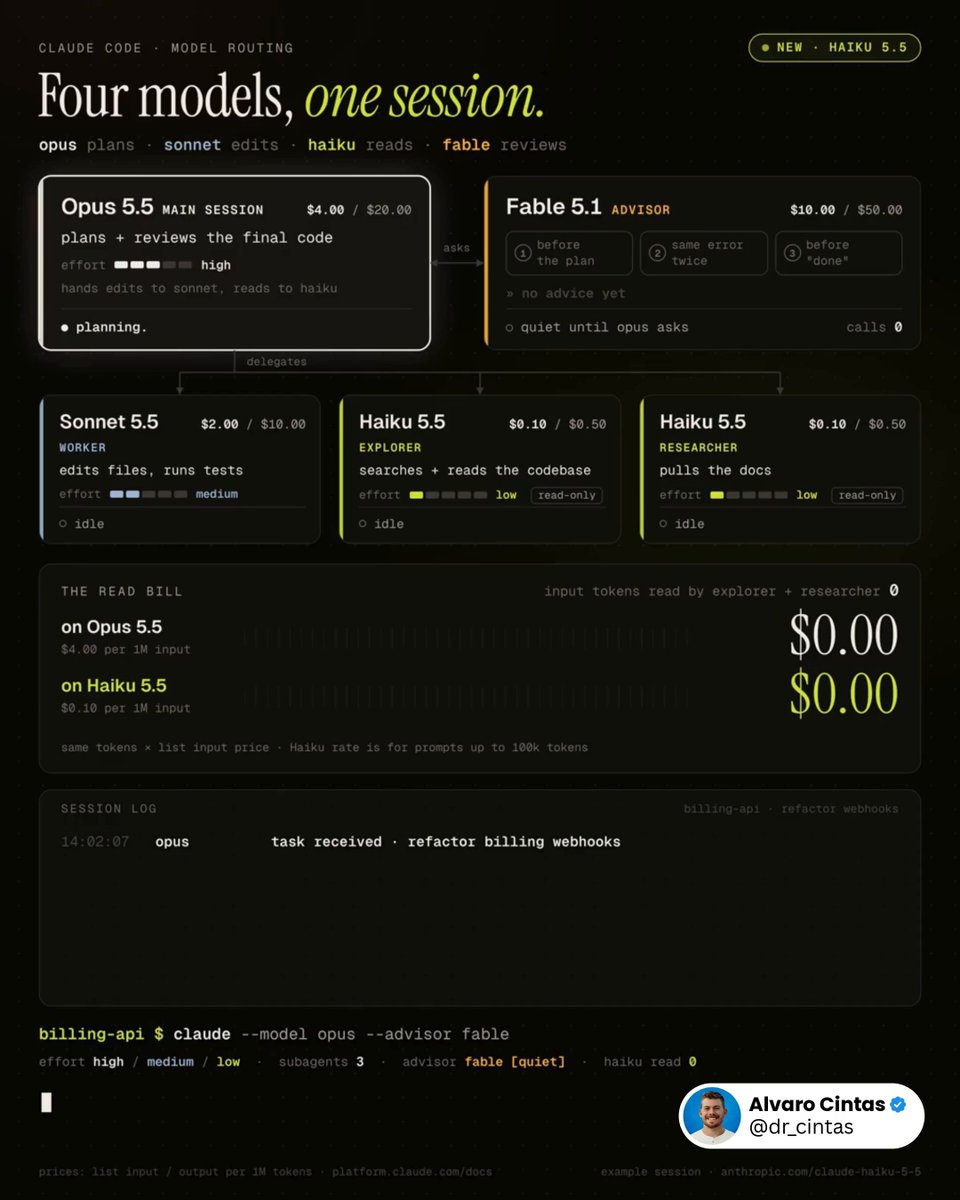
This workflow will save you thousands with Claude. Run Opus 5.5, Sonnet 5.5, Haiku 5.5, and Fable 5.1 together, and stop spending Opus tokens on work that doesn't need Opus. The entire idea in one line: Opus plans, Sonnet edits, Haiku reads, Fable reviews at decision points. Roles, broken down: - Opus 5.5, high effort, owns the plan and reviews the final code - Sonnet 5.5, medium effort, is the worker: edits files, runs tests - Haiku 5.5, low effort, splits into explorer (searches and reads the codebase) and researcher (pulls docs). it's the first Haiku with an effort setting - Fable 5.1, set with /advisor fable. Opus calls it at decision points, and it gets the full transcript each time Three moments Opus tends to call it: → before committing to a plan: is this the right approach? → the same error shows up again: is this going nowhere? → before marking the task done: did something get skipped? Why Haiku only reads: Anthropic's launch post says Sonnet 5.5 and Opus 5.5 are still the better choice for complex agentic coding (Terminal-Bench 4.0: 39.2% for Haiku 5.5, 70.6% for Sonnet 5.5) and that Haiku 5.5 fits narrowly scoped subagent work. so it gets the lookups, not the edits. Anyone still running one model for everything is paying $4 per million input tokens to check whether a file exists. Haiku 5.5 does it for $0.10. Drop this into Claude Code 👇 "Rebuild my Claude Code setup around this structure: Confirm Claude Code is v2.1.293 or later, so the haiku alias resolves to Haiku 5.5. If it isn't, stop and tell me to run claude update. Look through ~/.claude/agents and .claude/agents for subagents already covering explorer, worker, and researcher. Only create new ones for roles that are missing. Set model: haiku, effort: low on explorer and researcher, with no Edit or Write tools. Set model: sonnet, effort: medium on worker. If an existing subagent is locked to a different model, leave it as is and just list it. Name the explorer subagent Explore so it overrides the built-in one, which otherwise runs on my main model. In ~/.claude/settings.json, set advisorModel to fable, and set effortLevel to high for claude-opus-5-5 under modelSettings. A top-level effortLevel in user settings doesn't apply to Opus 5.5. Check for anything disabling the advisor: CLAUDE_CODE_DISABLE_ADVISOR_TOOL, DISABLE_TELEMETRY, or anything blocking feature-flag fetches. Also check CLAUDE_CODE_EFFORT_LEVEL, which overrides subagent effort settings, and CLAUDE_CODE_SUBAGENT_MODEL_FORCE, which makes Claude Code ignore subagent model fields. Report what you find. Don't change any of it yet. Add one line to ~/.claude/CLAUDE.md: consult the advisor before a big plan, when the same error shows up twice, and before marking a long task done. Show every change as a diff first. Wait for my go-ahead before touching anything."

Alvaro Cintas

56,940 görüntüleme • 13 gün önce