

MrNeRF
@janusch_patas • 16,943 subscribers
BDFL of https://t.co/5MjtfpwEU3 | Your guide to radiance fields | Host of the podcast @ViewDependent | FTP: 279 | discord: https://t.co/lrl64WGvlD
Shorts


![Is Google taking initial steps to enhance Street View? For some reason, Street View seems stuck in technology that feels outdated. I wonder if we'll see such improvements on the product side. Also, note how much better it performs in all aspects compared to Zip-NeRF in their presented material. It offers more details and fewer artifacts. Great work! "LODGE: Level-of-Detail Large-Scale Gaussian Splatting with Efficient Rendering" Contributions: • We propose a novel LOD representation for 3DGS which, unlike previous methods [27, 28, 17], does not recompute the list of used Gaussians at each frame. This allows for acceleration and compaction, enabling the rendering of large-scale scenes even on mobile devices. • We design a strategy to automatically select optimal hyperparameters for splitting LODs, whereas most other methods require manual tuning of hyperparameters for each 3D scene. • To further accelerate rendering, we split the scene into chunks and pre-compute sets of active Gaussians per chunk. • Finally, we introduce a novel opacity interpolation scheme to produce visually pleasing rendering and eliminate artifacts when transitioning between chunks.](https://image.24vids.com/tw-1929093093942612265/amplify_video_thumb/1929093040574169088/img/-A69SLlByyCTSIvA.jpg)


![[SIGGRAPH ASIA '25] Detail-Enhanced Gaussian Splatting for Large-Scale Volumetric Capture Contributions: - A two-stage approach to performance capture, combining a scene-scale capture rig and a single-actor facial capture rig. - A novel high-quality scene-scale volumetric performance capture rig, incorporating both static and dynamic cameras to track the performance of multiple actors. - A reconstruction pipeline for dynamic performance capture, featuring stable calibration of moving cameras and 4DGS with improved dynamic range and color fidelity. - A detail enhancement Diffusion Model, which supports 4K, RGB, and Alpha, with improved temporal stability.](https://image.24vids.com/tw-1984398618137370750/amplify_video_thumb/1984398555117993985/img/si1qfpktD83Yfd3s.jpg)


![Seamless non-repetitive texture painting. This is awesome: "[SIGGRAPH '24] Diffusion Texture Painting" Paper (pdf): Project:](https://image.24vids.com/tw-1791010848015581545/ext_tw_video_thumb/1791010572844015616/pu/img/lFSvMCwIZnSR2Tox.jpg)


Videos

Preview: LichtFeld is slowly pivoting towards an end-to-end pipeline. Where traditional SfM pipelines fail, our SLAM-based dense reconstruction runs in real time at 30 FPS and 1920 px. Four minutes of capture condensed into one. Dense point cloud and camera poses from a single monocular walk with a DJI Osmo Action 4.
MrNeRF25,439 次观看 • 26 天前

Europe Builds. Others Profit. 3D Gaussian Splatting (3DGS) is the perfect case study. It reflects both Europe’s brilliance and its chronic inability to turn that brilliance into business. Almost everything that made 3DGS possible was born in Europe. From the early breakthroughs in point-based rasterization in Switzerland to the cumulative research from Austria, Greece, and Germany executed in France, Europe built the foundation. No other continent can match that level of scientific collaboration and intellectual strength. The LichtFeld Studio bounty later confirmed it: the biggest performance leaps came straight out of European labs. The science was here. The innovation was here. The talent was here. But the business was not. When 3DGS exploded, my inbox filled with messages from US-based companies, not from Europe. In the United States, Luma AI and Polycam turned the paper into products within weeks. They did not wait for funding programs or EU consortia. They simply built. Then came China, which not only caught up in research but quickly outpaced everyone in commercialization. XGRID, DJI, and many others built thriving businesses around what Europe invented. Today, most 3DGS papers come from Chinese institutions rather than European ones. Meanwhile, the usual giants such as Meta, NVIDIA, Google, Netflix, and Tesla continue to iterate, integrate, and push forward. A thriving ecosystem of startups like World Labs leverages this technology to create new products and markets. The innovation cycle in the United States and China is fast, relentless, and market-driven. Europe, in contrast, remains bureaucratic and slow. We fund excellence and celebrate publications, but we rarely ship, even though some small startups are trying to change the status quo. Our researchers create the breakthroughs; others create the successful products. Until Europe finds a way to bridge the gap between laboratories and markets, it will remain the world’s research and development department: brilliant, underpaid, and underleveraged. Research is Europe’s comfort zone. Execution must become its strength. Video: One of my dynamic 3D Gaussian implementations based on the paper "Representing Long Volumetric Video with Temporal Gaussian Hierarchy."
MrNeRF159,855 次观看 • 11 个月前


I'm excited to share the Geo Register Plugin for LichtFeld Studio from the LichtFeld community! This plugin helps bring Gaussian splat scenes into real-world geographic space. It registers a scene to WGS-84 and ECEF coordinates, so you can click any point on the model and get its latitude, longitude and altitude. It supports multiple georeferencing sources, including EXIF GPS data, image position CSVs, RealityScan camera parameters and saved similarity transforms. Once the scene is registered, you can export geo-referenced splat models as LAS, LAZ or 3D Tiles datasets for use in GIS and 3D mapping workflows. Built for anyone working with drone data, photogrammetry, Gaussian splatting, GIS, ArcGIS or CesiumJS. Link in the comment below!
MrNeRF51,983 次观看 • 5 个月前

1 Billion Gaussians (1,035,804,128 exactly) streaming to the viewer at 60fps (vsync) and 5GB VRAM. There is no limit anymore to how much it can do. Some need a billion dollar corp to make similar things happen, others need paid pseudo influencers without skills and knowledge to make your software look bad because someone is shitting his pants. LichtFeld Studio is a product of love and passion. So help support this project by donating to it. 1B training on a single RTX 4090 will fall next. Ply -> rad took 28min which is not optimized yet. There is in general some more room for optimization. The dataset is just a 2x2 tile provided by: 3D scanning data created and provided by Andrii Shramko, TELEPORTOUR. Links in comment to the dataset provider!
MrNeRF32,504 次观看 • 4 个月前

Skyfall-GS: Synthesizing Immersive 3D Urban Scenes from Satellite Imagery TL;DR: Skyfall-GS converts satellite images to explorable 3D urban scenes using diffusion models, with real-time rendering performance. Contributions: • We introduce Skyfall-GS, the first method to synthesize immersive, real-time, free-flight navigable 3D urban scenes solely from multi-view satellite imagery using generative refinement. • An open-domain refinement approach leverages pre-trained text-to-image diffusion models without domain-specific training. • A curriculum-learning-based iterative refinement strategy progressively enhances reconstruction quality from higher to lower viewpoints, significantly improving visual fidelity in occluded areas.
MrNeRF66,539 次观看 • 1 年前

Instant Skinned Gaussian Avatars for Web, Mobile and VR Applications Short summary: In our system, we animate a background 3D mesh and have the Gaussian splats follow the mesh’s vertices. During preprocessing, splats are assigned to mesh vertices, and their relative transformations are stored. Once this data is saved, you can instantly use it in your applications without further preprocessing. At runtime, we animate the background 3D mesh, update the Gaussian splats in parallel, and resort all Gaussian splats every frame based on the viewer’s perspective.
MrNeRF66,016 次观看 • 1 年前

3.11 billion Gaussians. I think this is a world record, no? The updates are already sluggish and I can't push further with the hardware limitations I have (mainly disk space). The viewer still sits at around 5GB VRAM. This is a proof of concept that it scales and works. With more optimization there should be no limit. However, I won't drive this forward as it is pretty much pointless as of today.
MrNeRF28,394 次观看 • 4 个月前

Here is some new footage from this paper, offering a glimpse into the future of dynamic 3D Gaussian Splatting models combined with static reconstructed scenes. Imagine this: when the lighting matches, the result becomes practically indistinguishable from reality. Just pick a scene, add characters, and record it from any angle. Apply diffusion models to instantly change the look. I firmly believe this is the future of VFX.
MrNeRF58,210 次观看 • 11 个月前

RT-Splatting: Joint Reflection-Transmission Modeling with Gaussian Splatting Contributions: • We introduce a unified surface-volume Gaussian scene representation for jointly modeling sharp specular reflections and clear transmission in real-world scenes containing thin semi-transparent surfaces. • We propose Specular-Aware Gradient Gating to suppress misleading gradients from complex specular regions, substantially reducing floaters in the transmission branch. • Extensive experiments demonstrate that RT-Splatting significantly outperforms prior methods while maintaining real-time rendering and enabling flexible scene editing.
MrNeRF28,472 次观看 • 5 个月前
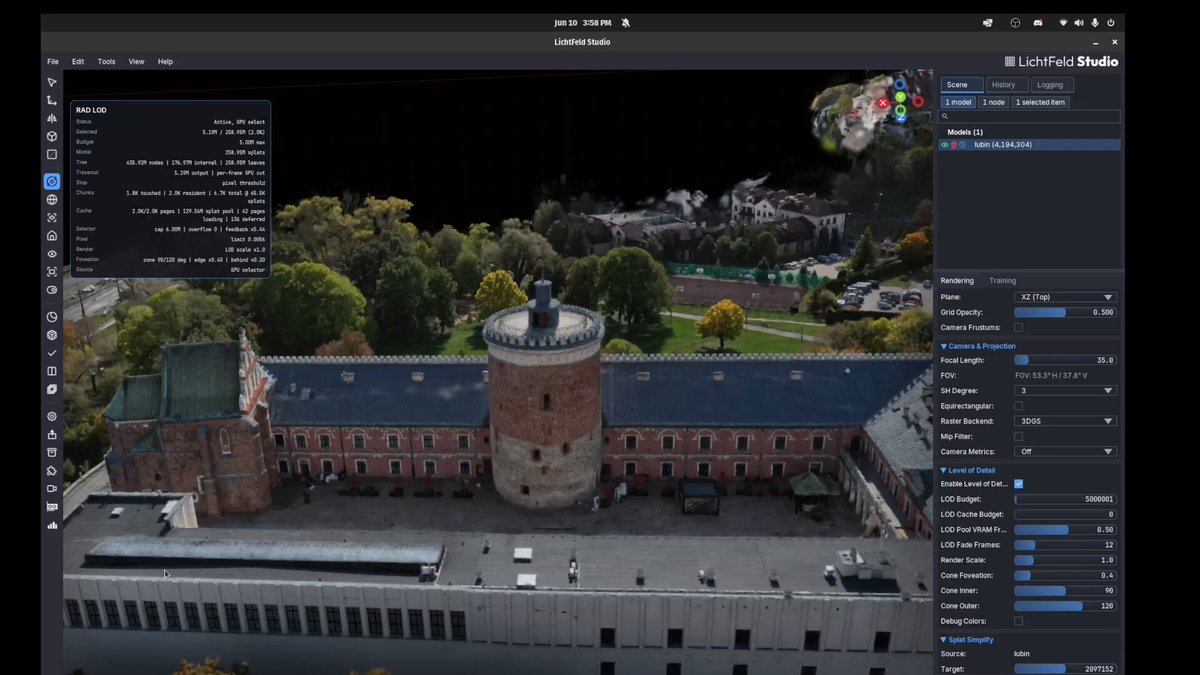
Everybody is stepping into the LOD game, and so is LichtFeld Studio. Preview of 260M Gaussians streaming into the viewer live. I use the RAD format which is processed on GPU within LichtFeld. It can be also simply dumped straight into the spark.js web viewer, albeit it will die at that amount of Gaussians. What other solutions don't tell you is that they need hours to preprocess a 3DGS ply to make it streamable. This was just a ply exported to RAD by LichtFeld Studio's convert tool (took 5 min at that size) and it is immediately ready to stream. In the comments there is a smaller dataset with 103M Gaussians that streams on startup into the viewer. Both datasets were created by Andrii Shramko. Let's see how far I can push this (need bigger datasets)
MrNeRF23,949 次观看 • 4 个月前

![[SIGGRAPH Asia '24 (TOG)] Representing Long Volumetric Video with Temporal Gaussian Hierarchy Contributions: • We introduce a novel, efficient, and expressive Temporal Gaussian Hierarchy representation for long volumetric video. To our knowledge, our method is the first approach capable of handling minutes of volumetric video data. • We propose a Compact Appearance Model and a new rasterization implementation to facilitate real-time, high-quality dynamic view synthesis while maintaining a compact size. • We propose a system to efficiently model long volumetric videos for the first time and demonstrate state-of-the-art dynamic view synthesis quality on the Neural3DV [Li et al. 2022], ENeRF-Outdoor [Lin et al. 2022], and MobileStage [Xu et al. 2024b] datasets, while also achieving the best rendering speed with reduced training cost and memory usage.](https://image.24vids.com/tw-1867479977408836093/amplify_video_thumb/1867479889764659203/img/D-9vGlMj-XPzg1Wu.jpg)
[SIGGRAPH Asia '24 (TOG)] Representing Long Volumetric Video with Temporal Gaussian Hierarchy Contributions: • We introduce a novel, efficient, and expressive Temporal Gaussian Hierarchy representation for long volumetric video. To our knowledge, our method is the first approach capable of handling minutes of volumetric video data. • We propose a Compact Appearance Model and a new rasterization implementation to facilitate real-time, high-quality dynamic view synthesis while maintaining a compact size. • We propose a system to efficiently model long volumetric videos for the first time and demonstrate state-of-the-art dynamic view synthesis quality on the Neural3DV [Li et al. 2022], ENeRF-Outdoor [Lin et al. 2022], and MobileStage [Xu et al. 2024b] datasets, while also achieving the best rendering speed with reduced training cost and memory usage.
MrNeRF79,493 次观看 • 1 年前

![[SIGGRAPH '26] Anchored Temporal Gaussian Splatting for Long Volumetric Video Representation TL;DR: We present ATGS, a novel framework for volumetric video reconstruction that effectively handles long sequences and complex motions. By utilizing time-conditioned anchors and a temporal windowing strategy, ATGS enhances temporal coherence and scalability. Abstract (excerpt): Key insight is that explicitly tracking long term complex motion with individual Gaussian primitives is inherently unstable. Instead, we organize Gaussians around time conditioned anchors that localize their spatial and temporal support, thereby reducing long range motion complexity. We further introduce a temporal windowing strategy to activate only anchors relevant to the queried time, which improves scalability and temporal coherence. In addition, to ensure spatial and temporal stability, we design a compact set of multi level anchor features that encode global features, local spatial features, and local temporal features, jointly constraining Gaussian generation. Extensive experiments demonstrate that ATGS consistently outperforms prior methods on long sequence volumetric videos with complex motions.](https://image.24vids.com/tw-2041880058722226334/amplify_video_thumb/2041879048733736960/img/uBJc0Yo_n8o2G2C0.jpg)
[SIGGRAPH '26] Anchored Temporal Gaussian Splatting for Long Volumetric Video Representation TL;DR: We present ATGS, a novel framework for volumetric video reconstruction that effectively handles long sequences and complex motions. By utilizing time-conditioned anchors and a temporal windowing strategy, ATGS enhances temporal coherence and scalability. Abstract (excerpt): Key insight is that explicitly tracking long term complex motion with individual Gaussian primitives is inherently unstable. Instead, we organize Gaussians around time conditioned anchors that localize their spatial and temporal support, thereby reducing long range motion complexity. We further introduce a temporal windowing strategy to activate only anchors relevant to the queried time, which improves scalability and temporal coherence. In addition, to ensure spatial and temporal stability, we design a compact set of multi level anchor features that encode global features, local spatial features, and local temporal features, jointly constraining Gaussian generation. Extensive experiments demonstrate that ATGS consistently outperforms prior methods on long sequence volumetric videos with complex motions.
MrNeRF27,936 次观看 • 6 个月前
[SIGGRAPH ASIA '25] Detail-Enhanced Gaussian Splatting for Large-Scale Volumetric Capture Contributions: - A two-stage approach to performance capture, combining a scene-scale capture rig and a single-actor facial capture rig. - A novel high-quality scene-scale volumetric performance capture rig, incorporating both static and dynamic cameras to track the performance of multiple actors. - A reconstruction pipeline for dynamic performance capture, featuring stable calibration of moving cameras and 4DGS with improved dynamic range and color fidelity. - A detail enhancement Diffusion Model, which supports 4K, RGB, and Alpha, with improved temporal stability.
MrNeRF42,570 次观看 • 11 个月前

ViPE: Video Pose Engine for 3D Geometric Perception Contributions: • A robust and efficient framework, ViPE, for estimating camera parameters and dense depth from diverse, in-the-wild videos. • A system design that integrates the strengths of classical SLAM (efficiency, scalability) and learned models (robustness), with key improvements in efficiency, dynamic object handling, and depth quality over prior work. • A large-scale dataset of annotated videos, created using ViPE, to facilitate future research in 3D computer vision.
MrNeRF42,646 次观看 • 1 年前

MAGS-SLAM: Monocular Multi-Agent Gaussian Splatting SLAM for Geometrically and Photometrically Consistent Reconstruction TL;DR: The first RGB-only multi-agent 3D Gaussian Splatting SLAM for collaborative photorealistic scene reconstruction. Contributions: (1) We propose the first monocular RGB-only multi-agent 3D Gaussian Splatting SLAM system. It integrates Gaussian front-ends, compact submap summaries, inter-agent verification, Sim(3) submap pose graph, and occupancy-aware fusion into a unified framework, achieving accurate tracking and photorealistic reconstruction without depth sensors. (2) We propose a Pose-Graph Bundle Adjustment (PGBA)-consistent Sim(3) loop closure mechanism for multi-agent systems, which jointly resolves intra- and inter-agent scale drift through a submap-level Sim(3) pose graph coupling geometric and photometric residuals. Robustness is ensured by a spatial-extent gate that rejects degenerate loops and an adaptive edge invalidation scheme consistent with evolving PGBA corrections. (3) We propose an occupancy-aware fusion framework for coherent multi-agent Gaussian maps. It combines occupancy-grid deduplication, decoupled coordinator, and joint pose-Gaussian photometric refinement to eliminate duplicated Gaussians, residual misalignment, and photometric seams across agents. (4) We introduce ReplicaMultiagent Plus dataset. While existing multi-agent datasets are typically limited to 2-3 agents with short trajectories, our dataset scales to 4 agents with long-horizon trajectories. In addition, we provide ground-truth geometry and semantic annotations, supporting the evaluation of monocular, RGB-D, and semantic multi-agent SLAM for collaborative dense reconstruction.
MrNeRF19,518 次观看 • 5 个月前


Spatio-Temporal Reconstruction Model for Large-Scale Outdoor Scenes Contributions: • We propose STORM, the first feed-forward, self-supervised method for fast and accurate reconstruction of dynamic 3D scenes from sparse, multi-timestep, posed camera images. • Our bottom-up framework aggregates and transforms per-frame 3D Gaussian Splats into a cohesive scene representation, enabling self-supervised motion estimation. Furthermore, we introduce motion tokens that capture common motion primitives and regularize motion predictions, facilitating dynamic motion group segmentation without explicit motion or correspondence supervision. • We present several enhancements for in-the-wild scenarios, including sky modeling, camera exposure inconsistency handling, large novel-view extrapolation, and fine-grained human motions reconstruction, making STORM well-suited for real-world applications.
MrNeRF53,292 次观看 • 1 年前